
How many calories are in an old fashioned drink?
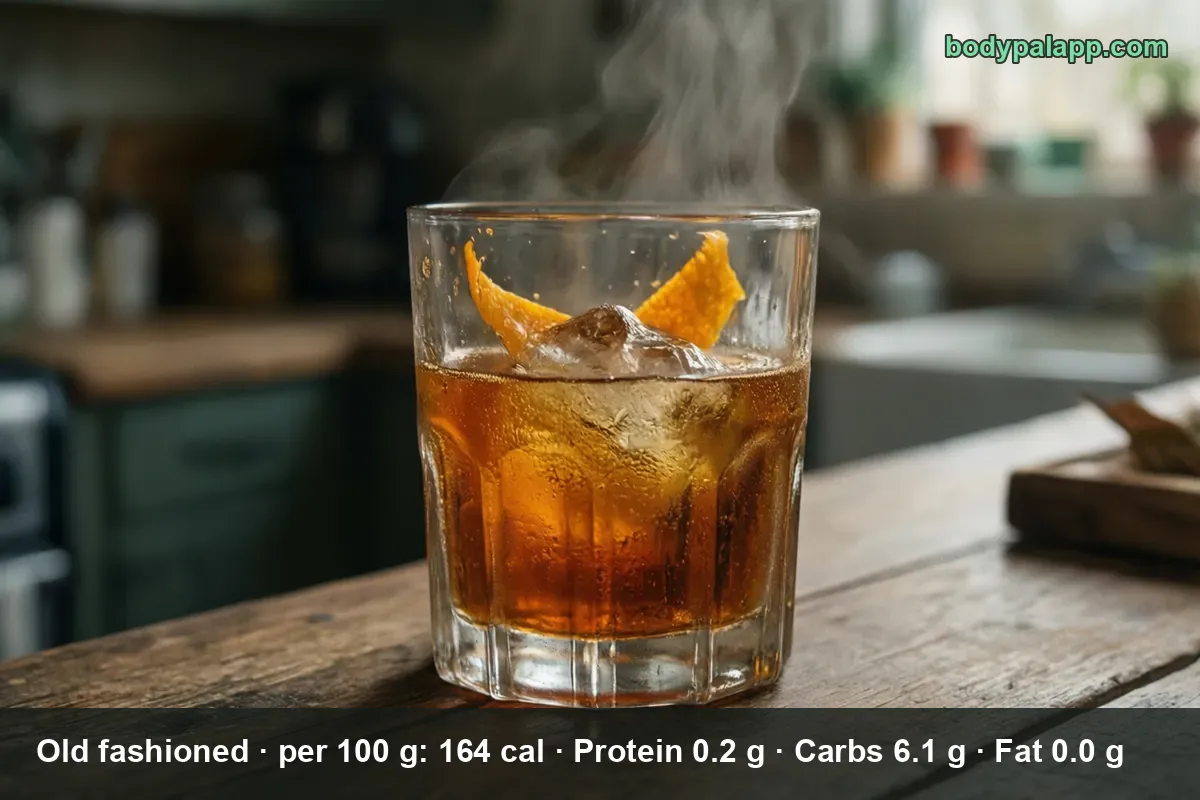
One old fashioned, poured the way USDA counts it at 180 g, is 295 calories. Per 100 g the drink runs 164 calories, which is more than most people expect from something that is mostly whiskey, a sugar cube and bitters. Carbs stay low at 11.0 g. The calories are almost all alcohol.
On this page
- Old fashioned quick facts
- US pours from one ounce to a full drink
- Old fashioned oats and the cake doughnut
- Where the calories actually come from
- How does an old fashioned compare
- FAQ
Old fashioned quick facts
The numbers below come from the one USDA record that describes the drink itself: FNDDS 2710646, "Old fashioned", filed under liquor and cocktails with a household measure of "1 drink" at 180 g. That record is the right anchor for anyone searching this phrase with a glass in hand, because every other "old fashioned" entry in the database is a different food entirely: rolled oats, a cake doughnut, a canned soup, two kinds of cookie. Those get their own section further down.
One thing to know before you read the table: 180 g is a generous pour. It is closer to a restaurant build than to a two-ounce home pour, and the calorie count moves with the pour more than with the recipe.
| Nutrient | Per 100 g | Per 1 drink (180 g) | % Daily Value |
|---|---|---|---|
| Calories | 164 | 295 | — |
| Total fat | 0.04 g | 0.1 g | 0% |
| Saturated fat | 0 g | 0 g | 0% |
| Carbohydrate | 6.11 g | 11.0 g | 4% |
| Dietary fiber | 0.5 g | 0.9 g | 3% |
| Total sugars | 5.57 g | 10.0 g | — |
| Protein | 0.16 g | 0.3 g | 1% |
| Sodium | 4 mg | 7 mg | 0% |
% Daily Value is based on a 2,000-calorie diet.
Verified nutrition data
Numbers on this page come from USDA FoodData Central, the U.S. Department of Agriculture’s food composition database, and from manufacturer labels where a branded product is named. Last verified September 2026. How we verify our data →
There is no added sugars row here, and no trans fat row, because this FNDDS release does not publish either value for cocktails. The sugar cube or simple syrup in the build is already inside the 5.57 g of total sugars per 100 g. Cholesterol is 0 mg. Potassium is 32 mg per 100 g, or 58 mg in a full drink, which is 1% of the Daily Value. Daily Value percentages follow the FDA's Nutrition Facts reference amounts for a 2,000-calorie diet.
US pours from one ounce to a full drink
| Serving | Weight | Calories |
|---|---|---|
| 1 fl oz | 30 g | 49 kcal |
| 1 oz | 28.35 g | 46 kcal |
| Short pour, about half a drink | 90 g | 148 kcal |
| One drink, USDA household measure | 180 g | 295 kcal |
| Per 100 g | 100 g | 164 kcal |
Only two of those rows are USDA servings: the 180 g drink and the fluid ounce. The 90 g short pour and the 28.35 g weight ounce are our own arithmetic from the USDA 100 g figure, not USDA servings, and they exist because so many people build a smaller drink at home than the one the database describes.
That gap is the whole story of this page. A bartender who pours two ounces of whiskey and a bar spoon of syrup lands near the 148-calorie line. A heavy home pour into a rocks glass, ice melting into it over twenty minutes, lands near 295. Same recipe, same ingredients, nearly double the calories, and the only variable is how much liquid ends up in the glass. If you log cocktails, log the pour, not the name of the drink.
Ice is worth one sentence too: it dilutes the drink and adds weight without adding calories, so a melted-down 180 g glass carries somewhat fewer calories than the table says. USDA's figure describes the drink as mixed, before it waters down.
Old fashioned oats and the cake doughnut
"Old fashioned" is one of the few food phrases that lands on completely different plates. Search volume is split across the cocktail, the oats and the doughnut, so here are all six USDA records that carry the name, with a realistic serving for each.
| Version | Per 100 g | Typical serving | Calories |
|---|---|---|---|
| Old fashioned cocktail | 164 kcal | 1 drink, 180 g | 295 kcal |
| Old fashioned rolled oats, dry | 382 kcal | 1/2 cup dry, 40 g | 153 kcal |
| Old-fashioned cake doughnut, plain | 434 kcal | 1 doughnut, 40 g | 174 kcal |
| Old fashioned vegetable beef soup, canned | 49 kcal | 1 cup, 247 g | 121 kcal |
| Old fashioned molasses cookies | 406 kcal | 1 cookie serving, 26 g | 106 kcal |
| Old fashioned windmill cookies | 468 kcal | 1 cookie serving, 20 g | 94 kcal |
Read that table twice, because per 100 g it says one thing and per serving it says the opposite. The windmill cookie is the densest food on this page at 468 calories per 100 g, nearly three times the drink. Yet a serving of it is 94 calories, the smallest number in the column, because a cookie serving weighs 20 g and a cocktail weighs 180 g.
The oats deserve their own note. That 382 per 100 g is dry weight, and dry is how the box is labeled. Half a cup of dry oats is 40 g and 153 calories; once it absorbs water it triples in volume and looks like a much bigger breakfast than the number suggests. People who weigh cooked oatmeal and then look up the dry figure end up logging two or three times what they ate. Weigh it dry, or weigh it cooked and use a cooked record.
The canned soup is the mirror image: 49 calories per 100 g because it is mostly water, but 121 calories in a full 247 g cup, and it carries 346 mg of sodium per 100 g against the 4 mg in the cocktail. If you are tracking sodium rather than calories, those two records are on opposite ends of the database.
Where the calories actually come from
Add up the macros in a full drink and they do not reach the total. Carbohydrate contributes about 44 calories, protein about 1 and fat about 1, for roughly 46 calories. The drink is 295. The missing 249 calories are ethanol, which carries about 7 calories per gram and shows up in no row of the Nutrition Facts panel.
That explains the strange shape of the %DV column. Every percentage on the label is small or zero, and yet the drink costs more than the 40 g cake doughnut above at 174 calories. There is nothing in it that a nutrient target notices, which is exactly why cocktails slip past people who log carefully all day. Carbohydrate is 4% of the Daily Value, fiber 3%, protein 1%, sodium and fat effectively nothing.
The practical read: an old fashioned is a low-carb drink and a high-calorie one at the same time, and those two facts are not in conflict. If you are watching carbs, 11.0 g in a full drink is genuinely modest. If you are watching total intake, 295 calories is a real slot in the day, close to a full breakfast. The Dietary Guidelines for Americans treat alcohol calories as calories that displace food, and the CDC's alcohol pages hold the current definitions of moderate drinking if you want the public-health framing rather than the arithmetic.
How does an old fashioned compare
All four of these are USDA cocktail records, so the fairest comparison is the shared fluid ounce rather than four different glass sizes.
| Cocktail | Per 100 g | US serving | Calories |
|---|---|---|---|
| Old fashioned | 164 kcal | 1 fl oz, 30 g | 49 kcal |
| Mint julep | 187 kcal | 1 fl oz, 30 g | 56 kcal |
| White Russian | 181 kcal | 1 fl oz, 30 g | 54 kcal |
| Piña colada | 151 kcal | 1 fl oz, 30 g | 45 kcal |
Our take: ounce for ounce the old fashioned is not the light option people assume it is, but it is not the heavy one either. Of these four, only the piña colada is lighter per 100 g, 151 against 164, and that is because it is diluted with juice rather than because it is a smaller drink. The mint julep is the densest at 187. Where the old fashioned actually wins is composition: 6.11 g of carbs per 100 g against the White Russian's cream and the colada's 19.48 g on the same basis. Pick it for a low-carb night, not for a low-calorie one, and control the pour instead of the recipe.
Old fashioned FAQs
How many calories are in an old fashioned?
295 calories in one drink, using USDA's household measure of 180 g, or 164 calories per 100 g. A shorter home pour of about 90 g works out to 148 calories by our own arithmetic from that 100 g figure. The pour size, not the recipe, decides the number.
How much sugar is in an old fashioned?
10.0 g of total sugars in a full 180 g drink, or 5.57 g per 100 g. That includes the sugar cube or simple syrup in the build. USDA does not publish an added sugars value for this cocktail record, so the syrup cannot be separated out from the total on this page.
Is an old fashioned a low-carb cocktail?
Yes, at 11.0 g of carbohydrate per drink, which is 4% of the Daily Value. Per 100 g it is 6.11 g. Very little of the drink's 295 calories comes from carbs, though. Roughly 249 of them are ethanol, which is why a low-carb cocktail can still be a high-calorie one.
How many calories in a double old fashioned?
About 590 calories if you double USDA's 180 g drink to 360 g, which is our own arithmetic from the 164 calories per 100 g figure rather than a USDA serving. Note that "double old fashioned" is also the name of the wide, short glass, which holds far more than the drink poured into it.
How many carbs are in an old fashioned?
11.0 g of carbohydrate in a 180 g drink, of which 10.0 g is sugars and 0.9 g is fiber. Per 100 g that is 6.11 g of carbohydrate. A single fluid ounce carries under 2 g. Protein is 0.3 g per drink and fat is 0.1 g, both effectively rounding to nothing.
How many calories in old fashioned oats?
153 calories in a half cup of dry oats, 40 g, from USDA's whole grain rolled oats record at 382 calories per 100 g. That is dry weight, the same basis as the box. Cooked oatmeal weighs two to three times more once it takes on water, so weigh it dry to avoid overlogging.
How many calories in an old fashioned donut?
174 calories for a 40 g plain cake doughnut, at 434 calories per 100 g. It also carries 24.93 g of fat and 11.11 g of saturated fat per 100 g, and 477 mg of sodium. Per serving the doughnut is well below the cocktail's 295 calories, but per 100 g it is far denser.
Does an old fashioned have more calories than a mint julep?
No, not ounce for ounce. A mint julep is 187 calories per 100 g against 164 for an old fashioned, so a fluid ounce is 56 calories versus 49. Julep glasses are usually packed with crushed ice, though, so the drink in hand often carries less liquid than the numbers imply.
Similar foods
- Whiskey Sour — 158 cal per drink
- White Russian — 407 cal per drink
- Chocolate Martini — 224 cal per drink
- Cosmopolitan — 224 cal per cocktail
- Espresso Martini — 224 cal per drink
- Sake — 78 cal per ochoko cup, 2 fl oz
Count it without the math
Point the camera at the glass and BodyPal counts the pour for you, sugar cube and all.


How long does it take to burn off 295 kcal of old fashioned?
One drink (180 g) is 295 kcal. Enter your weight and the amount you ate to see how long it takes you to burn that off:
lb
| Activity | Time to burn 295 kcal |
|---|---|
| Walking, brisk | 59 min |
| Cycling, moderate | 37 min |
| Swimming, moderate | 42 min |
| Jogging | 35 min |
| Weight training, moderate | 1 hr 6 min |
Times are for a 155 lb adult at a steady pace; change the weight to see yours. The amount is set to the portion in the text (180 g); change it to what you actually ate. BodyPal works this out from your steps automatically.
Want the bigger picture? Calculate your daily calorie needs — your maintenance figure, a target for losing or gaining, and the date you get there.