
How many calories are in a White Russian?
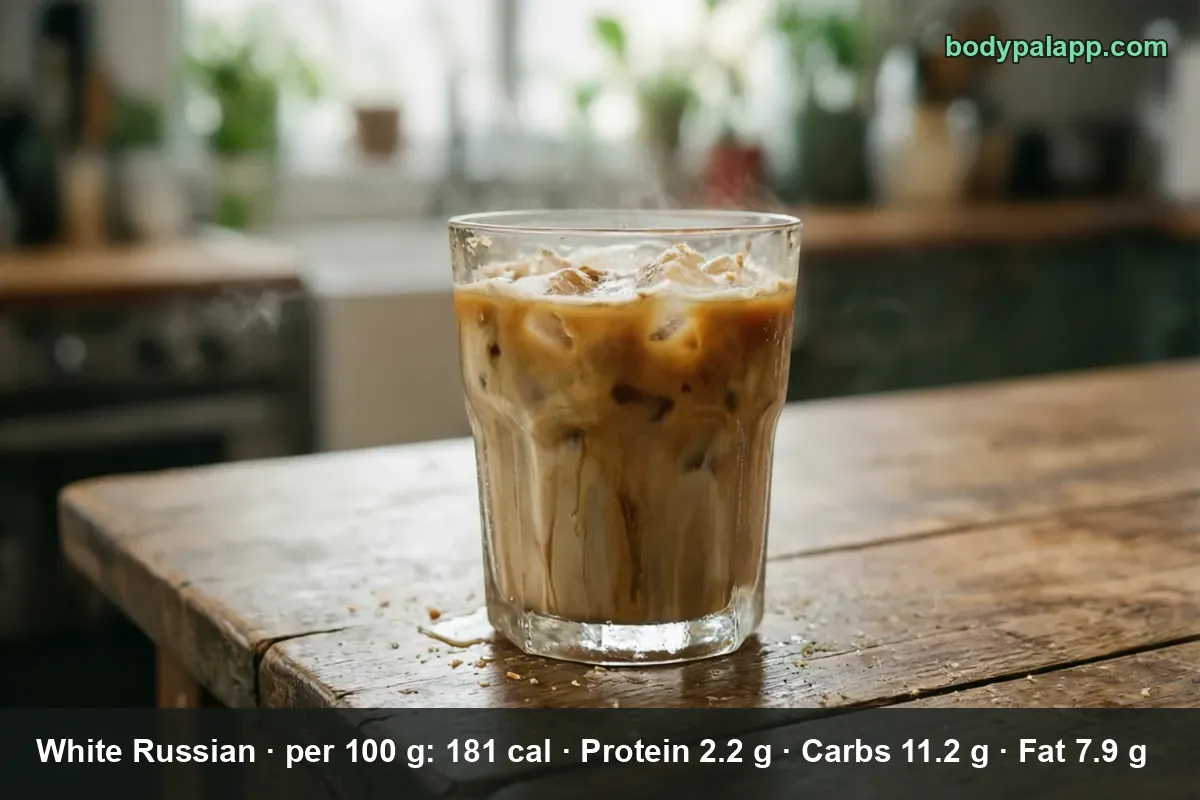
One standard White Russian — the 225 g glass USDA counts as a single drink — comes to 407 calories. Per 100 g the mixed drink runs 181 calories, which sounds mild right up until you see how much of it goes in the glass. The cream is doing most of the work here, not the vodka.
On this page
- White Russian quick facts
- US pours, from a shot to a full drink
- Cocktail for cocktail, ounce for ounce
- Saturated fat is the row that stings
- How does a White Russian compare?
- FAQ
White Russian quick facts
The row on this page is FNDDS 2710673, "White Russian", filed under liquor and cocktails. It is the only USDA entry for the finished drink rather than its parts, and the finished drink is what a person is holding: vodka, coffee liqueur and cream already in the glass over ice. FNDDS also attaches a household measure to it — "1 drink," weighed at 225 g — which is the pour a bar hands you, so that is the serving the table below leads with.
Two label rows are missing on purpose. FNDDS does not publish added sugars or trans fat for cocktails, so neither appears here; the sugar from the coffee liqueur is counted inside total sugars instead.
| Nutrient | Per 100 g | Per 1 drink (225 g) | % Daily Value |
|---|---|---|---|
| Calories | 181 | 407 | — |
| Total fat | 7.9 g | 17.8 g | 23% |
| Saturated fat | 4.82 g | 10.8 g | 54% |
| Carbohydrate | 11.17 g | 25.1 g | 9% |
| Dietary fiber | 0 g | 0 g | 0% |
| Total sugars | 9.56 g | 21.5 g | — |
| Protein | 2.15 g | 4.8 g | 10% |
| Sodium | 43 mg | 97 mg | 4% |
% Daily Value is based on a 2,000-calorie diet.
Verified nutrition data
Numbers on this page come from USDA FoodData Central, the U.S. Department of Agriculture’s food composition database, and from manufacturer labels where a branded product is named. Last verified September 2026. How we verify our data →
Two more rows worth knowing: one drink brings 54 mg of cholesterol, 18% of the Daily Value, and 216 mg of potassium, about 5%. The sodium is negligible — 97 mg is less than a twentieth of the day's 2,300 mg allowance, and nobody is drinking this for its salt.
US pours, from a shot to a full drink
| Serving | Weight | Calories |
|---|---|---|
| 1 fl oz | 30 g | 54 kcal |
| 1 oz | 28.4 g | 51 kcal |
| 1.5 fl oz pour | 45 g | 81 kcal |
| One drink, bar size | 225 g | 407 kcal |
| Per 100 g | 100 g | 181 kcal |
Only two of those are USDA's own measures: "1 drink" at 225 g and "1 fl oz" at 30 g. The 1.5 fl oz pour and the 1 oz line are our own arithmetic from the USDA 100 g figure, not USDA servings — useful if you are pouring at home and measuring with a jigger rather than filling a rocks glass.
That table is the whole trap of this drink. At 181 calories per 100 g the White Russian looks like a moderate cocktail, and per ounce it genuinely is one. But the standard glass is 225 g, which is 2.25 times the reference amount, so the per-100-g number understates what lands in front of you by more than half. Two drinks over an evening is 814 calories before any food. Log the glass, not the ounce.
Cocktail for cocktail, ounce for ounce
Held to the same volume, a White Russian is not the heaviest thing on the bar menu. USDA's cocktail records line up like this, all from FNDDS and all at the same 1 fl oz measure so the comparison is fair.
| Drink | Per 100 g | 1 fl oz (30 g) |
|---|---|---|
| Martini | 201 kcal | 60 kcal |
| Mint julep | 187 kcal | 56 kcal |
| White Russian | 181 kcal | 54 kcal |
| Old fashioned | 164 kcal | 49 kcal |
| Hot buttered rum | 160 kcal | 48 kcal |
| Pina colada | 151 kcal | 45 kcal |
The White Russian is third of six per 100 g, behind a martini and a mint julep. Every per-ounce figure in that column except the White Russian's own is our arithmetic scaled from each record's 100 g value.
So why does the White Russian feel heavier than a martini? Volume. A martini is served in a small glass and USDA's cocktail records reflect that; a White Russian is served long, over ice, at 225 g. The drink that is denser per ounce is the smaller drink. This is the same reason a shot of cream liqueur reads lighter than a milkshake made from it.
Saturated fat is the row that stings
Calories are not the interesting number on this page. Saturated fat is. One drink carries 10.8 g, which is 54% of the FDA Daily Value of 20 g — more than half a day's worth from a single glass, while the 407 calories are only about a fifth of a 2,000-calorie day. The proportions are lopsided in a way almost no other cocktail manages.
For context, the Dietary Guidelines for Americans put saturated fat below 10% of daily calories, which is roughly 22 g at 2,000. One White Russian uses close to half of that before dinner. If you are watching saturated fat specifically, a spirit-and-bitters drink is the better order; if you are only watching calories, the White Russian is a normal-sized indulgence at 407.
Alcohol itself is not broken out in this FNDDS record, so no gram figure for it is given here. For what counts as a standard drink in the US, the CDC's alcohol facts page is the reference point.
How does a White Russian compare?
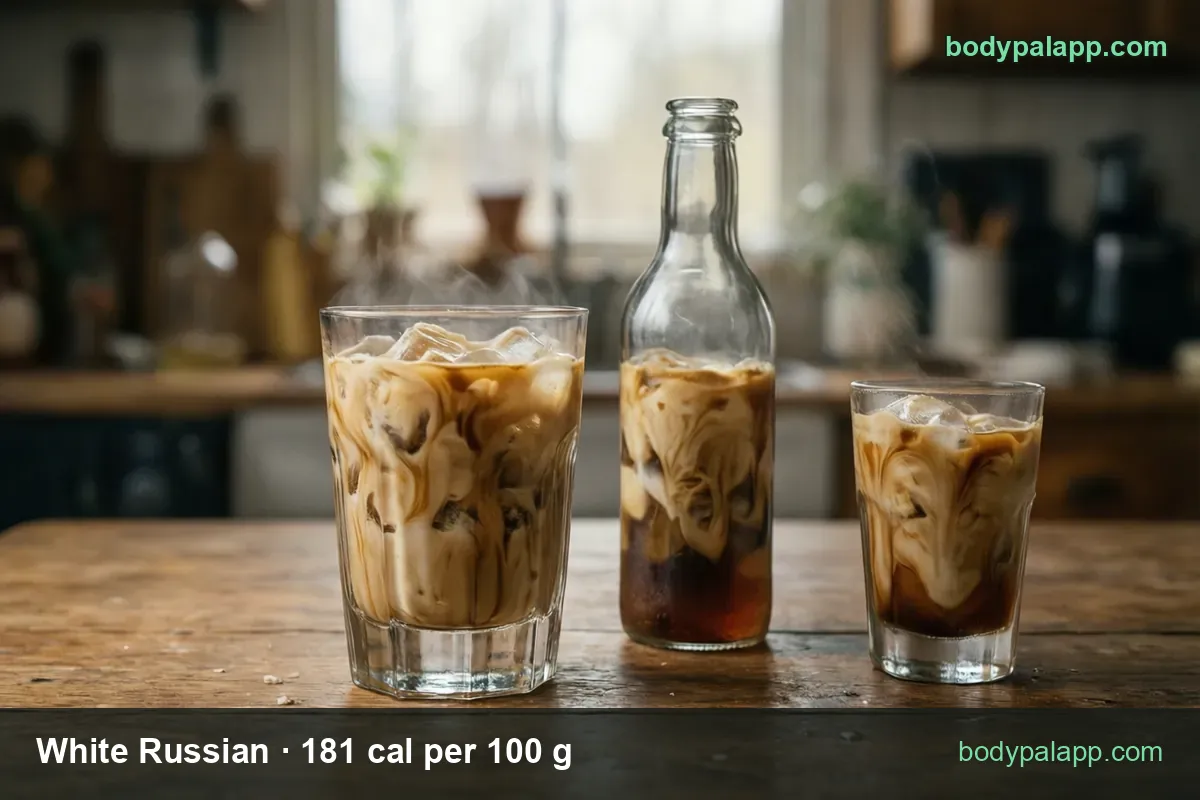
Three neighbors, with the macros that explain the gaps.
| Drink | Per 100 g | Protein | Carbs | Fat | 1 fl oz (30 g) |
|---|---|---|---|---|---|
| White Russian | 181 kcal | 2.15 g | 11.17 g | 7.9 g | 54 kcal |
| Martini | 201 kcal | 0.07 g | 0.15 g | 0 g | 60 kcal |
| Old fashioned | 164 kcal | 0.16 g | 6.11 g | 0.04 g | 49 kcal |
| Pina colada | 151 kcal | 0.36 g | 19.48 g | 2.14 g | 45 kcal |
Look down the fat column. The martini is at 0 g and the old fashioned at 0.04 g; those drinks are calories from alcohol and a little sugar, nothing else. The White Russian's 7.9 g of fat per 100 g is more than three times the pina colada's 2.14 g, and it is the only one of the four with meaningful protein — 2.15 g per 100 g, which is dairy, not liquor.
Our take: order the White Russian when you want it to be dessert, because that is what it is. For an evening of two or three drinks, the martini is denser per ounce but comes in a far smaller glass, so it costs you less overall; the old fashioned at 164 calories per 100 g with essentially no fat is the cleanest of the four if you plan to have more than one. And if the goal is sheer volume for the fewest calories, the pina colada is lightest per 100 g at 151 — though its 19.48 g of carbohydrate is nearly double the White Russian's 11.17 g, so the trade is fat for sugar, not one for nothing.
White Russian FAQs
How many calories are in a White Russian?
407 calories for one standard drink, which USDA logs as a 225 g glass. Per 100 g the same mixed drink is 181 calories, so a short 1 fl oz pour is only 54. The gap between those numbers is glass size, not recipe strength.
How many carbs are in a White Russian?
25.1 g of carbohydrate in a 225 g drink, 9% of the Daily Value, and 11.17 g per 100 g. Almost all of it is sugar: 21.5 g in the glass. The coffee liqueur, not the vodka, is what puts carbohydrate in this cocktail.
How much sugar is in a White Russian?
21.5 g of total sugars in one 225 g drink, or 9.56 g per 100 g. USDA does not publish an added sugars figure for this FNDDS record, so there is no percentage to give against the 50 g Daily Value. Most of it arrives with the coffee liqueur.
Is a White Russian high in fat?
Yes: 17.8 g of fat per drink, 23% of the Daily Value, and 10.8 g of that is saturated, which is 54% of a day's worth in one glass. Per 100 g the drink carries 7.9 g of fat. Cream is the reason; the martini beside it has none.
How many calories in a White Russian vs a pina colada?
181 calories per 100 g for the White Russian against 151 for a pina colada, so the White Russian is 30 calories heavier per 100 g. At 1 fl oz that is 54 calories versus 45. The colada carries more carbohydrate, 19.48 g per 100 g against 11.17 g.
White Russian vs Black Russian calories?
USDA publishes no FoodData Central record for a Black Russian, so there is no verified number beside the White Russian's 407 calories. What is measurable is the difference cream makes: the White Russian carries 7.9 g of fat and 181 calories per 100 g, and a Black Russian is the same drink without that cream.
How do I make a lower calorie White Russian?
Pour less: a 1 fl oz serve is 54 calories and a 1.5 fl oz pour is 81, against 407 for the full 225 g drink. Cutting the glass to 100 g puts it at 181. USDA has no record for a version made with lighter dairy, so no number is claimed for that here.
Is a White Russian keto friendly?
Not really: 25.1 g of carbohydrate per 225 g drink, and 21.5 g of that is sugar. Per 100 g it is 11.17 g of carbohydrate, so a 1 fl oz pour works out around 3.4 g. If you are watching carbohydrate closely, a martini at 0.15 g per 100 g is the lighter order.
Similar foods
- Chocolate Martini — 224 cal per drink
- Cosmopolitan — 224 cal per cocktail
- Espresso Martini — 224 cal per drink
- Old Fashioned Drink — 295 cal per drink
- Dirty Martini — 241 cal per drink
- Martini — 241 cal per drink
Count it without the math
Point the camera at the glass and BodyPal counts the drink for you, cream and all.


How long does it take to burn off 407 kcal of White Russian?
One drink (225 g) is 407 kcal. Enter your weight and the amount you ate to see how long it takes you to burn that off:
lb
| Activity | Time to burn 407 kcal |
|---|---|
| Walking, brisk | 1 hr 21 min |
| Cycling, moderate | 51 min |
| Swimming, moderate | 58 min |
| Jogging | 48 min |
| Weight training, moderate | 1 hr 30 min |
Times are for a 155 lb adult at a steady pace; change the weight to see yours. The amount is set to the portion in the text (225 g); change it to what you actually ate. BodyPal works this out from your steps automatically.
Want the bigger picture? Calculate your daily calorie needs — your maintenance figure, a target for losing or gaining, and the date you get there.