
How Many Calories in a Martini?
A martini is 241 calories for the drink USDA measures — 120 g, or 4 fl oz of gin or vodka with dry vermouth. Per 100 g it runs 201 calories. Carbohydrate in the whole glass: 0.18 g. There is no sugar to blame here, no cream, no juice. The calories in a martini are alcohol from the first sip to the last.
On this page
- Martini quick facts
- The glass is the whole story
- Pours, from one ounce to a full glass
- Flavored, dirty and the vodka question
- Empty calories, measured
- How does a martini compare?
- FAQ
Martini quick facts
The reference entry is USDA's Martini (fdc_id 2710639), filed under liquor and cocktails, and the serving is the one USDA itself calls a drink: 120 g, which is 4 fl oz.
| Nutrient | Per 100 g | Per 1 drink (120 g) | % Daily Value |
|---|---|---|---|
| Calories | 201 kcal | 241.2 kcal | — |
| Total fat | 0 g | 0 g | 0% |
| Saturated fat | 0 g | 0 g | 0% |
| Carbohydrate | 0.15 g | 0.18 g | 0% |
| Dietary fiber | 0 g | 0 g | 0% |
| Total sugars | 0.15 g | 0.18 g | — |
| Protein | 0.07 g | 0.08 g | 0% |
| Sodium | 2 mg | 2.4 mg | 0% |
% Daily Value is based on a 2,000-calorie diet, the reference set out in the FDA's Daily Value tables. Total sugars carry no Daily Value, so that row stays blank.
Verified nutrition data
Numbers on this page come from USDA FoodData Central, the U.S. Department of Agriculture’s food composition database, and from manufacturer labels where a branded product is named. Last verified September 2026. How we verify our data →
Read the right-hand column and you have read the drink. Every printable nutrient rounds to zero percent. The sodium figure is 2.4 mg against a 2,300 mg Daily Value, which is less than you would get from a mouthful of tap water in most American cities.
Two rows an American label normally carries are missing rather than zeroed: added sugars and trans fat. USDA's survey files do not collect either field for cocktails, so there is no figure to print and none has been invented. Potassium is the only nutrient with a pulse at all — 13 mg per 100 g, about 16 mg in a drink, which against the 4,700 mg Daily Value is a rounding error.
The glass is the whole story
USDA's household measure is one drink of 120 g. Bartenders did not sign that agreement.
A classic V-shaped martini glass is commonly a 6 oz vessel, and filled to where the liquid meets the rim it holds roughly 180 g. Run that through the same 201 calories per 100 g and the drink becomes 362 calories — half again as much as the USDA figure, with the identical recipe, the identical bottle and nothing added. No cocktail on earth changes its calorie count that much through ingredients. The glass does it on its own.
This is why arguing about gin brands is a waste of an evening. The gap between a 120 g pour and a 180 g pour is 121 calories. The gap between any two dry gins is nothing you can measure.
The ounce makes it worse, because there are two of them. USDA lists 1 fl oz as 30 g, giving 60.3 calories, while a weight ounce is 28.35 g, giving 57.0. That three-calorie difference sounds trivial until you notice which one your tracking app used. Log a martini as "1 oz" and you have recorded 57 calories for something that was 241 — a quarter of the truth, because the drink was four fluid ounces, not one.
For the record on standard drinks: the CDC counts 1.5 fl oz of 80-proof spirits as one standard drink. USDA's "1 drink" is a household serving size for the finished cocktail, not a standard-drink count, and the two are not interchangeable. One is about how much liquid sits in the glass. The other is about how much ethanol is in it.
Pours, from one ounce to a full glass
| Pour | Weight | Calories |
|---|---|---|
| One measure, 1 fl oz | 30 g | 60.3 kcal |
| One weight ounce | 28.35 g | 57.0 kcal |
| USDA drink, 4 fl oz | 120 g | 241.2 kcal |
| Filled 6 oz glass | 180 g | 361.8 kcal |
| Reference weight | 100 g | 201 kcal |
The first two rows are the measures you use while building the drink — a jigger of gin, a splash of vermouth. The 1 fl oz row is USDA's own portion for this entry; the weight ounce is our own conversion of the same 201 calories per 100 g to 28.35 g, and so is the 180 g row, a glass filled rather than portioned.
There is no cooked-versus-raw complication in a martini, no draining, no fat absorbed in a pan. That makes it one of the easiest things in a calorie diary to get exactly right, and one of the easiest to get badly wrong, since the only variable is a number nobody writes down: how much liquid you poured. Weigh your own glass once, filled the way you actually fill it, and you never have to guess again.
USDA also files martini olives as their own foods rather than as part of the drink — 105 calories per 100 g plain, 133 for pimento-stuffed, up to 158 for the blue-cheese kind. Against a 241-calorie drink the garnish is small change, but the blue-cheese version is not free.
Flavored, dirty and the vodka question
| Version | Per 100 g | Per drink (120 g) |
|---|---|---|
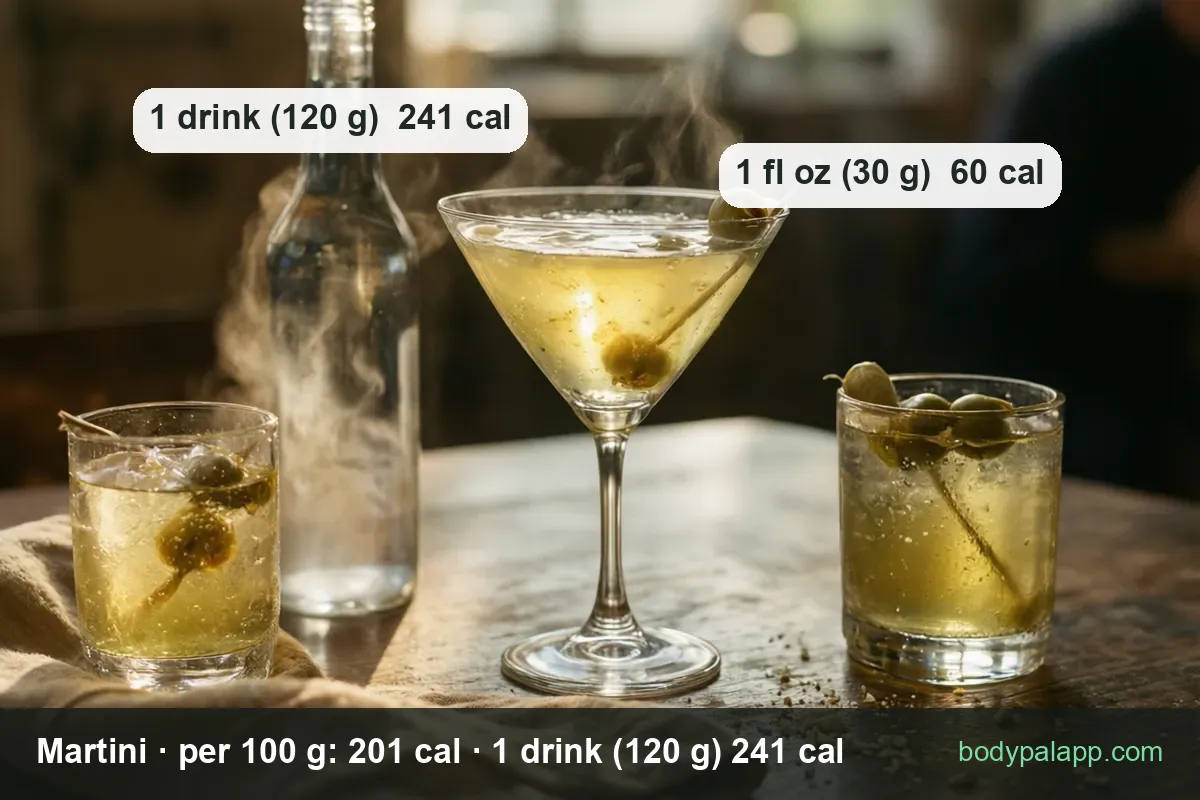
| Classic dry martini | 201 kcal | 241.2 kcal |
| Flavored martini (apple, espresso, lemon drop) | 187 kcal | 224.4 kcal |
That table looks upside down, and it is not a typo. The flavored martini (fdc_id 2710640) — the appletini, the espresso martini, the lemon drop — comes in 14 calories per 100 g lighter than the austere classic. Syrup and liqueur displace spirit, and alcohol carries more energy per gram than sugar does, so adding the sweet stuff dilutes the strongest ingredient in the glass.
The price shows up one row down. The classic holds 0.15 g of total sugars per 100 g. The flavored version holds 4.86 g, alongside 6.36 g of carbohydrate against the classic's 0.15 g. So the sweet martini is marginally cheaper in calories and thirty times more expensive in sugar. If you order an espresso martini expecting a calorie penalty for the syrup, there isn't one; the penalty is on a different line of the label.
A dirty martini is the case where USDA simply has no entry, and no honest page can produce one. What the olive brine changes is sodium, not energy: the "dirty martini juice" products on American shelves list 0 calories and roughly 1,045 to 2,200 mg of sodium per 100 g of brine. So a dirty martini stays a 241-calorie drink and stops being a 2.4 mg sodium one. How far it moves depends entirely on how heavy your hand is with the jar, which is why no number is printed here.
Vodka or gin makes no difference at all, and USDA settles it by keeping one entry for both. Neat spirits run the same energy either way — gin logs at 231 calories per 100 g, and so does rum at the same proof. The base spirit changes the flavor of a martini and nothing on its panel.
Empty calories, measured
Here is the arithmetic that makes a martini unusual. Carbohydrate and protein together come to 0.22 g per 100 g. At about four calories a gram, those two macros account for roughly one calorie out of 201. Fat is a flat zero. Everything else — over 99% of the energy — is ethanol, which contributes calories without ever appearing in a macro row.
That is what "empty calories" means as a measurement rather than a slogan. A 241-calorie drink delivers 0% of the day's fat, 0% of its carbohydrate, 0% of its protein, 0% of its fiber and 0% of its sodium. MyPlate puts alcohol outside the food groups entirely for this reason: there is nothing in the glass for a food group to count.
It also explains why a martini defeats carb-counting apps. Ask one whether a martini fits a low-carb day and it will wave the drink through on 0.18 g and never mention the 241 calories sitting behind them. Two of those in an evening is 482 calories that no macro tracker will show you, roughly what a substantial dinner side costs.
The Dietary Guidelines for Americans frame alcohol by drink count rather than by calorie count — adults of legal drinking age who choose to drink are advised to do so in moderation, defined there as up to one drink a day for women and two for men. Counted in calories rather than drinks, the martini is the expensive end of that allowance: at 201 calories per 100 g it is denser than nearly anything else poured over ice.
How does a martini compare?
| Drink | Per 100 g | US serving | Calories |
|---|---|---|---|
| Martini | 201 kcal | 1 drink (120 g) | 241.2 kcal |
| Manhattan | 222 kcal | 1 drink (120 g) | 266.4 kcal |
| Gimlet | 188 kcal | 1 drink (120 g) | 225.6 kcal |
| Rob Roy | 212 kcal | 1 drink (90 g) | 190.8 kcal |
| Gin, neat | 231 kcal | 1 shot (42 g) | 97.0 kcal |
All five are USDA survey entries from the same liquor and cocktails category, so they are directly comparable — no source-mixing, no label estimates. The Rob Roy row is the one that rewards a second look: it is denser than a martini at 212 calories per 100 g, yet lands 50 calories lighter per drink, purely because USDA measures it in a 90 g pour instead of a 120 g one. Same trap as the martini glass, running the other direction.
Our take: among the classic spirit-forward cocktails there is no meaningful saving to be found, and swapping a martini for a Manhattan or a gimlet moves the number by 15 to 25 calories, which is not a decision worth making. If you want the count down, the only lever that works is the shot — 97 calories of gin over ice, poured as a 42 g measure, is 144 calories cheaper than the same spirit served up in a stemmed glass. And if you are drinking martinis, drink them; measure the pour once, then log the glass you actually own instead of the one USDA owns.
Martini FAQs
How many calories are in a martini?
241 calories in the 120 g drink USDA measures, which is 4 fl oz, at 201 calories per 100 g. Poured into a 6 oz glass and filled to the rim, roughly 180 g, the same recipe reaches 362 calories. The pour is the only variable that matters.
How many calories in a dirty martini?
The same 241 calories as a classic martini. USDA has no separate entry, and olive brine adds no meaningful energy: the dirty martini juices sold in the US list 0 calories per 100 g. What they do add is sodium, between about 1,045 and 2,200 mg per 100 g of brine, against the 2.4 mg in a plain martini.
Vodka martini or gin martini — which has fewer calories?
Neither: USDA keeps one entry covering both, at 201 calories per 100 g and 241 per drink. Neat spirits carry the same energy at the same proof, with gin logging 231 calories per 100 g. Changing the base spirit changes the flavor and nothing on the nutrition panel.
How many carbs are in a martini?
0.18 g of carbohydrate in a 120 g drink, which is 0.15 g per 100 g and 0% of the Daily Value. Total sugars are the same 0.18 g, since the carbohydrate here is all sugar. Those carbs account for well under one calorie of the 241 in the glass.
Is a martini keto-friendly?
A martini carries 0.18 g of carbohydrate per 120 g drink, so it will not move a carb budget. It will move a calorie budget by 241, almost all of it alcohol rather than any macro a tracker displays. Those are the figures; the arithmetic for your own day is yours to do.
How many calories in an espresso or appletini?
224 calories per 120 g drink, at 187 per 100 g — slightly fewer than a classic martini, because syrup displaces spirit and alcohol is more calorie-dense than sugar. The trade is sugar: 4.86 g per 100 g against 0.15 g, with 6.36 g of carbohydrate.
Martini or Manhattan — which has more calories?
The Manhattan, by 25 calories a drink: 266 against 241 for the same 120 g pour, or 222 against 201 per 100 g. The gimlet undercuts both at 226 a drink. All three sit close enough that the size of the glass decides the real total.
Why is a martini so high in calories with no sugar in it?
Because ethanol supplies over 99% of the 201 calories per 100 g, and it never appears in a macro row on any label. Carbohydrate and protein together come to 0.22 g per 100 g, worth about one calorie of the 201, and fat is zero.
Similar foods
- Dirty Martini — 241 cal per drink
- Chocolate Martini — 224 cal per drink
- Cosmopolitan — 224 cal per cocktail
- Espresso Martini — 224 cal per drink
- White Russian — 407 cal per drink
- Manhattan — 266 cal per drink
Log the glass, not the recipe
Point the camera at the drink and BodyPal counts the pour, so a 6 oz glass never gets logged as a 4 oz one.


How long does it take to burn off a martini?
A 120 g drink (4 fl oz) is 241 kcal. Enter your weight and the amount you ate to see how long it takes you to burn that off:
lb
| Activity | Time to burn 241 kcal |
|---|---|
| Walking, brisk | 48 min |
| Cycling, moderate | 30 min |
| Swimming, moderate | 34 min |
| Jogging | 28 min |
| Weight training, moderate | 54 min |
Times are for a 155 lb adult at a steady pace; change the weight to see yours. The amount is set to the portion in the text (120 g); change it to what you actually ate. BodyPal works this out from your steps automatically.
This table assumes you know your daily total. If you do not, the daily calorie calculator works it out from five numbers.