
How many calories are in a cosmopolitan?
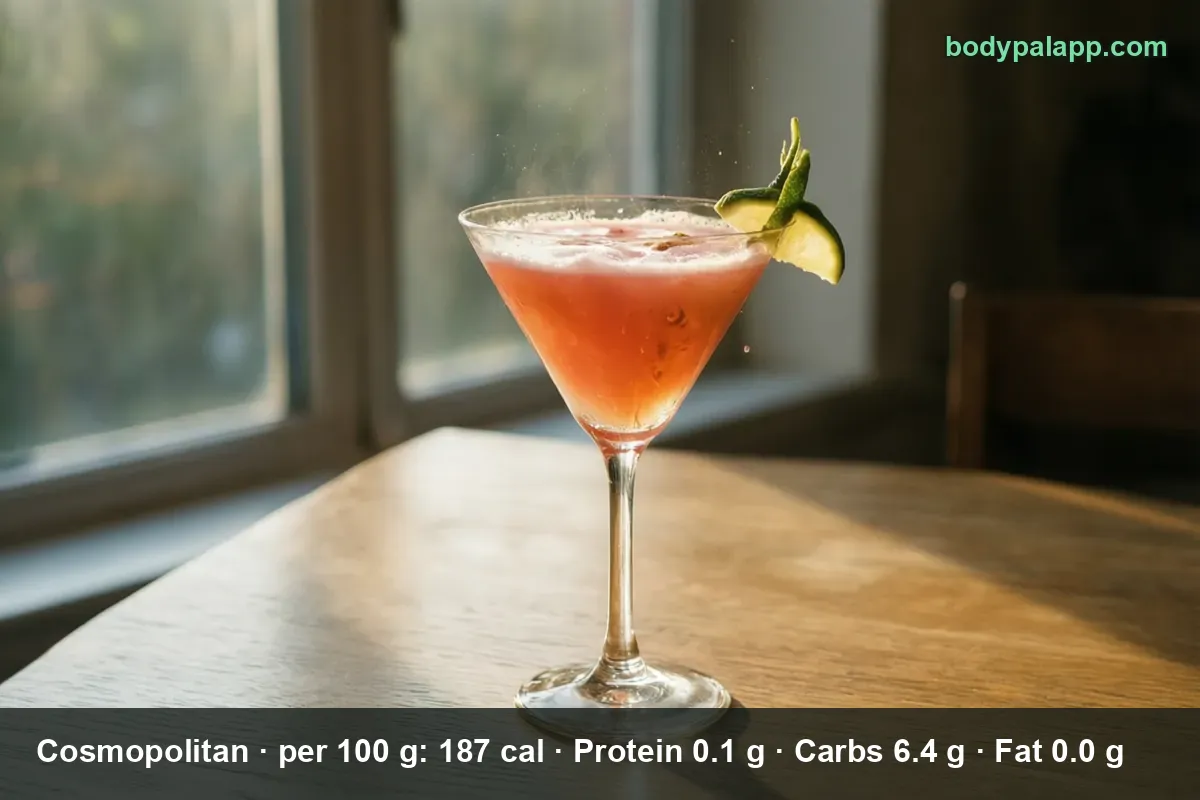
A cosmopolitan is 224 calories in the 4 fl oz martini glass it is served in, or 187 calories per 100 g. Sugar accounts for hardly any of that: the drink holds 5.8 g, roughly a sixth of what a margarita carries. The vodka and the triple sec do the work, not the cranberry.
On this page
- Cosmopolitan quick facts
- Why USDA has no cosmopolitan row
- The glass is the portion
- Where the 224 calories actually come from
- Skinny, mocktail and vodka on its own
- How does a cosmopolitan compare
- Most popular cosmopolitan brands
- FAQ
Cosmopolitan quick facts
The reference drink here is one cocktail as USDA pours it: 120 g in the glass, which is 4 fl oz of finished drink, vodka and triple sec and cranberry and lime already mixed.
| Nutrient | Per 100 g | Per 1 cocktail (120 g) | % Daily Value |
|---|---|---|---|
| Calories | 187 kcal | 224 kcal | — |
| Total fat | 0.03 g | 0.0 g | 0% |
| Saturated fat | 0.002 g | 0.0 g | 0% |
| Carbohydrate | 6.36 g | 7.6 g | 3% |
| Dietary fiber | 0.1 g | 0.1 g | 0% |
| Total sugars | 4.86 g | 5.8 g | — |
| Protein | 0.09 g | 0.1 g | 0% |
| Sodium | 1 mg | 1 mg | 0% |
% Daily Value is based on a 2,000-calorie diet.
Verified nutrition data
Numbers on this page come from USDA FoodData Central, the U.S. Department of Agriculture’s food composition database, and from manufacturer labels where a branded product is named. Last verified September 2026. How we verify our data →
Two rows that appear on a packaged label are absent here on purpose. USDA publishes no added sugars figure and no trans fat figure for any record in its liquor and cocktails category, so there is nothing to quote and nothing has been borrowed from a similar drink to fill the gap. Total sugars carry no Daily Value on a US label either, which is why that cell is a dash.
The record also holds 27 mg of potassium and 0 mg of cholesterol per 100 g. Neither changes how you read the drink.
Why USDA has no cosmopolitan row
Search USDA FoodData Central for "cosmopolitan" and the only hits are bottled mixers, a lettuce variety and a flavored goat cheese log. There is no cocktail. Foundation Foods has none, SR Legacy has none, and the survey database that covers restaurant and bar food has none by that name.
What it does have is record 2710640, "Martini, flavored", food code 93301111. That is the slot a cosmopolitan falls into: a spirit base, an orange liqueur, fruit juice and citrus, served up in a martini glass. The numbers confirm the fit rather than just the description. At 187 calories with 4.86 g of sugar and 0.03 g of fat per 100 g, this is a drink whose energy is almost entirely alcohol, which is exactly what a cosmopolitan is.
The contrast with the plain martini makes the point sharper. Record 2710639, "Martini", runs 201 calories per 100 g with 0.15 g of carbohydrate. That is gin or vodka and vermouth, nothing else. The flavored version is lower in calories per gram, at 187, because the juice and the liqueur dilute the spirit faster than the sugar adds back.
One more record is worth knowing about. A kamikaze is vodka, triple sec and lime with no cranberry, and USDA puts it at 187 calories per 100 g — the same figure, to the calorie. Adding cranberry juice to a kamikaze changes the color and the name of the drink. It does not change the calorie density at all.
The glass is the portion
| Serving | Weight | Calories |
|---|---|---|
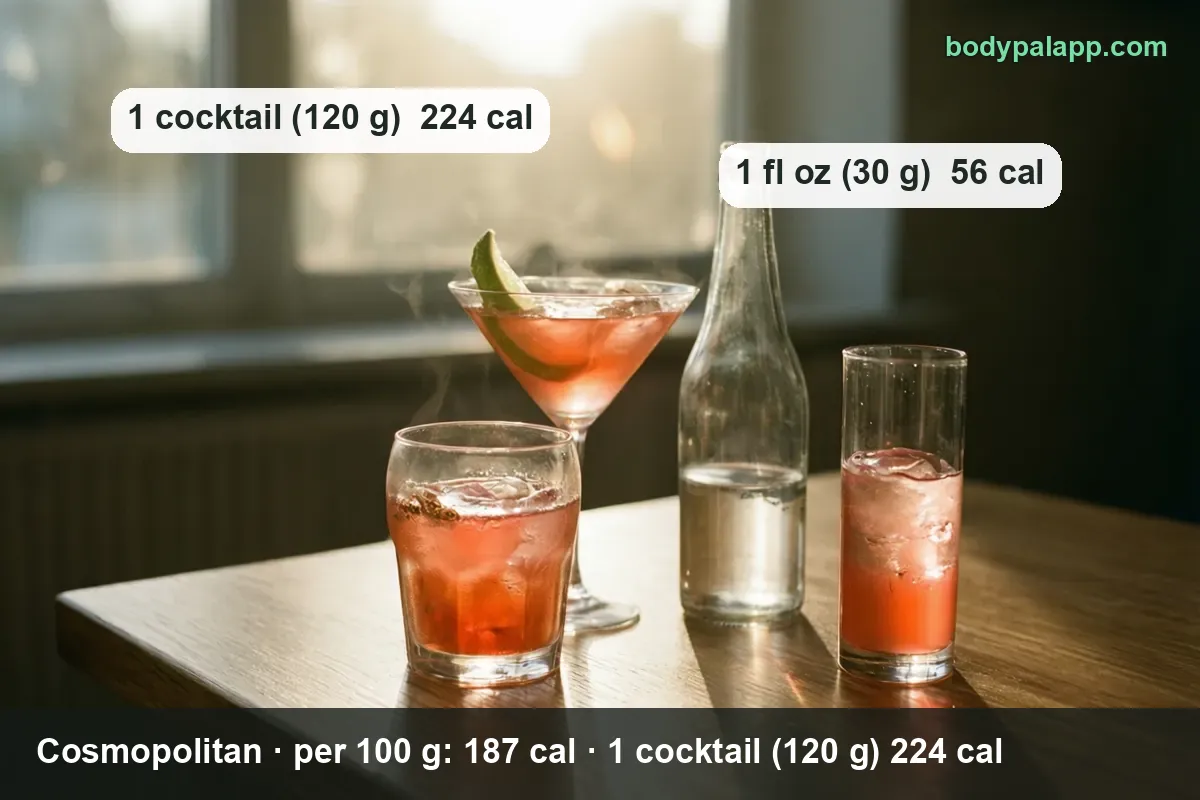
| One cocktail, standard martini glass | 120 g (4 fl oz) | 224 kcal |
| 1 fl oz poured | 30 g | 56 kcal |
| 1 oz by weight | 28 g | 53 kcal |
| Per 100 g | 100 g | 187 kcal |
Four fluid ounces is a small glass, and that is the single most useful fact on this page. USDA pours a margarita and a daiquiri at 225 g, nearly double, because those drinks arrive in a wide-bowled coupe or over ice. A cosmopolitan comes in a stemmed martini glass that is full at 4 fl oz.
That is why a drink which is 65 calories denser per 100 g than a margarita still finishes 51 calories lighter in the hand. The recipe is heavier. The pour is smaller, and the pour wins.
It cuts the other way in a bar that free-pours into a 6 oz glass. There is no USDA row for that, so the honest arithmetic is the per-ounce figure: every extra fluid ounce over the standard pour is another 56 calories. Two generous cosmopolitans can quietly cost what three modest ones do.
Where the 224 calories actually come from
Alcohol carries about seven calories per gram, more than carbohydrate or protein and second only to fat. That is the whole explanation for this drink.
Look at what the 224 calories are not. Fat: 0.0 g, and 0% of the day. Saturated fat: 0%. Protein: 0.1 g. Sodium: 1 mg, which is 0% of the 2,300 mg Daily Value an American label is built around. Carbohydrate reaches 7.6 g, or 3% of the day. Add every labeled nutrient in a cosmopolitan together and you have accounted for a rounding error.
The sugar figure is the one that surprises people. A cosmopolitan holds 5.8 g of sugar, about a teaspoon and a half. A daiquiri holds 33.6 g and a margarita 36.1 g in a single drink. The pink drink with fruit juice in it is by a wide margin the least sweet of the three, because cranberry juice cocktail and a splash of orange liqueur are a much smaller sugar load than the lime-and-sweetener base those two are built on.
So the standard advice to "watch the sugary cocktails" points at the wrong drink here. If you are counting sugar, a cosmopolitan is a good order. If you are counting calories, it is a middling one, and no substitution in the shaker will change that as long as the vodka stays in. The federal Dietary Guidelines for Americans treat calories from alcohol as calories that displace food rather than add nutrients, and this drink is the cleanest illustration of that idea you will find on a bar menu.
Skinny, mocktail and vodka on its own
| Version | Per 100 g | Serving | Calories |
|---|---|---|---|
| Classic cosmopolitan | 187 kcal | 1 cocktail (120 g) | 224 kcal |
| Dry martini, for reference | 201 kcal | 1 cocktail (120 g) | 241 kcal |
| Vodka and cranberry, no triple sec | 98 kcal | 1 drink (225 g) | 221 kcal |
| Non-alcoholic mixer alone | 119 kcal | 4 fl oz (118 g) | 140 kcal |
| Sugar-free mixer plus one shot of vodka | — | 4 fl oz mixer plus 1.5 fl oz vodka | about 102 kcal |
| Vodka on its own | 231 kcal | 1 shot, 1.5 fl oz (42 g) | 97 kcal |
Three of those rows deserve a sentence each.
Dropping the triple sec turns the drink into what USDA files as a Cape Cod: vodka and cranberry juice over ice, 98 calories per 100 g. It sounds like the lighter order, and per gram it is by a mile. But it is poured at 225 g instead of 120 g, so the finished drink lands at 221 calories — three fewer than the cosmopolitan — while carrying 22.9 g of carbohydrate instead of 7.6 g. You would trade almost nothing in calories for three times the carbohydrate.
The mocktail is the trap. Take the alcohol out and pour a bottled cosmopolitan mixer neat, and a 4 fl oz serving of a full-sugar mixer such as Powell & Mahoney's runs 140 calories with 35.0 g of carbohydrate. It is 84 calories lighter than the real thing and carries roughly five times the carbohydrate. Removing the alcohol does not remove the calories; it changes which macronutrient they are made of.
The skinny version works because of the mixer, not the spirit. A zero-sugar cosmopolitan mixer such as Jordan's Skinny Mixes is 4 calories per 100 g, so a 4 fl oz pour is 5 calories. Add a 1.5 fl oz shot of vodka at 97 calories and the glass comes to about 102 calories, less than half the classic; that total is our own addition of two USDA rows, not a published serving. Note where the saving is: the vodka is still 97 of those 102 calories. Cutting the mixer saves you 122 calories, and after that only cutting the spirit would save any more.
How does a cosmopolitan compare
| Drink | Per 100 g | US serving | Calories | Sugars |
|---|---|---|---|---|
| Cosmopolitan | 187 kcal | 1 cocktail (120 g) | 224 kcal | 5.8 g |
| Dry martini | 201 kcal | 1 cocktail (120 g) | 241 kcal | 0.2 g |
| Margarita | 122 kcal | 1 drink (225 g) | 275 kcal | 36.1 g |
| Daiquiri | 119 kcal | 1 drink (225 g) | 268 kcal | 33.6 g |
| Vodka and cranberry | 98 kcal | 1 drink (225 g) | 221 kcal | 20.1 g |
Read that table down the "per 100 g" column and the cosmopolitan looks like the worst thing on the list, second only to a straight martini. Read it across to the serving column and it is the second-lightest drink there. Both readings are true, and the reason is the glass rather than the recipe.
Our take: for the fewest calories in the glass, vodka and cranberry at 221 is the marginal winner, but it costs you 22.9 g of carbohydrate to save three calories, so it is not a real win. The cosmopolitan is the better order — it is 51 calories under a margarita, 44 under a daiquiri, and it carries a sixth of the sugar a margarita does. The only genuinely lighter route is the sugar-free mixer at about 102 calories, and even then the shot of vodka is nearly the whole bill.
Most popular cosmopolitan brands in the United States
Ranked by how widely each product appears among foods sold in the United States, from the BodyPal food database of over 3.3 million products. Calories are the figures printed on each Nutrition Facts label, checked against USDA FoodData Central.
| Product | Calories (per 100 g) |
|---|---|
| Master of Mixes Cosmopolitan Martini Mixer | 89 cal |
| Powell & Mahoney Classic Cosmopolitan Cocktail Mixer | 119 cal |
| Taste of Inspirations Cosmopolitan Cocktail Mix | 92 cal |
| Splash Cosmopolitan Premium Cocktail Mixer | 33 cal |
| Splash Non-Alcoholic Premium Cocktail Mixer Cosmopolitan | 33 cal |
| Jordan's Skinny Mixes Cosmopolitan | 4 cal |
Brand popularity: BodyPal food database. Nutrition: manufacturer labels / USDA FoodData Central.
Cosmopolitan FAQs
How many calories are in a cosmopolitan?
224 calories in a standard 4 fl oz cocktail, which weighs 120 g, or 187 calories per 100 g. That comes with 7.6 g of carbohydrate, 5.8 g of sugar and essentially no fat, protein or sodium. Every extra fluid ounce a bartender pours adds another 56 calories.
How much sugar is in a cosmopolitan?
5.8 g in one cocktail, about a teaspoon and a half. That is far less than most people expect from a pink, fruit-juice drink: a daiquiri carries 33.6 g and a margarita 36.1 g in a single serving. USDA does not publish an added sugars figure for cocktails, so only total sugars can be quoted.
How many carbs are in a cosmopolitan?
7.6 g of carbohydrate in one 120 g cocktail, which is 3% of the Daily Value. Per 100 g the figure is 6.36 g. Swap the triple sec for a plain vodka and cranberry and carbohydrate jumps to 22.9 g, because that drink is poured almost twice as large.
Is a cosmopolitan high in calories?
It is dense but small: at 187 calories per 100 g it is one of the heaviest mixed drinks USDA lists, ahead of a margarita at 122 and a daiquiri at 119. Because it is served in a 120 g martini glass rather than a 225 g one, the finished drink is 224 calories, lighter than either of them.
Cosmopolitan or margarita, which has fewer calories?
The cosmopolitan, at 224 calories against 275 for a margarita. The margarita is the lighter drink per 100 g, 122 against 187, but it is poured at 225 g instead of 120 g. The sugar gap is wider still: 5.8 g against 36.1 g.
How many calories in a skinny cosmopolitan?
About 102 calories using a zero-sugar mixer. A 4 fl oz pour of a sugar-free cosmopolitan mixer is 5 calories, and a 1.5 fl oz shot of vodka is 97. That is a saving of roughly 122 calories against the classic, and 97 of the 102 that remain come from the spirit.
Does a non-alcoholic cosmopolitan have fewer calories?
Fewer, but not few: a 4 fl oz serving of a full-sugar bottled mixer poured without spirit is 140 calories with 35.0 g of carbohydrate, against 224 calories and 7.6 g for the real cocktail. Taking the alcohol out swaps alcohol calories for sugar calories rather than removing them.
How many calories are in the vodka alone?
97 calories in a 1.5 fl oz shot, which weighs 42 g, and 231 calories per 100 g. A single fluid ounce poured without ice is 65 calories. In a 224-calorie cosmopolitan the shot of vodka is close to half the total, which is why changing the mixer moves the number more easily than changing the recipe.
Similar foods
- Chocolate Martini — 224 cal per drink
- Espresso Martini — 224 cal per drink
- White Russian — 407 cal per drink
- Dirty Martini — 241 cal per drink
- Martini — 241 cal per drink
- Old Fashioned Drink — 295 cal per drink
Count it without the math
Point the camera at the glass and BodyPal logs the calories, the carbs and the sugar before the lime wedge goes on.


How long does it take to burn off a cosmopolitan?
One 4 fl oz cocktail (120 g) is 224 kcal. Enter your weight and the amount you ate to see how long it takes you to burn that off:
lb
| Activity | Time to burn 224 kcal |
|---|---|
| Walking, brisk | 45 min |
| Cycling, moderate | 28 min |
| Swimming, moderate | 32 min |
| Jogging | 26 min |
| Weight training, moderate | 50 min |
Times are for a 155 lb adult at a steady pace; change the weight to see yours. The amount is set to the portion in the text (120 g); change it to what you actually ate. BodyPal works this out from your steps automatically.
Want the bigger picture? Calculate your daily calorie needs — your maintenance figure, a target for losing or gaining, and the date you get there.