
How many calories are in an espresso martini?
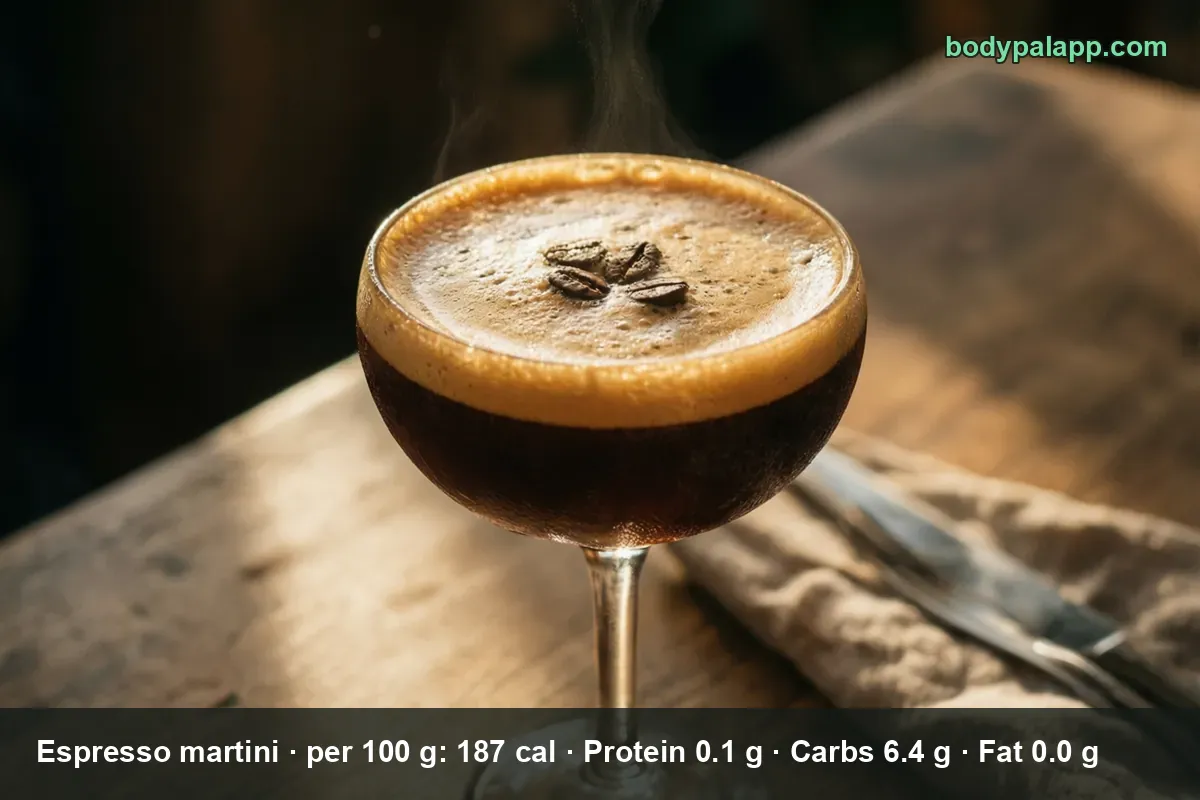
One espresso martini, poured at a standard 120 g, is 224 calories. Per 100 g the drink runs 187 calories, which puts it in the same band as most shaken cocktails. The coffee liqueur does most of that damage; the espresso itself adds essentially nothing but flavor and caffeine.
On this page
- Espresso martini quick facts
- US pours from one ounce to a big coupe
- Dry martini and coffee liqueur versions
- The alcohol carries the calories not the sugar
- How does an espresso martini compare?
- Espresso martini FAQs
Espresso martini quick facts
There is no USDA record called "espresso martini." The closest match, and the one used here, is FNDDS 2710640, "Martini, flavored" from the 2021-2023 survey release, filed under liquor and cocktails. It is the only sweetened martini-style cocktail with a ready-made "1 drink" portion, which is exactly what a bartender hands you. The dry Martini record, 2710639, has no liqueur and no sugar at all, so it belongs further down the page as a variant rather than as the headline number.
Say that out loud once and the rest of the page makes sense: you are looking at a sweetened, shaken, spirit-forward drink of about 4 fl oz, not at a lab analysis of one bar's recipe.
| Nutrient | Per 100 g | Per 1 drink (120 g) | % Daily Value |
|---|---|---|---|
| Calories | 187 | 224 | — |
| Total fat | 0.03 g | 0.0 g | 0% |
| Saturated fat | 0 g | 0.0 g | 0% |
| Carbohydrate | 6.36 g | 7.6 g | 3% |
| Dietary fiber | 0.1 g | 0.1 g | 0% |
| Total sugars | 4.86 g | 5.8 g | — |
| Protein | 0.09 g | 0.1 g | 0% |
| Sodium | 1 mg | 1 mg | 0% |
% Daily Value is based on a 2,000-calorie diet.
Verified nutrition data
Numbers on this page come from USDA FoodData Central, the U.S. Department of Agriculture’s food composition database, and from manufacturer labels where a branded product is named. Last verified September 2026. How we verify our data →
Two rows you would expect on a Nutrition Facts panel are missing: added sugars and trans fat. USDA does not publish either for this record, so they are left out rather than guessed at, even though the coffee liqueur is clearly where the sweetness comes from. Cholesterol is 0 mg and potassium is 32 mg per drink, about 1% of the Daily Value, which is the sort of number that tells you the glass is mostly alcohol and water. Daily Values themselves come from the FDA nutrition label rules.
US pours from one ounce to a big coupe
Cocktails are the one food category where the glass, not the recipe, decides the calorie count. A 120 g serve in a small coupe and a 150 g serve in the wide vintage glass your local bar bought last year are the same drink on paper and 56 calories apart in practice.
| Serving | Weight | Calories |
|---|---|---|
| 1 fl oz | 30 g | 56 kcal |
| 1 oz | 28.4 g | 53 kcal |
| One drink, standard pour | 120 g | 224 kcal |
| Large coupe pour, 5 fl oz | 150 g | 280 kcal |
| Per 100 g | 100 g | 187 kcal |
Only two of those are USDA household measures: the 120 g drink and the 1 fl oz pour. The 1 oz by weight and the 150 g coupe are our own arithmetic from the USDA 100 g figure, not USDA servings, because bar glassware runs bigger than survey data assumes.
The fluid-ounce trap is worth naming. A fluid ounce of this drink weighs about 30 g, slightly more than an ounce by weight, so counting "ounces" without checking which kind you mean shifts every number by a few percent. When you log it, log the glass.
Dry martini and coffee liqueur versions
| Version | Per 100 g | Typical pour | Calories |
|---|---|---|---|
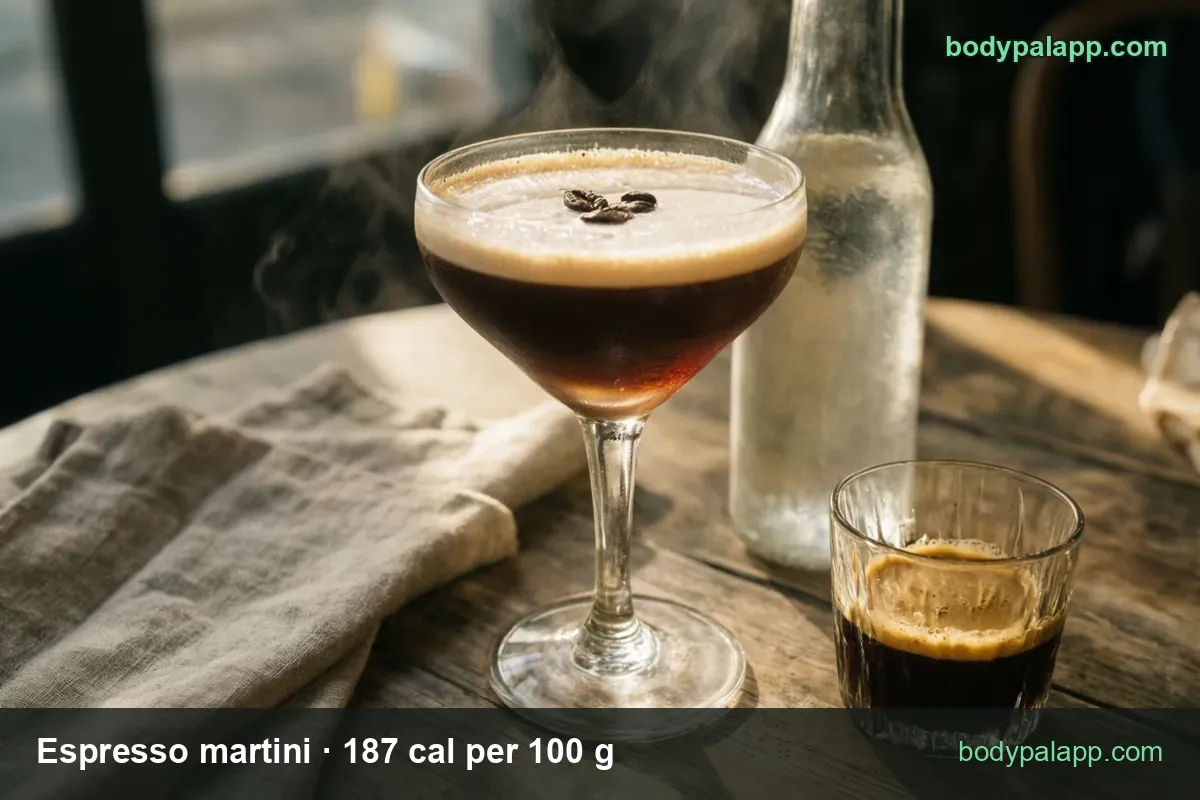
| Classic espresso martini | 187 kcal | 1 drink (120 g) | 224 kcal |
| Dry martini, no coffee liqueur | 201 kcal | 1 drink (120 g) | 241 kcal |
| Coffee liqueur on its own | 336 kcal | 1 shot (45 g) | 151 kcal |
| Coffee liqueur, 63 proof | 308 kcal | 1.5 fl oz (52 g) | 160 kcal |
| Cream coffee liqueur, 34 proof | 327 kcal | 1.5 fl oz (47 g) | 154 kcal |
| White Russian | 181 kcal | 1 drink (120 g) | 217 kcal |
The White Russian line in that table is our own 120 g scaling of the USDA 100 g figure, not a USDA serving.
The dry martini result surprises people. Strip out the coffee liqueur and the drink gets heavier per 100 g, 201 against 187, because what replaces the sugar is more gin or vodka. The dry version carries 0.15 g of carbohydrate per 100 g and no sugars whatsoever, yet a full 120 g drink lands at 241 calories, seventeen more than the sweet one.
The liqueur is where the espresso martini's number actually comes from. A single 45 g shot is 151 calories, and neat it measures 336 calories per 100 g with 46.8 g of carbohydrate. The 63-proof bottling is stronger and less sweet, 308 calories and 32.2 g of carbohydrate per 100 g, so switching bottles trades sugar for alcohol without saving much.
Cream coffee liqueur is the outlier: 327 calories per 100 g, but built from 15.7 g of fat and 9.66 g of saturated fat rather than from sugar. Fat does the work in that bottle, not sugar. Ready-to-drink espresso martinis in a can exist on US shelves but not in USDA Branded, because American alcohol labels are regulated by TTB rather than FDA, so there is no verified row to quote for them.
The alcohol carries the calories not the sugar
Run the arithmetic and the picture flips. The 6.36 g of carbohydrate in 100 g of espresso martini account for roughly 25 calories. The other 162 come from the ethanol, which has no Daily Value, no percentage, and no row on any label. That is why the %DV column on this page is a wall of zeros while the calorie count sits at 224.
It also explains why the drink looks harmless on a tracking app that only flags fat, sodium and sugar. Total fat is 0% DV. Sodium is 1 mg, effectively 0%. Carbohydrate is 3%. Nothing lights up, and the glass has still cost you 224 calories.
If you are watching intake, the honest framing is the pour, not the recipe tweak. Sugar-free syrup and cold brew instead of liqueur will save real calories; skim milk foam and a smaller garnish will not. And the CDC's guidance on moderate drinking caps intake at one drink a day for women and two for men, which happens to be the same line where the calorie math starts to matter. The Dietary Guidelines for Americans treat alcohol calories as calories that displace nutritious food, and this drink is a clean example: 224 calories and almost no protein, fiber or minerals in return.
How does an espresso martini compare?
| Cocktail | Per 100 g | US serving | Calories |
|---|---|---|---|
| Espresso martini | 187 kcal | 1 drink, 120 g | 224 kcal |
| White Russian | 181 kcal | 1 drink, 120 g | 217 kcal |
| Manhattan | 222 kcal | 1 drink, 120 g | 266 kcal |
| Rob Roy | 212 kcal | 1 drink, 120 g | 254 kcal |
The three neighbor drinks are scaled to the same 120 g pour from their USDA 100 g figures, which is our own arithmetic rather than a USDA serving.
Our take: the espresso martini is the second-lightest drink in this group and the White Russian is the only one that beats it, by 6 calories per 100 g and 7 per glass. If you want the coffee flavor and the smallest number, order the espresso martini and skip the cream. If you are choosing on calories alone, the whiskey cocktails are the ones to leave on the menu: a Manhattan costs you 42 more calories than the same-sized espresso martini for a drink most people sip slower anyway. And if you plan on two, count them before you order the second, because 448 calories is a course, not a nightcap.
Espresso martini FAQs
How many calories are in an espresso martini?
224 calories for a standard 120 g drink, or 187 calories per 100 g, using the USDA FNDDS row for a flavored martini. Most of that comes from the alcohol and the coffee liqueur rather than the espresso. A larger 5 fl oz coupe pour works out to roughly 280 calories.
How many carbs are in an espresso martini?
7.6 g of carbohydrate in a 120 g drink, which is 3% of the Daily Value. Per 100 g the figure is 6.36 g. That is low for something this sweet-tasting, because the alcohol itself contributes calories without carbs. A dry martini with no liqueur has almost none at 0.15 g per 100 g.
How much sugar is in an espresso martini?
5.8 g of total sugars per 120 g drink, from 4.86 g per 100 g. Nearly all of it rides in on the coffee liqueur, which is 38.3 g of sugars per 100 g on its own. USDA does not publish added sugars for this record, so the label split is unavailable.
Espresso martini vs White Russian: which has more calories?
The espresso martini, by 7 calories: 224 against 217 for a White Russian at the same 120 g pour, that 217 being our own arithmetic from the USDA 100 g figure. Per 100 g the White Russian is lighter, 181 against 187, since cream and milk dilute the alcohol.
How many calories are in a shot of coffee liqueur?
151 calories in a 45 g shot of coffee liqueur, which is two thirds of a whole espresso martini. Undiluted, the liqueur is 336 calories per 100 g and 46.8 g of carbohydrate. The 63-proof version is 308 calories per 100 g, stronger but less sweet at 32.2 g.
How can I make a lower calorie espresso martini?
Cut the liqueur: it carries 151 of the 224 calories in a standard drink, so halving it to a 22 g pour takes roughly 75 calories off, by our own arithmetic. Espresso and vodka do the rest: a plain martini base is 201 calories per 100 g with 0.15 g of carbohydrate.
Does an espresso martini have any fat?
0.0 g of fat in a 120 g drink, from 0.03 g per 100 g, and no saturated fat or cholesterol at all. Fat only appears if you switch to a cream coffee liqueur, which brings 15.7 g of fat and 9.66 g of saturated fat per 100 g.
How many calories in two espresso martinis?
448 calories for two standard 120 g drinks, our own doubling of the USDA figure, plus 15.2 g of carbohydrate and 11.6 g of sugars. That is a dessert-sized total on top of dinner, and the CDC's moderate-drinking guidance tops out at one drink a day for women and two for men.
Similar foods
- Chocolate Martini — 224 cal per drink
- Cosmopolitan — 224 cal per cocktail
- White Russian — 407 cal per drink
- Dirty Martini — 241 cal per drink
- Martini — 241 cal per drink
- Old Fashioned Drink — 295 cal per drink
Count it without the math
Point the camera at the glass and BodyPal counts the drink for you, liqueur and all.


How long does it take to burn off 224 kcal of espresso martini?
One drink (120 g) is 224 kcal. Enter your weight and the amount you ate to see how long it takes you to burn that off:
lb
| Activity | Time to burn 224 kcal |
|---|---|
| Walking, brisk | 45 min |
| Cycling, moderate | 28 min |
| Swimming, moderate | 32 min |
| Jogging | 26 min |
| Weight training, moderate | 50 min |
Times are for a 155 lb adult at a steady pace; change the weight to see yours. The amount is set to the portion in the text (120 g); change it to what you actually ate. BodyPal works this out from your steps automatically.
Burning it off is one side of it. The other is knowing your number: work out how many calories you need a day, with macros and a goal date.