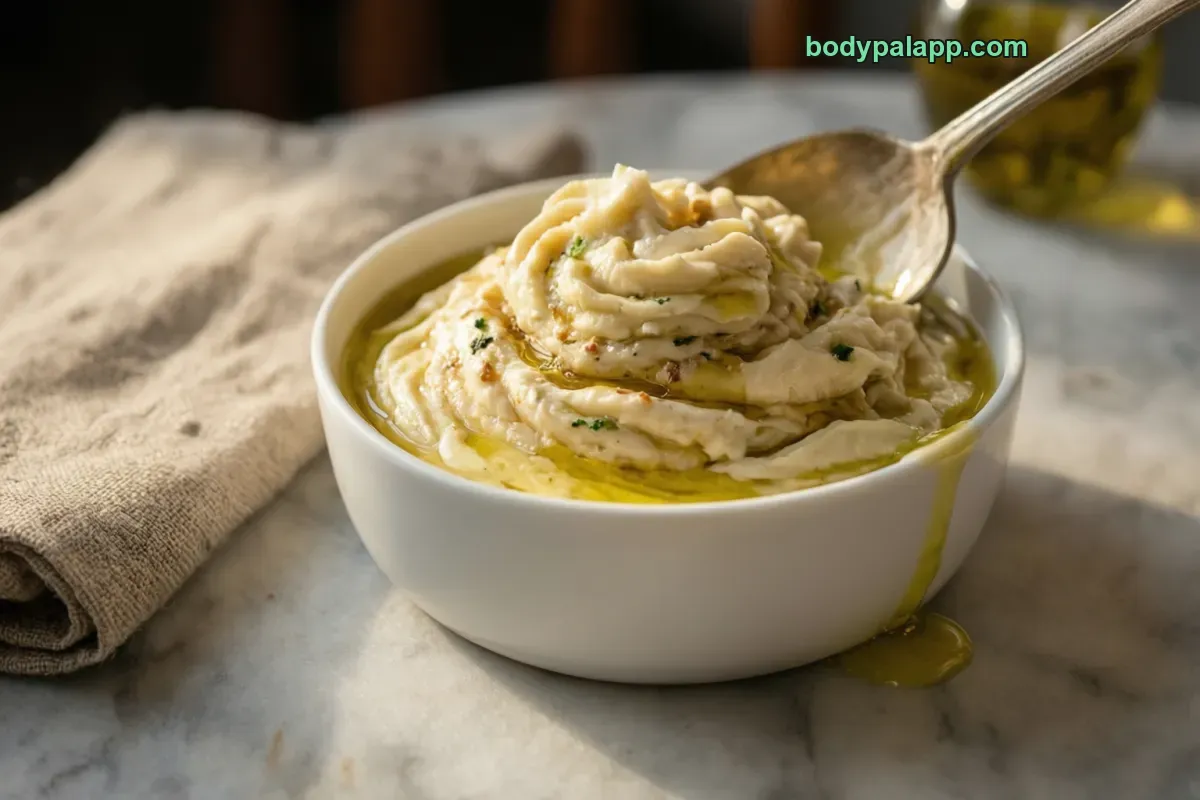
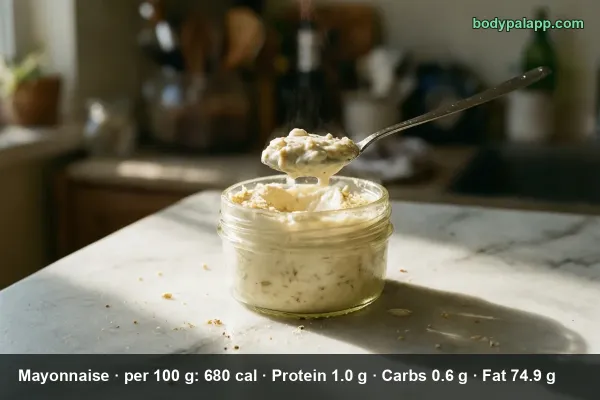
Olive oil mayo calories come to 54 for 1 tbsp (15 g) and 361 per 100 g, based on the USDA row for reduced fat mayonnaise made with olive oil. The thing to notice: 100% of those calories come from fat, so the size of your spoon matters far more than which jar you buy.
54kcal
1 tablespoon · 15 g, reduced fat
0%protein
0.1 gProtein
0 gCarbs
6 gFat
How to burn off 54 kcal
—Walking, brisk
—Jogging
—Cycling, moderate
—Swimming
Skip the math. BodyPal counts these calories from your steps and workouts automatically.
Nutrition facts
Reduced fat · per 15 g
Calories
54 kcal
Protein
0.1 g
Carbohydrate
0 g
Fat
6 g
Saturated fat
0.8 g
Cholesterol
5 mg
Sodium
120 mg
Potassium
5 mg
Iron
0 mg
Source: USDA FoodData Central
🛡️
Verified nutrition data
Numbers on this page come from USDA FoodData Central, the U.S. Department of Agriculture’s food composition database, and from manufacturer labels where a branded product is named. Last verified September 2026. How we verify our data →
Olive oil mayo: calories, protein and sodium by serving
Percent of daily value uses the FDA reference of 2,000 kcal a day.
Serving
kcal
Protein
Carbs
Fat
Sodium
% DV kcal
1 tbsp (15 g)
54
0.1 g
0 g
6 g
120 mg
3%
1 packet (12 g)
43
0 g
0 g
4.8 g
96 mg
2%
1 cup (232 g)
838
0.9 g
0 g
92.8 g
1,856 mg
42%
100 g
361
0.4 g
0 g
40 g
800 mg
18%
3 × 1 tbsp (15 g)
162
0.2 g
360 mg
5 × 1 tbsp (15 g)
271
0.3 g
600 mg
Two tablespoons already make 108 calories
A single level tbsp (15 g) is 54 calories, about 3% of the daily value for energy. That is a modest number on its own. The trouble is that few people stop at one level spoon, and nothing in this food slows the total down because it has no protein, fiber or carbs to speak of.
Watch how quickly it climbs. Two tablespoons come to 108 calories, three reach 162, and a generous five-spoon dollop on a big sandwich or a bowl of tuna salad lands at 271. A full cup (232 g), the kind of amount a potato salad recipe calls for, carries 838 calories, or 42% of the daily value, before any other ingredient goes in.
Single-serve packets are the easiest way to keep the count honest. One packet (12 g) holds 43 calories, a little less than a tablespoon, and you know exactly how much went on the bread. At home, level the spoon instead of heaping it. A rounded scoop can quietly double the number you think you are logging.
Every calorie here is fat
The calorie split is blunt: 100% fat, with protein and carbs both at 0%. Per 100 g you get 40 g of fat, 0.4 g of protein, 0 g of carbs, 0 g of sugars and 0 g of fiber. One tbsp carries 6 g of fat and just 0.1 g of protein. This is a condiment that adds richness and nothing else to the macro side of your plate.
The reduced fat label is real, though. Regular mayo has 74.9 g of fat per 100 g, and this version has 40 g, which is why the calorie count sits at 361 instead of 680. Manufacturers get there by adding water and thickeners, so the jar feels similar on a sandwich while delivering roughly half the energy.
Saturated fat is 5.4 g per 100 g, and cholesterol is 33 mg. Neither number is large at a one-spoon serving, but both scale with the scoop just like the calories do. If you track saturated fat, the cup-sized amounts in dips and dressings deserve a second look.
Sodium is the row that catches people out
Per 100 g, olive oil mayo has 800 mg of sodium, which is 35% of the daily value. That is higher than regular mayo at 635 mg per 100 g. Lighter recipes often lean on salt to keep the flavor up once some of the fat is gone, and this one follows the pattern.
At normal portions the numbers stay manageable. One tbsp has 120 mg, or 5% of the daily value, and a packet has 96 mg. Five tablespoons push it to 600 mg, and a full cup reaches 1,856 mg, which is 81% of the daily value in a single ingredient.
If you watch sodium, count the mayo together with what it sits on. Deli meat, cheese, pickles and bread all bring their own salt, and the spread is rarely the biggest contributor. Plain extra virgin olive oil has only 2 mg per 100 g, so a drizzle of oil with lemon is the low-sodium swap when you want fat for flavor without the salt.
Spread thin, it fits most lunches
Because olive oil mayo brings fat and nothing else, it works best next to foods that supply what it lacks. Lean turkey, chicken, eggs or tuna add protein. Lettuce, tomato, cucumber and whole grain bread add fiber and volume. Put together, a sandwich with one level spoon of mayo is a balanced plate rather than a fat delivery system.
For salads like chicken, egg or potato salad, try cutting the mayo with plain yogurt or mustard. You keep the creamy texture, use fewer tablespoons, and the calorie count drops along with the sodium. Brands such as Hellmann's, Best Foods, Kraft, Kroger and Spectrum all sell an olive oil version, so check the label on the jar you own, since recipes vary.
Logging is where most mayo calories go missing, because people forget the spread entirely. If you snap a photo of your sandwich, BodyPal can log the food from the picture, which makes it easier to remember the spoonful that went inside.
How does olive oil mayo compare?
Here is olive oil mayo next to regular mayo, a mayo packet and extra virgin olive oil, per 100 g and per usual serving.
Verdict: For cutting calories, olive oil mayo is the clear pick at 361 per 100 g, while regular mayo has 680, about 1.9 times as much. For sodium the order flips: regular mayo has 635 mg per 100 g and plain extra virgin olive oil only 2 mg, though the oil packs 884 calories per 100 g and 119 in a single tablespoon.
Most popular olive oil mayo brands in the United States
Brand recipes use different amounts of oil, so labels range from 333 to 714 calories per 100 g against the reduced-fat number above. Source: manufacturer labels / USDA FoodData Central.
Olive oil mayo FAQs
How many calories are in a tablespoon of olive oil mayo?
About 54 calories in one tablespoon (15 g), or 361 calories per 100 g.
Is olive oil mayo good for weight loss?
It has 361 calories per 100 g, compared with 680 for regular mayo. A tablespoon still carries 6 g of fat.
Olive oil mayo vs regular mayo: which has fewer calories?
Olive oil mayo has 361 calories and 40 g fat per 100 g, while regular mayo has 680 calories and 74.85 g fat.
How much fat is in olive oil mayo?
One tablespoon (15 g) has 6 g of fat, 0 g carbs and 120 mg sodium.
How many calories are in a packet of olive oil mayo?
A packet (12 g) of olive oil mayo has 43 calories. It also carries 4.8 g of fat and 96 mg of sodium, with no carbs or sugar, so it comes in slightly under a level tablespoon.
How much sodium is in olive oil mayo?
One tbsp of olive oil mayo has 120 mg of sodium, 5% of the daily value. Per 100 g it reaches 800 mg, or 35%, which is more than regular mayo at 635 mg per 100 g.
Does olive oil mayo have carbs or sugar?
Olive oil mayo has 0 g of carbs and 0 g of sugars per 100 g. All of its calories come from fat, so it fits low-carb eating, as long as you keep track of the tablespoons.
How many calories are in a cup of olive oil mayo?
A cup (232 g) of olive oil mayo has 838 calories, 42% of the daily value. It also holds 92.8 g of fat and 1,856 mg of sodium, so recipe amounts add up fast.
Does olive oil mayo have fewer calories than olive oil?
Yes. Olive oil mayo has 361 calories per 100 g, while extra virgin olive oil has 884, about 2.4 times as much. A tablespoon of oil is 119 calories against 54 for the mayo.