
How many calories are in olive oil?
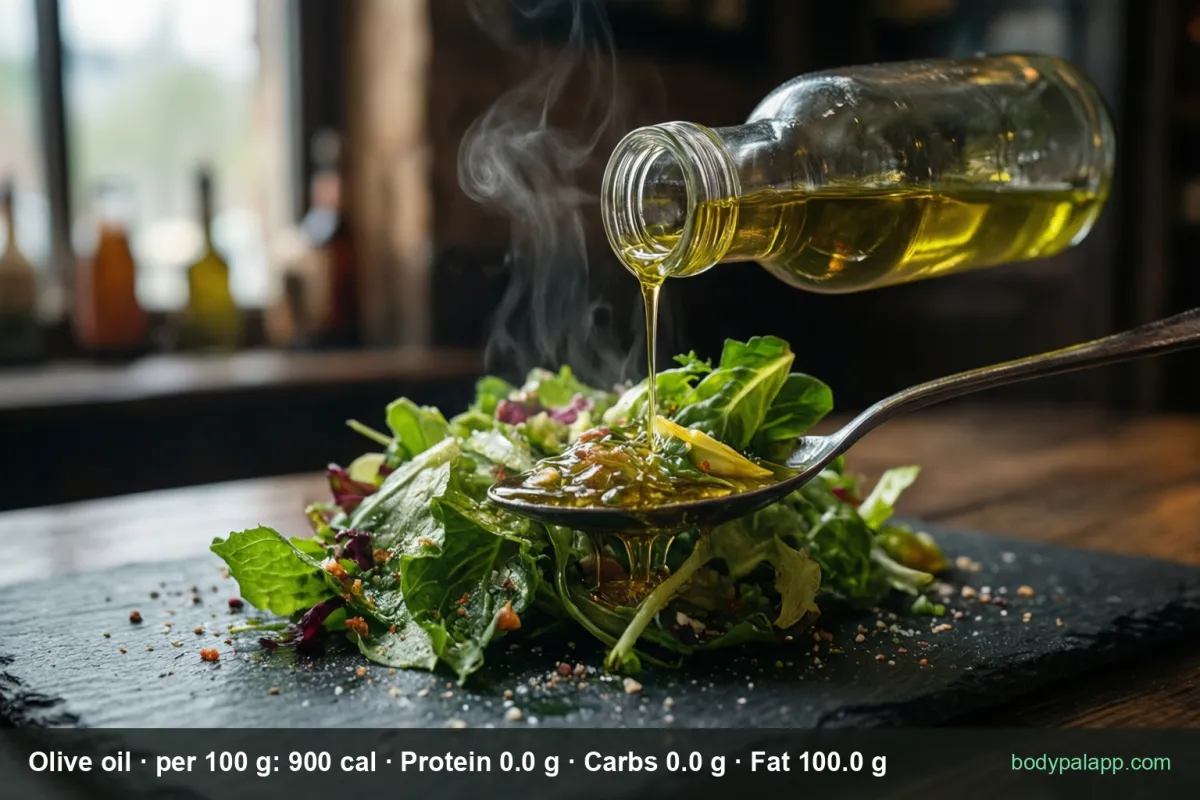
One tablespoon of olive oil is 126 calories, and per 100 grams it is 900 calories — about as high as a food number goes, because olive oil is 100 percent fat with no water, no carbohydrate and no protein to dilute it. From here on, the only variable is how much of it leaves the bottle.
On this page
- Olive oil quick facts
- US servings from a teaspoon to a full cup
- The tablespoon and the cup trap
- Extra virgin bottles and olive oil mayo
- Saturated fat is the row that moves
- How does olive oil compare?
- Most popular olive oil brands
- FAQ
Olive oil quick facts
The row used here is FNDDS 2710186, "Olive oil" — plain oil out of a bottle, not a dressing, not a spread, not a seasoning blend that happens to contain oil. That is the thing most people are holding when they look this up, and it is the row that carries the household measures Americans actually cook with: the tablespoon, the teaspoon and the cup.
Two rows you would expect on a Nutrition Facts panel are not here. Added sugars are not published in this FNDDS release, and pure oil has no sugar of any kind to add. Trans fat is not published either; it shows up in partially hydrogenated fats, not in a pressed oil.
| Nutrient | Per 100 g | Per 1 tablespoon (14 g) | % Daily Value |
|---|---|---|---|
| Calories | 900 | 126 | — |
| Total fat | 100 g | 14.0 g | 18% |
| Saturated fat | 15.52 g | 2.2 g | 11% |
| Carbohydrate | 0 g | 0.0 g | 0% |
| Dietary fiber | 0 g | 0.0 g | 0% |
| Total sugars | 0 g | 0.0 g | — |
| Protein | 0 g | 0.0 g | 0% |
| Sodium | 2 mg | 0 mg | 0% |
% Daily Value is based on a 2,000-calorie diet.
Verified nutrition data
Numbers on this page come from USDA FoodData Central, the U.S. Department of Agriculture’s food composition database, and from manufacturer labels where a branded product is named. Last verified September 2026. How we verify our data →
Cholesterol is 0 mg and potassium is 1 mg per 100 grams, so both round to zero on any realistic pour. Sodium behaves the same way: 2 mg per 100 grams becomes 0 mg on a tablespoon. If you are watching salt, the oil is never the problem — the thing you cook in it is. The Daily Values used in that last column come from the FDA's Nutrition Facts label reference.
US servings from a teaspoon to a full cup
| Serving | Weight | Calories |
|---|---|---|
| 1 teaspoon | 4.7 g | 42 kcal |
| 1 tablespoon | 14 g | 126 kcal |
| 2 tablespoons | 28 g | 252 kcal |
| 1 oz | 28.35 g | 255 kcal |
| 1 cup | 224 g | 2016 kcal |
| Per 100 g | 100 g | 900 kcal |
The tablespoon and the cup are USDA household measures on the FNDDS record. The teaspoon, the two-tablespoon line and the ounce are our own arithmetic from the USDA 100 gram figure, not USDA servings — at 9 calories per gram, oil scales cleanly, so the math is honest even when the row is ours.
The useful thing in that table is how fast the ladder climbs. A teaspoon greasing a pan is 42 calories and barely worth logging. Two tablespoons over a salad is 252, which is a snack with no volume to show for it. And the cup, a measure people reach for without flinching when a recipe calls for it, is 2016 — more than a day's calories for many people, in a liquid that fits in one hand.
The tablespoon and the cup trap
| Version | Per 100 g | Typical serving | Calories |
|---|---|---|---|
| Olive oil, 1 tablespoon | 900 kcal | 1 tbsp (14 g) | 126 kcal |
| Olive oil, 1 teaspoon | 900 kcal | 1 tsp (4.7 g) | 42 kcal |
| Olive oil, 1 cup | 900 kcal | 1 cup (224 g) | 2016 kcal |
Same oil, same record, three answers. The spread between them is the whole story of this food: 42 to 2016 calories, a factor of 48, decided entirely by which piece of kitchen equipment you happen to be holding.
The cup is where people get caught. A cup is 224 grams and 2016 calories, and it hides inside instructions rather than on plates — a marinade, a batch of vinaigrette, a pan of roasted vegetables. Even a quarter cup is 56 grams and 504 calories, which is our own arithmetic from the USDA cup figure, and that is four tablespoons of oil in a bowl of dressing that a table of people will share without measuring.
The teaspoon is the lever in the other direction. Three teaspoons make a tablespoon, so cooking with a teaspoon instead of a free pour takes 126 calories down to 42 without changing a single thing about how the food tastes when it comes off the heat.
Extra virgin bottles and olive oil mayo
| Product | Per 100 g | Label serving | Calories |
|---|---|---|---|
| Extra virgin olive oil, bottled | 800 kcal | 1 Tbsp (15 mL) | 120 kcal |
| Olive oil mayonnaise, reduced fat | 361 kcal | 1 tbsp (15 g) | 54 kcal |
Pick up a bottle of extra virgin at the store and the panel will usually say 120 calories per tablespoon and 800 per 100 grams. USDA's FNDDS row says 126 and 900. Nothing is wrong with either one. The label measures its tablespoon in milliliters and rounds the result to the nearest ten, the way Nutrition Facts rules allow; FNDDS measures a 14 gram tablespoon and reports it unrounded. Extra virgin, refined, organic, California-pressed, lemon-infused — nearly every bottled version in the USDA Branded set lands on the same 120 per tablespoon — one label reads 130 — because grade and origin change flavor and price far more than they change calories.
Olive oil mayonnaise is a different animal and worth separating out. The reduced-fat version is 361 calories per 100 grams, so a tablespoon is 54 — well under half a tablespoon of the oil itself, because the jar is mostly water and emulsifier. The trade is sodium: 800 mg per 100 grams, which works out to about 120 mg in that tablespoon by our own arithmetic from the USDA figure, against effectively zero in the oil.
Saturated fat is the row that moves
Everything else on the panel sits at zero, so saturated fat is the only line that does any work. A tablespoon carries 2.2 grams, 11 percent of the 20 gram Daily Value. Three tablespoons across a day of cooking — a pan in the morning, a salad at lunch, a roast at dinner — is roughly a third of it.
The Dietary Guidelines for Americans put the ceiling at less than 10 percent of daily calories from saturated fat, which on a 2,000-calorie day is about 20 grams, and they treat oils as a food group of their own rather than a fat to be minimized. MyPlate suggests roughly 5 to 6 teaspoons of oil a day for most adults, which is 210 to 252 calories at olive oil's rate.
That number is worth sitting with. Six teaspoons is two tablespoons — less oil than a single generous pour over a salad. If you are counting calories and something isn't adding up at the end of the day, the untracked oil in the pan is the most common place the missing few hundred calories are hiding.
How does olive oil compare?
| Oil | Per 100 g | US serving | Calories |
|---|---|---|---|
| Olive oil | 900 kcal | 1 tbsp (14 g) | 126 kcal |
| Canola oil | 900 kcal | 1 tbsp (14 g) | 126 kcal |
| Corn oil | 900 kcal | 1 tbsp (14 g) | 126 kcal |
| Coconut oil | 895 kcal | 1 tbsp (14 g) | 125 kcal |
Our take: there is no calorie reason to switch oils. Canola and corn match olive oil exactly at 900 per 100 grams, and coconut oil is 895 — a difference of one calorie per tablespoon, which is noise; those three per-tablespoon figures are our own arithmetic from their USDA 100 gram numbers. What separates them is the fat profile: olive oil's 15.52 grams of saturated fat per 100 grams sits far below coconut oil's, and that is the comparison worth making. If the goal is fewer calories, the answer is not a different bottle. It is a smaller spoon.
Most popular olive oil brands in the United States
Ranked by how widely each product appears among foods sold in the United States, from the BodyPal food database of over 3.3 million products. Calories are the figures printed on each Nutrition Facts label, checked against USDA FoodData Central.
| Product | Calories (per 100 g) |
|---|---|
| Filippo Berio Extra Virgin Olive Oil | 800 cal |
| Filippo Berio Organic Extra Virgin Olive Oil | 800 cal |
| Filippo Berio California Extra Virgin Olive Oil | 800 cal |
| Filippo Berio Delicato Extra Virgin Olive Oil | 800 cal |
| De Cecco Extra Virgin Olive Oil | 867 cal |
| Filippo Berio Lemon Organic Extra Virgin Olive Oil | 800 cal |
Brand popularity: BodyPal food database. Nutrition: manufacturer labels / USDA FoodData Central.
Olive oil FAQs
How many calories are in 1 tablespoon of olive oil?
One tablespoon of olive oil is 126 calories, based on the USDA FNDDS figure of 900 calories per 100 grams and a 14 gram tablespoon. All 126 come from fat: 14 grams of it, or 18 percent of the Daily Value. There is no protein, no carbohydrate and no sugar.
How many calories are in 1 teaspoon of olive oil?
A teaspoon of olive oil is 42 calories. USDA lists the teaspoon at 4.7 grams, and at 900 calories per 100 grams that works out to 42 — our own arithmetic from the 100 gram figure. Three teaspoons make a tablespoon, so the swap saves 84 calories per pour.
Does extra virgin olive oil have fewer calories than regular olive oil?
No — both are 900 calories per 100 grams, pure fat either way, so the calories track the grams. Bottle labels for extra virgin read 120 calories per 15 milliliter tablespoon and 800 per 100 grams; the USDA FNDDS row for olive oil reads 126 and 900. Same oil, different measuring base.
How many calories are in a cup of olive oil?
A full cup of olive oil is 2,016 calories. USDA puts the cup at 224 grams, and at 900 calories per 100 grams that is 2,016 — sixteen tablespoons in a row. Even a quarter cup, the amount a big batch of vinaigrette can swallow, is 504 calories.
Is olive oil lower in calories than canola oil?
No — both are 900 calories per 100 grams. USDA lists corn oil at the same 900 and coconut oil at 895. A tablespoon of any of them lands at 125 or 126 calories. Choosing an oil changes the fat profile, not the calorie count.
How much saturated fat is in olive oil?
A tablespoon of olive oil has 2.2 grams of saturated fat, 11 percent of the Daily Value; per 100 grams it is 15.52 grams. That is the one row on the label that climbs fast — three tablespoons over a day of cooking reaches roughly a third of the daily limit.
Does olive oil have carbs or protein?
Neither — olive oil is 0 grams of carbohydrate, 0 grams of sugar, 0 grams of fiber and 0 grams of protein per 100 grams — it is 100 percent fat. Sodium is 2 milligrams per 100 grams, which rounds to 0 on a tablespoon, and cholesterol is zero.
How many calories does olive oil add to a salad?
Two tablespoons, a normal pour over a big salad, add 252 calories, and a teaspoon still adds 42. Oil is the one salad ingredient with no volume payoff — it disappears into the leaves. Measuring the pour instead of free-pouring is the biggest single lever on a salad's calorie count.
Similar foods
- Butter — 102 cal per tbsp
- Yum yum sauce — 170 cal for 2 tbsp
- Oat flour — 105 cal for 1/4 cup
- Cheese — 113 cal per slice
- Thousand Island Dressing — 216 cal per dipping-size container
- Gouda cheese — 75 cal per slice
Count it without the math
Point the camera at the plate and BodyPal counts the oil along with everything it is sitting on.


How long does it take to burn off Olive oil?
One tablespoon (14 g) is 126 kcal. Enter your weight and the amount you ate to see how long it takes you to burn that off:
lb
| Activity | Time to burn 126 kcal |
|---|---|
| Walking, brisk | 25 min |
| Cycling, moderate | 16 min |
| Swimming, moderate | 18 min |
| Jogging | 15 min |
| Weight training, moderate | 28 min |
Times are for a 155 lb adult at a steady pace; change the weight to see yours. The amount is set to the portion in the text (14 g); change it to what you actually ate. BodyPal works this out from your steps automatically.
One food is easy to picture; a whole day is harder. See how many calories you need a day and what a deficit actually looks like.