
How many calories are in yum yum sauce?
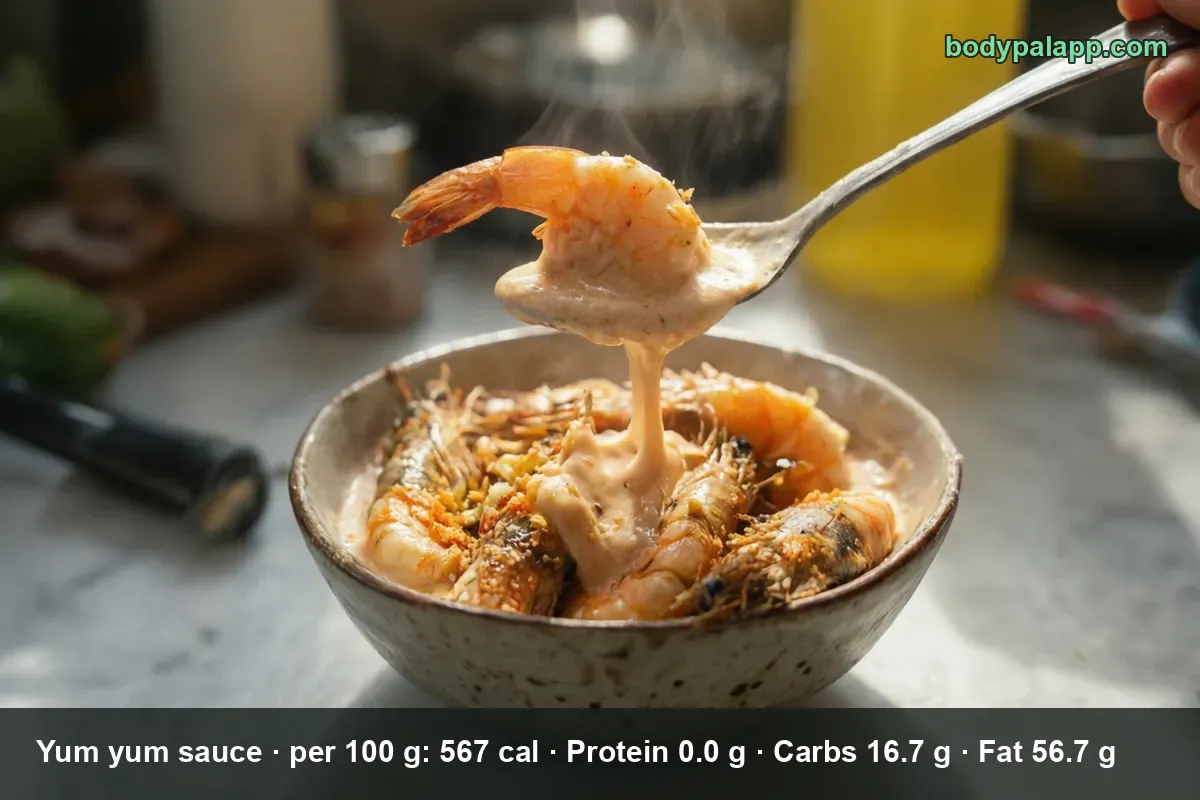
Two tablespoons of yum yum sauce — 30 g, the serving printed on the bottle — is 170 calories, or 567 per 100 g. One tablespoon is 85. Those numbers come from the Terry Ho's label, the reference bottle for this page. Other bottles run anywhere from 320 to 571 calories per 100 g, which is why the brand in your refrigerator matters more than the name of the sauce.
On this page
- Yum yum sauce quick facts
- The bottle decides, not the recipe
- Spoon, ounce, quarter cup
- Spicy is not the lighter one
- Fat is the limit here, not sodium
- Yum yum sauce on shrimp
- How does yum yum sauce compare?
- Most popular yum yum sauce brands
- FAQ
Yum yum sauce quick facts
One thing to settle before the table. USDA has no generic entry for this sauce — no Foundation row, no SR Legacy row, no survey row. Every number available is a manufacturer label, so the figures below are a specific product: USDA FoodData Central 2671145, "YUM YUM SAUCE", Terry Ho's. Read them as one bottle, not as a national average.
| Nutrient | Per 100 g | Per 2 tbsp (30 g) | % Daily Value |
|---|---|---|---|
| Calories | 567 cal | 170 cal | — |
| Total fat | 56.7 g | 17.0 g | 22% |
| Saturated fat | 8.3 g | 2.5 g | 13% |
| Carbohydrate | 16.7 g | 5.0 g | 2% |
| Dietary fiber | 0.0 g | 0.0 g | 0% |
| Total sugars | 13.3 g | 4.0 g | — |
| Protein | 0.0 g | 0.0 g | 0% |
| Sodium | 533 mg | 160 mg | 7% |
% Daily Value is based on a 2,000-calorie diet.
Verified nutrition data
Numbers on this page come from USDA FoodData Central, the U.S. Department of Agriculture’s food composition database, and from manufacturer labels where a branded product is named. Last verified September 2026. How we verify our data →
Two tablespoons also carry 15 mg of cholesterol, 5% of the Daily Value the FDA sets for the label. Added sugars and potassium are not declared in this record, so those rows are absent rather than guessed — some of the 4.0 g of sugars is certainly added, since sugar and corn syrup follow oil and water on the ingredient list, but the split is not in the data.
The shape of the table is the story. A condiment with zero protein and zero fiber puts 17 g of fat into a two-tablespoon puddle. That is the whole nutritional argument, and it happens in a serving most people pour without looking.
The bottle decides, not the recipe
Yum yum sauce is not one number. Across the USDA Branded records the range runs 1.8× wide: Makoto sits at 571 calories per 100 g, Terry Ho's and its Original Spicy and Sun Luck at 567, Weis and Sun Luck Spicy at 500, Hisakawa at 333 and Ying's at 320. Per the serving each label prints, that is 160 calories for Makoto (2 Tbsp, 28 g), 170 for the three bottles at 567 (2 Tbsp, 30 g or 30 mL), 150 for Weis and Sun Luck Spicy, 100 for Hisakawa, and 48 for Ying's — which prints a 1 Tbsp (15 g) serving.
The spread is all mayonnaise. Makoto declares 60.71 g of fat per 100 g; Ying's declares 26.0 g. Same category, same pink-orange color, more than double the oil. Nothing in the name tells you which one you bought.
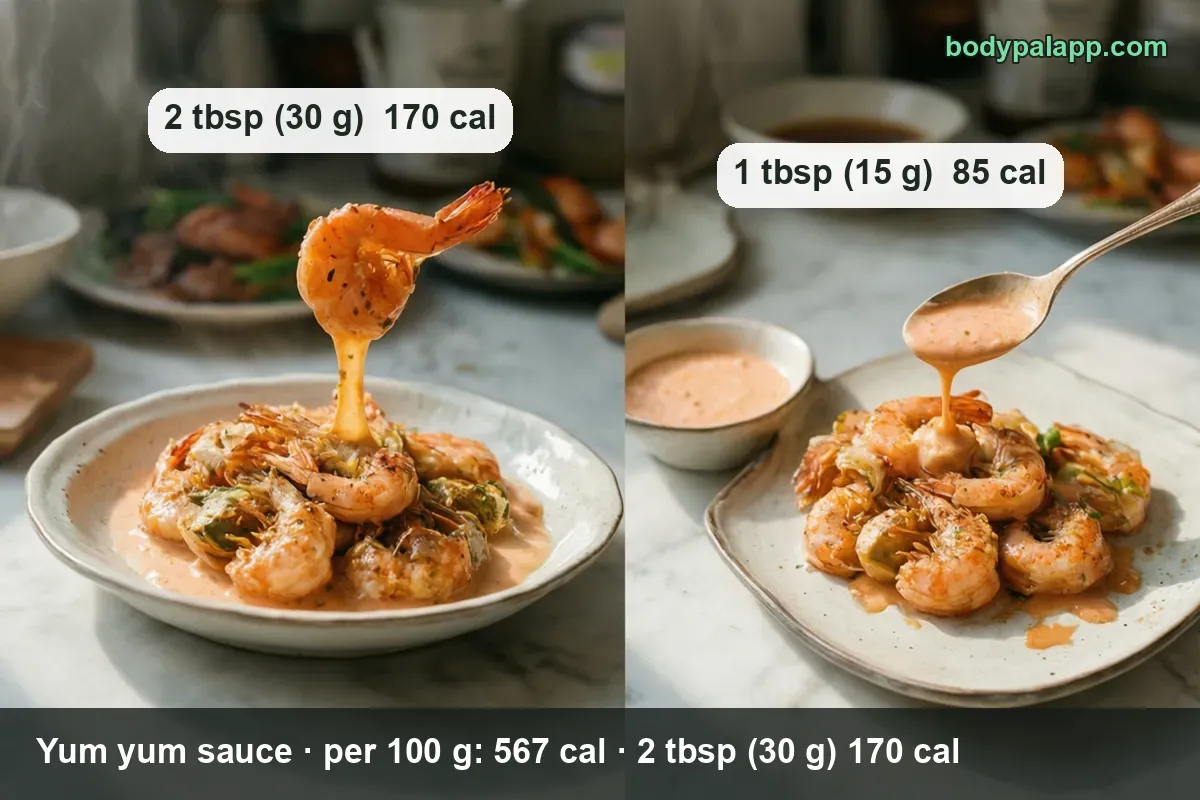
Now look at the per-serving numbers instead, and the panel lies to you. Ying's shows 48 calories a serving against Terry Ho's 170 — that reads as three and a half times lighter. Per 100 g the real gap is 320 against 567, or 1.8×. The difference is that Ying's prints a 1 Tbsp serving while almost everyone else prints 2 Tbsp. Matched at 30 g, Ying's is 96 calories and Terry Ho's is 170.
That is the trap worth carrying to any condiment aisle: the serving size on the panel is a marketing decision, and comparing "per serving" across two bottles compares two different amounts of sauce.
One more oddity in the data. Hisakawa, Hannaford and Food Lion Original report identical numbers down to the decimal — 333 calories, 13.33 g of carbohydrate, 30 g of fat, 350 mg of sodium and 50 mg of cholesterol per 100 g. That is one co-packer filling three labels. Buy any of the three and you have bought the same sauce, at 100 calories per 2 tbsp — 70 fewer than the reference bottle.
Spoon, ounce, quarter cup
| Serving | Weight | Calories |
|---|---|---|
| 1 tbsp | 15 g | 85 cal |
| 2 tbsp, the label serving | 30 g | 170 cal |
| 1 oz | 28.35 g | 161 cal |
| 1/4 cup | 60 g | 340 cal |
| 100 g | 100 g | 567 cal |
The 15 g tablespoon is not an assumption: it is the label's own arithmetic, since Terry Ho's declares 2 Tbsp as 30 g. USDA uses the same weight for creamy condiments elsewhere — 15 g per tablespoon for ranch dressing and 30 g for two tablespoons of tartar sauce.
The quarter-cup row is the one that catches people. Poured into a small dipping bowl, a quarter cup of yum yum sauce disappears fast next to a plate of hibachi vegetables, and it is 340 calories — four times the 3 oz of shrimp it is usually poured over. Sauce is rarely logged. This one deserves to be.
Restaurant sauce is a separate question with no clean answer. Hibachi kitchens mix their own, and USDA has no survey entry for it, so no honest figure exists for the bowl at your table. What can be said is that it is built the same way — mayonnaise, a little tomato paste, sugar, water — which puts it in the same 320 to 571 calories per 100 g band as the bottles.
Spicy is not the lighter one
Heat has no calories, and the labels prove it. Terry Ho's The Original Spicy (2585265) lands at exactly the same 567 calories per 100 g as the original: 170 calories per 2 tbsp, 17.0 g of fat, 3.0 g of carbohydrate. The chili replaces some of the sugar, not the oil.
Sun Luck's spicy version is the exception, and only by formula rather than by being spicy: 500 calories per 100 g, so 150 per 2 tbsp, with 14.0 g of fat and 6.0 g of carbohydrate. It also carries 320 mg of sodium in that serving, double the reference bottle's 160 mg, because the base recipe is saltier at 1,067 mg per 100 g.
If you want fewer calories, the lever is the formula, not the heat. Ying's at 320 calories per 100 g gives you 96 calories per 2 tbsp, 7.8 g of fat and 146 mg of sodium — 74 calories less than the same spoonful of Terry Ho's. The private-label group at 333 calories per 100 g saves 70. Neither is a diet product; both are meaningfully lighter for the same amount on the plate.
Fat is the limit here, not sodium
People brace for salt in an Asian-style sauce. The label says otherwise.
- Two tablespoons: 160 mg of sodium, 7% of the Daily Value
- Two tablespoons: 17.0 g of fat, 22% of the Daily Value
- Two tablespoons: 2.5 g of saturated fat, 13% of the Daily Value
You would need roughly fourteen servings to reach the 2,300 mg sodium limit, but under five to spend the whole day's fat allowance. Compare that with teriyaki sauce, USDA record 171167, which packs 3,833 mg of sodium per 100 g at just 89 calories — the mirror image. Two condiments, two entirely different problems.
Saturated fat is the row the Dietary Guidelines for Americans actually caps, at under 10% of daily calories. A generous quarter cup of this sauce is 5.0 g of saturates, a quarter of the 20 g Daily Value, before anything it is poured over is counted. And because the sugar sits alongside the oil rather than replacing it, 2 tbsp delivers 17 g of fat and 4 g of sugars at the same time — MyPlate treats both as the discretionary part of a meal, and here they arrive together.
Yum yum sauce on shrimp
The classic plate is worth costing, because the intuition about it is usually backwards.
Three ounces of cooked shrimp (85 g, USDA record 175180) is 84 calories and 20.4 g of protein. Add the standard 2 tbsp of sauce at 170 calories and the plate becomes 254 calories.
The sauce contributes 67% of the calories and none of the protein. The shrimp contributes all 20.4 g of the protein and a third of the energy. Nobody searching for shrimp calories expects the condiment to outweigh the shellfish two to one, but at 567 calories per 100 g against 99 for shrimp, that is the arithmetic.
Halve the sauce to 1 tbsp and the plate drops to 169 calories, a 33% cut, with the protein untouched. Switch instead to the lighter formula at the full 2 tbsp and it lands at 180. Either move works; doing both gives you a 132-calorie plate with the same 20.4 g of protein.
How does yum yum sauce compare?
| Sauce | Per 100 g | 2 tbsp | Fat per serving |
|---|---|---|---|
| Yum yum sauce (Terry Ho's) | 567 cal | 30 g → 170 cal | 17.0 g |
| Mayonnaise, regular | 680 cal | 27.6 g → 188 cal | 20.7 g |
| Ranch dressing, regular | 430 cal | 30 g → 129 cal | 13.4 g |
| Tartar sauce | 211 cal | 30 g → 63 cal | 5.0 g |
| Sweet and sour sauce | 154 cal | 35 g → 54 cal | 0.0 g |
Our take: yum yum sauce belongs with the mayonnaise family, not with the sweet dipping sauces it sits beside on a hibachi plate. It is only 17% lighter than straight mayonnaise per 100 g, and 3.7× heavier than sweet and sour. The sugar in it does not dilute the oil — it is added on top of it.
So the swap that pays is a swap of category. If you want a creamy sauce for a fried appetizer, tartar at 63 calories per 2 tbsp does the job for a bit over a third of the calories. If you want the sweet-savory note without the oil, sweet and sour at 54 is lower still, though it brings 13.4 g of carbohydrate to the spoon. And if it has to be yum yum sauce, buy by the panel: the same two tablespoons cost 170, 100 or 96 calories depending on which bottle is in the cart.
Most popular yum yum sauce brands in the United States
Ranked by how widely each product appears among foods sold in the United States, from the BodyPal food database of over 3.3 million products. Calories are the figures printed on each Nutrition Facts label, checked against USDA FoodData Central.
| Product | Calories (per 100 g) |
|---|---|
| Terry Ho's Yum Yum Sauce | 567 cal |
| Terry Ho's The Original Spicy Yum Yum Sauce | 567 cal |
| Ying's Yum Yum Sauce | 320 cal |
| Makoto Yum Yum Sauce | 571 cal |
| Sun Luck Yum Yum Sauce | 567 cal |
| Sun Luck Spicy Yum Yum Sauce | 500 cal |
Brand popularity: BodyPal food database. Nutrition: manufacturer labels / USDA FoodData Central.
Yum yum sauce FAQs
How many calories are in yum yum sauce?
170 calories in the standard 2 tablespoon (30 g) serving, at 567 calories per 100 g, using the Terry Ho's label in USDA FoodData Central. One tablespoon is 85. Other bottles range from 320 to 571 calories per 100 g, so check the panel on the one you own.
How many calories in 2 tablespoons of yum yum sauce?
170 calories for 30 g, which is the serving printed on most bottles. That comes with 17.0 g of fat, 5.0 g of carbohydrate, 4.0 g of sugars and 160 mg of sodium. The fat alone is 22% of the Daily Value.
How many calories in 1 tablespoon of yum yum sauce?
85 calories for 15 g, half the label serving, with 8.5 g of fat. A single tablespoon is a realistic amount for one piece of shrimp or a few bites of rice. A quarter cup, which is what a dipping bowl usually holds, is 340.
Is spicy yum yum sauce lower in calories?
No — Terry Ho's spicy version is identical to the original at 567 calories per 100 g and 170 per 2 tbsp. Sun Luck's spicy sauce is lighter at 500 per 100 g, or 150 per serving, but that is its formula rather than the chili, and it carries 320 mg of sodium.
Which yum yum sauce has the fewest calories?
Ying's, at 320 calories per 100 g, which is 96 calories for the same 30 g other brands call a serving. The supermarket sauce co-packed for Hisakawa, Hannaford and Food Lion is next at 333 per 100 g, or 100 calories per 2 tbsp. Both beat the 170 of the reference bottle.
How many calories in shrimp with yum yum sauce?
254 calories for 3 oz of cooked shrimp (85 g, 84 calories) with 2 tbsp of sauce. The sauce is 67% of that total and contributes no protein; the shrimp supplies all 20.4 g of it. Cutting the sauce to one tablespoon brings the plate to 169.
How much sodium is in yum yum sauce?
160 mg per 2 tbsp, 7% of the Daily Value, from a base of 533 mg per 100 g. That is modest for a savory sauce — teriyaki runs 3,833 mg per 100 g. Saltier bottles exist: Sun Luck sits at 933 mg per 100 g and its spicy version at 1,067 mg.
What is yum yum sauce made of?
By the numbers it is mostly oil: 56.7 g of fat, 16.7 g of carbohydrate and no protein or fiber per 100 g. Oil and water lead the ingredient list on the reference label, with sugar and corn syrup next, which is why the sauce is essentially sweetened mayonnaise.
Similar foods
- Sesame Seeds — 52 cal per tbsp
- Caesar Dressing — 163 cal per 2 tbsp
- Almond Flour — 170 cal per 1/4 cup
- Semi-Sweet Chocolate Chips — 806 cal per cup
- Bacon Bit — 33 cal per tablespoon
- Taco Shell — 61 cal per shell
Count it without the math
Point the camera at the bowl and BodyPal logs the sauce and the shrimp separately, so the 170 does not vanish into the plate.


How long does it take to burn off Yum Yum sauce?
A 2-tablespoon (30 g) serving is 170 kcal. Enter your weight and the amount you ate to see how long it takes you to burn that off:
lb
| Activity | Time to burn 170 kcal |
|---|---|
| Walking, brisk | 34 min |
| Cycling, moderate | 21 min |
| Swimming, moderate | 24 min |
| Jogging | 20 min |
| Weight training, moderate | 38 min |
Times are for a 155 lb adult at a steady pace; change the weight to see yours. The amount is set to the portion in the text (30 g); change it to what you actually ate. BodyPal works this out from your steps automatically.
This table assumes you know your daily total. If you do not, the daily calorie calculator works it out from five numbers.