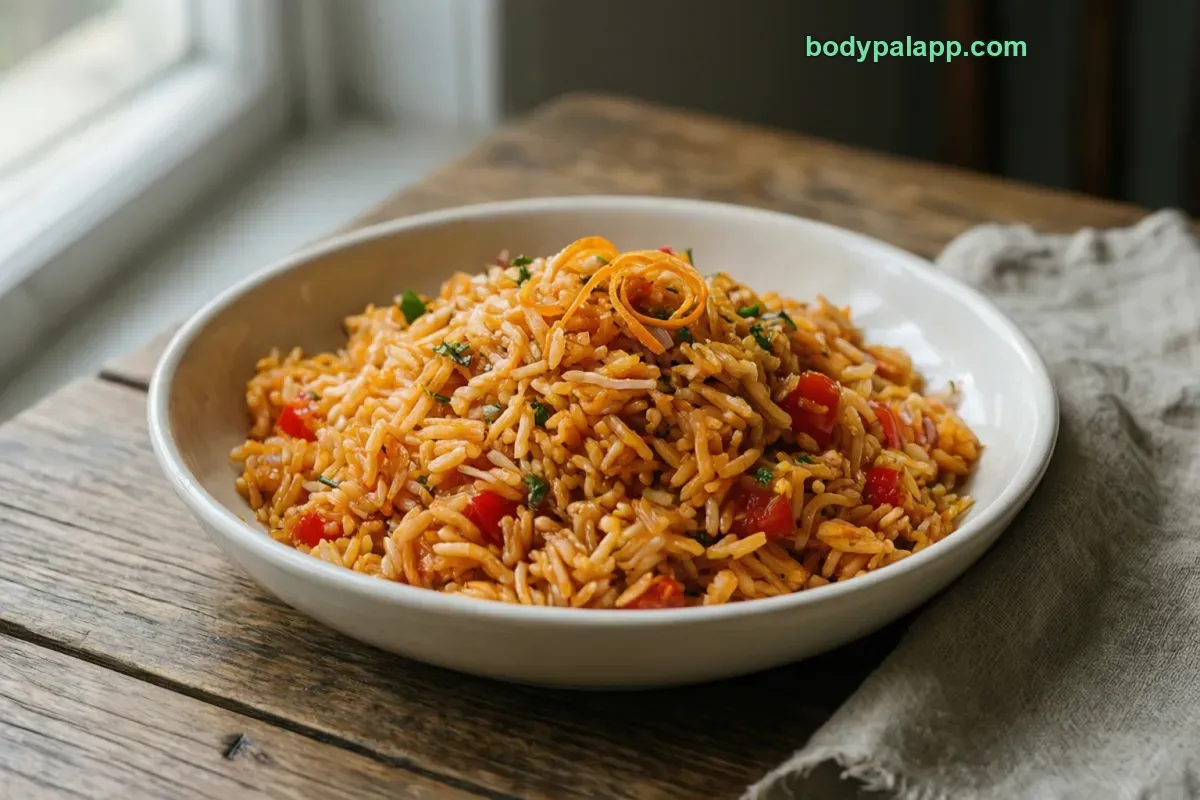
Orange rice calories come to 340 for one 206 g serving and 165 per 100 g of packaged orange chicken fried rice. Notice the sodium before the calories. One serving carries 1,131 mg of sodium, which is 49% of the daily value, while its calories fill only 17% of a 2000-calorie day.
340kcal
1 serving · 206 g, packaged, per label
11%protein
9 gProtein
59 gCarbs
5 gFat
How to burn off 340 kcal
—Walking, brisk
—Jogging
—Cycling, moderate
—Swimming
Skip the math. BodyPal counts these calories from your steps and workouts automatically.
Nutrition facts
Packaged, per label · per 206 g
Calories
340 kcal
Protein
9 g
Carbohydrate
59 g
Fat
5 g
Saturated fat
1 g
Cholesterol
14 mg
Sodium
1131 mg
Source: USDA FoodData Central
🛡️
Verified nutrition data
Numbers on this page come from USDA FoodData Central, the U.S. Department of Agriculture’s food composition database, and from manufacturer labels where a branded product is named. Last verified September 2026. How we verify our data →
Orange rice: calories, protein and sodium by serving
Percent of daily value uses the FDA reference of 2,000 kcal a day.
Serving
kcal
Protein
Carbs
Fat
Sodium
% DV kcal
1 serving (206 g)
340
9 g
59 g
5 g
1,131 mg
17%
Full bag (255 g)
431
11 g
79 g
6 g
1,410 mg
22%
100 g
165
4.4 g
28.6 g
2.4 g
549 mg
8%
3 × 1 serving (206 g)
1,020
27 g
3,393 mg
5 × 1 serving (206 g)
1,700
45 g
5,655 mg
The full bag is a 431-calorie meal
The label serving is 206 g and 340 calories, but this rice is sold in a 255 g bag. Eat the whole bag and you take in 431 calories, 22% of the daily value. That is a fair lunch on its own, not a side dish. Most people who heat a bag finish it, so the full-bag row is the honest number to log.
The total climbs fast once you go past one bag. Two label servings weigh 412 g and come to 680 calories. Three servings, 618 g, reach 1,020 calories, and a large family pan of five servings at 1,030 g lands at 1,700 calories. The rice is not dense in calories per bite, so the risk is volume: a big bowl does not look like much on the plate.
If you share a bag, weigh your part or split it by eye into clear halves. A 100 g scoop is 165 calories, which makes it easy to scale. BodyPal can also log the food from a photo of your plate, which helps when the portion did not come straight from the package.
Carbs supply 74% of the calories
This is a rice dish first and an orange chicken dish a distant second. Carbohydrates provide 74% of the calories, fat 14% and protein only 11%. Per 100 g that works out to 28.6 g of carbs, 2.4 g of fat and 4.4 g of protein. The chicken is a flavoring here, not the main event.
A 206 g serving gives 59 g of carbs and 9 g of protein, which is 18% of the daily value for protein. The full bag brings 79 g of carbs and 11 g of protein. That protein figure is modest for a meal of this size, and it explains why a bowl of fried rice can leave you hungry again sooner than a plate with a real portion of meat.
Fat stays low. A serving has 5 g of fat, and saturated fat is just 0.5 g per 100 g. Fiber is light at 2.1 g per serving, and sugars are 7 g, with the orange glaze adding a sweet note. The bag label lists 14 g of sugars, so the sweetness adds up when you eat it all.
Sodium is the row to watch
Sodium runs at 549 mg per 100 g, which is 24% of the daily value in a portion that only costs 165 calories. That gap is the core issue with this food. Per calorie, it delivers far more salt than energy.
One 206 g serving carries 1,131 mg, 49% of the 2300 mg daily value. The full 255 g bag carries 1,410 mg, or 61%. Two servings push you to 2,262 mg, nearly the whole day's sodium allowance in one sitting, and three servings reach 3,393 mg. Soy sauce and the orange glaze do most of that work.
If you watch sodium, treat one serving as the ceiling and keep the rest of the day lighter on salty foods such as cured meats, chips and canned soups. Skip extra soy sauce at the table. Drinking water alongside will not cancel the sodium, but stretching the rice with plain vegetables lowers how much you eat per bowl.
Add protein and vegetables to round it out
On its own, orange rice is a carb-heavy plate with little protein and little fiber. The fix is simple: add something rather than take something away. Steamed broccoli, snap peas or a bagged stir-fry mix bulk up the bowl with fiber and volume for few calories, so a 206 g serving feels like more food.
For protein, a fried or boiled egg, some leftover grilled chicken, or a handful of edamame lifts the protein share well above 11% of calories. Choose unsalted additions, since the rice already carries plenty of sodium. A side of plain cucumber or a simple green salad with a light dressing works better than another salty side.
Brands on this page include Ajinomoto Orange Chicken Fried Rice and Simmering Samurai Orange Chicken Fried Rice, plus Element Sweet Orange Rice Cakes, which are a snack rather than a meal. Read the label of the one you buy, since sauces and serving sizes differ between products.
How does orange rice compare?
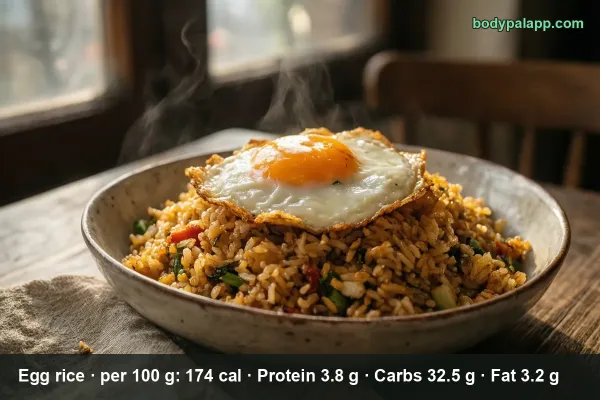
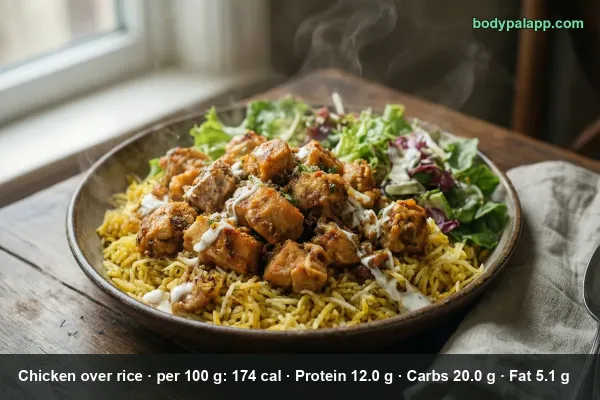
Here is how orange rice stacks up against orange chicken, egg rice and chicken over rice, per 100 g and per usual serving.
Verdict: For the fewest calories, orange rice at 165 per 100 g edges out egg rice and chicken over rice at 174, while orange chicken runs about 1.6 times higher at 262. For staying full pick chicken over rice with 12 g of protein per 100 g against 4.4 g here, and if sodium is your concern egg rice is lower at 361 mg versus 549 mg.
Most popular orange rice brands in the United States
Ranked by popularity in the BodyPal database
# Productkcal / 100 g
1Ajinomoto Orange Chicken Fried Rice1 bag · 255 g169 kcal
One 206 g serving has 340 calories. A full 255 g bag comes to 431 calories.
Is orange rice good for weight loss?
A 206 g serving is 340 calories with 9.0 g protein, 59.0 g carbs and 5.0 g fat, so it fits a day more like a meal than a side. Sodium is 1,131 mg per serving.
Orange rice or orange chicken: which has more calories?
Orange chicken is 262 calories per 100 g against 165 for orange rice, so the chicken is the denser of the two.
How much protein is in orange rice?
Around 4.4 g per 100 g, which is 9.0 g in a 206 g serving and 11.1 g in a 255 g bag.
How many calories are in a full bag of orange rice?
A full 255 g bag of orange rice has 431 calories, 22% of the daily value. It also carries 1,410 mg of sodium, which is 61% of the daily value, so the whole bag is a full meal.
How much sodium is in orange rice?
One 206 g serving of orange rice has 1,131 mg of sodium, 49% of the daily value. Per 100 g it is 549 mg, or 24%, which is high for a food with only 165 calories per 100 g.
How many carbs are in orange rice?
A 206 g serving of orange rice has 59 g of carbs, and 100 g has 28.6 g. Carbohydrates supply 74% of its calories, making it mostly a starch dish with a sweet orange glaze.
How much sugar is in orange rice?
Orange rice has 7 g of sugars per 206 g serving and 3.4 g per 100 g. The full bag label lists 14 g, so finishing the package doubles the sugar of one serving.
Is orange rice high in fat?
No. Orange rice has 5 g of fat per 206 g serving and 2.4 g per 100 g, with only 0.5 g saturated fat per 100 g. Fat makes up just 14% of its calories.