
How Many Calories Are in Chicken Over Rice?
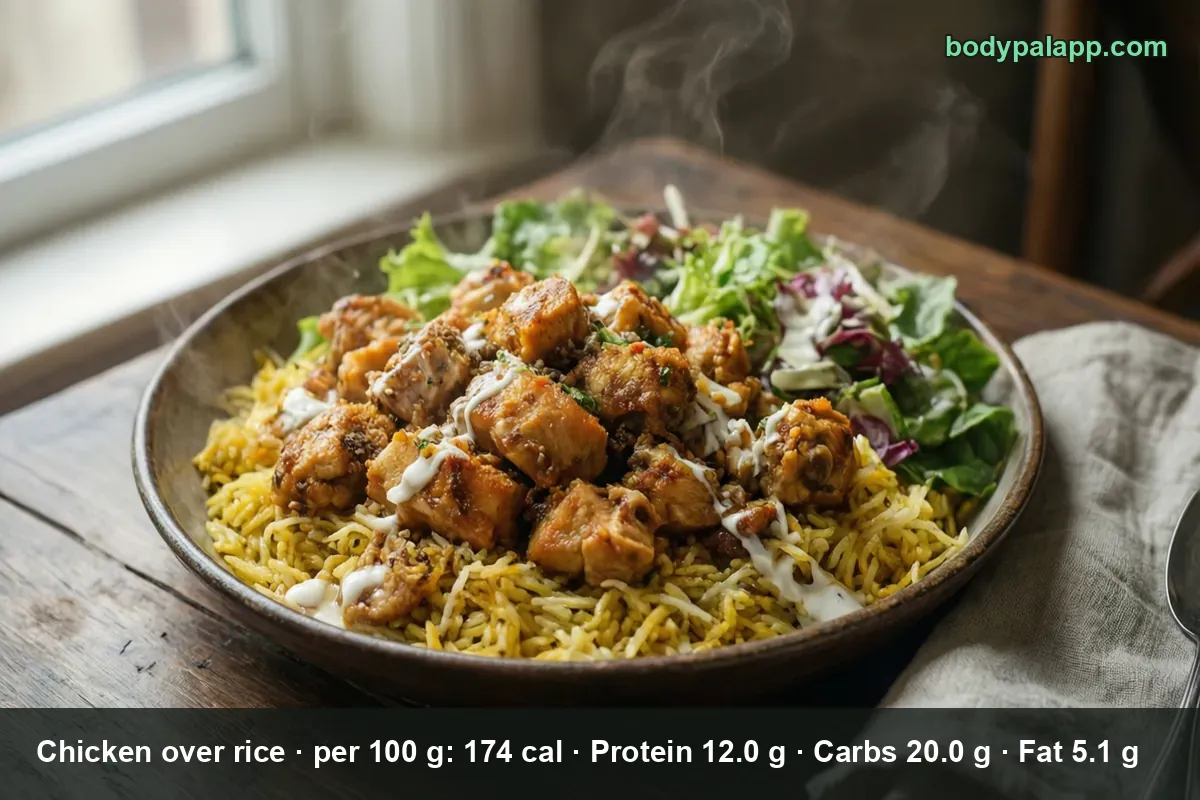
A full 16 oz platter of chicken over rice, yellow rice with chopped chicken and white sauce over the top, comes to 790 calories for 454 g. Per 100 g the dish runs 174 calories, so the 8 oz bowl most people actually finish is 395. Weight decides this plate more than anything else.
On this page
- Chicken over rice quick facts
- US servings, from one ounce to a full platter
- Frozen meals, burrito bowls and soup
- Sodium is the ceiling, not the calories
- How does chicken over rice compare?
- Most popular chicken over rice brands
- Chicken over rice FAQs
Chicken over rice quick facts
The record behind every number on this page is SR Legacy 167659, "Restaurant, Latino, chicken and rice, entree, prepared". It is the one USDA entry for a cooked restaurant plate of chicken and rice rather than a frozen tray, and that matters: the person searching is holding a foil container from a cart or a counter, cooked in oil, not a 300-calorie microwave dinner.
The column below is scaled to a 16 oz platter, the size a street cart or a counter shop hands you when you order the regular. If your container is smaller, halve it and read the 8 oz line in the next table.
| Nutrient | Per 100 g | Per 1 platter (454 g) | % Daily Value |
|---|---|---|---|
| Calories | 174 | 790 | — |
| Total fat | 5.06 g | 23.0 g | 29% |
| Saturated fat | 1.1 g | 5.0 g | 25% |
| Carbohydrate | 20.03 g | 90.9 g | 33% |
| Dietary fiber | 1.2 g | 5.4 g | 19% |
| Total sugars | 0.55 g | 2.5 g | — |
| Protein | 12.02 g | 54.6 g | 109% |
| Sodium | 518 mg | 2352 mg | 102% |
| Cholesterol | 36 mg | 163 mg | 54% |
| Potassium | 184 mg | 835 mg | 18% |
% Daily Value is based on a 2,000-calorie diet.
Verified nutrition data
Numbers on this page come from USDA FoodData Central, the U.S. Department of Agriculture’s food composition database, and from manufacturer labels where a branded product is named. Last verified September 2026. How we verify our data →
There is no added-sugars row here, because USDA does not publish added sugars for this restaurant record. Total sugars are almost nothing anyway at 0.55 g per 100 g, which tells you the plate is savory all the way through. Cholesterol lands at 163 mg for the platter, 54% of the 300 mg Daily Value, and potassium at 835 mg, 18%.
One honest caveat: USDA has no line for the halal-cart plate specifically, white sauce and red sauce included. The record above is a prepared restaurant entree with its own sauce already in it. Heavy extra white sauce is a topping on top of these numbers, not inside them.
US servings, from one ounce to a full platter
Every line below is our own arithmetic from the USDA 100 g figure. This restaurant record carries no household serving of its own, so the ounce and platter weights are ours, taken from what carts and counters actually hand out.
| Serving | Weight | Calories |
|---|---|---|
| 1 oz | 28.4 g | 49 kcal |
| 4 oz, a side portion | 113 g | 197 kcal |
| 8 oz bowl, or half a platter | 227 g | 395 kcal |
| 12 oz small platter | 340 g | 592 kcal |
| One 16 oz platter | 454 g | 790 kcal |
| Per 100 g | 100 g | 174 kcal |
The jump from the bowl to the platter is where people get caught. Both look like "chicken over rice" in a log, and there is a 395-calorie gap between them: the difference is a whole second meal. Weigh the container once, empty, and you will know forever which line you are eating.
The 8 oz bowl is the sweet spot for most lunches. It gives 395 calories, about 27.3 g of protein and roughly 1,176 mg of sodium, which is half a day's worth rather than all of it. If you want the full platter, the practical move is to eat half at lunch and keep the rest for dinner rather than talking yourself into "it's just rice."
Frozen meals, burrito bowls and soup
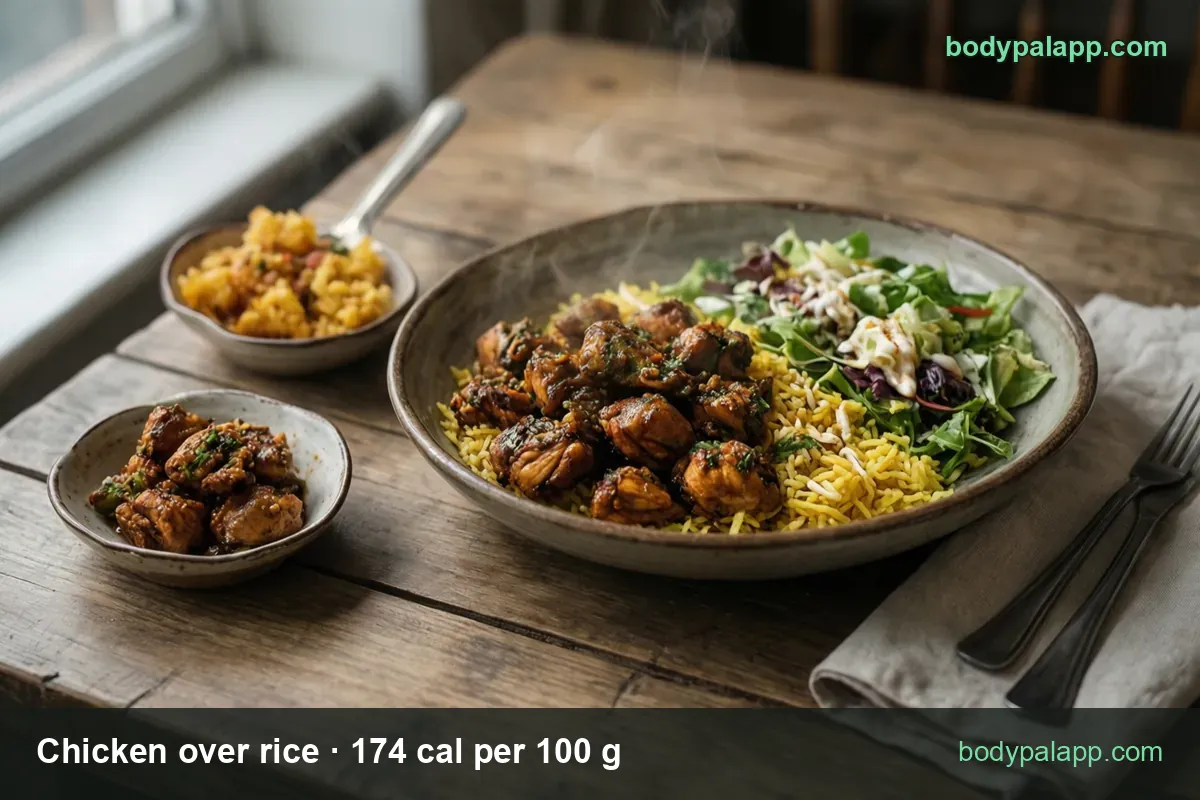
Chicken and rice covers six different USDA records, and they are not interchangeable. The restaurant plate runs 174 calories per 100 g; a diet frozen meal with the same name is 111, which makes the plate 57% denser per gram. Same words on the label, different food.
| Version | Per 100 g | Typical portion | Calories |
|---|---|---|---|
| Restaurant chicken and rice platter | 174 kcal | 8 oz (227 g) | 395 kcal |
| Chicken with rice and vegetable, frozen meal | 111 kcal | 1 meal, 8.5 oz (241 g) | 268 kcal |
| Teriyaki chicken with rice, frozen meal | 126 kcal | 1 meal, 11 oz (312 g) | 393 kcal |
| Burrito bowl, chicken with rice | 155 kcal | 1 cup (120 g) | 186 kcal |
| Burrito, chicken, with rice and cheese | 215 kcal | 1 small burrito (220 g) | 473 kcal |
| Chicken rice soup, chunky, ready-to-serve | 53 kcal | 8 oz (227 g) | 120 kcal |
The burrito is the heaviest per gram at 215, because the tortilla and cheese ride along. The soup is the only one of the six under 100 calories per 100 g, and only because it is mostly water. And the teriyaki tray is the sugar outlier: 4.07 g of total sugars per 100 g, about 12.7 g in an 11 oz meal, from the sweetened soy glaze. The restaurant platter has essentially none. The 8 oz portions for the restaurant plate and the soup are our own scaling from the USDA 100 g figures; the frozen-meal and burrito portions are USDA's own.
Freezer-aisle bowls sold under a brand name land between 109 and 176 calories per 100 g in USDA's branded data. A hibachi chicken and rice package (283 g) comes to 379 calories, a 9 oz general tso's chicken rice bowl to 411, and a 9 oz teriyaki bowl to 329. Only one, a store-brand roasted chicken and rice at 176 per 100 g, edges past the restaurant plate's 174 on density, and even that one is sold in a 4.4 oz portion, so it never gets near 790 in a sitting.
Sodium is the ceiling, not the calories
Look again at the platter column. Calories are 790, which is a big but ordinary restaurant lunch. Sodium is 2,352 mg, which is 102% of the FDA Daily Value of 2,300 mg in a single container. That is roughly a teaspoon of table salt. The Dietary Guidelines for Americans put the same 2,300 mg figure as the daily limit for adults, so one platter uses it up before dinner.
Per 100 g this dish carries 518 mg of sodium, more than any other chicken-and-rice record we compared: 446 for the burrito, 410 for the plain frozen meal, 370 for the soup, 333 for the teriyaki tray and 277 for the burrito bowl. If you are watching sodium, the 8 oz bowl at about 1,176 mg is the version that fits a normal day.
The protein side is the good news. A platter gives 54.6 g, 109% of the 50 g Daily Value, which is more than most people get from a whole day of meals and enough to anchor a protein target on its own. A 241 g frozen chicken-and-rice meal gives only 23.6 g, less than half, and the reason is the amount of meat in the tray, not the recipe. Per calorie, chicken over rice is one of the better protein buys on any takeout menu.
Fat is modest for a takeout plate: 23.0 g, 29% of the Daily Value, with 5.0 g saturated (25%). The rice, not the chicken, is doing the calorie work here at 90.9 g of carbohydrate.
How does chicken over rice compare?
| Dish | Per 100 g | US serving | Calories |
|---|---|---|---|
| Chicken over rice, restaurant platter | 174 kcal | one platter, 454 g | 790 kcal |
| Burrito bowl, chicken with rice | 155 kcal | 1 cup, 120 g | 186 kcal |
| Chicken with rice and vegetable, frozen meal | 111 kcal | 1 meal, 241 g | 268 kcal |
| Teriyaki chicken with rice, frozen meal | 126 kcal | 1 meal, 312 g | 393 kcal |
Our take: the restaurant platter is not dramatically richer per gram than its rivals, it is just served in a far bigger container. A cup of burrito bowl is 186 calories and a full platter is 790, yet the density gap between them is only 19 calories per 100 g. If you are cutting, order the bowl size or split the platter and you land at 395 with 27 g of protein, which is a genuinely strong lunch. If you want the most protein in a single takeout container, the platter wins outright, as long as the sodium fits the rest of your day.
Most popular chicken over rice brands in the United States
Ranked by how widely each product appears among foods sold in the United States, from the BodyPal food database of over 3.3 million products. Calories are the figures printed on each Nutrition Facts label, checked against USDA FoodData Central.
| Product | Calories (per 100 g) |
|---|---|
| Benihana Hibachi Chicken Rice | 134 cal |
| InnovAsian General Tso's Chicken Rice Bowl | 161 cal |
| InnovAsian Teriyaki Chicken Rice Bowl | 129 cal |
| Wei-Chuan Curry Chicken Rice Bowl | 121 cal |
| Fortune Avenue Chicken Rice Meal | 109 cal |
| Harris Teeter Roasted Chicken Rice | 176 cal |
Brand popularity: BodyPal food database. Nutrition: manufacturer labels / USDA FoodData Central.
Chicken over rice FAQs
How many calories are in a chicken over rice platter?
A full 16 oz platter (454 g) runs 790 calories, based on the USDA restaurant chicken and rice entree at 174 calories per 100 g. That plate also carries 54.6 g of protein, 90.9 g of carbohydrate and 23.0 g of fat. Extra white sauce and hot sauce sit on top of those numbers.
How many calories in a half platter of chicken over rice?
Half a platter is 227 g and 395 calories, exactly half the 790 in the full 16 oz plate. Protein lands near 27.3 g and sodium near 1,176 mg, about 51% of the Daily Value. Splitting the container is the simplest way to keep the salt inside a normal day.
Is chicken over rice healthy?
One platter delivers 54.6 g of protein, 109% of the 50 g Daily Value, plus 5.4 g of fiber and only 2.5 g of total sugars. The catch is 2,352 mg of sodium, 102% of a day in one meal. As an occasional protein-heavy lunch it works well; the salt is what limits it.
How much protein is in chicken over rice?
A full platter carries 54.6 g of protein, 109% of the FDA Daily Value of 50 g. Per 100 g the dish runs 12.02 g, so an 8 oz bowl gives about 27.3 g. A 241 g frozen chicken-and-rice meal gives only 23.6 g, because the tray holds less meat, not because the recipe differs.
How much sodium is in chicken over rice?
The full 454 g platter carries 2,352 mg of sodium, 102% of the 2,300 mg Daily Value, roughly a teaspoon of table salt. An 8 oz bowl is about 1,176 mg, or 51%. Per 100 g the dish runs 518 mg, higher than any other chicken-and-rice record we compared.
How many calories in chicken over rice without sauce?
The closest sauce-light USDA entry, chicken with rice and vegetable as a frozen meal, is 111 calories per 100 g against 174 for the restaurant plate, about 36% lower. USDA publishes no sauce-free halal-cart record, so there is no exact figure for the cart version. Sauce and cooking oil explain most of that gap.
Chicken over rice vs chicken burrito bowl calories?
A chicken burrito bowl with rice is 155 calories per 100 g against 174 for the restaurant platter, and a 1 cup (120 g) bowl is only 186 calories. The real gap is portion size, not recipe: the platter weighs 454 g. Sodium is 277 mg per 100 g in the bowl versus 518.
How many calories in a chicken rice bowl from the freezer aisle?
Freezer-aisle chicken and rice bowls run 109 to 176 calories per 100 g in USDA's branded data. A 9 oz (255 g) teriyaki chicken rice bowl lands near 329 calories, a 283 g hibachi chicken and rice package near 379. Every one of them is lighter per container than the 790-calorie platter.
Similar foods
- Baba ganoush — 110 cal for 1/4 cup
- Penne pasta — 169 cal per cup
- Pasta — 168 cal per cup penne
- Prosciutto — 55 cal for 3 thin slices
- Rice — 205 cal per cup, cooked
- Mac And Cheese — 513 cal per cup
Count it without the math
Point the camera at the container and BodyPal counts the rice, the chicken and the sauce for you.


How long does it take to burn off 790 kcal of chicken over rice?
One 16 oz platter (454 g) is 790 kcal. Enter your weight and the amount you ate to see how long it takes you to burn that off:
lb
| Activity | Time to burn 790 kcal |
|---|---|
| Walking, brisk | 2 hr 38 min |
| Cycling, moderate | 1 hr 39 min |
| Swimming, moderate | 1 hr 53 min |
| Jogging | 1 hr 33 min |
| Weight training, moderate | 2 hr 56 min |
Times are for a 155 lb adult at a steady pace; change the weight to see yours. The amount is set to the portion in the text (454 g); change it to what you actually ate. BodyPal works this out from your steps automatically.
Burning it off is one side of it. The other is knowing your number: work out how many calories you need a day, with macros and a goal date.