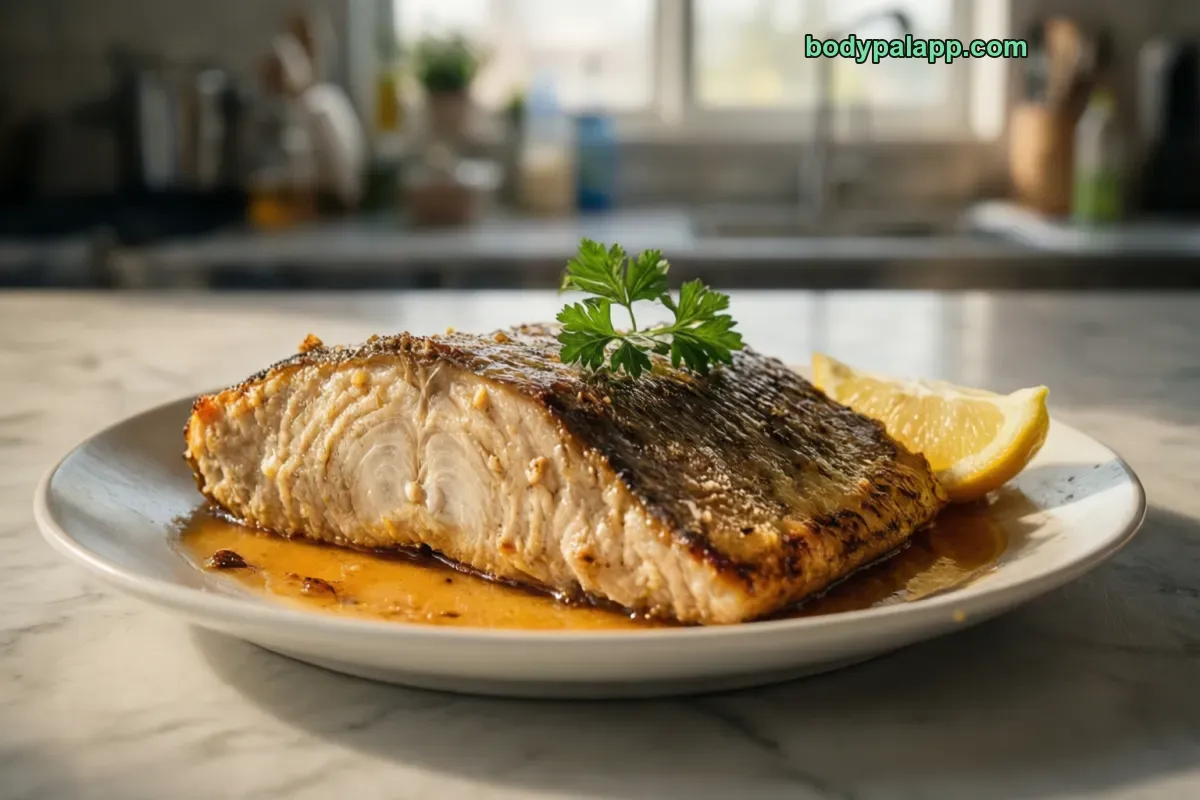
Orange roughy calories come to 89 for a 3 oz cooked portion (85 g) and 105 per 100 g. What stands out is how lean it is: protein supplies 92% of those calories, a portion carries 19.2 g of protein, and there are no carbs, no sugar and under a gram of fat.
89kcal
1 3 oz portion · 85 g, cooked, dry heat
92%protein
19.2 gProtein
0 gCarbs
0.8 gFat
How to burn off 89 kcal
—Walking, brisk
—Jogging
—Cycling, moderate
—Swimming
Skip the math. BodyPal counts these calories from your steps and workouts automatically.
Nutrition facts
Cooked, dry heat · per 85 g
Calories
89 kcal
Protein
19.2 g
Carbohydrate
0 g
Fat
0.8 g
Saturated fat
0 g
Cholesterol
68 mg
Sodium
59 mg
Potassium
154 mg
Iron
1 mg
Source: USDA FoodData Central
🛡️
Verified nutrition data
Numbers on this page come from USDA FoodData Central, the U.S. Department of Agriculture’s food composition database, and from manufacturer labels where a branded product is named. Last verified September 2026. How we verify our data →
Orange roughy: calories, protein and sodium by serving
Percent of daily value uses the FDA reference of 2,000 kcal a day.
Serving
kcal
Protein
Carbs
Fat
Sodium
% DV kcal
3 oz portion (85 g)
89
19.2 g
0 g
0.8 g
59 mg
4%
4 oz fillet (113 g)
119
25.6 g
0 g
1 g
78 mg
6%
Raw, 3 oz (85 g)
65
13.9 g
0 g
0.6 g
61 mg
3%
100 g
105
22.6 g
0 g
0.9 g
69 mg
5%
3 × 3 oz portion (85 g)
268
57.7 g
176 mg
5 × 3 oz portion (85 g)
446
96.2 g
293 mg
A 4 oz fillet lands at 119 calories
The USDA figures here are for orange roughy cooked by dry heat, which means baked, broiled or grilled with nothing added. A 3 oz portion (85 g) gives 89 calories, about 4% of the daily value for calories. A 4 oz fillet (113 g) gives 119 calories and 25.6 g of protein, which already covers 51% of the daily value for protein.
Because there is so little fat, the total climbs slowly as the plate gets bigger. Two 3 oz portions (170 g) come to 179 calories. Three portions (255 g) reach 268 calories and 57.7 g of protein. Even five portions (425 g), enough for a family dinner, add up to 446 calories with 96.2 g of protein. Few foods deliver that much protein for that few calories.
Watch which row you log. Raw, 3 oz (85 g) lists only 65 calories and 13.9 g of protein. The fish has not changed; cooking drives out water, so 85 g of cooked fillet holds more fish than 85 g of raw fillet. If you weigh before cooking, use the raw row. If you weigh on the plate, use the cooked one.
Protein supplies 92% of the calories
Per 100 g, cooked orange roughy has 22.6 g of protein, 0.9 g of fat and 0 g of carbohydrate. Fiber and sugars are both 0, and saturated fat is listed at 0. The calorie split is about as one-sided as food gets: 92% protein, 8% fat, 0% carbs.
That makes it a straightforward protein source. A single 3 oz portion covers 38% of the 50 g daily value for protein while using only a small slice of the day's calories. If you track macros, it is close to a pure protein entry, and it leaves plenty of room for carbs and fat from the rest of the meal.
The flip side is that the fish brings almost no flavor fat of its own. Whatever goes on it during cooking changes the numbers. Butter, oil, breading or a creamy sauce add calories that the USDA row does not include, so log them as separate items. Baked or broiled with lemon and herbs, the fillet stays close to the figures on this page.
Sodium stays low; cholesterol is the row to notice
Plain orange roughy is low in sodium. A 3 oz portion has 59 mg, a 4 oz fillet 78 mg, and both sit at 3% of the daily value. Even five portions only reach 293 mg. If you watch sodium, the fish itself is not the problem; the seasoning, marinade or sauce you pair it with will set the total.
Cholesterol is the row that stands out on a fish this lean. Orange roughy lists 80 mg per 100 g, measured against a daily value of 300 mg. That is not unusual for fish, but if you track cholesterol, it is the one line worth reading before you serve yourself a double portion.
Potassium is modest at 181 mg per 100 g, a small share of the 4,700 mg daily value. Think of orange roughy as a lean protein base rather than a source of minerals, and let vegetables and other sides fill that gap.
Build the plate around what the fillet lacks
With 0 g of carbs and 0 g of fiber, a fillet on its own is not a full meal. Pair it with something that brings fiber and carbohydrate: roasted vegetables, a green salad, brown rice, potatoes or whole grain bread. Those sides will usually supply more calories than the fish, so they decide where the meal lands.
Its mild flavor works with bright, light toppings. Lemon, capers, salsa, herbs and a spoon of olive oil all suit it. Heavy cream sauces and deep frying turn a lean fillet into a much richer plate, and the numbers on this page will no longer describe what you eat.
Packaged fillets from brands such as Sea Best, Seamazz, Heinen's and Weis are sold skinless and boneless, which makes weighing simple. If you would rather skip the scale, BodyPal can log the plate from a photo.
How does orange roughy compare?
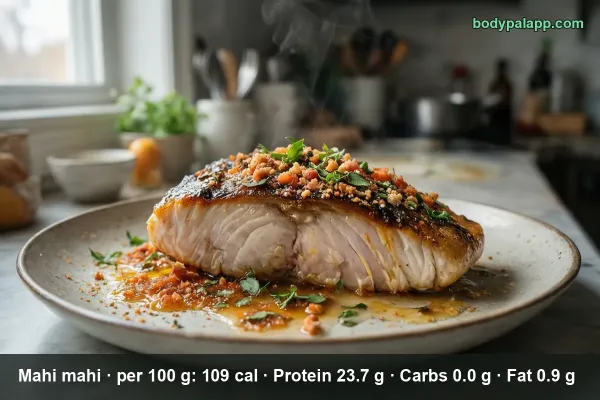
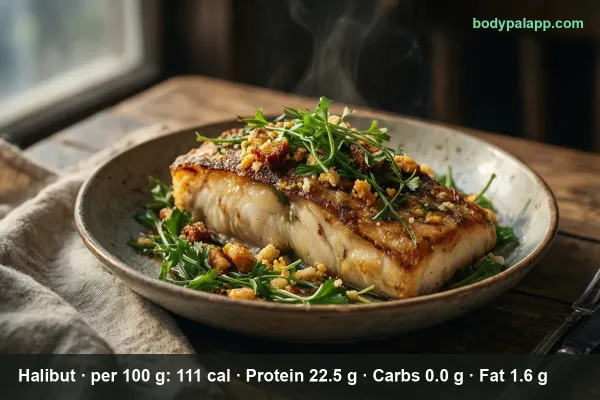
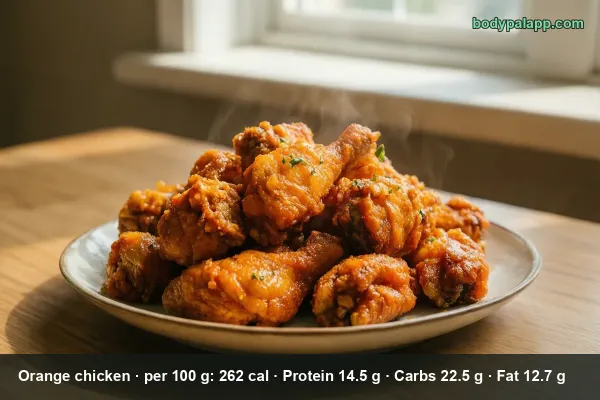
Here is orange roughy next to mahi mahi, orange chicken and a salmon roll, compared per 100 g and per usual serving.
Verdict: For the leanest plate, orange roughy and mahi mahi are near twins at 105 and 109 calories per 100 g, with mahi mahi slightly ahead on protein at 23.7 g but higher in sodium at 113 mg. Skip orange chicken if calories matter: at 262 per 100 g it runs about 2.5 times orange roughy and carries 553 mg of sodium.
Most popular orange roughy brands in the United States
6Seamazz Wild-Caught Orange Roughy Fillets4 oz · 112 g80 kcal
Retail fillets are labeled at raw weight, so most of them read closer to the raw figure of 76 calories per 100 g than to the cooked number above. Source: manufacturer labels / USDA FoodData Central.
Orange roughy FAQs
How many calories are in orange roughy?
A 3 oz cooked portion (85 g) has 89 calories and a 4 oz fillet (113 g) has 119. Per 100 g, cooked orange roughy is 105 calories.
Is orange roughy good for weight loss?
A 3 oz portion has 89 calories, 19.2 g protein, 0.8 g fat and no carbs, so it is one of the leaner white fish options.
Orange roughy or mahi mahi: which has fewer calories?
Orange roughy has 105 calories per 100 g cooked, mahi mahi 109, so the two are close to identical.
How much protein is in orange roughy?
Cooked orange roughy has 22.6 g protein per 100 g, which is 19.2 g in a 3 oz portion (85 g).
What are the nutrition facts for orange roughy?
Per 100 g, cooked orange roughy has 105 calories, 22.6 g of protein, 0.9 g of fat, 0 g of carbs and 69 mg of sodium. Fiber and sugars are both 0.
Is orange roughy a healthy choice?
By the numbers it is very lean: 92% of its calories come from protein, and a 3 oz portion has 89 calories, 0.8 g of fat and 59 mg of sodium. Cooking method and sauces change that picture.
How many calories are in an orange roughy fillet?
A 4 oz fillet (113 g) of cooked orange roughy has 119 calories and 25.6 g of protein. A smaller 3 oz portion (85 g) has 89 calories.
What is the nutritional value of orange roughy beyond protein?
Orange roughy has 80 mg of cholesterol per 100 g against a 300 mg daily value, plus 181 mg of potassium and 69 mg of sodium. It has no fiber, no carbs and no sugar.
Does orange roughy have carbs or sugar?
No. Cooked orange roughy has 0 g of carbohydrate, 0 g of sugars and 0 g of fiber per 100 g. Its 105 calories come from protein and a little fat.