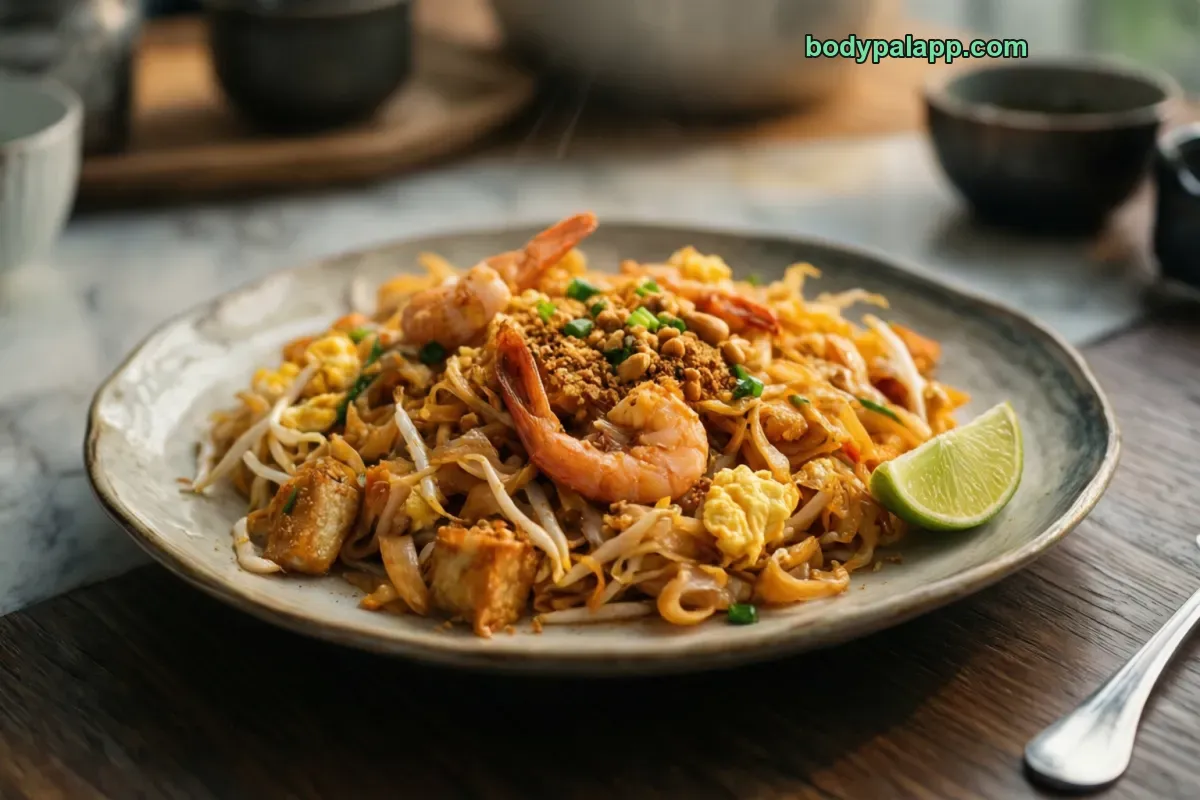
Pad thai calories come to 308 for 1 cup (200 g) and 154 per 100 g, stir-fried and served. Fat supplies 43% of those calories, more than the noodles do, and that same cup carries 768 mg of sodium, or 33% of the daily value. Portion size decides the rest, because takeout servings rarely stop at one cup.
308kcal
1 cup · 200 g, stir-fried, as served
21%protein
16.3 gProtein
29 gCarbs
15 gFat
How to burn off 308 kcal
—Walking, brisk
—Jogging
—Cycling, moderate
—Swimming
Skip the math. BodyPal counts these calories from your steps and workouts automatically.
Nutrition facts
Stir-fried, as served · per 200 g
Calories
308 kcal
Protein
16.3 g
Carbohydrate
29 g
Fat
15 g
Saturated fat
2.6 g
Cholesterol
96 mg
Sodium
768 mg
Potassium
304 mg
Iron
1.4 mg
Source: USDA FoodData Central
🛡️
Verified nutrition data
Numbers on this page come from USDA FoodData Central, the U.S. Department of Agriculture’s food composition database, and from manufacturer labels where a branded product is named. Last verified September 2026. How we verify our data →
Pad thai: calories, protein and sodium by serving
Percent of daily value uses the FDA reference of 2,000 kcal a day.
Serving
kcal
Protein
Carbs
Fat
Sodium
% DV kcal
1 cup (200 g)
308
16.3 g
28.7 g
15 g
768 mg
15%
With seafood (200 g)
294
13.7 g
30.1 g
13.6 g
698 mg
15%
Meatless (200 g)
330
11.6 g
32.7 g
18.4 g
688 mg
17%
100 g
154
8.1 g
14.4 g
7.5 g
384 mg
8%
3 × 1 cup (200 g)
924
48.8 g
2,304 mg
5 × 1 cup (200 g)
1,540
81.3 g
3,840 mg
Three cups of pad thai reach 924 calories
One cup (200 g) is the reference serving at 308 calories, about 15% of a 2000-calorie daily value. That is a reasonable lunch on paper. The trouble is that few people eat pad thai by the cup. A restaurant plate or takeout box usually holds two or three cups of noodles, and the numbers climb fast.
Two cups (400 g) come to 616 calories with 32.5 g of protein. Three cups (600 g) reach 924 calories and 48.8 g of protein. If you split a big family-style order and end up eating five cups (1,000 g), the total is 1,540 calories, close to a full day's energy budget for many adults in a single sitting.
The fix is simple. Decide on your portion before you start eating, and move the rest to a container for tomorrow. One measured cup on a plate looks small next to a full box, but it keeps the meal near 308 calories instead of tripling it. If you log the meal, BodyPal can identify pad thai from a photo, which helps when the plate size is hard to judge.
Fat, not noodles, supplies the most calories
Pad thai looks like a noodle dish, so most people assume carbs dominate. The calorie split says otherwise: 43% of the calories come from fat, 36% from carbs and 21% from protein. Per 100 g that works out to 7.5 g of fat, 14.4 g of carbs and 8.1 g of protein.
The fat comes from the oil used in the wok, the egg, and the crushed peanuts on top. Saturated fat stays modest at 1.3 g per 100 g, so most of that fat is the unsaturated kind found in cooking oil and nuts. Cholesterol is 48 mg per 100 g, largely from egg and whatever protein is added.
Protein is the pleasant surprise. A cup delivers 16.3 g, a third of the daily value at 33%. Fiber is thin at 1.2 g per 100 g, and sugars sit at 4.1 g per 100 g, mostly from the tamarind and palm sugar in the sauce. So pad thai fills you with fat and protein more than with bulk.
Sodium is the row to watch
Fish sauce and soy-based seasonings make pad thai salty. Per 100 g there are 384 mg of sodium, and one cup carries 768 mg, which is 33% of the daily value. That share is more than double the 15% of daily calories the same cup provides.
Scale it up and the sodium outpaces the calories. Two cups hold 1,536 mg. Three cups reach 2,304 mg, already past a full day's daily value in one meal. Five cups come to 3,840 mg. If you watch sodium, portion control does more here than any swap of protein or noodle type.
Potassium is low at 152 mg per 100 g, so the dish does little to balance that salt on its own. If sodium matters to you, eat one cup, skip the extra fish sauce at the table, and round out the day with lower-sodium meals.
Seafood trims calories, meatless adds them
The USDA lists separate rows for pad thai variations, and they do not behave the way most people expect. With seafood, a 200 g serving drops to 294 calories, with 13.6 g of fat and 698 mg of sodium. That is the leanest version in the data.
Meatless pad thai is the highest at 330 calories for 200 g, with 18.4 g of fat. Without meat, cooks tend to lean on more oil, egg and peanuts, and protein falls to 11.6 g, or 23% of the daily value, compared with 16.3 g in the standard cup. Fiber rises to 3.6 g, and sodium is slightly lower at 688 mg.
Packaged kits and frozen meals, such as Thai Kitchen Pad Thai Noodle Kit or Amy's Pad Thai, follow their own recipes, so read the label for those. For restaurant and homemade pad thai, seafood is the lighter pick and the meatless plate is the richer one.
How does pad thai compare?
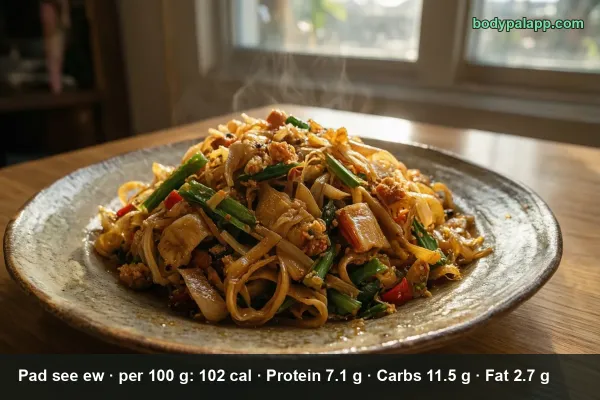
Here is how pad thai stacks up against pad see ew, pho and california roll, per 100 g and per usual serving.
Verdict: For the fewest calories per 100 g, pho wins at 77 against 154 for pad thai, and a full 1 bowl (454 g) of pho is 350 calories, close to two cups of noodles in volume terms but far lighter. If you want noodles anyway, pad see ew at 102 calories per 100 g with 2.7 g of fat is the leaner stir-fry, while pad thai gives more protein at 8.1 g per 100 g.
Most popular pad thai brands in the United States
Ranked by popularity in the BodyPal database
# Productkcal / 100 g
1Ethnic Gourmet Pad Thai Rice Noodles With Tofu1 package · 255 g118 kcal
Noodle kits are labeled by dry weight, so they read far higher per 100 g than the frozen trays and pouches, which are weighed with the sauce and vegetables. Source: manufacturer labels / USDA FoodData Central.
Pad thai FAQs
How many calories are in a cup of pad thai?
About 308 calories in a 1-cup serving (200 g), which works out to 154 calories per 100 g.
Is pad thai good for weight loss?
One cup is 308 calories with 16.3 g protein, 28.7 g carbs and 15 g fat, while a two-cup restaurant plate comes to about 616 calories.
Pad thai vs pad see ew: which has fewer calories?
Pad see ew is 102 calories per 100 g against 154 for pad thai, so a 200 g cup is about 204 calories versus 308.
How much protein is in pad thai?
A cup with chicken has 16.3 g protein (8.13 g per 100 g). The seafood version has 13.7 g per cup and the meatless version 11.6 g.
How many calories are in 100 g of pad thai?
There are 154 calories in 100 g of pad thai, with 8.1 g of protein, 14.4 g of carbs and 7.5 g of fat. That 100 g also holds 384 mg of sodium, 17% of the daily value.
How much sodium is in pad thai?
One cup (200 g) of pad thai has 768 mg of sodium, 33% of the daily value. Three cups, a common takeout amount, reach 2,304 mg, which is more than a full day's daily value in one meal.
How many calories are in a large takeout order of pad thai?
Three cups (600 g) of pad thai come to 924 calories, and two cups (400 g) to 616 calories. Takeout boxes vary, so check how many cups your order really holds before logging it.
Does shrimp pad thai have fewer calories than regular pad thai?
Yes. Pad thai with seafood has 294 calories per 200 g, compared with 308 for the standard cup. It also has less fat, at 13.6 g, and less sodium, at 698 mg.
Is vegetarian pad thai lower in calories?
No. Meatless pad thai has 330 calories per 200 g, the highest of the versions listed, with 18.4 g of fat. It does offer more fiber, 3.6 g, but less protein at 11.6 g.
What share of the calories in pad thai comes from fat?
About 43% of the calories in pad thai come from fat, 36% from carbs and 21% from protein. The fat mostly comes from wok oil, egg and peanuts, while saturated fat stays at 1.3 g per 100 g.