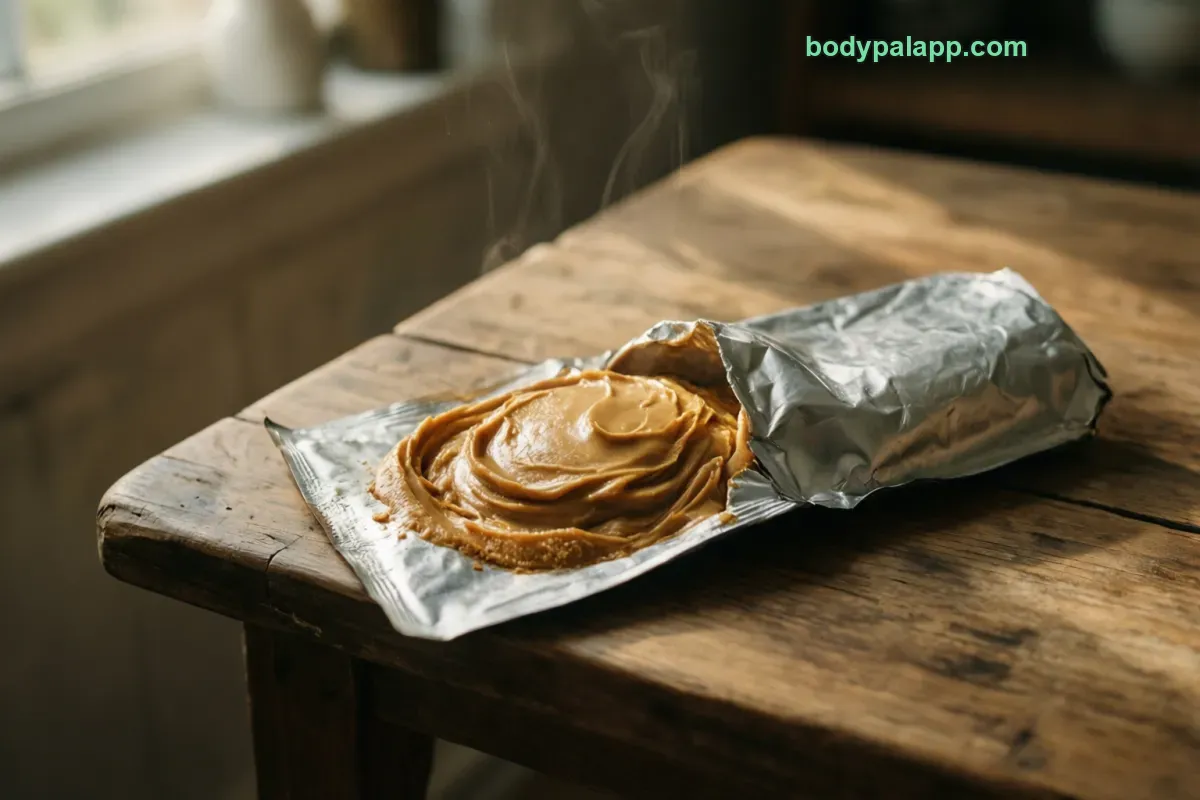
Peanut butter packet calories come to 191 for one 32 g packet and 598 per 100 g. Fat supplies 72% of those calories, so a small squeeze adds up fast. The large 45 g single serve reaches 269, while a 16 g tablespoon is 96. Protein is real but secondary at 7.1 g per packet.
191kcal
1 packet · 32 g, single-serve packet
14%protein
7.1 gProtein
7 gCarbs
16.4 gFat
How to burn off 191 kcal
—Walking, brisk
—Jogging
—Cycling, moderate
—Swimming
Skip the math. BodyPal counts these calories from your steps and workouts automatically.
Nutrition facts
Single-serve packet · per 32 g
Calories
191 kcal
Protein
7.1 g
Carbohydrate
7.1 g
Fat
16.4 g
Saturated fat
3.3 g
Cholesterol
0 mg
Sodium
136 mg
Potassium
179 mg
Iron
0.6 mg
Source: USDA FoodData Central
🛡️
Verified nutrition data
Numbers on this page come from USDA FoodData Central, the U.S. Department of Agriculture’s food composition database, and from manufacturer labels where a branded product is named. Last verified September 2026. How we verify our data →
Peanut butter packet: calories, protein and sodium by serving
Percent of daily value uses the FDA reference of 2,000 kcal a day.
Serving
kcal
Protein
Carbs
Fat
Sodium
% DV kcal
1 packet (32 g)
191
7.1 g
7.1 g
16.4 g
136 mg
10%
Large single serve (45 g)
269
10 g
10 g
23.1 g
192 mg
13%
1 tbsp (16 g)
96
3.6 g
3.6 g
8.2 g
68 mg
5%
100 g
598
22.2 g
22.3 g
51.4 g
426 mg
30%
3 × 1 packet (32 g)
574
21.3 g
409 mg
5 × 1 packet (32 g)
957
35.5 g
682 mg
One packet is 191 calories, and they stack quickly
The standard packet holds 32 g and lands at 191 calories, about 10% of the daily value for calories. That is roughly two tablespoons, since a 16 g tablespoon comes to 96. The large single serve is a different product in practice: at 45 g it brings 269 calories, or 13% of the daily value, plus 10 g of protein.
Packets are easy to stack because each one feels small. Two packets (64 g) total 383 calories and 14.2 g of protein. Three packets (96 g) reach 574 calories, nearly the same as the 598 in a full 100 g. Five packets (160 g) climb to 957 calories and 682 mg of sodium, which is a full meal's worth of energy from a spread.
Check the label before you log it. A 32 g packet and a 45 g single serve look alike in a lunch bag, yet the bigger one adds close to a third more. If you track closely, count each packet as its own entry rather than guessing a spoonful.
Fat is nearly three quarters of every calorie
The calorie split is 72% fat, 14% protein and 14% carbs. Per 100 g that works out to 51.4 g of fat, 22.2 g of protein and 22.3 g of carbohydrate. In one packet you get 16.4 g of fat, 7.1 g of protein and 7.1 g of carbs.
So peanut butter is a fat food with some protein attached, not a protein food. The 7.1 g in a packet covers 14% of the daily value for protein, which is useful, but the same packet delivers 191 calories to get there. If protein is your main goal, the packet works best as a partner to a leaner source rather than the source itself.
The carbohydrate side is modest. A packet has 1.6 g of fiber and 3.4 g of sugars, and per 100 g those rise to 5 g and 10.5 g. That fiber, together with the fat, is a big part of why a packet holds you longer than a sugary snack of similar calories.
Sodium stays small; saturated fat is the row to watch
One packet carries 136 mg of sodium, 6% of the 2300 mg daily value. The large 45 g serve has 192 mg, or 8%. Even at 100 g the figure is 426 mg, 19% of the daily value, so salt is rarely the reason to skip peanut butter unless you eat several packets in a row.
Saturated fat deserves more attention. At 10.3 g per 100 g, measured against a daily value of 20 g, a 100 g portion uses up about half the day's allowance. A single packet is a much smaller slice of that, but the number grows with every extra packet you open.
Cholesterol reads 0, since peanut butter is a plant food. Potassium is a quiet plus at 558 mg per 100 g against a 4700 mg daily value. Neither changes the main story: the calories and the fat are what move your totals.
A packet works best paired with produce or grains
Because a packet is portion-controlled, it is one of the easier ways to eat peanut butter without overshooting. The packaging does the measuring for you. Spread it on apple slices, a banana, celery or whole grain toast and you add volume and carbohydrate to a food that is mostly fat.
It also makes a solid add-on to oatmeal or plain yogurt, where the fat and 7.1 g of protein help a light breakfast last until lunch. For a pre-workout snack, one packet with fruit is a reasonable size. If you are counting calories, the risk is not one packet but the second and third, which take you to 383 and 574.
If logging feels like a chore, BodyPal can log the packet from a photo, so the 191 calories land in your diary without typing.
How does peanut butter packet compare?
Here is how a peanut butter packet compares with other single-serve packets on calories per 100 g and per usual serving.
Verdict: For the fewest calories per packet, the mayo packet wins at 68 in a 10 g serving, but it brings just 1 g of protein per 100 g against 22.2 g here. For staying full, pick peanut butter; the ramen packet has 1,855 mg of sodium per 100 g versus 426 mg for peanut butter.
Peanut butter packet FAQs
How many calories are in a peanut butter packet?
A 32 g packet has about 191 calories, and a larger 45 g single-serve packet has about 269.
Is a peanut butter packet good for weight loss?
A 32 g packet is 191 calories with 16.4 g of fat and 7.1 g of protein, so it is calorie-dense for its size. The fixed portion makes it easy to count.
Peanut butter packet vs mayo packet: which has more calories?
Per 100 g, peanut butter has 598 calories and mayo has 680. Peanut butter also brings 22.2 g of protein per 100 g.
How much protein is in a peanut butter packet?
About 7.1 g of protein in a 32 g packet, or 10.0 g in a 45 g packet. The 32 g packet also has 7.1 g of carbs and 3.4 g of sugar.
How many calories are in a tablespoon of peanut butter?
A 16 g tablespoon of peanut butter has 96 calories, with 8.2 g of fat, 3.6 g of protein and 3.6 g of carbs. A standard 32 g packet holds roughly two tablespoons' worth.
How many calories are in a large peanut butter single serve?
The large 45 g single serve has 269 calories, 13% of the daily value. It also gives 10 g of protein, 23.1 g of fat and 192 mg of sodium, noticeably more than the 32 g packet.
How much sodium is in a peanut butter packet?
A 32 g peanut butter packet contains 136 mg of sodium, which is 6% of the daily value. Even 100 g of peanut butter has 426 mg, or 19% of the daily value.
How much sugar and fiber are in a peanut butter packet?
One 32 g packet has 3.4 g of sugars and 1.6 g of fiber. Per 100 g, peanut butter has 10.5 g of sugars and 5 g of fiber.
How many calories are in two peanut butter packets?
Two 32 g packets (64 g) total 383 calories with 14.2 g of protein and 273 mg of sodium. Three packets reach 574 calories.