
How many calories are in peanut butter powder?
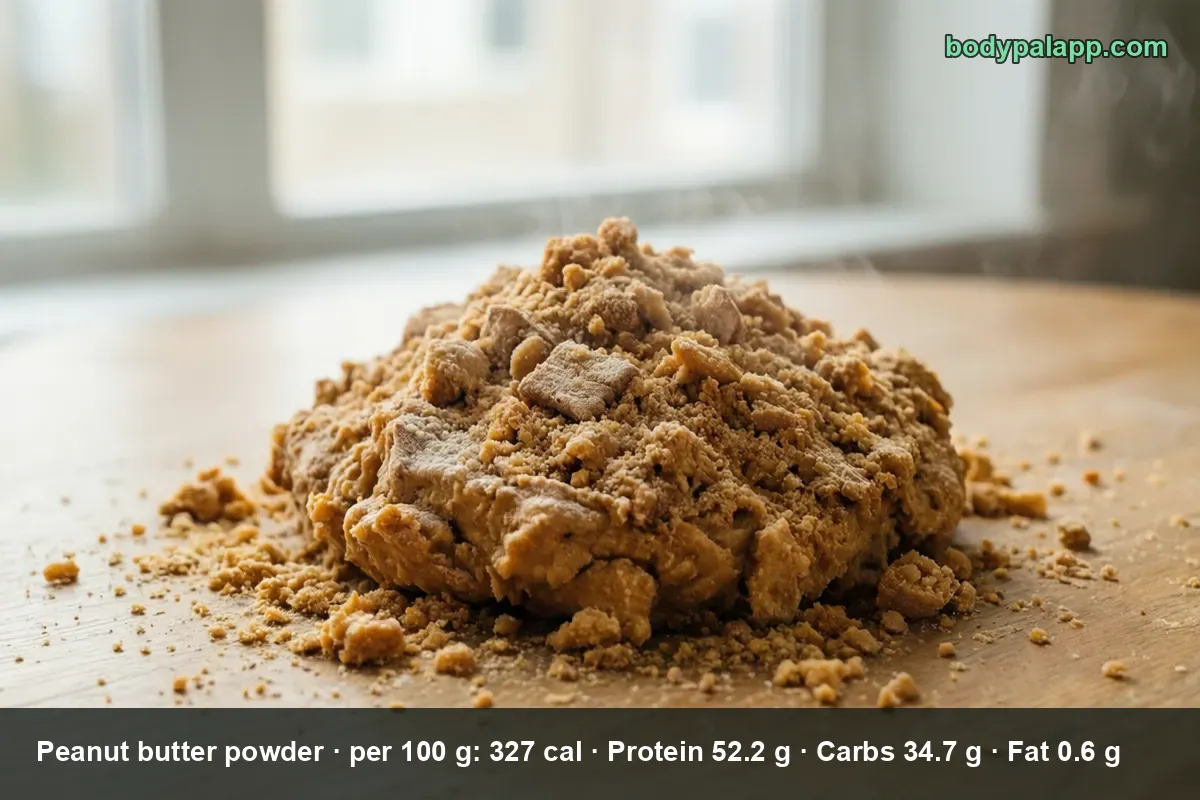
Two tablespoons of plain peanut butter powder, 12 g on a typical label, come to 39 calories, and the powder itself runs 327 calories per 100 g. That density looks alarming until you notice nobody eats 100 g of it. The scoop is tiny, the protein is high, and that combination is the whole point.
On this page
- Peanut butter powder quick facts
- US servings, from two tablespoons to a cup
- Sweetened blends, chocolate and full-fat powders
- Protein and fiber are the rows that matter
- How does peanut butter powder compare?
- Most popular peanut butter powder brands
- FAQ
Peanut butter powder quick facts
The record this page runs on is USDA's SR Legacy entry for Peanut flour, defatted (FDC 174267). It is the plain pressed and ground peanut solid, with no sugar and no salt added, and it is exactly what sits inside a jar of powdered peanut butter before a brand blends anything into it. Every branded tub in the aisle is this material plus some combination of cane sugar, salt and leftover oil, which is why those rows sit higher and why they get their own section below.
The column that matters to most people is the label scoop: 2 tablespoons, 12 g, the measure printed on the back of the jar.
| Nutrient | Per 100 g | Per 2 Tbsp (12 g) | % Daily Value |
|---|---|---|---|
| Calories | 327 | 39 | — |
| Total fat | 0.55 g | 0.1 g | 0% |
| Saturated fat | 0.06 g | 0.0 g | 0% |
| Carbohydrate | 34.7 g | 4.2 g | 2% |
| Dietary fiber | 15.8 g | 1.9 g | 7% |
| Total sugars | 8.22 g | 1.0 g | — |
| Protein | 52.2 g | 6.3 g | 13% |
| Sodium | 180 mg | 22 mg | 1% |
| Cholesterol | 0 mg | 0 mg | 0% |
| Potassium | 1290 mg | 155 mg | 3% |
% Daily Value is based on a 2,000-calorie diet.
Verified nutrition data
Numbers on this page come from USDA FoodData Central, the U.S. Department of Agriculture’s food composition database, and from manufacturer labels where a branded product is named. Last verified September 2026. How we verify our data →
There is no added sugars row here because USDA does not publish added sugars for this SR Legacy record — the plain flour has none by definition, and the 8.22 g of total sugars per 100 g is what peanuts bring on their own. Cholesterol is a flat zero, as it is in every plant food, and the potassium is quietly good: 1,290 mg per 100 g, or 155 mg in a scoop.
US servings, from two tablespoons to a cup
| Serving | Weight | Calories |
|---|---|---|
| 2 Tbsp, the label scoop | 12 g | 39 kcal |
| 1/4 cup | 15 g | 49 kcal |
| 1 single-serve packet | 24 g | 78 kcal |
| 1 oz | 28.35 g | 93 kcal |
| 1 cup | 60 g | 196 kcal |
| Per 100 g | 100 g | 327 kcal |
The ounce and the cup are USDA's own household measures for this record. The 12 g scoop, the quarter cup and the packet are our own arithmetic from the USDA 100 g figure, not USDA servings.
Here is the trap almost nobody mentions. USDA weighs one cup of this powder at 60 g, which makes 2 tablespoons about 7.5 g and roughly 25 calories. US brand labels weigh their 2 tablespoons at 12 to 16 g. Same spoon, up to double the calories, because commercial powder is packed and settled rather than loosely spooned. If you log by tablespoon instead of by gram, you can be off by half without doing anything wrong. A kitchen scale settles it in three seconds.
The other quiet gap is the difference between a scoop and a habit. Two tablespoons stirred into oatmeal is 39 calories. Four tablespoons whisked into a shake, plus a spoonful on top of a bowl later, is closer to 100 — still small, but no longer the rounding error people treat it as.
Sweetened blends, chocolate and full-fat powders
| Version | Per 100 g | Label serving | Calories |
|---|---|---|---|
| Defatted peanut flour, plain | 327 kcal | 2 Tbsp (12 g) | 39 kcal |
| PB2 original powdered peanut butter | 462 kcal | 2 Tbsp (13 g) | 60 kcal |
| PB2 premium chocolate | 375 kcal | 2 Tbsp (12 g) | 45 kcal |
| BetterBody organic peanut butter powder | 438 kcal | 2 Tbsp (16 g) | 70 kcal |
| BetterBody full-fat peanut butter powder | 542 kcal | 2 Tbsp (12 g) | 65 kcal |
| Single-serve packet | 458 kcal | 1 packet (24 g) | 110 kcal |
"Powder" does not automatically mean defatted. The plain flour carries 0.55 g of fat per 100 g; the full-fat version carries 33.33 g, which is roughly sixty times as much and pushes the row to 542 calories per 100 g. Two jars can sit side by side on the same shelf, both labeled peanut butter powder, and differ by 215 calories per 100 g.
The rest of the aisle lands between those poles. PBfit reads 438 calories per 100 g, and because its label scoop is a heavy 16 g, that scoop costs 70 calories. Tru-Nut is among the lightest of the common ones at 375 per 100 g and 45 per scoop, Great Value sits at 417 and 50, and Wegmans matches PB2 at 462 and 60. Chocolate versions are not automatically worse: PB2's chocolate blend reads 375 per 100 g, lower than its plain original, because cocoa solids displace some of the peanut.
Single-serve packets are the one format worth watching. A 24 g branded packet is 110 calories — nearly three label scoops in a sleeve that feels like one.
Protein and fiber are the rows that matter
A 12 g scoop delivers 6.3 g of protein, 13% of the FDA Daily Value of 50 g, for 39 calories. That ratio is the reason the stuff exists. An ounce takes it to 14.8 g of protein for 93 calories, which puts it in the same conversation as the concentrated plant proteins on the MyPlate protein foods list rather than with dessert toppings.
Fiber comes along for free: 1.9 g per scoop, 7% of the 28 g Daily Value, and 15.8 g per 100 g. Saturated fat is essentially absent at 0.06 g per 100 g, so the whole scoop rounds to 0% DV — unusual for anything peanut-flavored.
Sodium is the row that separates plain from branded. The generic powder is 22 mg per scoop, 1% DV. Salted blends run 692 mg per 100 g for PB2 and 1,033 mg for the full-fat BetterBody powder, which works out to roughly 90 mg and 124 mg per label serving by our own arithmetic from those 100 g figures. That is still modest, but if you're watching sodium and using four scoops a day, the plain flour is the better pick.
How does peanut butter powder compare?
| Food | Per 100 g | US serving | Calories |
|---|---|---|---|
| Peanut butter powder, defatted | 327 kcal | 1 oz (28.35 g) | 93 kcal |
| Soy flour, defatted | 327 kcal | 1 oz (28.35 g) | 93 kcal |
| Soy protein concentrate | 328 kcal | 1 oz (28.35 g) | 93 kcal |
| Adzuki beans, raw | 329 kcal | 1 oz (28.35 g) | 93 kcal |
Our take: all four of these land within 2 calories of each other per 100 g and at an identical 93 calories per ounce, which tells you energy is the wrong axis to compare them on. What differs is what fills the ounce. Soy protein concentrate carries the most protein at 63.63 g per 100 g against peanut powder's 52.2 g, so for pure protein per calorie it wins. Peanut butter powder wins everywhere else that matters day to day: it tastes like peanuts, it brings 15.8 g of fiber, and it dissolves into oatmeal or yogurt without a chalky aftertaste. Dry adzuki beans sit at the same calorie mark with only 19.87 g of protein and 62.9 g of carbohydrate, which is a reminder that "329 calories per 100 g" says nothing at all about what a food does for you.
Most popular peanut butter powder brands in the United States
Ranked by how widely each product appears among foods sold in the United States, from the BodyPal food database of over 3.3 million products. Calories are the figures printed on each Nutrition Facts label, checked against USDA FoodData Central.
| Product | Calories (per 100 g) |
|---|---|
| PB2 Powdered Peanut Butter | 462 cal |
| BetterBody Foods Peanut Butter Powder | 542 cal |
| PBfit Peanut Butter Powder | 438 cal |
| Tru-Nut Powdered Peanut Butter | 375 cal |
| Great Value Powdered Peanut Butter | 417 cal |
| Wegmans Powdered Peanut Butter | 462 cal |
Brand popularity: BodyPal food database. Nutrition: manufacturer labels / USDA FoodData Central.
Peanut butter powder FAQs
How many calories are in 2 tablespoons of peanut butter powder?
Two tablespoons of plain defatted peanut butter powder weigh 12 g and carry 39 calories, from a base of 327 calories per 100 g. That scoop also brings 6.3 g of protein and 1.9 g of fiber. Sweetened store blends run higher: PB2's own 2-tablespoon serving is 60 calories.
How many calories are in 1 oz of peanut butter powder?
One ounce is 28.35 g and 93 calories of plain powder, our own arithmetic from the USDA 100 g figure of 327. That ounce carries 14.8 g of protein, 4.5 g of fiber and 51 mg of sodium. It's a little over two label scoops.
How much protein is in peanut butter powder?
Plain defatted peanut butter powder is 52.2 g of protein per 100 g, so a 12 g scoop gives 6.3 g, 13% of the Daily Value. An ounce gives 14.8 g. Defatting is what concentrates it: the oil comes out and protein and fiber take the space.
Is peanut butter powder the same as peanut flour?
Effectively yes: the USDA record behind this page is "Peanut flour, defatted" at 327 calories per 100 g, and that pressed, ground peanut solid is what fills a jar of powdered peanut butter. Store blends then add sugar and salt, which is why PB2 reads 462 calories per 100 g instead of 327.
Does peanut butter powder have added sugar?
The plain USDA record shows 8.22 g of total sugars per 100 g, which is 1.0 g in a 12 g scoop, and that is the sugar naturally in peanuts. USDA does not publish added sugars for this SR Legacy record, so check the jar: sweetened blends list cane sugar high in the ingredients.
How much sodium is in powdered peanut butter?
Plain powder is 180 mg of sodium per 100 g, or 22 mg in a 2-tablespoon scoop, 1% of the Daily Value. Salted store blends are a different story: PB2 is listed at 692 mg per 100 g and BetterBody's full-fat powder at 1,033 mg per 100 g.
How many calories are in PB2?
PB2 Powdered Peanut Butter is 462 calories per 100 g, and its own label serving of 2 tablespoons (13 g) is 60 calories. That's 21 calories above a plain 12 g scoop of defatted peanut flour, because the blend keeps more of the oil and adds sugar and salt.
Is peanut butter powder good for weight loss?
It's a low-calorie way to get peanut flavor: 39 calories per 12 g scoop, with 6.3 g of protein and 1.9 g of fiber. Stirred into oatmeal or a shake it costs very little. It is not a free food, though — an ounce is 93 calories, and salted blends add sodium.
Similar foods
- Fries — 452 cal per medium fast food order
- Onion Rings — 282 cal for 8 rings
- Funnel cake — 318 cal per cake, 6-inch
- Cannoli — 227 cal per cannoli
- Nachos — 663 cal per order
- Fudge — 70 cal per piece
Count it without the math
Point the camera at the bowl and BodyPal counts the scoop of powder along with everything under it.


How long does it take to burn off 39 kcal of peanut butter powder?
Two tablespoons (12 g) is 39 kcal. Enter your weight and the amount you ate to see how long it takes you to burn that off:
lb
| Activity | Time to burn 39 kcal |
|---|---|
| Walking, brisk | 8 min |
| Cycling, moderate | 5 min |
| Swimming, moderate | 6 min |
| Jogging | 5 min |
| Weight training, moderate | 9 min |
Times are for a 155 lb adult at a steady pace; change the weight to see yours. The amount is set to the portion in the text (12 g); change it to what you actually ate. BodyPal works this out from your steps automatically.
Burning it off is one side of it. The other is knowing your number: work out how many calories you need a day, with macros and a goal date.