
How many calories are in a pack of chicken ramen?
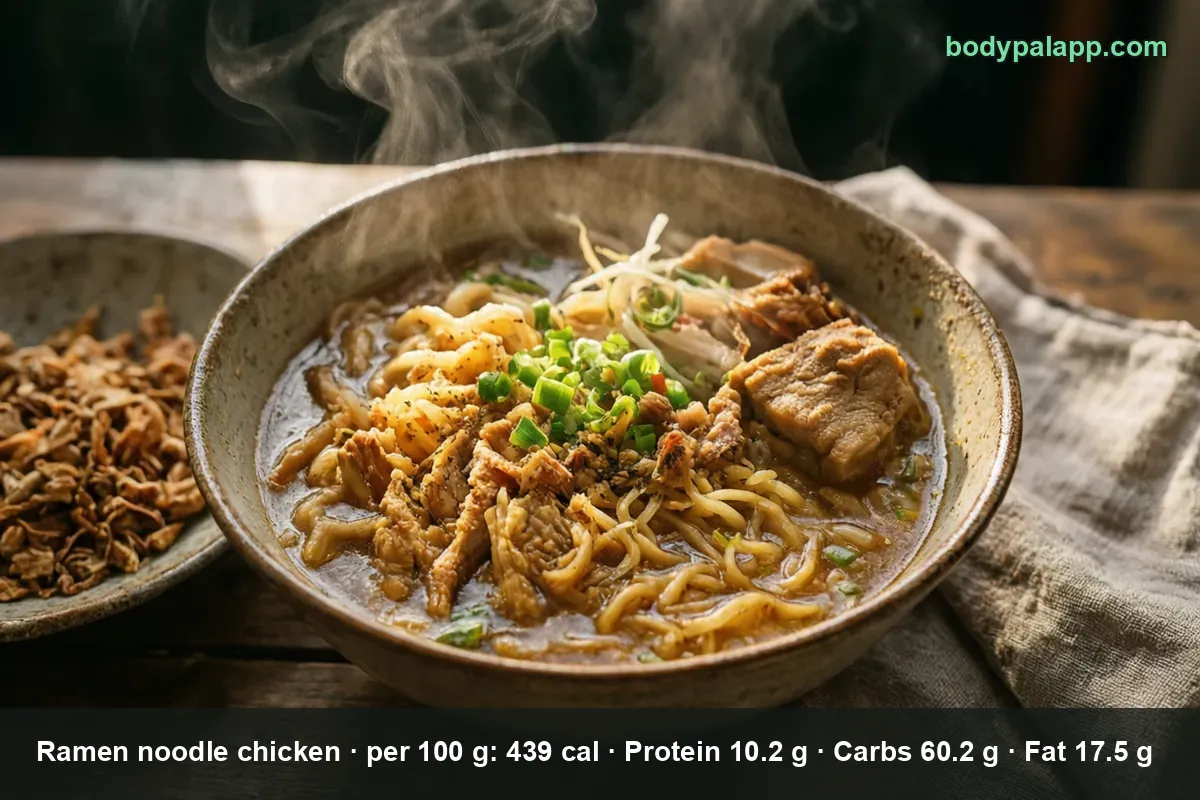
One package of chicken-flavor instant ramen, noodles only, is 356 calories for 81 g of dry block. Per 100 g the dry noodles run 439 calories. Add the seasoning packet and the full package reaches 382. Boiling changes the weight of the bowl, not the calorie count.
On this page
- Chicken ramen quick facts
- US servings, from one ounce to the whole package
- The seasoning packet, the beef version and the generic block
- Sodium and saturated fat are the two rows to watch
- How does chicken ramen compare?
- Most popular ramen noodle chicken brands
- FAQ
Chicken ramen quick facts
The row that matches the thing in your hand is SR Legacy 171615, "Soup, ramen noodle, chicken flavor, dry". It is the only USDA record written specifically for chicken-flavor instant ramen, and it describes the product as it comes off the shelf: a pressed block of dry noodles with a foil packet of seasoning beside it. The USDA household serving is one package without the flavor packet, 81 g.
A warning before the table. There is no USDA record for a restaurant-style bowl of ramen with sliced chicken, egg and broth, so nothing on this page covers that. Everything here is the packaged block, cooked or not. Water adds weight but no calories, so a finished bowl made from one block still carries the same 356.
| Nutrient | Per 100 g | Per 1 package without packet (81 g) | % Daily Value |
|---|---|---|---|
| Calories | 439 | 356 | — |
| Total fat | 17.52 g | 14.2 g | 18% |
| Saturated fat | 8.1 g | 6.6 g | 33% |
| Carbohydrate | 60.23 g | 48.8 g | 18% |
| Dietary fiber | 2.9 g | 2.3 g | 8% |
| Total sugars | 1.96 g | 1.6 g | — |
| Protein | 10.22 g | 8.3 g | 17% |
| Sodium | 1923 mg | 1558 mg | 68% |
% Daily Value is based on a 2,000-calorie diet.
Verified nutrition data
Numbers on this page come from USDA FoodData Central, the U.S. Department of Agriculture’s food composition database, and from manufacturer labels where a branded product is named. Last verified September 2026. How we verify our data →
Two rows you will see on a printed label are missing above, and that is deliberate. The SR Legacy edition of this record does not measure added sugars or cholesterol at all, so writing a number in either row would mean inventing one. Potassium is measured: 183 mg per 100 g, or 148 mg in a block, which is 3% of the Daily Value.
US servings, from one ounce to the whole package
| Serving | Weight | Calories |
|---|---|---|
| 1 oz, dry | 28.35 g | 124 kcal |
| Half a noodle block | 40.5 g | 178 kcal |
| One package, noodles only | 81 g | 356 kcal |
| One package with the seasoning packet | 87 g | 382 kcal |
| Per 100 g | 100 g | 439 kcal |
Only two of those are USDA servings: the 81 g block and the per-100 g row. The 6 g seasoning packet is a USDA serving too, and it makes up the difference between 81 and 87. The ounce, the half block and the combined 87 g package are our own arithmetic from the USDA 100 g figure, not USDA servings.
The ounce row is where people go wrong. An ounce of dry ramen sounds like a snack-sized amount and costs only 124 calories, but a standard block is closer to three ounces. If you log "1 oz ramen" because that is the first option in the list, you are logging about a third of what you actually ate. Weigh the block once, remember the number, and use it forever.
The seasoning packet, the beef version and the generic block
| Version | Per 100 g | Typical serving | Calories |
|---|---|---|---|
| Noodle block, packet thrown away | 439 kcal | one block, 81 g | 356 kcal |
| Whole package with seasoning | 439 kcal | block plus packet, 87 g | 382 kcal |
| Seasoning packet alone | 439 kcal | one packet, 6 g | 26 kcal |
| Beef flavor ramen | 441 kcal | 1 oz, 28.35 g | 125 kcal |
| Any flavor ramen | 440 kcal | 1 oz, 28.35 g | 125 kcal |
The packet is small change. Twenty-six calories out of 382 is under 7% of the package. People throw it away expecting a real saving and get almost none of one. What they do save is sodium: roughly 115 mg of the package total, our own arithmetic from the 100 g figure. That is the honest reason to skip it, and it is a modest one.
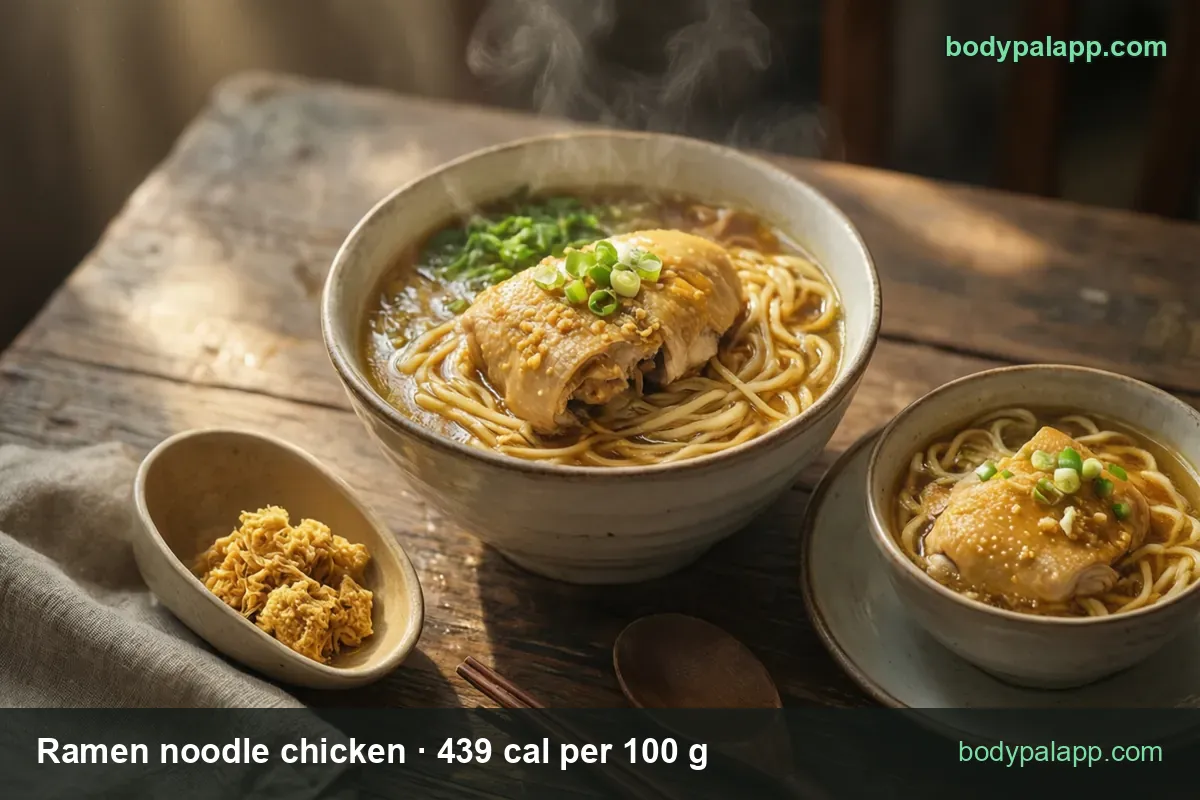
Flavor does not move calories. Chicken flavor is 439 calories per 100 g, the generic any-flavor record 440, beef flavor 441. Three records, a spread of 2 calories per 100 g, which is under half a percent. The noodles are identical; only the powder in the foil changes. If a chart or an app tells you beef ramen is meaningfully heavier than chicken ramen, it is not reading USDA data.
Chicken ramen has no supermarket-brand entries in the USDA Branded database, so there is no branded row to compare against the generic one here. The single dry-soup record covers what nearly every store block contains.
Sodium and saturated fat are the two rows to watch
One block is 1,558 mg of sodium, 68% of the FDA Daily Value of 2,300 mg. Prepare the whole package, packet included, and you are at about 1,673 mg, or 73% of the day, from one lunch. The Dietary Guidelines for Americans put the same 2,300 mg ceiling on adults, and most Americans are already over it before dinner.
Here is the part that surprises people: the noodles carry most of that salt, not the packet. Take the seasoning away and you still have 1,558 of the 1,673 mg. The block is salted during manufacture, so "no seasoning" ramen is not low-sodium ramen.
The second row worth a look is saturated fat. A dry, meatless block of noodles delivers 6.6 g, 33% of the Daily Value, because instant ramen is flash-fried in oil before it is dried. That is a third of a day's saturated fat from a food that contains no chicken at all, and often more than the chicken you would add to the bowl. Air-dried or baked ramen exists and reads lower, but it is not the product in this USDA record.
Protein is the pleasant surprise in the other direction: 8.3 g in a block, 17% of the Daily Value, all of it from wheat. That is enough to make ramen a real base rather than empty volume, though it is not enough to make it a complete meal. Two eggs, a handful of frozen peas or some shredded chicken cost you almost nothing in preparation and change the shape of the plate completely.
How does chicken ramen compare?
| Dry soup product | Per 100 g | US serving | Calories |
|---|---|---|---|
| Chicken ramen (this page) | 439 kcal | one block, 81 g | 356 kcal |
| Any-flavor ramen | 440 kcal | 1 oz, 28.35 g | 125 kcal |
| Beef-flavor ramen | 441 kcal | 1 oz, 28.35 g | 125 kcal |
| Low-sodium bouillon, dry | 438 kcal | 1 oz, 28.35 g | 124 kcal |
Our take: on a per-gram basis these four records are effectively one food, spread across just 3 calories per 100 g from 438 to 441. What separates them is what you eat of them. Nobody eats an ounce of bouillon; almost everybody eats a whole block of ramen. For weight loss, the lever is the block, not the flavor: half a block with a full packet of vegetables and an egg lands near 178 calories from noodles instead of 356. For satiety, keep the whole block and build around it, since 8.3 g of protein and 2.3 g of fiber will not hold you on their own. And if sodium is what you are managing, the bouillon column is the tell: at 16.7 g of protein per 100 g against ramen's 10.22 g, the low-sodium record shows how much of ramen's character is salt and frying oil rather than substance.
Most popular ramen noodle chicken brands in the United States
Ranked by how widely each product appears among foods sold in the United States, from the BodyPal food database of over 3.3 million products. Calories are the figures printed on each Nutrition Facts label, checked against USDA FoodData Central.
| Product | Calories (per 100 g) |
|---|---|
| Maruchan Ramen Noodle Soup Chicken Flavor | 442 cal |
Brand popularity: BodyPal food database. Nutrition: manufacturer labels / USDA FoodData Central.
Chicken ramen FAQs
How many calories are in a pack of chicken ramen?
The noodle block alone is 356 calories at 81 g, and the whole package with its seasoning comes to 382. USDA lists the dry block at 439 calories per 100 g. Cooking adds water, not calories, so the boiled bowl lands in the same place.
How many calories in half a pack of ramen?
Half a noodle block is 178 calories at about 40.5 g, our own arithmetic from the USDA 100 g figure rather than a listed serving. Split the seasoning too and you add 13 more, for 191 calories and roughly 837 mg of sodium.
How much sodium is in chicken ramen noodles?
A full package with the packet carries about 1,673 mg of sodium, 73% of the FDA Daily Value of 2,300 mg. The noodle block by itself is 1,558 mg, still 68%. Most of it is in the noodles, not only in the seasoning.
Do the noodles or the flavor packet have more calories?
The noodles, by a wide margin: 356 calories in the 81 g block against roughly 26 in the 6 g packet. Tossing the packet saves about 7% of the calories but around 115 mg of sodium, which is the better reason to skip it.
Is chicken ramen higher in calories than beef ramen?
No — chicken flavor is 439 calories per 100 g and beef flavor 441, a gap of 2 calories that disappears in any real serving. The generic any-flavor record sits between them at 440. Pick the flavor you like; the calories are the same noodles either way.
How much protein is in chicken ramen noodles?
One block gives 8.3 g of protein, 17% of the Daily Value, from 10.22 g per 100 g. That is wheat protein, not chicken, since the packet is flavoring. Adding two eggs or some cooked chicken is what turns the bowl into a full meal.
Do ramen noodles have fiber?
A little: 2.9 g per 100 g, so 2.3 g in one block, which is 8% of the 28 g Daily Value. Refined wheat flour is the reason it is not zero and not much more. A cup of vegetables in the broth does more than the noodles do.
Are instant ramen noodles fried?
Almost always, and the fat rows show it: 17.52 g of total fat and 8.1 g of saturated fat per 100 g in a dry product with no meat in it. One block delivers 6.6 g of saturated fat, 33% of the Daily Value.
Similar foods
- Oat flour — 105 cal for 1/4 cup
- Cheese — 113 cal per slice
- Thousand Island Dressing — 216 cal per dipping-size container
- Gouda cheese — 75 cal per slice
- Condensed Milk — 122 cal per 2 tbsp
- Yum yum sauce — 170 cal for 2 tbsp
Count it without the math
Point the camera at the bowl and BodyPal counts the noodles, the packet and whatever you dropped in on top.


How long does it take to burn off chicken ramen?
One package without the flavor packet (81 g) is 356 kcal. Enter your weight and the amount you ate to see how long it takes you to burn that off:
lb
| Activity | Time to burn 356 kcal |
|---|---|
| Walking, brisk | 1 hr 11 min |
| Cycling, moderate | 44 min |
| Swimming, moderate | 51 min |
| Jogging | 42 min |
| Weight training, moderate | 1 hr 19 min |
Times are for a 155 lb adult at a steady pace; change the weight to see yours. The amount is set to the portion in the text (81 g); change it to what you actually ate. BodyPal works this out from your steps automatically.
Want the bigger picture? Calculate your daily calorie needs — your maintenance figure, a target for losing or gaining, and the date you get there.