
How many calories are in ramen noodles without the seasoning?
One instant ramen block weighs 81 grams and carries 356 calories once the seasoning packet goes in the trash. Dry, the noodles run 440 calories per 100 g, so even a single ounce snapped off the block is 125. The packet itself was worth only 26 calories of the pack.
On this page
- Ramen noodle quick facts
- US servings, from one ounce to a whole block
- The packet, half blocks and lighter noodles
- Dry block or cooked bowl?
- Sodium and saturated fat are the rows to watch
- How does ramen compare?
- Most popular ramen noodles brands
- FAQ
Ramen noodle quick facts
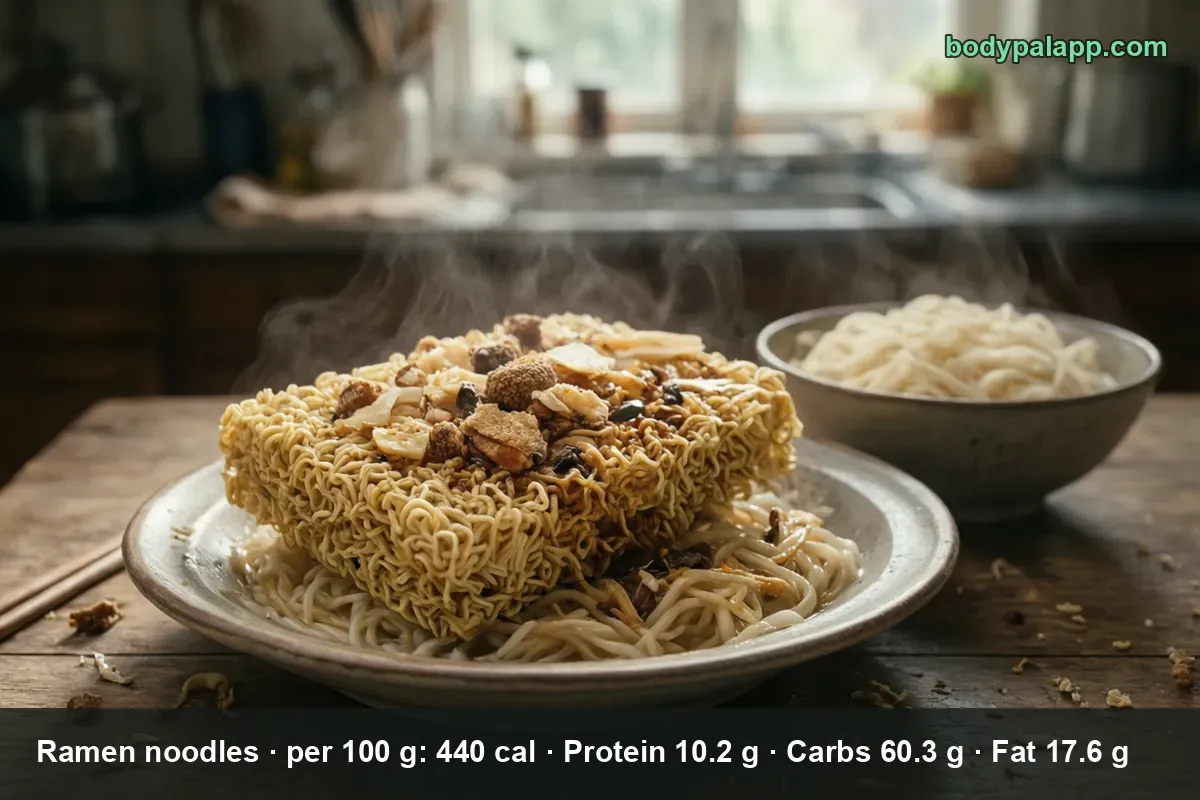
The number people want is the one for the square in their hand, and USDA keeps a record built exactly that way. SR Legacy 171177, "Soup, ramen noodle, any flavor, dry", carries its own household serving: 1 package without flavor packet, 81 g. That is the noodle brick minus the foil sachet, and it comes to 356 calories.
One caveat before you read the table. USDA analyzes the dry soup as a single product, block and packet together, then reports it per 100 g. The fat, carbohydrate and protein rows are essentially the noodles, because the packet is a rounding error by weight. The sodium row is not: most of the salt in an instant ramen pack lives in that sachet, and no one publishes a split. Read the sodium figure as the ceiling for the whole pack, not as a measurement of naked noodles.
| Nutrient | Per 100 g | Per 1 package without flavor packet (81 g) | % Daily Value |
|---|---|---|---|
| Calories | 440 | 356 | — |
| Total fat | 17.59 g | 14.2 g | 18% |
| Saturated fat | 8.12 g | 6.6 g | 33% |
| Carbohydrate | 60.26 g | 48.8 g | 18% |
| Dietary fiber | 2.9 g | 2.3 g | 8% |
| Total sugars | 1.98 g | 1.6 g | — |
| Protein | 10.17 g | 8.2 g | 16% |
| Sodium | 1855 mg | 1503 mg | 65% |
% Daily Value is based on a 2,000-calorie diet.
Verified nutrition data
Numbers on this page come from USDA FoodData Central, the U.S. Department of Agriculture’s food composition database, and from manufacturer labels where a branded product is named. Last verified September 2026. How we verify our data →
There is no added sugars row above because USDA does not publish added sugars for this record. Cholesterol is 0 mg, as you would expect from flour, water and palm oil with no egg or dairy in it. Potassium is 181 mg per 100 g, or 147 mg in the block, which is 3% of the Daily Value.
US servings, from one ounce to a whole block
| Serving | Weight | Calories |
|---|---|---|
| 1 oz of dry noodles | 28.35 g | 125 kcal |
| One seasoning packet | 5.8 g | 26 kcal |
| Half a noodle block | 40.5 g | 178 kcal |
| One package without the flavor packet | 81 g | 356 kcal |
| Per 100 g | 100 g | 440 kcal |
Two of those are USDA household measures: the 81 g package and the 5.8 g flavor packet both come straight off the record. The half block and the ounce are our own arithmetic from the USDA 100 g figure, not USDA servings, which is why they land on awkward weights like 40.5 g.
The ounce line is the one worth memorizing, because dry ramen is a snack food as often as it is a soup. Break a corner off, eat it crunchy in front of the television, and you are spending 125 calories per ounce — a little under what an ounce of potato chips costs. The whole block eaten dry is still 356.
Store brands and name brands sit close enough together that the block on your counter is covered by these numbers. American instant packs cluster around 3 ounces gross weight, of which the noodles are roughly 81 g and the sachet the rest.
The packet, half blocks and lighter noodles
| Version | Per 100 g | Typical serving | Calories |
|---|---|---|---|
| Ramen block without the seasoning packet | 440 kcal | 1 package, 81 g | 356 kcal |
| The seasoning packet on its own | 440 kcal | 1 packet, 5.8 g | 26 kcal |
| Beef flavor, noodles only | 441 kcal | 1 package, 82 g | 362 kcal |
| Chicken flavor, noodles only | 439 kcal | 1 package, 81 g | 356 kcal |
| Reduced fat, reduced sodium | 350 kcal | half block, 40 g | 140 kcal |
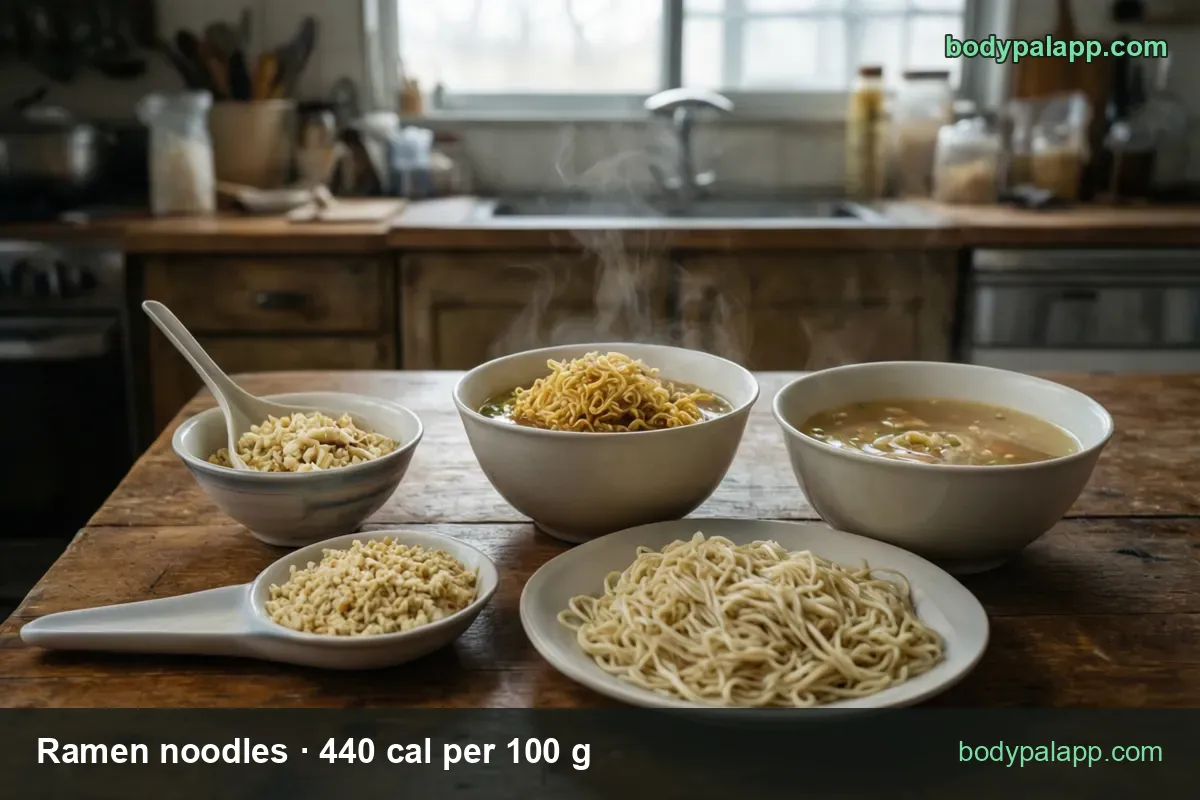
| Cooked with water | 66 kcal | 1 cup, 245 g | 162 kcal |
Throwing away the packet is a salt decision, not a calorie decision. Beef, chicken and "any flavor" blocks land within 2 calories of each other per 100 g, and the sachet you discard is 26 calories. If you want the flavor without the sodium, half a packet costs you 13 calories and half the salt.
Halving the block is the move that actually changes the math. Half a block — 40.5 g of dry noodles — is 178 calories, 24.4 g of carbohydrate and 4.1 g of protein, and in a bowl with an egg and vegetables it still reads as a full meal. Cooks who do this once a week are the ones logging 178 rather than 356.
The reduced-fat, reduced-sodium block is a different product rather than a smaller one. It is baked instead of fried, which drops fat from 17.59 g to 2.5 g per 100 g, takes saturated fat to zero, and pushes carbohydrate up to 70.95 g as the starch takes the space the oil used to fill. Net calories: 350 per 100 g against 440.
Plain ramen noodles sold on their own — the kind in the Asian aisle with no sachet in the bag — are usually not fried at all. King Soba's organic buckwheat noodles are 311 calories per 100 g, Simply Asia's Japanese-style noodles 357, and Annie Chun's fresh cooked noodles just 160 because they arrive already hydrated. If you buy noodles rather than a soup kit, the number on the shelf is lower before you cook anything.
Dry block or cooked bowl?
This is where most ramen logs go wrong. The block is a dry ingredient. The bowl on the table is mostly water.
USDA's cooked record, FNDDS 2709152 "Soup, ramen noodles, water added", is 66 calories per 100 g. A 1-cup serving weighs 245 g and comes to 162 calories, with 9.04 g of carbohydrate and 282 mg of sodium per 100 g. The noodles soak up roughly four times their own weight, so the same brick that was 356 calories dry spreads across about two cups of soup.
That means a single cup of cooked ramen is lighter than half a dry block: 162 against 178. It also means you cannot weigh a cooked bowl and read it off a dry label. Weigh the block before it hits the pot, or log the cooked cup and stop there — doing both counts the noodles twice, and doubling 356 is the single most common ramen mistake we see.
Broth adds a little on top of the noodle number, and anything you drop in — egg, scallions, sliced pork, a spoon of chili crisp — is counted separately.
Sodium and saturated fat are the rows to watch
Calories are not the interesting part of a ramen pack. The interesting part is that one block delivers 6.6 g of saturated fat, which is 33% of the FDA Daily Value of 20 g, from a food most people file mentally under "just noodles." That is the frying oil, and it is why the baked reduced-fat version reads so differently.
Sodium is the other one. The full dry pack scales to 1,503 mg in an 81 g serving, 65% of the 2,300 mg Daily Value — about two-thirds of a teaspoon of table salt in one pack. The Dietary Guidelines for Americans use that same 2,300 mg figure as the daily limit for adults. Since the sachet carries the bulk of it, tipping in half the packet, or none, is the lever that moves this row most; the calories barely notice either way.
Fiber is the quiet disappointment: 2.3 g in a block, 8% of the Daily Value, from a food that is 48.8 g of carbohydrate. If you're watching sodium or saturated fat, the reduced-fat block or plain dried noodles from the Asian aisle are the better pick, and the vegetables you throw in are what make the bowl worth eating.
How does ramen compare?
| Ramen | Per 100 g | US serving | Calories |
|---|---|---|---|
| Ramen block, no seasoning | 440 kcal | 1 package, 81 g | 356 kcal |
| Beef flavor block, noodles only | 441 kcal | 1 package, 82 g | 362 kcal |
| Reduced fat, reduced sodium block | 350 kcal | half block, 40 g | 140 kcal |
| Ramen cooked with water | 66 kcal | 1 cup, 245 g | 162 kcal |
Our take: the flavor on the pack changes nothing worth logging — beef and "any flavor" are one calorie apart per 100 g. The two choices that matter are how much of the block you use and whether it was fried. Half a standard block at 178 calories and a whole baked reduced-fat block are both cheaper than one fried block, and both taste like ramen. If you eat instant noodles twice a week, switching to the baked version saves 90 calories per 100 g and every gram of the saturated fat.
Most popular ramen noodles brands in the United States
Ranked by how widely each product appears among foods sold in the United States, from the BodyPal food database of over 3.3 million products. Calories are the figures printed on each Nutrition Facts label, checked against USDA FoodData Central.
| Product | Calories (per 100 g) |
|---|---|
| King Soba Organic Buckwheat Ramen Noodles | 311 cal |
| Umi Organic Fresh Organic Ramen Noodles | 239 cal |
| Kaedama Ramen Noodles | 264 cal |
| Simply Asia Japanese Style Ramen Noodles | 357 cal |
| WA Imports Ramen Noodles | 361 cal |
| Annie Chun's Fresh Cooked Ramen Noodles | 160 cal |
Brand popularity: BodyPal food database. Nutrition: manufacturer labels / USDA FoodData Central.
Ramen noodle FAQs
How many calories are in ramen noodles without the seasoning packet?
356 calories for a standard 81 g block, the serving USDA lists as one package without the flavor packet. The dry noodles are 440 calories per 100 g. Dropping the packet saves only 26 calories, so the noodles carry almost the whole number either way.
How many calories are in half a block of ramen noodles?
178 calories for half of an 81 g block, which works out to 40.5 g of dry noodles. That is our own arithmetic from the USDA figure of 440 calories per 100 g, not a USDA serving. Half a block also carries 24.4 g of carbohydrate and 4.1 g of protein.
How much sodium is in ramen noodles without the seasoning?
1,855 mg per 100 g and 1,503 mg for the 81 g package, which is 65% of the Daily Value, about two-thirds of a teaspoon of table salt. USDA measures the dry soup as one product, so it does not publish a separate sodium figure for the noodles alone.
How many carbs are in one block of ramen noodles?
48.8 g of carbohydrate in the 81 g block, which is 18% of the Daily Value, with 2.3 g of that as fiber and 1.6 g as sugars. Per 100 g the dry noodles are 60.26 g carbohydrate. The reduced-fat version is higher still at 70.95 g.
How much protein is in a pack of ramen noodles?
8.2 g of protein in one 81 g block, 16% of the Daily Value, from 10.17 g per 100 g. That is respectable for a starch, but it arrives with 14.2 g of fat. An egg or some sliced chicken is the cheaper way to push the protein up.
Are ramen noodles fried?
Yes, and 17.59 g of fat per 100 g is the giveaway, because plain wheat noodles carry almost none. The block is flash-fried in oil before packing, which is where 8.12 g of saturated fat per 100 g comes from. The baked reduced-fat version reports 2.5 g of fat.
Can you eat ramen noodles raw?
125 calories per ounce if you snack on the dry block, which is how plenty of people eat it. The noodles are already cooked and fried before packing, so nothing is raw in the flour-and-water sense. Crushed dry, they behave like a salty cracker at 440 calories per 100 g.
How many calories are in a cup of cooked ramen noodles?
162 calories for a 1-cup (245 g) serving of ramen noodles cooked with water, at 66 calories per 100 g. The noodles soak up roughly four times their weight, so a cup lands below even half a dry block. Sodium is 282 mg per 100 g of the cooked mix.
Similar foods
- Oat flour — 105 cal for 1/4 cup
- Cheese — 113 cal per slice
- Thousand Island Dressing — 216 cal per dipping-size container
- Gouda cheese — 75 cal per slice
- Condensed Milk — 122 cal per 2 tbsp
- Yum yum sauce — 170 cal for 2 tbsp
Count it without the math
Point the camera at the bowl and BodyPal counts the noodles for you, block or half block.


How long does it take to burn off 356 kcal of ramen no seasoning?
One package without the flavor packet (81 g) is 356 kcal. Enter your weight and the amount you ate to see how long it takes you to burn that off:
lb
| Activity | Time to burn 356 kcal |
|---|---|
| Walking, brisk | 1 hr 11 min |
| Cycling, moderate | 44 min |
| Swimming, moderate | 51 min |
| Jogging | 42 min |
| Weight training, moderate | 1 hr 19 min |
Times are for a 155 lb adult at a steady pace; change the weight to see yours. The amount is set to the portion in the text (81 g); change it to what you actually ate. BodyPal works this out from your steps automatically.
One food is easy to picture; a whole day is harder. See how many calories you need a day and what a deficit actually looks like.