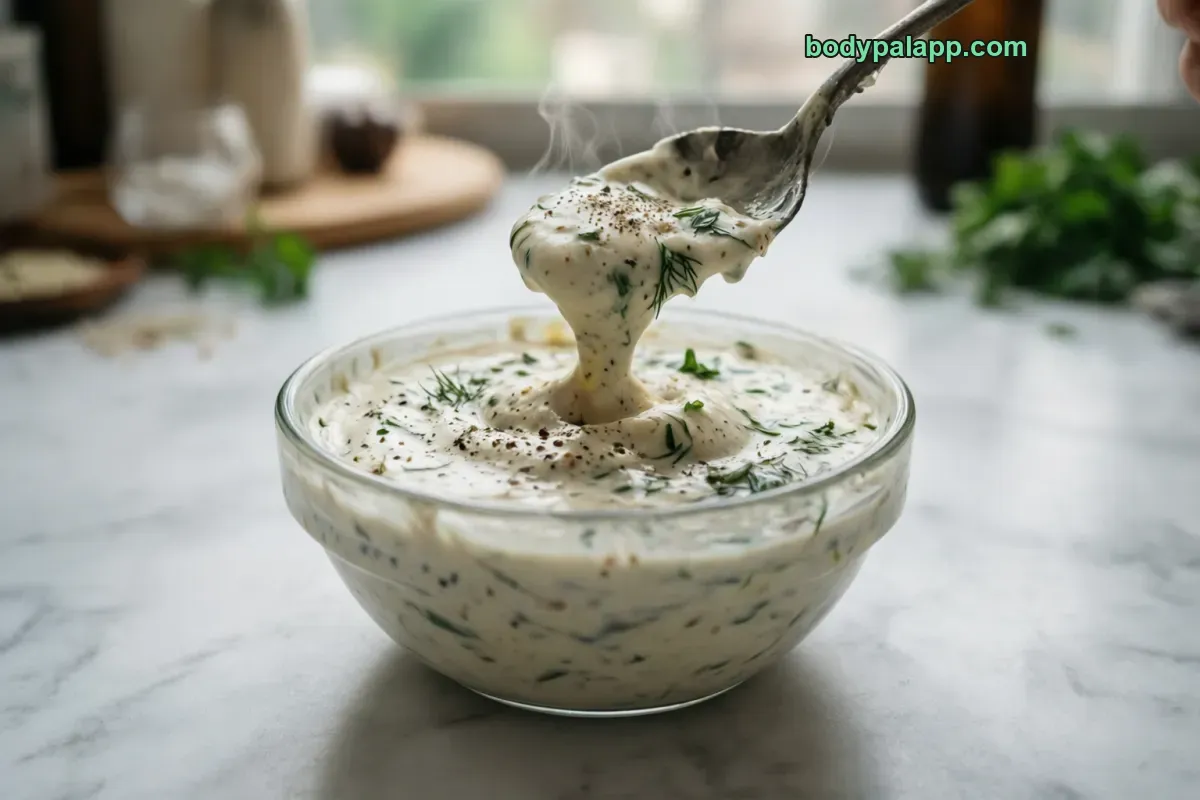
Hidden Valley Ranch dressing calories come to 140 for a 2 tbsp (30 g) serving and 467 per 100 g. The number to notice is the fat: it supplies 91% of those calories. Ranch is a small pour with a big payload, so the total depends almost entirely on how much lands on the plate.
140kcal
1 2 tbsp serving · 30 g, packaged, per label
3%protein
1 gProtein
2 gCarbs
14 gFat
How to burn off 140 kcal
—Walking, brisk
—Jogging
—Cycling, moderate
—Swimming
Skip the math. BodyPal counts these calories from your steps and workouts automatically.
Nutrition facts
Packaged, per label · per 30 g
Calories
140 kcal
Protein
1 g
Carbohydrate
2 g
Fat
14 g
Saturated fat
2.5 g
Cholesterol
10 mg
Sodium
260 mg
Source: USDA FoodData Central
🛡️
Verified nutrition data
Numbers on this page come from USDA FoodData Central, the U.S. Department of Agriculture’s food composition database, and from manufacturer labels where a branded product is named. Last verified September 2026. How we verify our data →
Hidden Valley Ranch dressing: calories, protein and sodium by serving
Percent of daily value uses the FDA reference of 2,000 kcal a day.
Serving
kcal
Protein
Carbs
Fat
Sodium
% DV kcal
2 tbsp (30 g)
140
1 g
2 g
14 g
260 mg
7%
100 g
467
3.3 g
6.7 g
46.7 g
867 mg
23%
3 × 2 tbsp (30 g)
420
3 g
780 mg
5 × 2 tbsp (30 g)
701
5 g
1,301 mg
Every extra pour adds 140 calories
The label serving is 2 tbsp (30 g). That spoonful carries 140 calories, 14 g of fat and 260 mg of sodium. Against the daily values, it is 7% of the calorie benchmark and 11% of the sodium one. On paper, that is a modest cost for a lot of flavor.
The trouble is that few people stop at the measured line. Double the pour to 60 g and you reach 280 calories and 520 mg of sodium. Three servings, 90 g, land at 420 calories and 780 mg of sodium. A generous dunking session of 150 g, five label servings, reaches 701 calories and 1,301 mg of sodium. That is more than many full meals, delivered by a condiment.
The fix is simple and boring: measure once. Pour 2 tbsp into a small bowl and look at how much it actually covers. Most people are surprised by how little it is, and that picture sticks. Dipping from a ramekin also beats drizzling from the bottle, because a drizzle has no natural stopping point. If you track meals, BodyPal can log the dressing from a photo of the plate.
Fat is 91% of every calorie
Ranch is, nutritionally speaking, flavored oil. Per 100 g it holds 46.7 g of fat, 6.7 g of carbs and 3.3 g of protein. The calorie split makes the point bluntly: 91% from fat, 6% from carbs and 3% from protein. Nothing else on the label comes close to the fat number.
Protein barely registers. A 2 tbsp serving gives 1 g, which is 2% of the daily value. Sugar is low too, at 1 g per serving and 3.3 g per 100 g, and fiber is 0. So ranch does not add sweetness or bulk to a salad; it adds richness and calories, almost nothing else.
Saturated fat sits at 8.3 g per 100 g, measured against a daily value of 20 g. Cholesterol is 33 mg per 100 g, a small figure next to the 300 mg daily value. Neither is the headline here. The real story is calorie density: a liquid with 467 calories per 100 g is easy to over-pour because it does not look or feel like much.
Sodium is the row to watch
After fat, sodium is the number that deserves attention. Per 100 g, ranch carries 867 mg, which is 38% of the 2300 mg daily value. A single 2 tbsp serving is a reasonable 260 mg, or 11%. The problem, as with calories, is the pour.
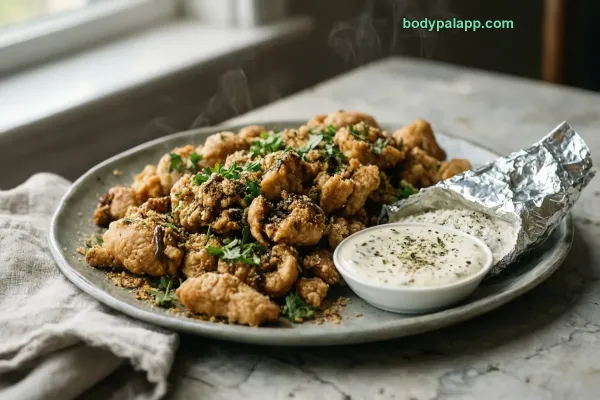
Scale it up and the sodium climbs quickly. Two servings bring 520 mg, three bring 780 mg, and a 150 g helping hits 1,301 mg. Ranch rarely travels alone, either. It usually sits next to wings, pizza, fries or a salad with cheese and croutons, all of which bring their own salt.
If you watch sodium, treat the dressing as part of the meal's salt budget rather than an afterthought. Keep the portion to a single measured serving, and pair it with foods that are naturally low in salt, like raw vegetables or plain grilled chicken. That way the ranch provides the flavor without stacking sodium on sodium.
Ranch works best as a measured dip
Because ranch offers so little protein or fiber, it pairs best with foods that supply both. Crunchy raw vegetables such as carrots, celery, cucumber and bell pepper bring volume and fiber for very few calories, so a measured serving of dressing goes a long way. A salad built on greens and a lean protein gives the dressing something to work with besides croutons.
Think of ranch as the flavor layer, not the base. A meal where the dressing is the most calorie-dense item on the plate is usually one where the portion has drifted. If the bowl of dip looks bigger than the pile of vegetables, the balance has flipped.
Lighter versions exist. Hidden Valley also sells a light line, including The Original Ranch Fiesta Salsa Dressing Light, which some shoppers use when they want more volume per serving. Read that label on its own terms, since the numbers on this page describe the classic dressing. Whichever bottle you pick, the habit that matters most is the same: measure the first pour, then decide if you really want a second.
How does Hidden Valley Ranch dressing compare?
Here is how Hidden Valley Ranch dressing stacks up against ranch dip, a ranch packet and avocado ranch dressing, per 100 g and per usual serving.
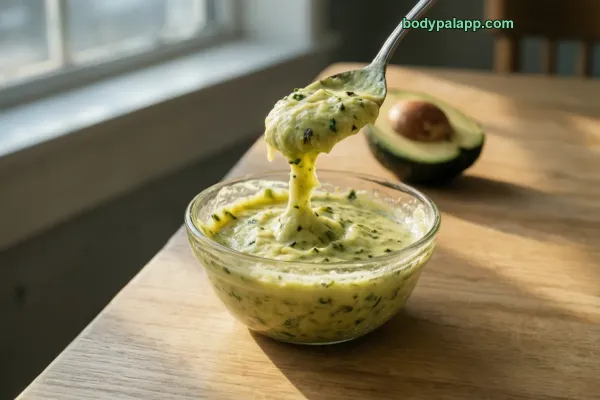
Verdict: For the fewest calories per pour, avocado ranch dressing edges ahead at 130 per 2 tbsp versus 140, and it is lower in sodium at 633 mg per 100 g against 867. Ranch dip looks lightest at 65 calories, but that is for just 1 tablespoon (15 g), and at 432 per 100 g it is close to the same food, so pick by portion size rather than by label.
Most popular Hidden Valley Ranch dressing brands in the United States
Ranked by popularity in the BodyPal database
# Productkcal / 100 g
1Hidden Valley The Original Ranch Fiesta Salsa Dressing Light2 Tbsp · 30 g200 kcal
How many calories are in 2 tablespoons of Hidden Valley Ranch?
A 2 tbsp label serving (30 g) has 140 calories. Per 100 g it is 467 calories.
Is Hidden Valley Ranch good for weight loss?
It is calorie-dense at 467 calories per 100 g, mostly from fat (46.7 g per 100 g). One 2 tbsp serving adds 140 calories.
Hidden Valley Ranch dressing vs ranch dip: which has more calories?
Hidden Valley Ranch dressing has 467 calories per 100 g, ranch dip 432 per 100 g.
How much fat is in Hidden Valley Ranch?
A 2 tbsp serving has 14 g fat, 2 g carbs, 1 g sugar and 1 g protein.
How many calories are in 100 g of Hidden Valley Ranch?
There are 467 calories in 100 g of Hidden Valley Ranch dressing, with 46.7 g of fat, 6.7 g of carbs and 3.3 g of protein. That amount also carries 867 mg of sodium, or 38% of the daily value.
How much sodium is in a serving of Hidden Valley Ranch?
A 2 tbsp (30 g) serving has 260 mg of sodium, which is 11% of the daily value. Double the pour to 60 g and it reaches 520 mg, so portion size drives the total.
Does Hidden Valley Ranch have any protein?
Very little. A 2 tbsp serving contains 1 g of protein, just 2% of the daily value, and protein supplies only 3% of the dressing's calories. Fat provides 91%.
How much sugar is in Hidden Valley Ranch dressing?
Hidden Valley Ranch has 1 g of sugar per 2 tbsp serving and 3.3 g per 100 g. Fiber is 0, and carbs make up only 6% of the calories, so sugar is not the concern here.
Is a ranch packet higher in calories than bottled Hidden Valley Ranch?
Per serving, yes: a 1 packet (44 g) portion has 189 calories versus 140 for 2 tbsp of bottled dressing. Per 100 g the packet is slightly lower, at 430 against 467, because the packet simply holds more.