
How many calories are in a rice cake?
One standard round rice cake weighs 13 g and carries 51 calories. Per 100 g the same cake runs 392 calories — dense on paper, light in the hand, because the cake is mostly air. Two of them come to 102 calories, before anything goes on top.
On this page
- Rice cake quick facts
- US servings, from a 3 g mini to a full cup
- Brown rice, sesame, buckwheat and rye
- Sodium and fiber: the rows worth checking
- How does a rice cake compare?
- Most popular rice cake brands
- FAQ
Rice cake quick facts
The numbers below come from the USDA record FNDDS 2708162, "Rice cake" — the plain, unflavored round cake that most people actually pull out of the bag. The older SR Legacy entry (168107) carries an identical nutrient profile, so there is nothing to choose between them on composition; the FNDDS record simply comes with US household measures attached.
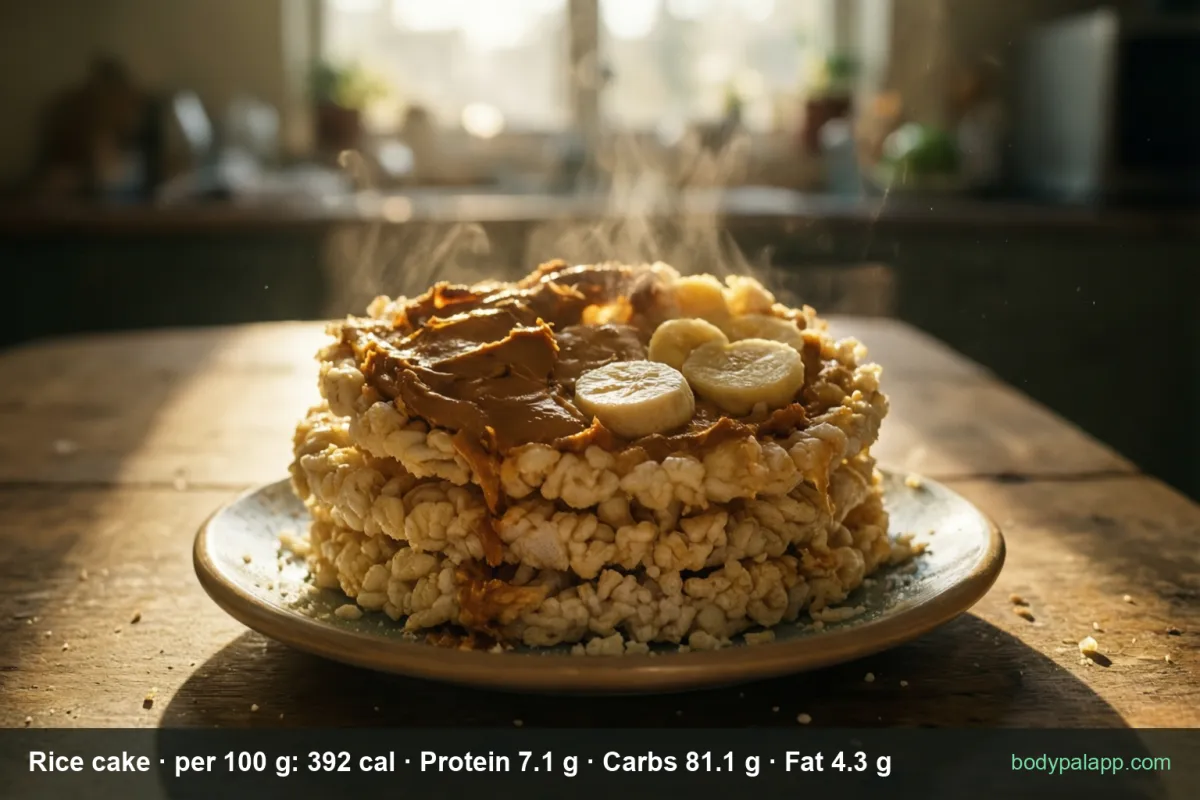
One decision matters more than the record: the weight. USDA's own "1 cake" for this entry is a 3 g mini. The Nutrition Facts panel on a full-size round cake, such as Quaker's 13 g cake, uses 13 g. That is the cake in the photo above, and it is the one used throughout this page.
| Nutrient | Per 100 g | Per 1 cake (13 g) | % Daily Value |
|---|---|---|---|
| Calories | 392 | 51 | — |
| Total fat | 4.3 g | 0.6 g | 1% |
| Saturated fat | 0.88 g | 0.1 g | 1% |
| Carbohydrate | 81.1 g | 10.5 g | 4% |
| Dietary fiber | 4.2 g | 0.5 g | 2% |
| Total sugars | 0.88 g | 0.1 g | — |
| Protein | 7.1 g | 0.9 g | 2% |
| Sodium | 71 mg | 9 mg | 0% |
| Cholesterol | 0 mg | 0 mg | 0% |
| Potassium | 428 mg | 56 mg | 1% |
% Daily Value is based on a 2,000-calorie diet.
Verified nutrition data
Numbers on this page come from USDA FoodData Central, the U.S. Department of Agriculture’s food composition database, and from manufacturer labels where a branded product is named. Last verified September 2026. How we verify our data →
There is no added sugars row and no trans fat row here, because this FNDDS edition does not publish either figure. For a plain cake that is a small loss: total sugars are 0.88 g per 100 g, and a puffed rice cake has nothing sweet in it to add. Percent Daily Values follow the FDA's current reference amounts.
US servings, from a 3 g mini to a full cup
| Serving | Weight | Calories |
|---|---|---|
| 1 mini cake, USDA "1 cake" | 3 g | 12 kcal |
| 1 cake, standard round (label serving) | 13 g | 51 kcal |
| 2 cakes | 26 g | 102 kcal |
| 1 oz | 28.35 g | 111 kcal |
| 1 cup, NFS | 30 g | 118 kcal |
| Per 100 g | 100 g | 392 kcal |
Three of these are USDA measures: the 3 g mini, the 1 cup entry and the 100 g reference. The 13 g cake is the label serving from the branded record, and the two-cake line is our own arithmetic from the USDA 100 g figure, not a USDA serving.
Look at the top and second rows together. The same two words — "one cake" — cover 12 calories and 51 calories, a fourfold gap, depending on which bag you opened. Nobody logging a snack thinks about that, and it is the single biggest source of error on this food. Weigh the cake once, write the number on the bag, and you never have to think about it again.
The cup line is the other quiet trap. A cup of rice cakes is 30 g and 118 calories, roughly two and a third full-size cakes, because broken cakes pack loosely. Measuring a dry, hollow snack by volume is guesswork; the 13 g figure is far more reliable.
Brown rice, sesame, buckwheat and rye
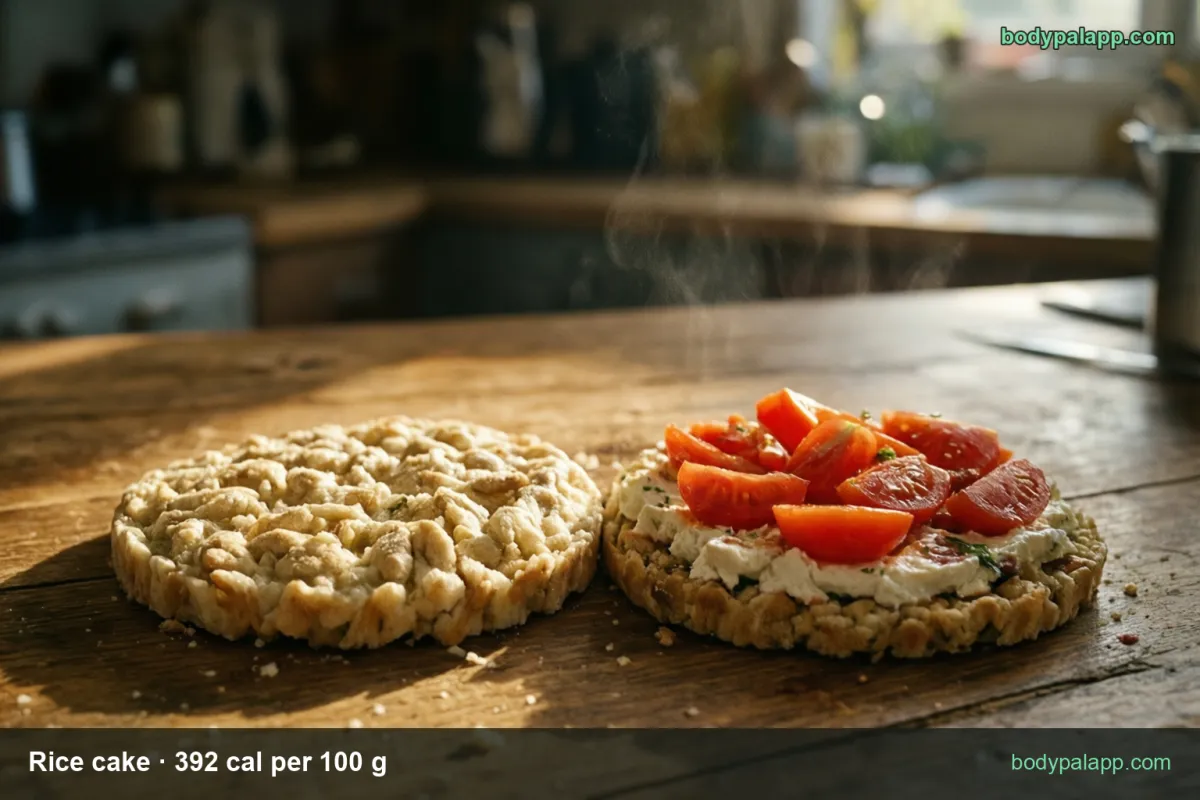
Brown rice cakes are pressed thinner than the classic white round, so a single cake lands closer to 9 g. Calories per cake below use that 9 g weight, which is our own arithmetic from each USDA 100 g figure rather than a listed USDA serving.
| Version | Per 100 g | Fiber /100 g | Sodium /100 g | One 9 g cake |
|---|---|---|---|---|
| Brown rice, plain, unsalted | 387 kcal | 4.2 g | 26 mg | 35 kcal |
| Brown rice, multigrain | 387 kcal | 3 g | 252 mg | 35 kcal |
| Brown rice, sesame seed | 392 kcal | 5.4 g | 227 mg | 35 kcal |
| Brown rice, buckwheat | 380 kcal | 3.8 g | 116 mg | 34 kcal |
| Brown rice, corn | 385 kcal | 2.9 g | 167 mg | 35 kcal |
| Brown rice, rye | 386 kcal | 4 g | 110 mg | 35 kcal |
The calorie column barely moves. Six varieties span 380 to 392 per 100 g — a 3% spread, which at cake size is a single calorie. Choosing between them on calories is wasted effort.
The other columns do move. Sesame seed cakes hold the most fiber of the set at 5.4 g per 100 g; corn the least at 2.9 g. Buckwheat cakes carry the most protein at 9 g per 100 g, against 7.1 g for the plain white record. And sodium runs from 26 mg to 252 mg, a spread of nearly ten times.
Flavored and store-brand cakes behave the same way until fat enters. Quaker's apple cinnamon cake sits at exactly 392 calories per 100 g, the same as the plain USDA record, and 51 calories per 13 g cake — the flavoring is not what costs you. A dark chocolate coated cake is a different animal: 467 calories per 100 g, with fat climbing from 4.3 g to 23.33 g per 100 g, so a 15 g coated slice is 70 calories. Thin unsalted cakes from the same brands are 5 g each and 20 calories; mini cakes are sold five to a 7 g serving at 25 calories.
Sodium and fiber: the rows worth checking
Rice cakes have a reputation as a salty snack, and per 100 g the multigrain record earns it at 252 mg. The reputation does not survive contact with a real portion. Even at a full 13 g, that saltiest record works out to about 33 mg of sodium — 1% of the 2,300 mg Daily Value — which is our own arithmetic from the 100 g figure. The plain cake is 9 mg. Sodium is not the reason to skip a rice cake, and picking the unsalted version saves you almost nothing.
Fiber tells the opposite story: good per 100 g, thin per cake. The plain record holds 4.2 g per 100 g, which is 15% of the 28 g Daily Value, but the 13 g cake delivers 0.5 g, or 2%. Two cakes get you to 1.1 g. If you are counting on rice cakes to move your fiber number, the MyPlate grains guidance points somewhere more productive — whole grain bread, oatmeal, brown rice by the cup.
The same shrinkage hits protein. 7.1 g per 100 g reads well; 0.9 g per cake does not, and that is 2% of the 50 g Daily Value. Rice cakes are a vehicle, not a meal. What goes on top decides whether the snack holds you, which is why the Dietary Guidelines frame snacks by what they contribute rather than what they cost.
How does a rice cake compare?
Rice cakes are usually compared to bread. The fairer comparison is to the other dry, puffed and baked crackers they share a shelf with. All four below are scaled to the same 13 g piece — our own arithmetic from each USDA 100 g figure, since these records do not publish a household serving.
| Snack | Per 100 g | Same 13 g piece | Calories |
|---|---|---|---|
| Rice cake | 392 kcal | 13 g | 51 kcal |
| Popcorn cake | 384 kcal | 13 g | 50 kcal |
| Melba toast | 390 kcal | 13 g | 51 kcal |
| Matzo cracker | 395 kcal | 13 g | 51 kcal |
Our take: on calories per gram these four are the same food. Only the popcorn cake and melba toast are lighter per 100 g, by 8 and 2 calories, and at snack size the entire field lands within one calorie of 51. So the choice is not a calorie choice. Melba toast brings the most protein of the four at 12.1 g per 100 g; matzo the most carbohydrate at 83.7 g. For weight loss, the rice cake wins on portion control rather than density — it is physically hard to eat six. For staying full, none of them work alone, and the topping is where your real budget goes.
Most popular rice cake brands in the United States
Ranked by how widely each product appears among foods sold in the United States, from the BodyPal food database of over 3.3 million products. Calories are the figures printed on each Nutrition Facts label, checked against USDA FoodData Central.
| Product | Calories (per 100 g) |
|---|---|
| Quaker Rice Cakes Apple Cinnamon | 392 cal |
| Nature's Basket Mini Rice Cakes Apple | 357 cal |
| Lidl Multigrain Rice Cakes | 400 cal |
| Lieber's Sesame Rice Cakes | 400 cal |
| Lieber's Unsalted Thin Rice Cakes | 400 cal |
| Lieber's Rice Cakes with Dark Chocolate | 467 cal |
Brand popularity: BodyPal food database. Nutrition: manufacturer labels / USDA FoodData Central.
Rice cake FAQs
How many calories are in one rice cake?
A standard round rice cake weighs 13 g and carries 51 calories, from a base of 392 calories per 100 g. Mini cakes are the trap: USDA's own "1 cake" measure is a 3 g mini at 12 calories, so four minis fit inside one full-size number.
How many rice cakes is a serving?
One cake, 13 g, 51 calories, is the label serving on a full-size round cake. Two make 102 calories, which is our own arithmetic from the 100 g figure rather than a USDA serving. Some mini cakes are sold five to a 7 g serving, at 25 calories.
Are rice cakes good for weight loss?
At 51 calories a cake they are cheap per piece, but 392 calories per 100 g puts them among the denser snacks by weight — they are simply light. Two cakes give 102 calories, 1.1 g of fiber and 1.8 g of protein, so they satisfy little on their own.
Are brown rice cakes healthier than white?
Plain brown rice cakes run 387 calories per 100 g against 392 for the standard record — 5 calories per 100 g, or under half a calorie per 9 g cake. The real gaps are sodium, 26 mg against 71 mg, and protein, 8.2 g against 7.1 g. Calories are not the difference.
How much protein is in a rice cake?
0.9 g per 13 g cake, which is 2% of the 50 g Daily Value. Per 100 g the plain record holds 7.1 g. Buckwheat brown rice cakes lead the USDA set at 9 g per 100 g, and even those give only about 0.8 g in a 9 g cake.
Do rice cakes have fiber?
4.2 g per 100 g, which is 15% of the 28 g Daily Value — but a 13 g cake carries only 0.5 g, or 2%. Sesame seed brown rice cakes are the highest in the USDA set at 5.4 g per 100 g; corn versions the lowest at 2.9 g.
Are unsalted rice cakes lower in sodium?
Yes: 26 mg per 100 g against 71 mg for the standard salted record and 252 mg for multigrain, a spread of nearly ten times. At cake size the amounts are tiny. Even the saltiest record works out to about 33 mg in a 13 g cake, 1% of the 2,300 mg Daily Value.
Are rice cakes gluten free?
The two plain USDA records, 392 and 387 calories per 100 g, are built on rice alone — but "rice cake" describes a shape, not a recipe. The rye version, 386 calories per 100 g, is brown rice with rye added, and multigrain cakes blend other grains. Read the label, not the name.
Similar foods
- Rice Krispie Treat — 92 cal per square
- Uncooked White Rice — 716 cal per cup
- Chocolate Rice Cake — 80 cal per cake
- Chicken Over Rice — 790 cal per platter
- Egg Rice — 289 cal per cup
- Shrimp Rice — 329 cal per cup
Count it without the math
Point the camera at the plate and BodyPal counts the cakes and the topping together.


How long does it take to burn off a rice cake?
One rice cake (13 g) is 51 kcal. Enter your weight and the amount you ate to see how long it takes you to burn that off:
lb
| Activity | Time to burn 51 kcal |
|---|---|
| Walking, brisk | 10 min |
| Cycling, moderate | 6 min |
| Swimming, moderate | 7 min |
| Jogging | 6 min |
| Weight training, moderate | 11 min |
Times are for a 155 lb adult at a steady pace; change the weight to see yours. The amount is set to the portion in the text (13 g); change it to what you actually ate. BodyPal works this out from your steps automatically.
This table assumes you know your daily total. If you do not, the daily calorie calculator works it out from five numbers.