
How many calories are in a rice krispie treat?
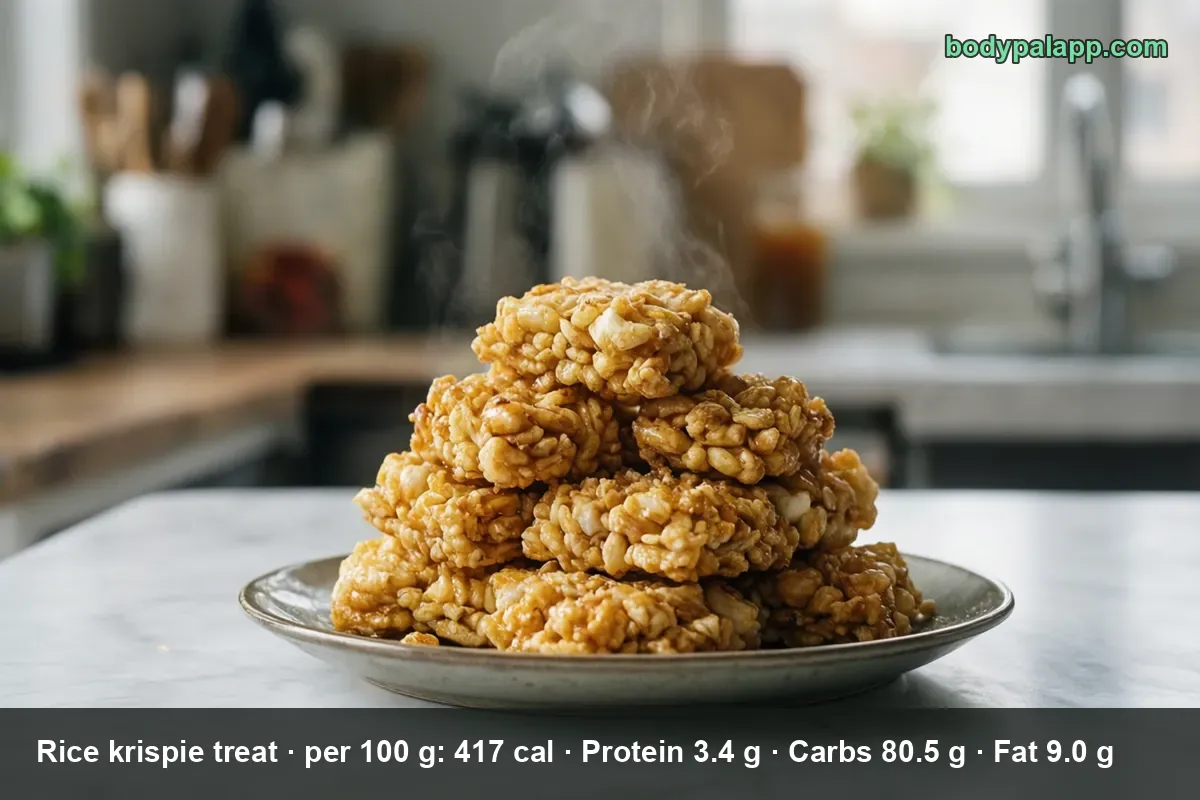
One Kellogg's Rice Krispies Treats square weighs 22 g and carries 92 calories. Per 100 g the bar runs 417 calories, which is dense for something that feels like air — the crisped rice is mostly puffed starch, and the marshmallow and butter that hold it together do the rest of the counting.
On this page
- Rice krispie treat quick facts
- US servings, from one square to a plate of four
- Bakery squares, holiday flavors and the homemade pan
- Carbs and sodium are the rows to watch
- How does a rice krispie treat compare?
- Most popular rice krispie treat brands
- FAQ
Rice krispie treat quick facts
The row on this page is the one you actually hold: SR Legacy 169687, "Snacks, KELLOGG, KELLOGG'S RICE KRISPIES TREATS Squares". It is the wrapped factory bar, and USDA gives it its own household serving of 22 g, so the per-square column below is a real serving rather than something we invented.
That matters more than usual with this snack. Most of the numbers people quote online are for a hand-cut square from a 9x13 pan, which is two to three times the weight of the wrapped bar. Both are below, and they are not the same food-sized thing.
| Nutrient | Per 100 g | Per 1 square (22 g) | % Daily Value |
|---|---|---|---|
| Calories | 417 | 92 | — |
| Total fat | 9 g | 2.0 g | 3% |
| Saturated fat | 1.4 g | 0.3 g | 2% |
| Carbohydrate | 80.5 g | 17.7 g | 6% |
| Dietary fiber | 0 g | 0 g | 0% |
| Total sugars | 19.36 g | 4.3 g | — |
| Protein | 3.4 g | 0.7 g | 1% |
| Sodium | 351 mg | 77 mg | 3% |
% Daily Value is based on a 2,000-calorie diet.
Verified nutrition data
Numbers on this page come from USDA FoodData Central, the U.S. Department of Agriculture’s food composition database, and from manufacturer labels where a branded product is named. Last verified September 2026. How we verify our data →
Two rows you would see on the wrapper are missing here on purpose. The SR Legacy edition of this record does not carry added sugars or trans fat at all, so we leave them out rather than guess — the 19.36 g of total sugars per 100 g is the only sugar figure USDA publishes for it. Cholesterol is 0 mg, which figures for a butter-and-marshmallow bar this small, and potassium is 39 mg per 100 g, or 9 mg in a square: less than 1% of the Daily Value.
US servings, from one square to a plate of four
| Serving | Weight | Calories |
|---|---|---|
| 1 square, wrapped factory bar | 22 g | 92 kcal |
| 1 oz | 28 g | 118 kcal |
| 2 squares | 44 g | 183 kcal |
| 4 squares, a plate | 88 g | 367 kcal |
| 1 large bakery square | 57 g | 238 kcal |
| Per 100 g | 100 g | 417 kcal |
Only the 22 g line is a USDA household measure. The ounce, the multiples and the 57 g bakery square are our own arithmetic from the USDA 100 g figure, not USDA servings — at 4.17 calories per gram, you can scale any weight yourself by multiplying grams by 4.17.
The practical trap is the plate. Four small squares look like a modest handful and land at 367 calories, more than a glazed doughnut, because nothing in the bar slows you down: no fiber, 0.7 g of protein per square, and a texture that is 90% air by feel and 80.5 g of carbohydrate per 100 g by the numbers.
Bakery squares, holiday flavors and the homemade pan
| Version | Per 100 g | Typical piece | Calories |
|---|---|---|---|
| Kellogg's Rice Krispies Treats square, original | 417 kcal | 1 square (22 g) | 92 kcal |
| Bakery-size square, cut from a pan | 417 kcal | 1 large square (57 g) | 238 kcal |
| Treat House Christmas confetti treat | 421 kcal | 2 oz (57 g) | 240 kcal |
| Treat House Easter jelly bean treat | 368 kcal | 2 oz (57 g) | 210 kcal |
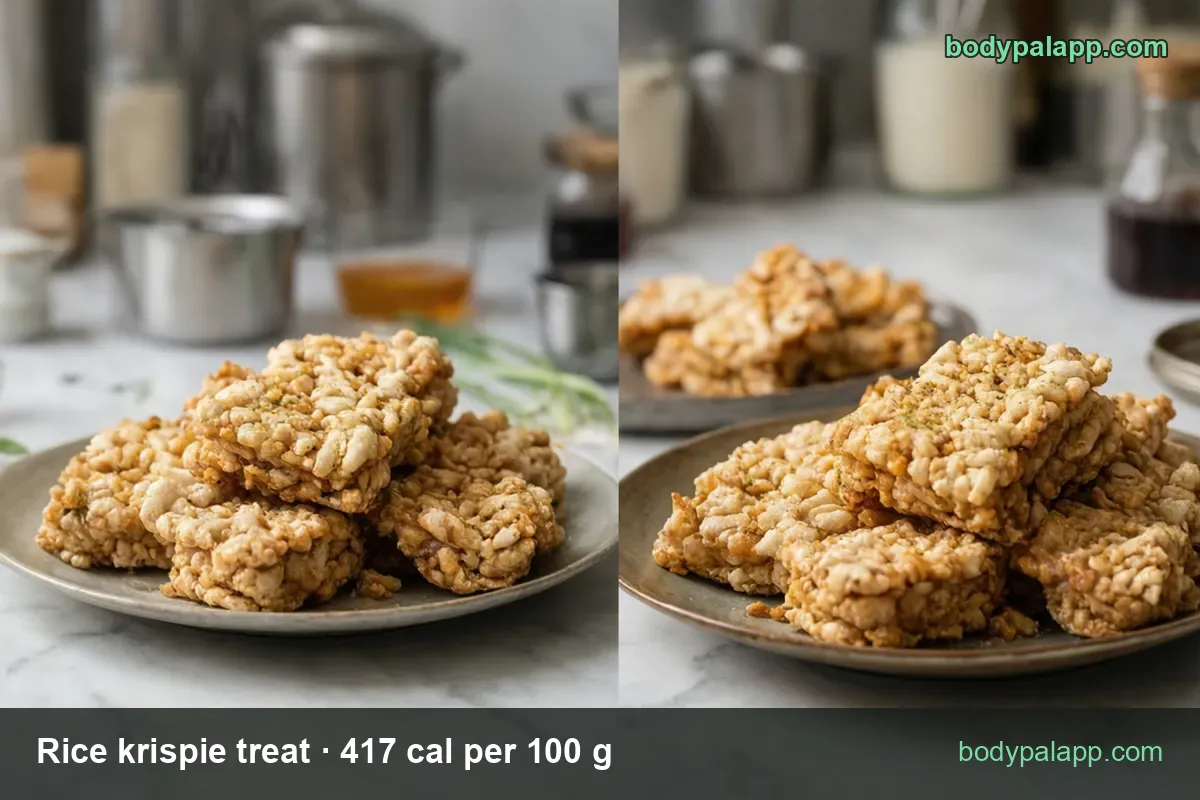
The size gap is the whole story. A wrapped bar is 22 g; a cafe or bake-sale square is usually about 57 g, and at the same density that is 238 calories — more than double the same-shaped snack. If you logged "one rice krispie treat" after a coffee shop, 92 is almost certainly the wrong entry.
Branded holiday versions stay in the same band per gram. The confetti square is 421 calories per 100 g, four above the original, and the jelly bean version 368, about 12% below it, so the sprinkles and candy pieces move the color more than the count. Both are sold at 2 oz, which is why they read as 240 and 210 rather than 92.
Homemade is the one number we can't hand you. USDA does not publish a record for a home-made pan, and the ratio of butter and marshmallow to cereal varies by cook, so treat the factory row as the floor: a heavier hand with butter pushes the fat row up from 9 g per 100 g, not down. Weigh your square once, multiply by 4.17, and you'll be closer than any generic estimate.
Carbs and sodium are the rows to watch
Fat is not the issue here. A square carries 2.0 g of total fat, 3% of the Daily Value, and 0.3 g of saturated fat. The calories come almost entirely from carbohydrate: 80.5 g per 100 g, which is 29% of the FDA Daily Value of 275 g, with 0 g of fiber against a 28 g Daily Value. Grain snacks like this one sit at the opposite end of the MyPlate grains group from the whole grains the guidance actually asks for.
Then there is the salt, which nobody expects in a dessert. The bar runs 351 mg of sodium per 100 g. One square is 77 mg, easy to ignore, but a plate of four is 88 g and 309 mg — 13% of the 2,300 mg Daily Value, roughly an eighth of a teaspoon of table salt, from something you were counting as candy.
On sugar, USDA gives 19.36 g per 100 g of total sugars and 4.3 g in a square, but no added-sugars breakdown in this record, so we won't pretend to know how that splits against the Dietary Guidelines limit. If you're watching sugar rather than calories, weigh the square first: the difference between a 22 g bar and a 57 g bakery cut is about 7 g of sugar.
How does a rice krispie treat compare?
| Snack | Per 100 g | US serving | Calories |
|---|---|---|---|
| Rice krispie treat | 417 kcal | 1 square, 22 g | 92 kcal |
| Rice crackers | 416 kcal | 1 oz, 28 g | 118 kcal |
| Soft granola bar, chocolate chip | 418 kcal | 1 oz, 28 g | 119 kcal |
| KUDOS whole grain bar with M&M's | 415 kcal | 1 oz, 28 g | 118 kcal |
All four sit between 415 and 418 calories per 100 g — a spread of three calories across four very different snacks. What changes is where the calories come from. The granola bar gets 16.57 g of fat per 100 g against 9 g here, and rice crackers deliver 10 g of protein per 100 g, nearly triple the 3.4 g in a treat.
Our take: the rice krispie treat wins on portion control and loses on everything else. Because the factory bar is only 22 g, it is the cheapest of these to fit into a day — 92 calories versus roughly 118 for an ounce of any of the others. But per gram it is the emptiest: no fiber, almost no protein, and 19.36 g of sugars per 100 g. Buy the wrapped squares, not the pan, and the size does the work for you.
Most popular rice krispie treat brands in the United States
Ranked by how widely each product appears among foods sold in the United States, from the BodyPal food database of over 3.3 million products. Calories are the figures printed on each Nutrition Facts label, checked against USDA FoodData Central.
| Product | Calories (per 100 g) |
|---|---|
| Treat House Christmas Confetti Rice Krispie Treat | 421 cal |
| Treat House Easter Jelly Bean Rice Krispie Treat | 368 cal |
Brand popularity: BodyPal food database. Nutrition: manufacturer labels / USDA FoodData Central.
Rice krispie treat FAQs
How many calories are in a rice krispie treat?
92 calories for one standard Kellogg's square of 22 g, or 417 calories per 100 g. That is the factory-wrapped bar, the one USDA lists with its own 22 g serving. A bakery square cut from a pan is usually 57 g, which works out to 238 calories.
How many calories are in a big rice krispie treat?
238 calories for a 57 g bakery square, more than double the 92 in a wrapped 22 g bar. That figure is our own arithmetic from the USDA 100 g value, not a USDA serving. Two of the Treat House holiday squares, also 57 g, land at 240 and 210.
How many carbs are in a rice krispie treat?
17.7 g of carbohydrate in one 22 g square, 6% of the Daily Value. Per 100 g the bar is 80.5 g of carbohydrate, or 29% DV, which is about as carb-dense as a snack gets. None of it is fiber, so every gram counts as available carbohydrate.
How much sugar is in a rice krispie treat?
4.3 g of total sugars in one 22 g square, and 19.36 g per 100 g. A 57 g bakery square carries about 11 g. USDA's SR Legacy record does not break out added sugars for this product, so we can't give you that split — total sugars is the honest number here.
How much sodium is in a rice krispie treat?
77 mg in one 22 g square, 3% of the Daily Value. Per 100 g it is 351 mg, which is real salt for something sweet. Four squares on a plate, 88 g, come to 309 mg — 13% DV, roughly an eighth of a teaspoon of table salt.
Do rice krispie treats have fiber?
0 g. USDA lists no dietary fiber at all in this record, per 100 g or per square, against a Daily Value of 28 g. Crisped rice is made from milled white rice, and marshmallow adds nothing. If you want fiber from a grain snack, this is not the one.
Are rice krispie treats healthy?
One 22 g square is 92 calories, 0.7 g protein and 0 g fiber — a small sweet, not a snack that holds you. At 29% DV carbohydrate per 100 g and nothing in the fiber row, it fills a calorie slot without doing much else. Fine as a treat, poor as fuel.
How many calories are in two rice krispie treats?
183 calories for two 22 g squares, 44 g in total — our own arithmetic from the USDA 100 g figure, not a USDA serving. That pair brings 35.4 g of carbohydrate, 8.5 g of sugars and 154 mg of sodium. Three squares would be 275, four 367.
Similar foods
- Rice Cake — 51 cal per rice cake
- Chocolate Rice Cake — 80 cal per cake
- Uncooked White Rice — 716 cal per cup
- Chicken Over Rice — 790 cal per platter
- Egg Rice — 289 cal per cup
- Shrimp Rice — 329 cal per cup
Count it without the math
Point the camera at the plate and BodyPal counts the squares for you, bakery-size or wrapped.


How long does it take to burn off 92 kcal of rice krispie treat?
One square (22 g) is 92 kcal. Enter your weight and the amount you ate to see how long it takes you to burn that off:
lb
| Activity | Time to burn 92 kcal |
|---|---|
| Walking, brisk | 18 min |
| Cycling, moderate | 12 min |
| Swimming, moderate | 13 min |
| Jogging | 11 min |
| Weight training, moderate | 20 min |
Times are for a 155 lb adult at a steady pace; change the weight to see yours. The amount is set to the portion in the text (22 g); change it to what you actually ate. BodyPal works this out from your steps automatically.
One food is easy to picture; a whole day is harder. See how many calories you need a day and what a deficit actually looks like.