
How many calories are in roast pork?
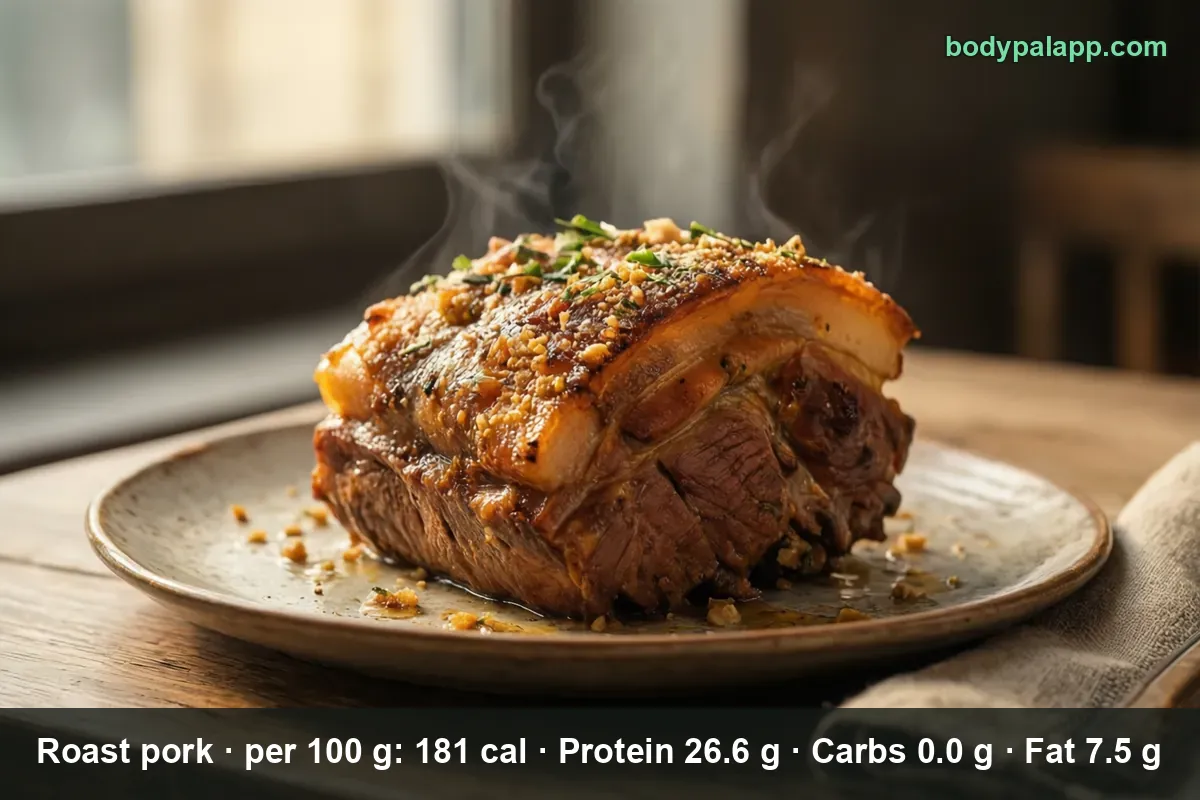
One thick slice of roast pork, about 90 g carved off the joint, is 163 calories. Per 100 g the same roast runs 181 calories, with 26.63 g of protein and no carbohydrate at all. Cut it thinner, at 60 g, and a slice drops to 109.
On this page
- Roast pork quick facts
- US servings from one slice to a cup
- The cut moves the number more than the roasting does
- Protein and sodium are the rows to watch
- How does roast pork compare?
- Most popular roast pork brands
- FAQ
Roast pork quick facts
The number most people need is for the meat they are actually carving: seasoned, cooked, a normal mix of lean and the fat that renders into it. That is the FNDDS record 2705882, "Pork, roast", and it is the only roast pork entry USDA publishes with real household measures — slices and cups, not just grams. Everything on this page is built on it unless a row says otherwise.
The lean-only cuts further down are cleaner laboratory numbers, but they describe meat with the fat trimmed off and no salt in the pan. They are useful for comparison, not for a Sunday plate.
| Nutrient | Per 100 g | Per 1 thick slice (90 g) | % Daily Value |
|---|---|---|---|
| Calories | 181 | 163 | — |
| Total fat | 7.49 g | 6.7 g | 9% |
| Saturated fat | 2.36 g | 2.1 g | 11% |
| Carbohydrate | 0 g | 0 g | 0% |
| Dietary fiber | 0 g | 0 g | 0% |
| Total sugars | 0 g | 0 g | — |
| Protein | 26.63 g | 24.0 g | 48% |
| Sodium | 353 mg | 318 mg | 14% |
| Cholesterol | 79 mg | 71 mg | 24% |
| Potassium | 350 mg | 315 mg | 7% |
% Daily Value is based on a 2,000-calorie diet.
Verified nutrition data
Numbers on this page come from USDA FoodData Central, the U.S. Department of Agriculture’s food composition database, and from manufacturer labels where a branded product is named. Last verified September 2026. How we verify our data →
Two rows you would see on a packaged label are missing here: added sugars and trans fat. USDA does not publish either value for this roast pork record, so rather than guess them, they are left out.
US servings from one slice to a cup
| Serving | Weight | Calories |
|---|---|---|
| 1 cubic inch | 17 g | 31 kcal |
| 1 oz | 28 g | 51 kcal |
| One regular slice | 60 g | 109 kcal |
| One thick slice | 90 g | 163 kcal |
| 1 cup, diced | 135 g | 244 kcal |
| Per 100 g | 100 g | 181 kcal |
The slices, the cup and the cubic inch are USDA's own household measures for this record. The 1 oz line is our own arithmetic from the USDA 100 g figure, not a USDA serving, and it is there because deli counters and recipes still price pork by the ounce.
The cup is where people get caught. A cup of diced roast pork weighs 135 g and carries 244 calories — roughly 1.6 times the 3 oz portion most of us picture when we say "a serving of pork." It also delivers 72% of the Daily Value for protein in one measure, which is either the best news on the plate or a reason to serve less of it, depending on what else you are eating.
Going the other way, a single cubic inch of leftover roast picked out of the fridge is 31 calories. Four of them, which is about what a hand grabs, is 124 — the same as a small snack you would have logged without thinking.
The cut moves the number more than the roasting does
Roasting does not change pork much. The cut does. The same 3 oz serving swings from 122 calories to 248 depending on which piece of the animal went into the oven and whether the fat cap stayed on.
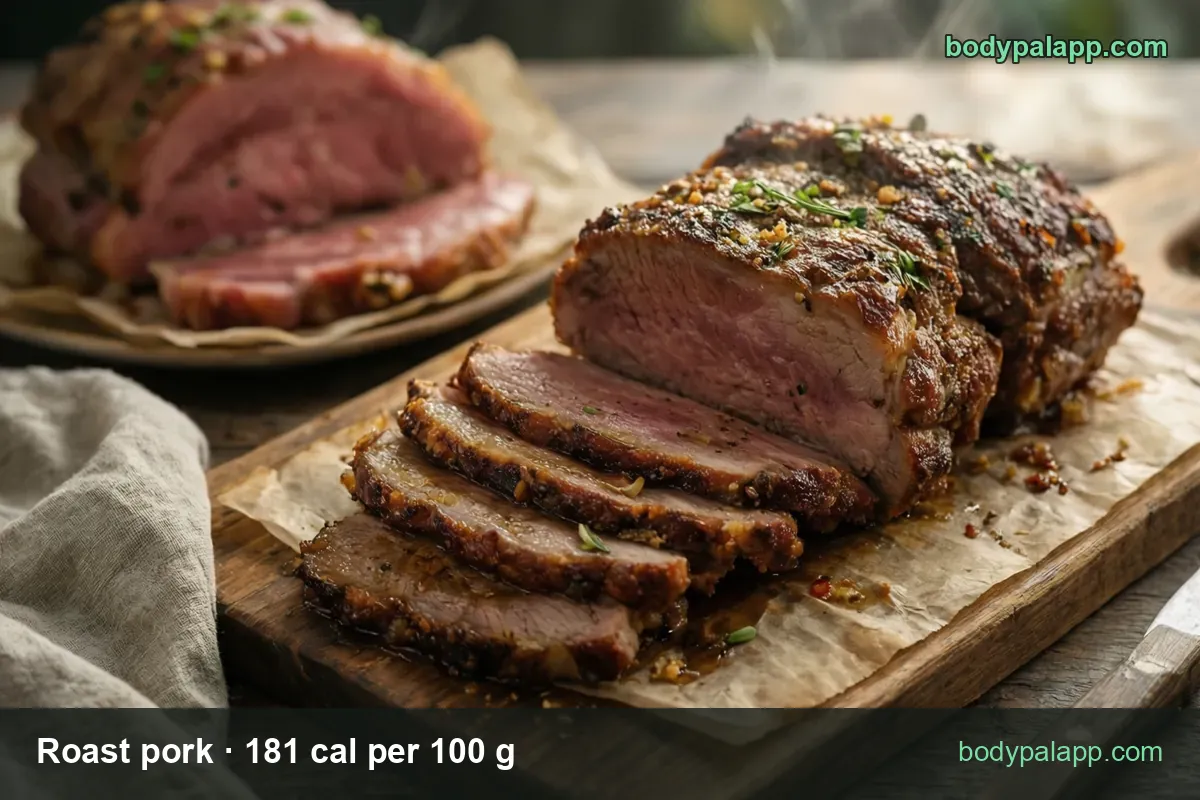
| Version | Per 100 g | Typical serving | Calories |
|---|---|---|---|
| Tenderloin, lean only | 143 kcal | 3 oz (85 g) | 122 kcal |
| Top loin roast, lean only | 173 kcal | 3 oz (85 g) | 147 kcal |
| Fresh ham (leg), lean only | 211 kcal | 3 oz (85 g) | 179 kcal |
| Whole loin, lean and fat | 248 kcal | 3 oz (85 g) | 211 kcal |
| Shoulder (Boston butt), lean only | 232 kcal | 3 oz (85 g) | 197 kcal |
| Shoulder (Boston butt), lean and fat | 292 kcal | 3 oz (85 g) | 248 kcal |
Two things fall out of that table. First, leaving the fat on costs more than choosing a fattier cut: loin goes from 173 to 248 calories per 100 g when the fat is eaten, a jump of 75, while shoulder goes from 232 to 292, a jump of 60. Second, a lean shoulder roast at 197 calories per 3 oz is heavier than either lean loin cut, 147 for top loin and 122 for tenderloin — pulled pork is not a light meat, however carefully you carve it.
Deli roast pork is its own category and worth reading the package for. USDA's branded records put Hatfield Deli Choice cooked roast pork at 232 calories per 100 g, or 130 in a 2 oz serving, while Dietz & Watson Italian style roast pork lands at 107 per 100 g, or 60 in the same 2 oz. Same words on the label, more than double the calories in one of them.
Protein and sodium are the rows to watch
One thick slice covers 48% of the Daily Value for protein. Two slices, which is a normal dinner portion, take you to 96% — essentially a full day from the meat alone. That is the honest reason roast pork works in a calorie deficit: at 181 calories per 100 g it buys more protein per calorie than almost anything else that comes out of an oven whole. MyPlate counts 1 oz of cooked meat as one ounce-equivalent in the protein group, so a thick slice is roughly three of them.
Sodium is the row that changes depending on what you bought. The FNDDS roast, salted the way a home cook salts it, is 353 mg per 100 g — 15% of the FDA Daily Value of 2,300 mg. A thick slice is 318 mg, about an eighth of a teaspoon of table salt. Untouched lean cuts are far lower: top loin roasted without salt is 47 mg per 100 g.
Then there is cured ham. Roasted lean cured ham is 157 calories per 100 g, lighter than the fresh roast, which makes it look like the smart pick. It also carries 1,327 mg of sodium per 100 g — 58% of the Daily Value per 100 g, and roughly 21 times the 64 mg in the same leg roasted fresh. If sodium is what you are managing, the fresh roast wins by a distance even though it costs you more calories.
Saturated fat is milder than pork's reputation suggests. A thick slice is 2.1 g, 11% of the Daily Value. Cholesterol is the quieter number at 71 mg per slice, 24% of the DV.
How does roast pork compare?
| Cut | Per 100 g | US serving | Calories |
|---|---|---|---|
| Roast pork, as carved | 181 kcal | one thick slice, 90 g | 163 kcal |
| Top loin roast, lean only | 173 kcal | 3 oz, 85 g | 147 kcal |
| Tenderloin, lean only | 143 kcal | 3 oz, 85 g | 122 kcal |
| Shoulder blade Boston roast, lean only | 232 kcal | 3 oz, 85 g | 197 kcal |
Our take: tenderloin is the lightest of the four per 100 g and the one to buy if the calorie budget is tight, because it gives up almost no protein — 26.17 g against 26.63 g — to save 38 calories per 100 g. For a roast that feeds people and still slices well, top loin is the better compromise at 173. Shoulder is the outlier: at 232 calories per 100 g lean, a modest-looking 3 oz portion of pulled pork is 197 calories before any sauce, which is where most barbecue plates quietly go wrong. Serve shoulder by the slice, not by the pile.
Most popular roast pork brands in the United States
Ranked by how widely each product appears among foods sold in the United States, from the BodyPal food database of over 3.3 million products. Calories are the figures printed on each Nutrition Facts label, checked against USDA FoodData Central.
| Product | Calories (per 100 g) |
|---|---|
| Hatfield Deli Choice Cooked Roast Pork | 232 cal |
| Dietz & Watson Italian Style Roast Pork | 107 cal |
Brand popularity: BodyPal food database. Nutrition: manufacturer labels / USDA FoodData Central.
Roast pork FAQs
How many calories are in a slice of roast pork?
A thick 90 g slice carries 163 calories and a thinner 60 g slice 109. The roast runs 181 calories per 100 g, so the thickness of the carve decides almost everything. If you dice it instead, a full cup at 135 g comes to 244 calories, more than either slice.
How many calories in 3 oz of roast pork?
Three ounces is 85 g, which works out to 154 calories at 181 per 100 g — our own arithmetic from the USDA figure, not a USDA serving. Lean top loin at the same weight is 147, tenderloin 122 and lean Boston shoulder 197, so the cut matters more than the ounces do.
Is roast pork high in protein?
Yes: 26.63 g per 100 g, and 24.0 g in a single thick slice, which is 48% of the Daily Value on a 2,000-calorie diet. Two slices cover almost all of it. Very little else served whole from an oven is that protein-dense at only 181 calories per 100 g.
How do roast pork and pork tenderloin calories compare?
Tenderloin is lighter: 143 calories per 100 g against 181 for a general roast, and 122 for a 3 oz serving against 147 for lean top loin. The protein barely moves, 26.17 g versus 26.63 g. The whole difference is fat, 3.51 g against 7.49 g per 100 g.
Is roast pork healthy for weight loss?
At 181 calories per 100 g with 26.63 g of protein and zero carbohydrate, it sits comfortably in a calorie deficit. Pick tenderloin or lean loin at 143 and 173 per 100 g and it gets easier still. What usually breaks the budget is the crackling, the gravy and the potatoes beside it.
How much sodium is in roast pork?
A thick slice holds 318 mg of sodium, 14% of the Daily Value and about an eighth of a teaspoon of table salt. Per 100 g the seasoned roast is 353 mg. Cured ham is a different animal at 1,327 mg per 100 g, roughly 21 times the fresh leg roasted plain.
Does the crackling add a lot of calories?
USDA publishes no separate record for crackling, but the lean-versus-fat rows show the scale of it: pork loin goes from 173 calories per 100 g lean to 248 with the fat left on, and shoulder from 232 to 292. Expect roughly 60 to 75 extra calories per 100 g eaten.
Is roast pork keto friendly?
Yes: roast pork has 0 g of carbohydrate and 0 g of sugar per 100 g, so a thick slice adds nothing at all to a carb count. It brings 7.49 g of fat and 26.63 g of protein per 100 g. The gravy and any sugar in the glaze are what to watch instead.
Similar foods
- Pork Chop — 220 cal per regular chop
- Pork Cutlet — 165 cal per thin cutlet
- Turkey Thigh — 637 cal per thigh
- Chicken Leg — 475 cal per leg
- Chicken Thigh Without Skin — 125 cal per medium thigh
- Chicken Hearts — 268 cal per cup, chopped
Count it without the math
Point the camera at the carving board and BodyPal counts the slices for you, thick or thin.


How long does it take to burn off roast pork?
One thick slice (90 g) is 163 kcal. Enter your weight and the amount you ate to see how long it takes you to burn that off:
lb
| Activity | Time to burn 163 kcal |
|---|---|
| Walking, brisk | 33 min |
| Cycling, moderate | 20 min |
| Swimming, moderate | 23 min |
| Jogging | 19 min |
| Weight training, moderate | 36 min |
Times are for a 155 lb adult at a steady pace; change the weight to see yours. The amount is set to the portion in the text (90 g); change it to what you actually ate. BodyPal works this out from your steps automatically.
One food is easy to picture; a whole day is harder. See how many calories you need a day and what a deficit actually looks like.