
How many calories are in a pork cutlet?
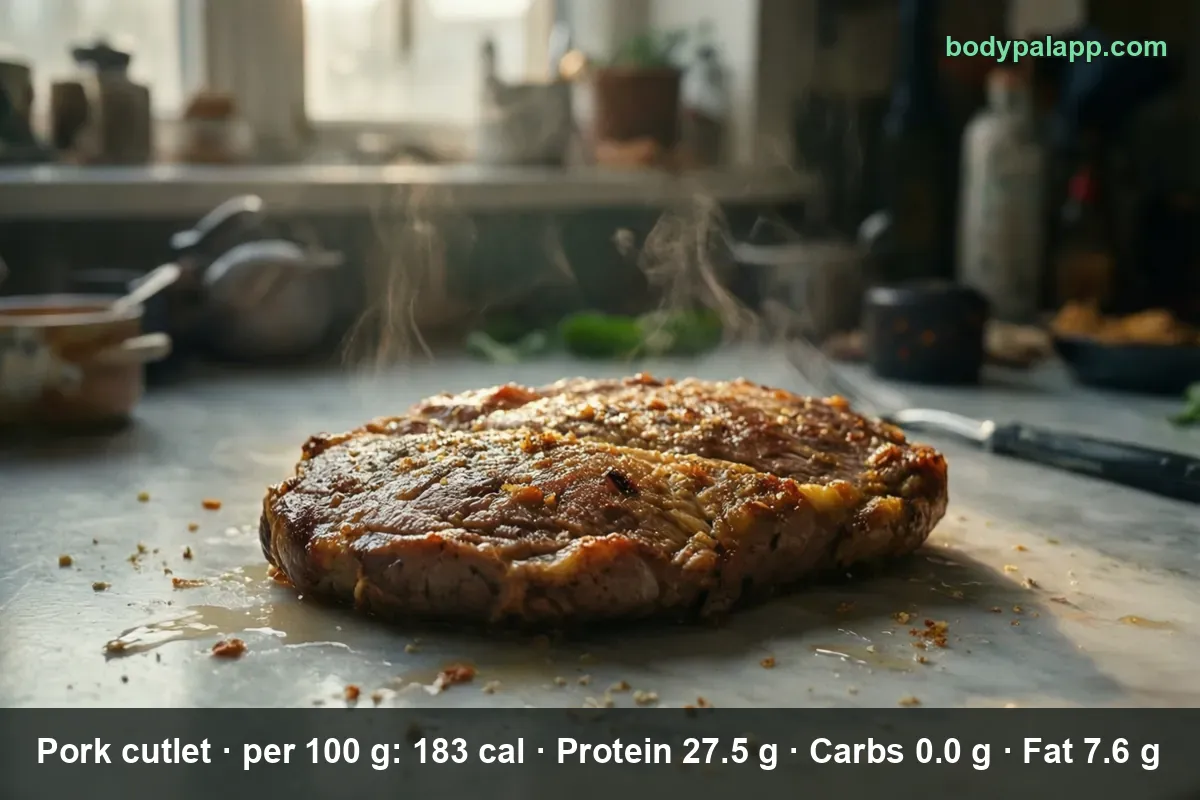
One thin pork cutlet weighs about 90 g and lands at 165 calories. Per 100 g the cooked, unbreaded meat runs 183 calories, with 27.5 g of protein and no carbohydrate at all. A thicker 120 g cutlet moves the number to 220, and breading it pushes it past 260.
On this page
- Pork cutlet quick facts
- US servings from one ounce to a cup of diced cutlet
- Breaded and trimmed pork cutlet variants
- Protein at 50 percent DV and the sodium that comes with it
- How does a pork cutlet compare?
- Most popular pork cutlet brands
- FAQ
Pork cutlet quick facts
In American kitchens a pork cutlet is a boneless loin chop sliced thin, seasoned and cooked through. The record that matches what ends up on the plate is USDA FNDDS 2705866, "Pork, chop, NS as to fat eaten" — cooked, salted, with the fat eaten as it comes rather than trimmed off or deliberately left behind. It carries the household portions people actually use: thin, regular and thick.
That record is unbreaded on purpose. Coating changes the food enough to deserve its own numbers, so the breaded versions get their own section further down instead of being blended into this table.
| Nutrient | Per 100 g | Per 1 thin cutlet (90 g) | % Daily Value |
|---|---|---|---|
| Calories | 183 | 165 | — |
| Total fat | 7.55 g | 6.8 g | 9% |
| Saturated fat | 2.6 g | 2.3 g | 12% |
| Carbohydrate | 0 g | 0 g | 0% |
| Dietary fiber | 0 g | 0 g | 0% |
| Total sugars | 0 g | 0 g | — |
| Protein | 27.5 g | 24.8 g | 50% |
| Sodium | 354 mg | 319 mg | 14% |
% Daily Value is based on a 2,000-calorie diet.
Verified nutrition data
Numbers on this page come from USDA FoodData Central, the U.S. Department of Agriculture’s food composition database, and from manufacturer labels where a branded product is named. Last verified September 2026. How we verify our data →
There is no added sugars row and no trans fat row here, because FNDDS does not publish either value for this record — and plain cooked pork has nothing to add sugar to. Two rows that did not fit the label order are worth knowing anyway: one thin cutlet holds 64 mg of cholesterol (21% DV) and 386 mg of potassium (8% DV).
US servings from one ounce to a cup of diced cutlet
| Serving | Weight | Calories |
|---|---|---|
| 1 oz cooked | 28 g | 51 kcal |
| One thin cutlet | 90 g | 165 kcal |
| One regular cutlet | 120 g | 220 kcal |
| 1 cup, diced | 135 g | 247 kcal |
| 4 oz cooked | 113 g | 207 kcal |
| Per 100 g | 100 g | 183 kcal |
The thin cutlet, the regular cutlet and the cup of diced meat are USDA household measures attached to this record. The two ounce-based lines are our own arithmetic from the USDA 100 g figure, not USDA servings — useful, because most American recipes and diner menus talk in ounces.
Here is the trap. A cup of diced cutlet looks like a modest side, yet at 135 g it comes to 247 calories — more than a whole regular cutlet of 120 g at 220. Dicing packs the meat down. If you log by cup, you are logging more pork than the piece you started with, not less.
Breaded and trimmed pork cutlet variants
| Version | Per 100 g | Typical piece | Calories |
|---|---|---|---|
| Breaded pork cutlet | 219 kcal | one regular, 120 g | 263 kcal |
| Breaded cutlet, lean only eaten | 208 kcal | one regular, 120 g | 250 kcal |
| Pork cutlet, lean only trimmed | 171 kcal | one thin, 90 g | 154 kcal |
| Pork cutlet, lean and fat eaten | 195 kcal | one thin, 90 g | 176 kcal |
| Raw boneless loin cutlet | 168 kcal | 4 oz raw, 113 g | 190 kcal |
| Broiled boneless loin steak | 158 kcal | 3 oz, 85 g | 134 kcal |
Breading is the single biggest lever on this page. The coated cutlet runs 219 calories per 100 g against 183 plain, so a regular 120 g piece goes from 220 to 263. Trim the fat before coating and you claw back 13 of those, landing at 250 — the crust costs more than the fat does.
Trimming alone is a smaller move than most people expect. Eating the lean only takes a thin cutlet down to 154 calories; eating the fatty edge along with it takes the same piece up to 176. That is a 22-calorie spread on one cutlet, roughly the size of a splash of milk in coffee.
Retail packs read lower than all of this, and the reason is that they are labeled raw. Store-brand boneless loin chops sit between 119 and 161 calories per 100 g on the package — Smithfield, Swift, Private Selection, Prairie Fresh — because the water has not cooked out yet. Log the package number only if you are also weighing the meat raw.
Protein at 50 percent DV and the sodium that comes with it
One thin cutlet delivers 24.8 g of protein — half the FDA Daily Value of 50 g — for 165 calories and 12% DV saturated fat. Very little else in the meat case does that arithmetic as cleanly. MyPlate counts a cutlet this size as roughly three ounce-equivalents from the protein foods group, about half a day's target for a moderately active adult.
The row that surprises people is sodium: 319 mg in one thin cutlet, 14% of the 2,300 mg Daily Value. That is about a seventh of a teaspoon of table salt. It does not come from the pig. Raw boneless loin measures 40.2 mg of sodium per 100 g against 354 mg once cooked and seasoned — so nearly nine tenths of the sodium on your plate arrived from the salt shaker, the brine or the pan. Season lighter and that row moves; nothing else on the label does.
Cooking also concentrates the meat. Raw loin is 168 calories per 100 g, cooked cutlet 183. Water leaves, the piece shrinks, and 4 oz of raw pork is not 4 oz of dinner. Weigh at one stage and stay there.
How does a pork cutlet compare?
| Cut | Per 100 g | US serving | Calories |
|---|---|---|---|
| Pork cutlet, as eaten | 183 kcal | one thin cutlet, 90 g | 165 kcal |
| Top loin chop, lean, pan-fried | 172 kcal | 3 oz, 85 g | 146 kcal |
| Top loin chop, lean, broiled | 173 kcal | 3 oz, 85 g | 147 kcal |
| Sirloin chop, lean and fat, braised | 171 kcal | 3 oz, 85 g | 145 kcal |
Our take: the three loin chops all land within 2 calories of each other per 3 oz serving, which tells you the cooking method barely matters once the fat is handled. The as-eaten cutlet is the highest of the four per 100 g at 183, and the gap is fat left on the plate rather than anything the pan did. Cut the same 85 g from a cutlet and it is 156 calories by our arithmetic from the 100 g figure — about 10 more than those chops. For a lean high-protein dinner, take the cutlet and trim it; for the most food per calorie, the difference between these four is too small to plan around.
Most popular pork cutlet brands in the United States
Ranked by how widely each product appears among foods sold in the United States, from the BodyPal food database of over 3.3 million products. Calories are the figures printed on each Nutrition Facts label, checked against USDA FoodData Central.
| Product | Calories (per 100 g) |
|---|---|
| Smithfield Boneless Center Cut Pork Chops Thick Cut | 127 cal |
| Smithfield Boneless Pork Chops | 131 cal |
| Stampede Bone-In Pork Loin Chop | 141 cal |
| Swift Boneless Pork Loin Chops | 119 cal |
| Private Selection Boneless Pork Loin Chops | 152 cal |
| Prairie Fresh Signature Pork Loin Chops | 161 cal |
Brand popularity: BodyPal food database. Nutrition: manufacturer labels / USDA FoodData Central.
Pork cutlet FAQs
How many calories are in a pork cutlet?
A thin pork cutlet of 90 g has 165 calories, and a regular 120 g cutlet has 220. The cooked, unbreaded meat runs 183 calories per 100 g. That comes with 27.5 g of protein per 100 g and no carbohydrate at all, which is why the cutlet logs so cleanly.
How many calories in a breaded pork cutlet?
A breaded regular cutlet of 120 g is 263 calories, against 220 for the same piece uncoated. Per 100 g the coated version is 219 calories versus 183. The crust also brings 7.2 g of carbohydrate and 0.4 g of fiber per 100 g, both of which are zero in a plain cutlet.
How much protein is in a pork cutlet?
One thin 90 g cutlet carries 24.8 g of protein, which is 50% of the FDA Daily Value of 50 g. Per 100 g the figure is 27.5 g. A regular 120 g cutlet lands at 33 g. Very few 165-calorie foods put that much protein on a plate.
Is pork cutlet the same as a boneless pork chop?
Nutritionally, yes: both use the same USDA record at 183 calories per 100 g. A cutlet is simply a boneless loin chop sliced thin, so the difference is thickness, not the cut. That matters for weight only — 90 g thin, 120 g regular — and not for calories per ounce.
How many calories in 4 oz of pork cutlet?
Four ounces of cooked cutlet is 113 g and 207 calories, our own arithmetic from the USDA 100 g figure rather than a USDA serving. Four ounces weighed raw is a different food: raw boneless loin is 168 calories per 100 g, so the same 113 g comes to 190 calories.
Raw or cooked: which weight should I log?
Pick one stage and stay with it: cooked cutlet is 183 calories per 100 g, raw boneless loin only 168, because cooking drives water out and shrinks the piece. Weighing raw and logging the cooked number, or the reverse, is the most common way this food gets mislogged by 10 percent.
Is pork cutlet good for weight loss?
It is one of the better meat-case picks: 165 calories in a thin cutlet, 24.8 g of protein, zero carbohydrate and 12% DV saturated fat. Keep it unbreaded and you save 43 calories on a regular piece. If you are watching sodium, the seasoning is the row to control, not the pork.
How much sodium is in a cooked pork cutlet?
One thin cutlet holds 319 mg of sodium, 14% of the 2,300 mg Daily Value, or about a seventh of a teaspoon of table salt. Raw boneless loin measures just 40.2 mg per 100 g, so almost all of that sodium comes from seasoning and the pan, not the meat.
Similar foods
- Pork Chop — 220 cal per regular chop
- Turkey Thigh — 637 cal per thigh
- Chicken Leg — 475 cal per leg
- Chicken Hearts — 268 cal per cup, chopped
- Roast Pork — 163 cal per thick slice
- Pork Butt — 210 cal for 4 oz raw
Count it without the math
Point the camera at the plate and BodyPal counts the cutlet for you, breading and all.


How long does it take to burn off pork cutlet?
One thin cutlet (90 g) is 165 kcal. Enter your weight and the amount you ate to see how long it takes you to burn that off:
lb
| Activity | Time to burn 165 kcal |
|---|---|
| Walking, brisk | 33 min |
| Cycling, moderate | 21 min |
| Swimming, moderate | 24 min |
| Jogging | 19 min |
| Weight training, moderate | 37 min |
Times are for a 155 lb adult at a steady pace; change the weight to see yours. The amount is set to the portion in the text (90 g); change it to what you actually ate. BodyPal works this out from your steps automatically.
This table assumes you know your daily total. If you do not, the daily calorie calculator works it out from five numbers.