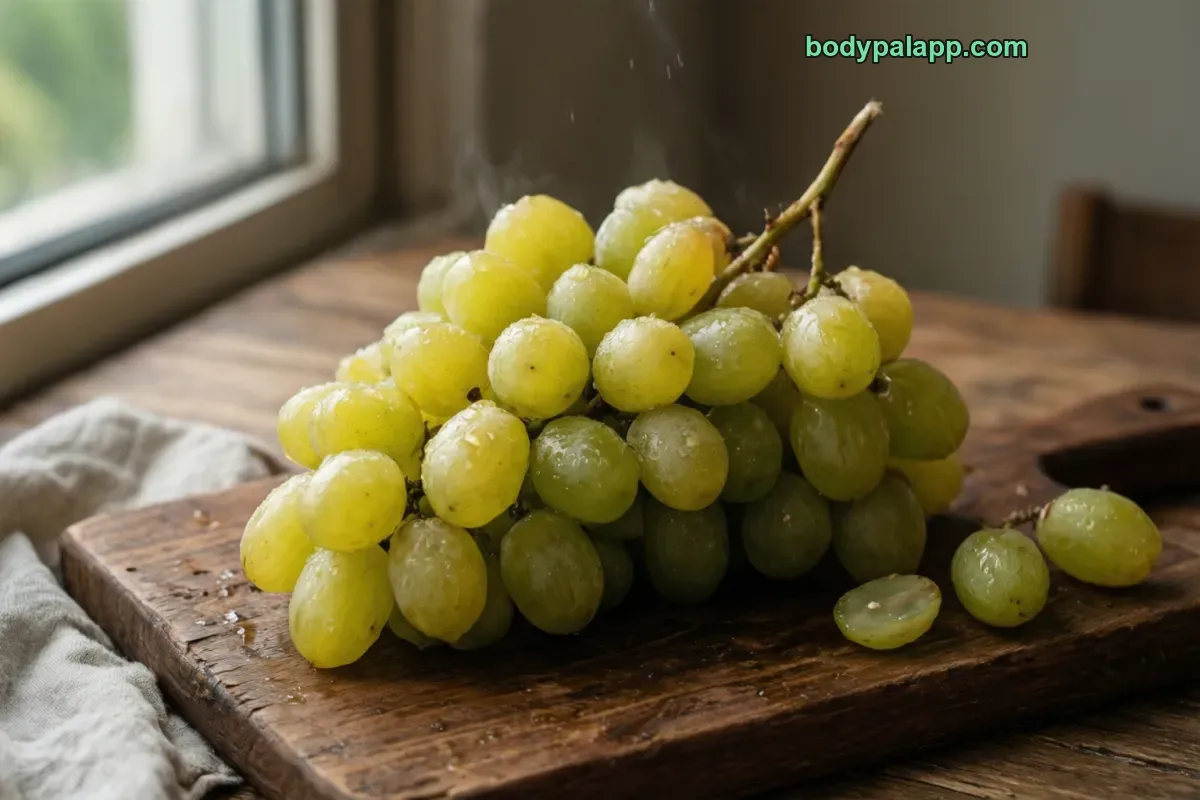
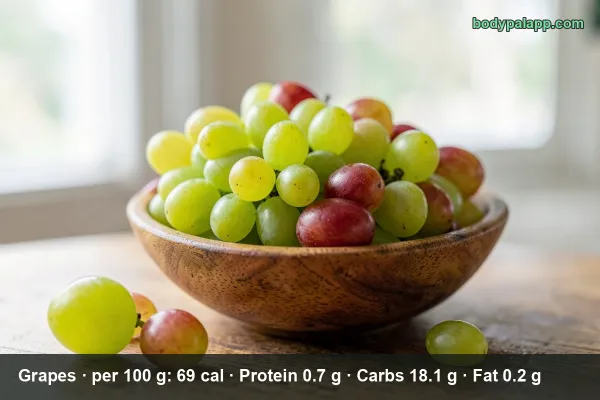
Seedless green grapes calories come to 104 for one cup (151 g) and 69 per 100 g, based on the USDA entry for raw Thompson seedless grapes. A count of 10 grapes (49 g) adds just 34. What you should notice: 94% of those calories come from carbohydrate, almost all of it sugar, so the size of the bowl matters most.
104kcal
1 cup · 151 g, raw, Thompson seedless
4%protein
1.1 gProtein
27 gCarbs
0.2 gFat
How to burn off 104 kcal
—Walking, brisk
—Jogging
—Cycling, moderate
—Swimming
Skip the math. BodyPal counts these calories from your steps and workouts automatically.
Nutrition facts
Raw, thompson seedless · per 151 g
Calories
104 kcal
Protein
1.1 g
Carbohydrate
27 g
Fat
0.2 g
Saturated fat
0.1 g
Cholesterol
0 mg
Sodium
3 mg
Potassium
288 mg
Iron
0.5 mg
Source: USDA FoodData Central
🛡️
Verified nutrition data
Numbers on this page come from USDA FoodData Central, the U.S. Department of Agriculture’s food composition database, and from manufacturer labels where a branded product is named. Last verified September 2026. How we verify our data →
Seedless green grapes: calories, protein and sodium by serving
Percent of daily value uses the FDA reference of 2,000 kcal a day.
Serving
kcal
Protein
Carbs
Fat
Sodium
% DV kcal
1 cup (151 g)
104
1.1 g
27.3 g
0.2 g
3 mg
5%
10 grapes (49 g)
34
0.4 g
8.9 g
0.1 g
1 mg
2%
100 g
69
0.7 g
18.1 g
0.2 g
2 mg
3%
3 × 1 cup (151 g)
313
3.3 g
9 mg
5 × 1 cup (151 g)
521
5.4 g
15 mg
A cup is 104 calories, a big bowl can pass 300
The standard cup (151 g) lands at 104 calories, about 5% of the daily value. A small count of 10 grapes (49 g) comes to 34 calories, which barely registers in a day. On their own, grapes are a light snack.
The catch is how people eat them. Nobody counts grapes; they pick from a bunch until it is gone. Two cups (302 g) reach 208 calories. Three cups (453 g) come to 313, and 5 cups (755 g), the kind of amount that vanishes from a shared bowl on a long evening, adds up to 521. The fruit stays the same; the total climbs with every handful.
If you track what you eat, the easiest fix is to portion grapes into a bowl instead of eating from the bag. Weighing once is even better: with 69 calories per 100 g, any amount on a kitchen scale converts quickly. You can also snap a photo and let BodyPal log the grapes for you, then adjust the grams if your bowl ran bigger than a cup.
Carbs supply 94% of every calorie
Grapes are a carbohydrate food, plain and simple. The calorie split is 94% carbs, 4% protein and 2% fat. Per 100 g you get 18.1 g of carbohydrate, 0.7 g of protein and 0.2 g of fat, with saturated fat at 0.1 g.
Scale that to the usual cup and the numbers read 27.3 g of carbs, 1.1 g of protein and 0.2 g of fat. The protein covers only about 2% of the daily value, so grapes do little to keep you full on their own. Fat is close to zero, which is why the calorie count stays low despite the sugar.
That profile makes grapes quick energy rather than a meal. They work as a sweet finish, a pre-workout bite or a swap for candy, but they will not carry you to the next meal by themselves. Treat them as the sweet part of a snack and build the rest around something with protein or fat.
Sugar is the row to watch, sodium is not
Most of the carbohydrate in grapes is sugar: 15.5 g per 100 g and 23.4 g in a cup (151 g). Even 10 grapes carry 7.6 g. This is sugar naturally present in the fruit, not added, but it still counts toward the total if you watch your sugar intake.
Fiber is modest. A cup gives 1.4 g, against a daily value of 28 g, and 100 g holds 0.9 g. Compared with the sugar, that is a thin buffer, which is part of why grapes go down so easily and why a bowl empties fast.
Sodium is a non-issue. A cup has 3 mg, which rounds to 0% of the daily value, and 100 g has 2 mg. Cholesterol is 0. Potassium is 191 mg per 100 g, a small contribution against the 4700 mg daily value. If you are counting sodium, grapes are an easy pick; if you are counting sugar, measure the portion.
Pair grapes with protein to make them last
Because grapes bring almost no protein or fat, they pair best with foods that do. A cup next to plain Greek yogurt, a piece of cheese or a small handful of nuts turns a quick sugar hit into a snack that holds you longer. The grapes add sweetness and water; the partner adds staying power.
Grapes also fit well into salads. Halved grapes with greens, grilled chicken and a sharp dressing give a meal sweetness without a sugary dressing. In chicken salad they stand in for dried fruit, which packs far more sugar into the same spoonful.
Freezing is the other trick worth knowing. Frozen grapes take longer to eat, so a single cup lasts through a show instead of disappearing in minutes. The calories do not change, but slowing down makes it easier to stop at one serving rather than reaching for a second or third cup.
How does seedless green grapes compare?
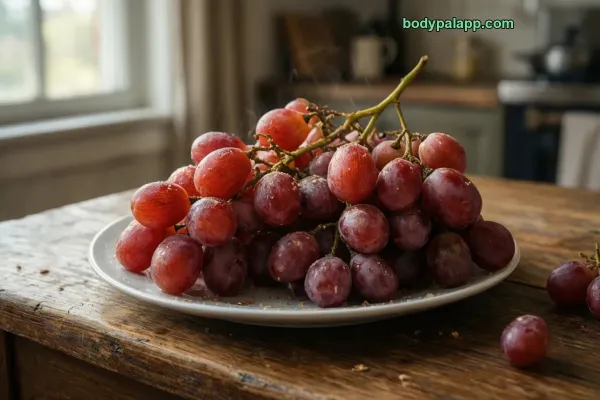
Here is how seedless green grapes stack up against green grapes, red seedless grapes and plain grapes, per 100 g and per usual serving.
Verdict: All of these entries share the same USDA data, so each reads 69 calories per 100 g and 104 per cup (151 g), with identical 18.1 g of carbs. Pick green or red by taste and price; for weight loss the color makes no difference, the size of the portion does.
Seedless green grapes FAQs
How many calories are in one cup of seedless green grapes?
About 104 calories in one cup (151 g) of raw seedless green grapes, and 34 calories in 10 grapes (49 g).
Are seedless green grapes good for weight loss?
A cup has 104 calories, 0.2 g of fat and 1.4 g of fiber. Per 100 g they have 69 calories.
Seedless green grapes vs red seedless grapes: which has fewer calories?
They are the same: both have 69 calories per 100 g, or 104 calories per cup (151 g).
How much sugar is in seedless green grapes?
One cup (151 g) has 23.4 g of sugar and 27.3 g of carbs. Per 100 g that is 15.5 g of sugar.
How many calories are in 10 seedless green grapes?
Ten seedless green grapes (49 g) have 34 calories, with 8.9 g of carbs, 7.6 g of sugars and 0.4 g of protein. That is about 2% of the daily calorie value, so a small handful barely moves your total.
How many calories are in 100 g of green grapes?
100 g of seedless green grapes has 69 calories. That weight holds 18.1 g of carbohydrate, 15.5 g of sugars, 0.9 g of fiber, 0.7 g of protein and 0.2 g of fat, so nearly all the energy comes from carbs.
How many calories are in 2 cups of green grapes?
Two cups of seedless green grapes (302 g) come to 208 calories with 2.2 g of protein and 6 mg of sodium. Three cups (453 g) reach 313 calories, so a large bowl adds up faster than it looks.
How much protein is in green grapes?
A cup of seedless green grapes (151 g) has 1.1 g of protein, about 2% of the daily value. Protein supplies only 4% of the calories, so pair grapes with yogurt, cheese or nuts if you want a filling snack.
How much fiber is in a cup of green grapes?
A cup of seedless green grapes (151 g) holds 1.4 g of fiber, against a daily value of 28 g. Per 100 g the figure is 0.9 g, which is low next to the 15.5 g of sugars in the same weight.
Are green grapes high in sodium?
No. A cup of seedless green grapes has 3 mg of sodium, which is 0% of the daily value, and 100 g has 2 mg. They also provide 191 mg of potassium per 100 g and no cholesterol.