
How many calories are in shrimp etouffee?
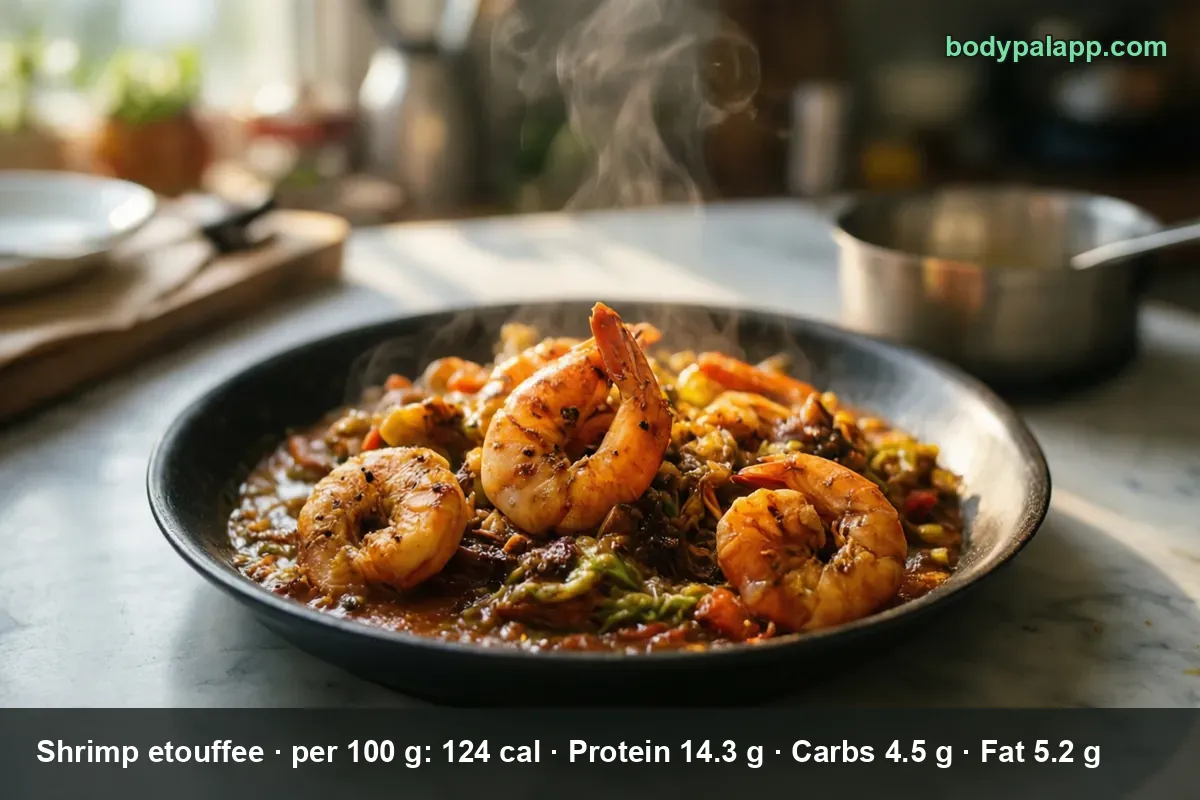
A 1-cup serving of shrimp etouffee, sauce and shrimp with no rice under it, is 305 calories. That works out to 124 calories per 100 grams, which is lighter than most people guess for a Louisiana dish built on a roux. The protein is the surprise: 35.3 grams in that cup.
On this page
- Shrimp etouffee quick facts
- US servings, from one ounce to two cups
- Over rice, jarred base and the frozen box
- Cholesterol, not fat, is the row to watch
- How does shrimp etouffee compare?
- Most popular shrimp etouffee brands
- FAQ
Shrimp etouffee quick facts
USDA does not publish a record called etouffee. The closest official entry, and the one used on this page, is FNDDS 2706856, "Shrimp creole, no rice": shrimp simmered in a seasoned sauce of onion, celery and bell pepper, served without a starch under it. That is the same plate an etouffee lands on, and it is the version people actually hold a fork over when they look this number up.
The difference between creole and etouffee in a home kitchen is the roux and the tomato, not the calorie math. A restaurant kitchen that darkens a heavy butter-and-flour roux will push the fat higher than the numbers below, but no federal record exists for that version, so nothing here guesses at it.
| Nutrient | Per 100 g | Per 1 cup (246 g) | % Daily Value |
|---|---|---|---|
| Calories | 124 | 305 | — |
| Total fat | 5.16 g | 12.7 g | 16% |
| Saturated fat | 1.09 g | 2.7 g | 13% |
| Carbohydrate | 4.51 g | 11.1 g | 4% |
| Dietary fiber | 1 g | 2.5 g | 9% |
| Total sugars | 1.32 g | 3.2 g | — |
| Protein | 14.33 g | 35.3 g | 71% |
| Sodium | 153 mg | 376 mg | 16% |
% Daily Value is based on a 2,000-calorie diet.
Verified nutrition data
Numbers on this page come from USDA FoodData Central, the U.S. Department of Agriculture’s food composition database, and from manufacturer labels where a branded product is named. Last verified September 2026. How we verify our data →
Two label rows are missing on purpose. Added sugars and trans fat have no entry in this FNDDS release for any mixed seafood dish, so printing a zero would be inventing data. Cholesterol and potassium do exist for this record: a cup carries 312 mg of cholesterol and 487 mg of potassium, worth 104% and 10% of the Daily Value in the FDA reference table.
US servings, from one ounce to two cups
| Serving | Weight | Calories |
|---|---|---|
| 1 oz | 28 g | 35 kcal |
| Per 100 g | 100 g | 124 kcal |
| 1/2 cup, a side ladle | 123 g | 153 kcal |
| 1 cup, the standard bowl | 246 g | 305 kcal |
| 1 1/2 cups | 369 g | 458 kcal |
| 2 cups, a hungry plate | 492 g | 610 kcal |
The 1-cup and 1/2-cup weights are USDA household measures for this record. The ounce, the cup-and-a-half and the two-cup lines are our own arithmetic from the USDA 100 g figure, not USDA servings, which is why they scale so cleanly.
Ladle size is where home tracking goes wrong. A restaurant bowl of etouffee is rarely a level cup, and the sauce is dense enough that a heaped serving spoon can add 60 to 80 grams without looking any different in the bowl. Two cups, the amount that comes out of a shared skillet on a Friday night, is 610 calories before a grain of rice or a piece of bread joins it.
Over rice, jarred base and the frozen box
| Version | Per 100 g | Typical serving | Calories |
|---|---|---|---|
| Etouffee, no rice | 124 kcal | 1 cup (246 g) | 305 kcal |
| Etouffee over rice | 123 kcal | 1 cup (243 g) | 299 kcal |
| Frozen etouffee entree | 106 kcal | 1 package (227 g) | 241 kcal |
| Jarred creole etouffee base | 263 kcal | 1/2 cup (118 g) | 310 kcal |
Here is the thing nobody writing about this dish says out loud. Rice does not add calories to a cup of etouffee, it swaps them. The mixed cup runs 123 calories per 100 grams against 124 for the sauce alone, so a full cup lands at 299 instead of 305, six calories lighter. What changes is what those calories are made of: protein falls from 35.3 g to 24.6 g, carbohydrate climbs from 11.1 g to 29.0 g, and sodium goes from 376 mg to 1,059 mg. You are eating a cup of cheaper food, not a cup of lighter food.
Boxed and jarred versions read differently again. A frozen shrimp etouffee entree sits at 106 calories per 100 g and 241 for the 227 g package, a genuinely small dinner that you will probably eat rice with. Jarred etouffee bases are concentrate, not dinner: one at 263 calories per 100 g means 310 calories in a half-cup jar measure before any shrimp goes in, while a lighter Cajun-style base runs 61 per 100 g and 149 in a full cup. Read the jar as an ingredient and add the shrimp separately.
Cholesterol, not fat, is the row to watch
For a dish with a reputation for richness, the fat rows are quiet. A cup gives 12.7 g of total fat and 2.7 g of saturated fat, 16% and 13% of the Daily Value. That is less saturated fat than a single tablespoon of butter.
Cholesterol is the outlier: 312 mg in one cup, 104% of the 300 mg Daily Value, and it comes from the shrimp rather than the sauce. The Dietary Guidelines for Americans ask people to keep dietary cholesterol as low as a healthy eating pattern allows rather than setting a hard cap, and shellfish is specifically named as a food to eat more of in the protein group. If a doctor has told you to watch cholesterol intake, the half-cup serving at 156 mg is the practical move.
The protein number deserves a second look too. At 35.3 g, one cup covers 71% of the Daily Value in a single bowl. MyPlate counts seafood twice a week as its own target, and etouffee without rice is one of the few comfort dishes that lands there. For satiety on a calorie budget, this is a strong 305 calories.
How does shrimp etouffee compare?
| Dish | Per 100 g | US serving | Calories |
|---|---|---|---|
| Shrimp etouffee, no rice | 124 kcal | 1 cup (246 g) | 305 kcal |
| Shrimp creole with rice | 123 kcal | 1 cup (243 g) | 299 kcal |
| Shrimp and vegetables, no sauce | 124 kcal | 1 oz (28 g) | 35 kcal |
| Shrimp and noodles with gravy | 131 kcal | 1 oz (28 g) | 37 kcal |
Look at the per-100-gram column: every dish here falls between 123 and 131 calories, a spread of eight. Shrimp dishes are dense in protein and light in energy no matter what you pour over them, so the sauce is not the villain in this family.
Our take: if you are cutting calories, order etouffee and skip the rice, because the rice costs you 10.7 g of protein and almost triples the sodium for a saving of six calories. If you want the meal to hold you until bedtime, the plain cup at 35.3 g of protein does more work per calorie than almost anything else on a Cajun menu. The only number that should change your order is cholesterol, and only if you have been told to track it.
Most popular shrimp etouffee brands in the United States
Ranked by how widely each product appears among foods sold in the United States, from the BodyPal food database of over 3.3 million products. Calories are the figures printed on each Nutrition Facts label, checked against USDA FoodData Central.
| Product | Calories (per 100 g) |
|---|---|
| Emeril's Creole Creations Shrimp Etouffee | 106 cal |
| Tastee Choice Shrimp Creole | 79 cal |
| Blue Runner Creole Etouffee Base | 263 cal |
| Blue Runner Shrimp Creole Base | 186 cal |
| Heritage Family Cajun Style Etouffee Base | 61 cal |
Brand popularity: BodyPal food database. Nutrition: manufacturer labels / USDA FoodData Central.
Shrimp etouffee FAQs
How many calories are in a cup of shrimp etouffee?
A 1-cup (246 g) serving with no rice under it is 305 calories, from the USDA record for shrimp creole without rice at 124 calories per 100 grams. Half a cup (123 g) is 153 calories and two cups run 610. That is the shrimp and sauce alone.
How many calories in shrimp etouffee with rice?
A 1-cup (243 g) serving over rice is 299 calories, six fewer than the same cup without it. The rice does not add calories, it displaces shrimp: protein drops from 35.3 g to 24.6 g, carbohydrate rises to 29.0 g, and sodium jumps from 376 mg to 1,059 mg per cup.
How much protein is in shrimp etouffee?
One cup delivers 35.3 g of protein, 71% of the Daily Value, from 14.33 g per 100 grams. That is one of the highest protein-per-calorie ratios in any Louisiana dish. Served over rice, the same cup gives 24.6 g because rice takes up room the shrimp would have filled.
How much sodium is in shrimp etouffee?
A cup without rice has 376 mg of sodium, 16% of the 2,300 mg Daily Value, or roughly a sixth of a teaspoon of table salt. The rice version is the trap at 1,059 mg per cup, 46% of a day, because the seasoning is spread through a larger, blander volume.
Is shrimp etouffee healthy?
For 305 calories a cup you get 35.3 g of protein, only 2.7 g of saturated fat and 11.1 g of carbohydrate, which is a strong trade. The caveat is cholesterol at 312 mg, 104% of the Daily Value. If you are watching that, half a cup at 156 mg works better.
How many carbs are in shrimp etouffee?
Just 11.1 g of carbohydrate in a 1-cup serving, 4% of the Daily Value, with 2.5 g of that fiber and 3.2 g sugars. Per 100 grams it is 4.51 g. Add rice and the same cup climbs to 29.0 g, which is where a low-carb plan gets derailed.
What is the difference between shrimp creole and shrimp etouffee in calories?
USDA publishes no separate etouffee record, so both share the same 124 calories per 100 grams and 305 per cup. In a kitchen the difference is a darker roux and less tomato in etouffee, which adds butter and flour. Expect a restaurant bowl to run above the federal figure.
Is shrimp etouffee high in cholesterol?
Yes, 312 mg in one cup, 104% of the 300 mg Daily Value, and it comes from the shrimp rather than the sauce. Total fat is modest at 12.7 g, 16% of a day. The Dietary Guidelines still list shellfish among protein foods to eat more often.
Similar foods
- Chilean Sea Bass — 125 cal per fillet
- Sea Bass — 125 cal per fillet
- Shrimp Fra Diavolo — 305 cal per cup
- Scallops Cooked — 107 cal per 3 oz
- Red Snapper — 218 cal per fillet
- Tilapia Cooked — 111 cal per fillet
Count it without the math
Point the camera at the bowl and BodyPal counts the etouffee for you, rice or no rice.


How long does it take to burn off 305 kcal of shrimp etouffee?
A 1-cup (246 g) serving is 305 kcal. Enter your weight and the amount you ate to see how long it takes you to burn that off:
lb
| Activity | Time to burn 305 kcal |
|---|---|
| Walking, brisk | 1 hr 1 min |
| Cycling, moderate | 38 min |
| Swimming, moderate | 44 min |
| Jogging | 36 min |
| Weight training, moderate | 1 hr 8 min |
Times are for a 155 lb adult at a steady pace; change the weight to see yours. The amount is set to the portion in the text (246 g); change it to what you actually ate. BodyPal works this out from your steps automatically.
Want the bigger picture? Calculate your daily calorie needs — your maintenance figure, a target for losing or gaining, and the date you get there.