
How many calories are in a steak kabob?
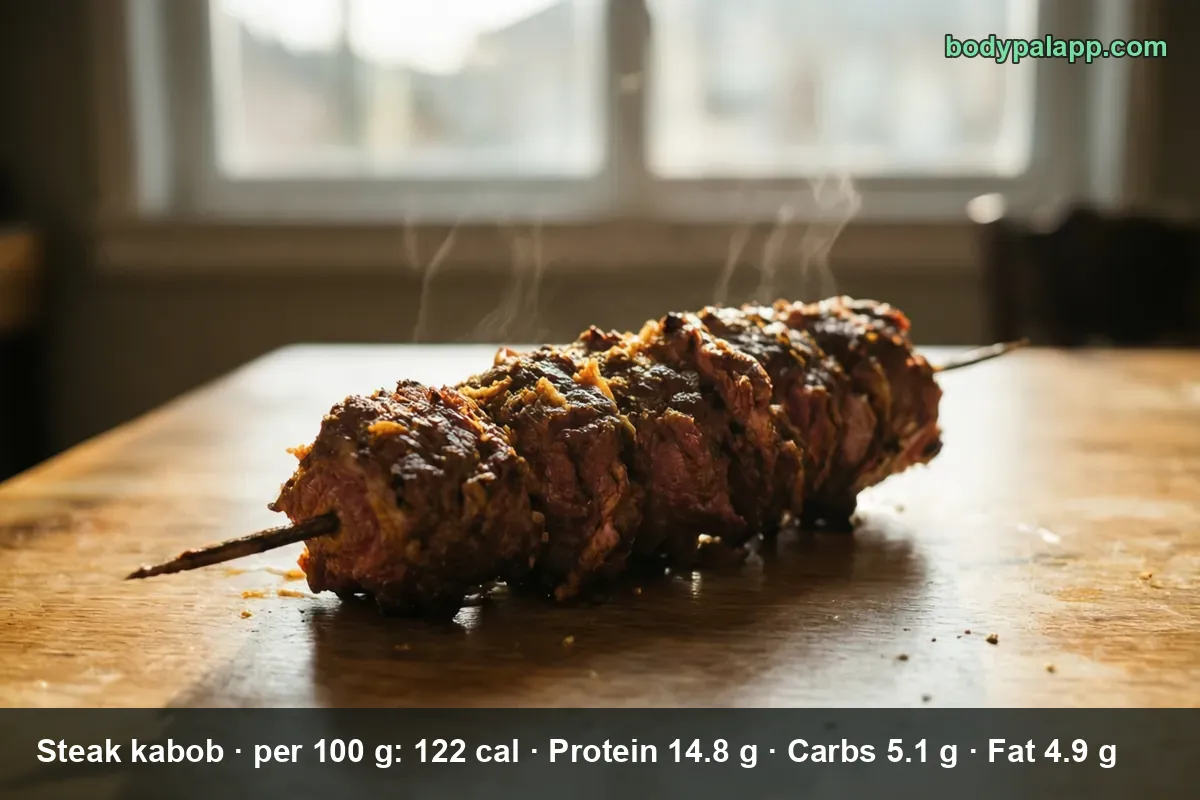
One grilled steak kabob, the full 202 g skewer, is 246 calories. Per 100 g the dish runs 122 calories, with 14.8 g of protein and 4.88 g of fat. The peppers and onion threaded between the beef are counted in that number, which is why it lands so low for a meat dinner.
On this page
- Steak kabob quick facts
- US servings, from one ounce to two skewers
- Pork, pan versions and store-bought skewers
- Protein is the row that stands out
- How does a steak kabob compare?
- Most popular steak kabob brands
- FAQ
Steak kabob quick facts
The record behind every figure here is FNDDS 2706730, "Beef shish kabob with vegetables, excluding potatoes", from the 2021-2023 survey files. It is the only USDA entry for the dish as people actually eat it: beef and vegetables on a skewer, measured after grilling, with a household measure of one shish kabob at 202 g. That is the thing in your hand at a cookout, so it sets the main number.
Raw kabobs from the meat case are a different measurement problem, and they sit further down this page rather than in the table below.
| Nutrient | Per 100 g | Per 1 shish kabob (202 g) | % Daily Value |
|---|---|---|---|
| Calories | 122 | 246 | — |
| Total fat | 4.88 g | 9.9 g | 13% |
| Saturated fat | 1.66 g | 3.4 g | 17% |
| Carbohydrate | 5.06 g | 10.2 g | 4% |
| Dietary fiber | 0.8 g | 1.6 g | 6% |
| Total sugars | 2.37 g | 4.8 g | — |
| Protein | 14.8 g | 29.9 g | 60% |
| Sodium | 208 mg | 420 mg | 18% |
| Cholesterol | 41 mg | 83 mg | 28% |
| Potassium | 238 mg | 481 mg | 10% |
% Daily Value is based on a 2,000-calorie diet.
Verified nutrition data
Numbers on this page come from USDA FoodData Central, the U.S. Department of Agriculture’s food composition database, and from manufacturer labels where a branded product is named. Last verified September 2026. How we verify our data →
Two rows you would see on a package label are missing on purpose. Added sugars and trans fat are not published in this edition of the USDA survey database for this food, so quoting either one would mean inventing it. Total sugars have no Daily Value at all, which is why that cell stays empty.
US servings, from one ounce to two skewers
| Serving | Weight | Calories |
|---|---|---|
| 1 oz | 28 g | 35 kcal |
| 4 oz | 113 g | 138 kcal |
| 1 cup, cut off the skewer | 154 g | 188 kcal |
| One shish kabob | 202 g | 246 kcal |
| Two shish kabobs | 404 g | 492 kcal |
| Per 100 g | 100 g | 122 kcal |
Only two of those are USDA household measures: the 202 g skewer and the 154 g cup of meat and vegetables pulled off the stick. The ounce rows and the two-skewer row are our own arithmetic from the USDA 100 g figure, not USDA servings, so treat them as scaling rather than as measured portions.
The cup is where people go wrong. A cup of kabob pieces weighs 154 g and comes to 188 calories, which sounds like most of a skewer, but it is only three quarters of one. When you slide everything off the stick, the pepper squares and onion layers stack loosely and the cup fills before the meat does. If you built the skewers yourself and know how many went on the grill, count skewers, not cups.
Restaurants push this further in the other direction. A kabob plate arrives with two or three skewers over rice, and two skewers alone are 492 calories before a grain of rice is served.
Pork, pan versions and store-bought skewers
| Version | Per 100 g | Typical portion | Calories |
|---|---|---|---|
| Beef shish kabob, on the skewer | 122 kcal | 1 shish kabob (202 g) | 246 kcal |
| Pork shish kabob | 124 kcal | 1 shish kabob (202 g) | 250 kcal |
| Beef and vegetables, no sauce | 121 kcal | 1 cup (154 g) | 186 kcal |
| Beef and vegetables with gravy | 122 kcal | 1 cup (154 g) | 188 kcal |
| Beef with mushroom sauce | 121 kcal | 1 cup (154 g) | 186 kcal |
| Pork and vegetables, no sauce | 123 kcal | 1 cup (154 g) | 189 kcal |
| Store-bought raw beef kabob | 93 kcal | 1 kabob (151 g) | 140 kcal |
Every portion in that table except the beef skewer and the store-bought one is our own arithmetic from each record's 100 g figure, using the household weights from the main record.
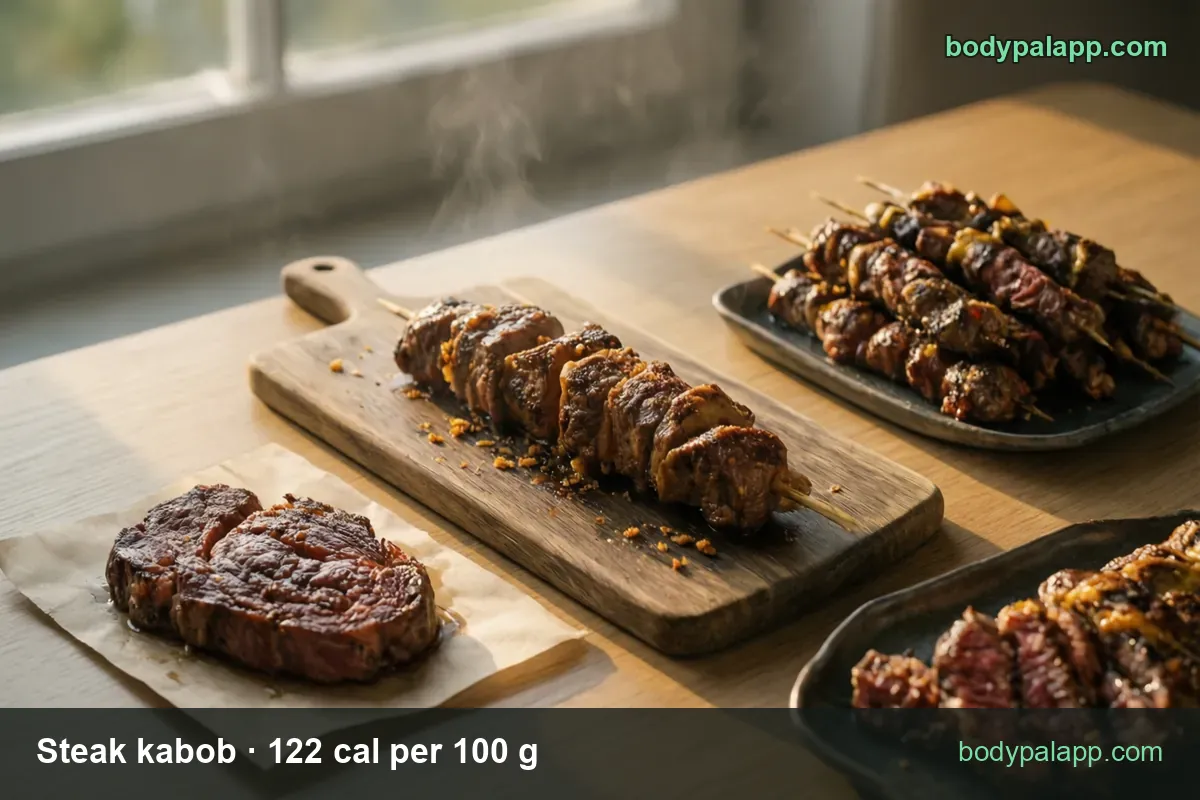
Swap beef for pork and a skewer moves from 246 to 250 calories. That is a four-calorie difference and nobody should plan a meal around it. The pork version carries slightly more fat, 5.17 g per 100 g against 4.88 g, and slightly less protein, 13.87 g against 14.8 g.
The pan versions are the interesting comparison. Cook the same beef and vegetables in a skillet instead of over coals and the calories per 100 g barely move, 121 to 122, but the composition shifts hard: fat climbs to 7.09 g and protein drops to 10.03 g per 100 g. Add gravy and protein falls to 8.11 g. The skewer wins not because grilling is magic but because nothing pools around the food and the meat-to-vegetable ratio stays high.
Store-bought kabobs are the trap. Target's Good & Gather beef kabobs with bell peppers and onions read 81 calories per 100 g, 110 for a half kabob at 136 g, and Archer Farms Angus kabobs read 93 per 100 g, 140 for a 151 g skewer. Those look far lighter than the 122 on this page. They are raw. Water leaves during grilling, the remaining weight concentrates, and once that skewer comes off the fire it behaves like the cooked record, not the package.
Protein is the row that stands out
Thirty grams of protein for 246 calories is the number worth remembering. One skewer covers 60% of the 50 g Daily Value the FDA uses on nutrition labels, while total fat sits at 13% and carbohydrate at 4%. Run the ratio across every beef-and-vegetable record in the same USDA set and the skewer is the best of them: 12.1 g of protein per 100 calories, against 8.2 g for the pan version without sauce and 6.6 g for the version with gravy.
That makes a kabob one of the easier ways to hit a protein target without a shake. MyPlate's protein guidance puts most adults around 5 to 6.5 ounce-equivalents a day, and a single skewer of beef does a large share of it while also delivering 481 mg of potassium, 10% of the Daily Value, mostly from the vegetables.
Sodium is the row to watch instead. A skewer carries 420 mg, 18% of the Daily Value, roughly what you would get from a fifth of a teaspoon of table salt. It is not in the beef; it is in the marinade, and it clings to the outside surfaces. Notice what happens with the cup measure: 154 g of the same food works out to 320 mg on the same per-gram figure, so the cup reads lower only because it holds less food, not because it is less salty. If you are watching sodium, the Dietary Guidelines cap of 2,300 mg a day leaves plenty of room for one skewer, but a three-skewer plate with a salted rice pilaf is a different conversation.
How does a steak kabob compare?
| Dish | Per 100 g | US serving | Calories |
|---|---|---|---|
| Beef shish kabob | 122 kcal | one skewer, 202 g | 246 kcal |
| Pork shish kabob | 124 kcal | one skewer, 202 g | 250 kcal |
| Beef and vegetables, no sauce | 121 kcal | 1 cup, 154 g | 186 kcal |
| Beef and vegetables, gravy | 122 kcal | 1 cup, 154 g | 188 kcal |
Our take: these four dishes are within 3 calories of each other per 100 g, so the calorie question answers itself and the protein question does the real work. If you are eating to stay full on fewer calories, the beef skewer is the pick, because 29.9 g of protein per 202 g is more than any of the pan-cooked versions delivers at the same weight. If you are eating for weight loss and counting by serving rather than by gram, a single cup of the sauced version is lighter on paper at 188 calories, but it is also a smaller pile of food with well under half the protein. Skip the gravy, keep the skewer.
Most popular steak kabob brands in the United States
Ranked by how widely each product appears among foods sold in the United States, from the BodyPal food database of over 3.3 million products. Calories are the figures printed on each Nutrition Facts label, checked against USDA FoodData Central.
| Product | Calories (per 100 g) |
|---|---|
| Good & Gather Beef Kabobs with Bell Peppers & Onions | 81 cal |
| Archer Farms Angus Beef Kabobs with Bell Peppers & Onions | 93 cal |
Brand popularity: BodyPal food database. Nutrition: manufacturer labels / USDA FoodData Central.
Steak kabob FAQs
How many calories are in one steak kabob?
One shish kabob weighing 202 g carries 246 calories, at 122 calories per 100 g. That is the USDA household serving for beef shish kabob with vegetables, measured after grilling. Two skewers off the same platter come to 492 calories, which is still a moderate dinner for most people before any rice or bread.
How much protein is in a beef kabob skewer?
A 202 g skewer delivers 29.9 g of protein, 60% of the Daily Value, from 246 calories. Per 100 g the dish runs 14.8 g. That is the highest protein-per-calorie ratio of any beef-and-vegetable record in the USDA survey set; the pan-cooked versions land between 7.85 and 10.03 g per 100 g.
Are steak kabobs good for weight loss?
At 246 calories with 29.9 g of protein, one skewer fits inside most calorie targets while covering more than half a day's protein. Fat is 9.9 g, 13% of the Daily Value. If you are choosing between a kabob and a sauced beef-and-vegetable dish, the skewer gives more protein for the same calories.
How many calories in a steak kabob without vegetables?
The 122 calories per 100 g already include the peppers and onion, and USDA publishes no meat-only skewer record, so there is no measured figure for beef alone. The closest comparison is the pan-cooked beef and vegetables without sauce at 121 calories per 100 g, which carries more fat and less protein.
Do steak kabobs have carbs?
Yes, 5.06 g of carbohydrate per 100 g, or 10.2 g on a 202 g skewer, which is 4% of the Daily Value. Of that, 2.37 g per 100 g is total sugars, from the peppers, onion and any sweetened marinade. Fiber is 0.8 g per 100 g, 1.6 g per skewer.
How much sodium is in a steak kabob?
One 202 g skewer has 420 mg of sodium, 18% of the 2,300 mg Daily Value and about what a fifth of a teaspoon of table salt supplies. A cup of the same food off the stick, 154 g, comes to 320 mg. Nearly all of it comes from the marinade rather than the beef.
How many calories in store-bought beef kabobs?
Good & Gather beef kabobs with bell peppers and onions read 81 calories per 100 g and 110 for a half kabob at 136 g; Archer Farms Angus kabobs read 93 per 100 g, 140 for a 151 g skewer. Those are raw weights, so grilled they behave like the 122 figure.
Are grilled kabobs healthier than a steak?
Per 100 g the skewer is 122 calories with 4.88 g of fat, lower fat than every pan-cooked beef-and-vegetable record in the same USDA set, which run 7.09 to 7.34 g. No matching plain-steak record sits in that set, so we do not quote one. The vegetables and the fixed skewer size do most of the work.
Similar foods
- Tomato Salad — 194 cal per cup
- Shakshuka — 289 cal per bowl
- Shrimp Teriyaki — 241 cal per cup
- Tomato Pasta — 300 cal per cup
- Beef Goulash — 270 cal per cup
- Chicken Teriyaki Bowl — 428 cal per bowl
Count it without the math
Point the camera at the plate and BodyPal counts the skewer for you, vegetables and all.


How long does it take to burn off steak kabob?
One shish kabob (202 g) is 246 kcal. Enter your weight and the amount you ate to see how long it takes you to burn that off:
lb
| Activity | Time to burn 246 kcal |
|---|---|
| Walking, brisk | 49 min |
| Cycling, moderate | 31 min |
| Swimming, moderate | 35 min |
| Jogging | 29 min |
| Weight training, moderate | 55 min |
Times are for a 155 lb adult at a steady pace; change the weight to see yours. The amount is set to the portion in the text (202 g); change it to what you actually ate. BodyPal works this out from your steps automatically.
Burning it off is one side of it. The other is knowing your number: work out how many calories you need a day, with macros and a goal date.