
How many calories are in a steak stir fry?
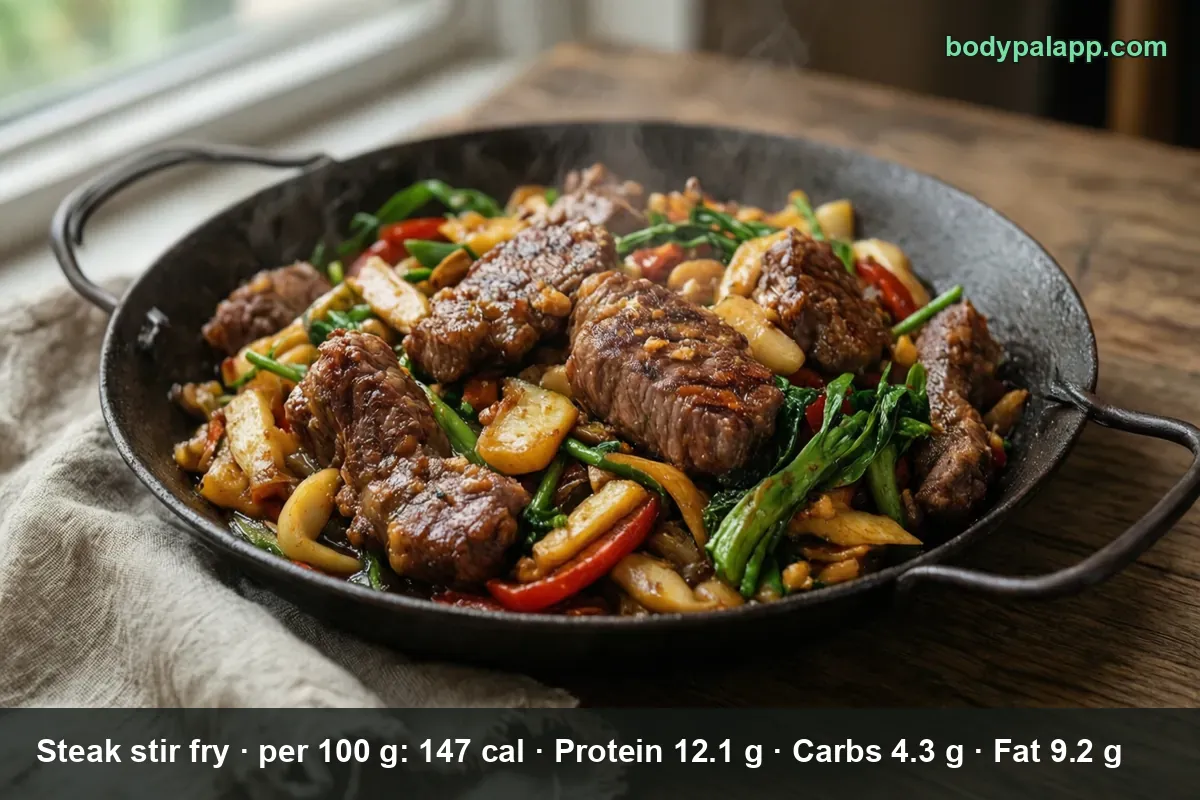
A 1-cup serving of steak stir fry weighs 217 g and lands at 319 calories. Per 100 g the dish runs 147 calories, which is modest for something built on beef, because vegetables and sauce carry most of the weight. The protein is the headline: 26.3 g in that single cup.
On this page
- Steak stir fry quick facts
- US servings, from one ounce to a two-cup bowl
- Rice, noodles and potatoes change the plate
- Protein and sodium are the two rows that matter
- How does steak stir fry compare?
- Most popular steak stir fry brands
- FAQ
Steak stir fry quick facts
The record used here is FNDDS 2706744, "Beef and vegetables excluding carrots, broccoli, and dark-green leafy; no potatoes, soy-based sauce". That is the plain version people mean when they type the search: strips or cubes of beef cooked hot with peppers, onion and green beans in a soy-based sauce, with no rice, noodles or potatoes stirred into the pan. It is also one of the few stir-fry records with its own household measure, a 1-cup serving of 217 g, so the serving column below is USDA's own portion rather than a guess.
If your dinner had rice or noodles cooked into it, the numbers shift, and those builds get their own section further down. Same database, different preparation.
| Nutrient | Per 100 g | Per 1 cup (217 g) | % Daily Value |
|---|---|---|---|
| Calories | 147 | 319 | — |
| Total fat | 9.15 g | 19.9 g | 25% |
| Saturated fat | 2.02 g | 4.4 g | 22% |
| Carbohydrate | 4.34 g | 9.4 g | 3% |
| Dietary fiber | 1 g | 2.2 g | 8% |
| Total sugars | 1.56 g | 3.4 g | — |
| Protein | 12.13 g | 26.3 g | 53% |
| Sodium | 245 mg | 532 mg | 23% |
% Daily Value is based on a 2,000-calorie diet.
Verified nutrition data
Numbers on this page come from USDA FoodData Central, the U.S. Department of Agriculture’s food composition database, and from manufacturer labels where a branded product is named. Last verified September 2026. How we verify our data →
Two label rows are missing on purpose. This FNDDS edition does not publish added sugars or trans fat for the record, so printing either one would mean inventing a number. The 3.4 g of total sugars in a cup come from the vegetables and whatever sweetener is in the sauce, and there is no way to split them from this data.
Cholesterol and potassium do have values: 32 mg and 229 mg per 100 g, which work out to 69 mg of cholesterol (23% of the Daily Value) and 497 mg of potassium (11%) in a cup.
US servings, from one ounce to a two-cup bowl
| Serving | Weight | Calories |
|---|---|---|
| 1 oz | 28 g | 41 kcal |
| Half cup | 108.5 g | 160 kcal |
| 1 cup | 217 g | 319 kcal |
| 1 1/2 cups | 326 g | 479 kcal |
| 2 cups | 434 g | 638 kcal |
| Per 100 g | 100 g | 147 kcal |
Only the 1-cup row and the 100 g row come straight from USDA. The half cup, the cup and a half, the two cups and the ounce are our own arithmetic scaled from the 147-calories-per-100-g figure, not USDA servings.
That distinction matters more here than with a packaged food, because a stir fry does not come in units. Nobody eats "one stir fry." A dinner plate of it, piled the way most people pile it, is closer to two cups than one, which is 638 calories before a scoop of rice goes next to it. Weighing the finished pan once, then dividing by the number of people eating, beats guessing at cups every time.
The oz row is worth keeping in your head for leftovers. At 41 calories an ounce, a small container of last night's stir fry that reads 8 oz on the kitchen scale is about 328 calories.
Rice, noodles and potatoes change the plate
| Version | Per 100 g | Typical serving | Calories |
|---|---|---|---|
| Steak stir fry, no rice or noodles | 147 kcal | 1 cup (217 g) | 319 kcal |
| Steak stir fry with rice | 143 kcal | 1 cup (217 g) | 310 kcal |
| Steak and rice stir fry, no leafy greens | 145 kcal | 1 cup (217 g) | 315 kcal |
| Steak stir fry with noodles | 139 kcal | 1 cup (217 g) | 302 kcal |
| Steak and noodle stir fry, no leafy greens | 139 kcal | 1 cup (217 g) | 302 kcal |
| Steak stir fry with potatoes | 148 kcal | 1 cup (252 g) | 373 kcal |
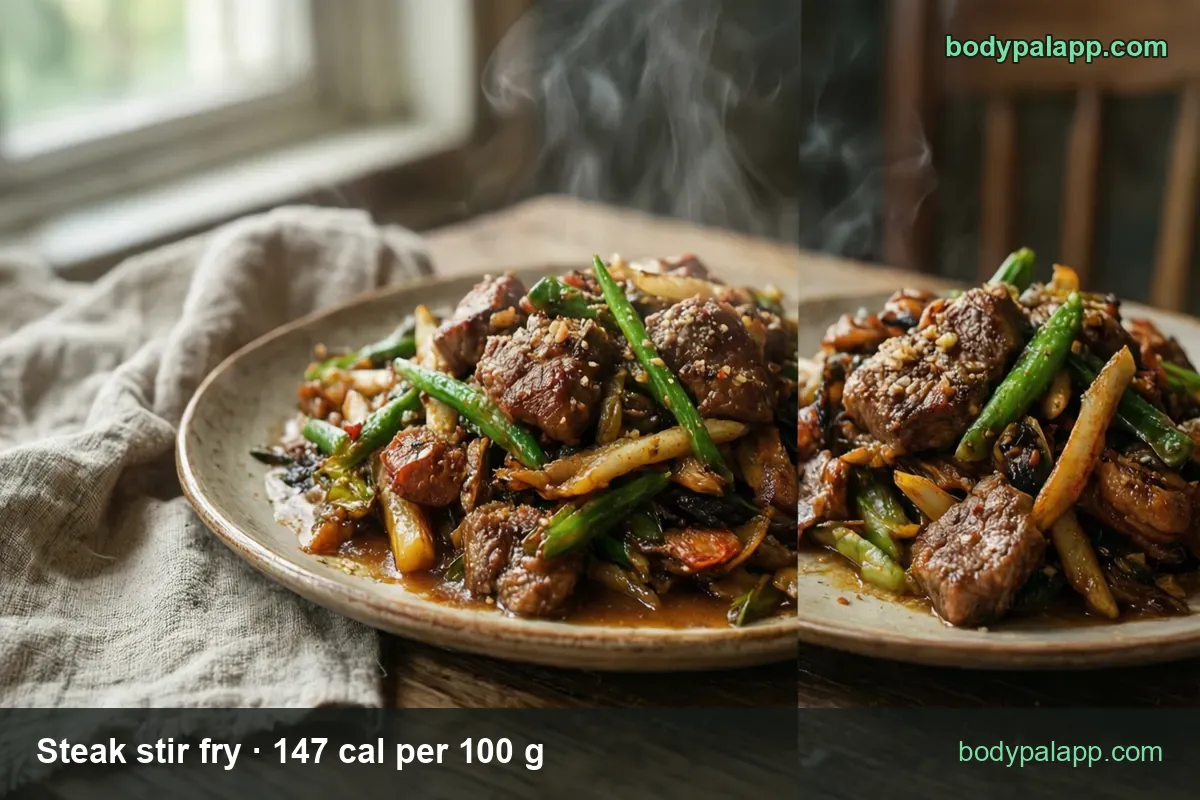
Here is the trap. The versions with rice (143) and noodles (139) show a lower calorie density than the plain one (147), which reads like good news. It is not, quite. The cup still weighs 217 g, so the difference on the plate is only nine to seventeen calories, while the carbohydrate nearly doubles: 4.34 g per 100 g becomes 7.9 g with rice and 7.6 g with noodles. The starch is not making the meal lighter, it is replacing beef by weight and taking the protein down with it, from 12.13 g per 100 g to 10.31 g in the noodle build.
The potato version is the outlier in the other direction. At 148 calories per 100 g it is the densest of the six, and USDA gives it a heavier cup, 252 g instead of 217 g, so a single cup reaches 373 calories. If you are counting, that one cup is worth 54 more calories than the plain version's cup.
Packaged stir fry is a separate animal again. A Kroger Beef Stir Fry kit is 62 calories per 100 g, and Charoen Pokphand Five Spice Beef Stir Fry is 110, while Tyson's Hibachi Style Beef Stir Fry with Noodles is 130 and The Fresh Market's Korean Beef Stir Fry is 154. The low numbers on the raw kits are not a cooking trick: they are uncooked mixes that have not yet lost water in the pan or picked up oil and sauce. Log the finished dish, not the bag.
Protein and sodium are the two rows that matter
One cup delivers 26.3 g of protein, which is 53% of the FDA Daily Value of 50 g. Half a day's protein for 319 calories is genuinely hard to beat outside plain grilled meat, and it explains why this dish holds up so well as a weeknight dinner that has to keep you full until morning. MyPlate puts lean beef in the same protein-foods group as poultry, eggs and beans, and the stir-fry format is one of the cheapest ways to stretch a small amount of it across a full plate of vegetables.
Sodium is the row pulling the other way. A cup carries 532 mg, 23% of the 2,300 mg Daily Value, and that is roughly a quarter teaspoon of table salt. Almost all of it rides in on the soy-based sauce. Eat two cups and you are at 46% of the day from one dinner. If you are watching sodium, the single easiest fix is cutting the sauce with water or an unsalted stock and adding garlic, ginger and citrus back for taste; the calories barely move, the sodium does.
Saturated fat sits at 4.4 g a cup, 22% of the Daily Value, nearly level with the 25% total-fat figure and more than a dish that looks mostly like vegetables suggests. Beef and cooking oil are both in there. Fiber is thin at 2.2 g, 8% of the Daily Value, so a stir fry is not the fiber win the vegetable count implies.
How does steak stir fry compare?
| Stir fry | Per 100 g | US serving | Calories |
|---|---|---|---|
| Steak stir fry, no starch | 147 kcal | 1 cup (217 g) | 319 kcal |
| Beef, rice and vegetables | 143 kcal | 1 cup (217 g) | 310 kcal |
| Beef, noodles and vegetables | 139 kcal | 1 cup (217 g) | 302 kcal |
| Beef, potatoes and vegetables | 148 kcal | 1 cup (252 g) | 373 kcal |
Our take: pick the plain version. Across these four rows the spread in calories per cup is only 71, so the starch is not really buying or costing you much energy, but it is quietly trading away protein, and protein is the whole reason this dish earns its place. The plain build gives 12.13 g per 100 g against 10.31 g for the noodle version and 10.56 g for the rice one. Cook the stir fry clean, then put a measured scoop of rice next to it instead of in it, and you get to see exactly what the starch costs rather than having it hidden in the pan.
Most popular steak stir fry brands in the United States
Ranked by how widely each product appears among foods sold in the United States, from the BodyPal food database of over 3.3 million products. Calories are the figures printed on each Nutrition Facts label, checked against USDA FoodData Central.
| Product | Calories (per 100 g) |
|---|---|
| Kroger Beef Stir Fry | 62 cal |
| Tyson Hibachi Style Beef Stir Fry with Noodles | 130 cal |
| The Fresh Market Korean Beef Stir Fry | 154 cal |
| Charoen Pokphand Five Spice Beef Stir Fry | 110 cal |
Brand popularity: BodyPal food database. Nutrition: manufacturer labels / USDA FoodData Central.
Steak stir fry FAQs
How many calories are in steak stir fry?
319 calories in a 1-cup (217 g) serving of beef and vegetable stir fry with a soy-based sauce and no rice, noodles or potatoes. Per 100 g that works out to 147 calories. The same cup carries 26.3 g of protein and 9.4 g of carbohydrate.
How much protein is in a steak stir fry?
26.3 g of protein in a 1-cup (217 g) serving, which is 53% of the FDA Daily Value of 50 g. That comes with 19.9 g of fat and only 9.4 g of carbohydrate, so the cup reads as a protein dish rather than a starch one.
Is steak stir fry good for weight loss?
A half cup (108.5 g) is 160 calories and a full cup is 319, with 26.3 g of protein in that cup. The protein-to-calorie ratio is the useful part, since 53% of the Daily Value for protein arrives for 319 calories. Sodium is the tradeoff at 532 mg a cup.
How many calories in steak stir fry with rice?
310 calories in a 1-cup (217 g) serving of beef, rice and vegetables in a soy-based sauce, at 143 calories per 100 g. The rice pulls the calorie density down slightly but nearly doubles the carbohydrate, from 4.34 g per 100 g to 7.9 g.
How many calories in steak stir fry with noodles?
302 calories in a 1-cup (217 g) serving of beef, noodles and vegetables with a soy-based sauce, or 139 calories per 100 g. No build on this page comes in lighter per cup, mostly because the noodles displace some of the fat-heavy beef.
How much sodium is in beef stir fry?
532 mg of sodium in a 1-cup (217 g) serving, or 23% of the 2,300 mg Daily Value. That is roughly a quarter teaspoon of table salt, and almost all of it comes from the soy-based sauce rather than the beef or the vegetables. Two cups would reach 46%.
Is steak stir fry high in carbs?
No: 9.4 g of carbohydrate in a 1-cup (217 g) serving, just 3% of the Daily Value, with 2.2 g of that as fiber and 3.4 g as total sugars. Rice or noodles change the answer, since those versions carry 7.9 g and 7.6 g per 100 g.
How many calories in a takeout beef and vegetable stir fry?
Two cups (434 g) come to 638 calories, so a takeout container that holds about that much lands near 638 before any rice on the side. That figure is our own arithmetic from the USDA 100 g number of 147 calories, not a USDA serving. Sodium doubles too, to 1,064 mg.
Similar foods
- Chicken Shawarma Plate — 200 cal per cup
- Lamb Vindaloo — 210 cal per 5 oz serving
- Quinoa Salad — 248 cal per cup
- Steak Dinner — 456 cal per meal
- Chicken And Rice — 292 cal per cup
- Rice With Chicken — 292 cal per cup
Count it without the math
Point the camera at the plate and BodyPal counts the beef, the vegetables and the sauce for you.


How long does it take to burn off steak stir fry?
A 1-cup (217 g) serving is 319 kcal. Enter your weight and the amount you ate to see how long it takes you to burn that off:
lb
| Activity | Time to burn 319 kcal |
|---|---|
| Walking, brisk | 1 hr 4 min |
| Cycling, moderate | 40 min |
| Swimming, moderate | 46 min |
| Jogging | 38 min |
| Weight training, moderate | 1 hr 11 min |
Times are for a 155 lb adult at a steady pace; change the weight to see yours. The amount is set to the portion in the text (217 g); change it to what you actually ate. BodyPal works this out from your steps automatically.
Burning it off is one side of it. The other is knowing your number: work out how many calories you need a day, with macros and a goal date.