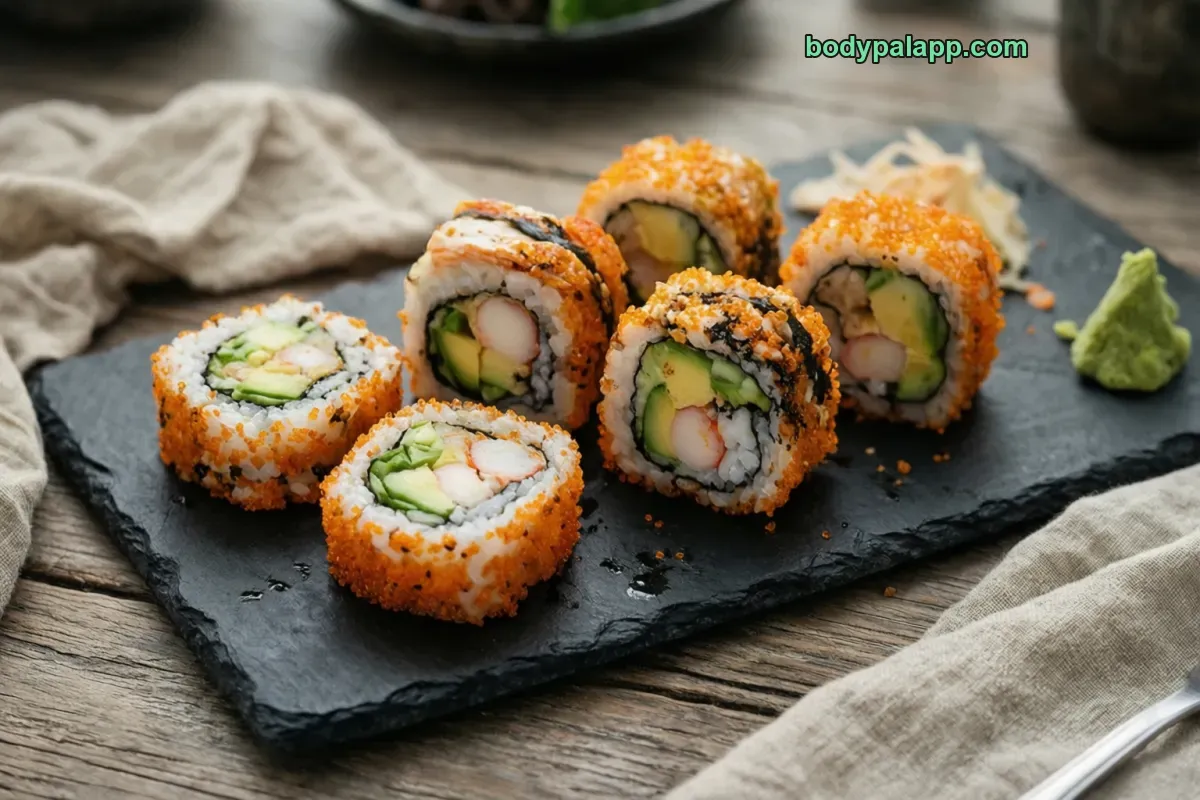
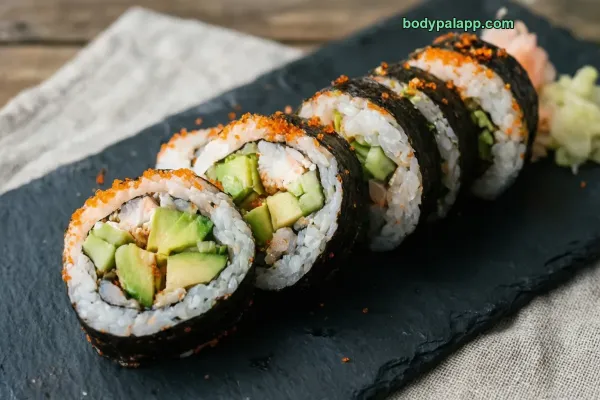
California roll calories come to 169 for a 6-piece roll (180 g) and 94 per 100 g. The number to notice is sodium: that same roll carries 770 mg, 33% of the daily value, before any soy sauce touches it. Carbs supply 81% of the calories, so the rice is doing most of the work.
169kcal
1 6-piece roll · 180 g, ready-to-eat
13%protein
5.3 gProtein
33 gCarbs
1.2 gFat
How to burn off 169 kcal
—Walking, brisk
—Jogging
—Cycling, moderate
—Swimming
Skip the math. BodyPal counts these calories from your steps and workouts automatically.
Nutrition facts
Ready-to-eat · per 180 g
Calories
169 kcal
Protein
5.3 g
Carbohydrate
33 g
Fat
1.2 g
Saturated fat
0.2 g
Cholesterol
7 mg
Sodium
770 mg
Potassium
86 mg
Iron
0.4 mg
Source: USDA FoodData Central
🛡️
Verified nutrition data
Numbers on this page come from USDA FoodData Central, the U.S. Department of Agriculture’s food composition database, and from manufacturer labels where a branded product is named. Last verified September 2026. How we verify our data →
California roll: calories, protein and sodium by serving
Percent of daily value uses the FDA reference of 2,000 kcal a day.
Serving
kcal
Protein
Carbs
Fat
Sodium
% DV kcal
6 pieces (180 g)
169
5.3 g
33.1 g
1.2 g
770 mg
8%
1 piece (30 g)
28
0.9 g
5.5 g
0.2 g
128 mg
1%
100 g
94
2.9 g
18.4 g
0.7 g
428 mg
5%
3 × 6 pieces (180 g)
508
15.8 g
2,311 mg
5 × 6 pieces (180 g)
846
26.3 g
3,852 mg
One roll is 169 calories, five rolls are 846
A standard California roll is 6 pieces weighing 180 g. It lands at 169 calories with 5.3 g protein, 33.1 g carbs and 1.2 g fat, which is 8% of the daily value for calories. Each piece weighs about 30 g and brings 28 calories, so counting pieces is an easy way to track a shared plate.
The total moves fast once rolls stack up. 2 rolls (360 g) come to 338 calories, 3 rolls (540 g) reach 508, and 5 rolls (900 g) total 846. Few sushi orders stop at a single roll, so a combo of 2 or 3 rolls is the more honest baseline for a full meal.
Protein does not keep pace with the calories. 3 rolls give 15.8 g of protein, and even 5 rolls deliver only 26.3 g. The calorie count per roll is modest, but the protein return is thin, which matters if you want a meal that holds you until the next one. Order size, not the roll itself, decides whether this is a light lunch or a heavy dinner.
Rice supplies 81% of the calories
The calorie split is lopsided: 81% from carbohydrates, 13% from protein and 7% from fat. Per 100 g that works out to 18.4 g carbs, 2.9 g protein and just 0.7 g fat. The rice is the bulk of the roll, and the numbers show it plainly.
Fat is lower than many people expect for a roll that contains avocado. A full 6-piece roll has 1.2 g of fat, and saturated fat sits at 0.1 g per 100 g. Cholesterol is only 4 mg per 100 g. Sugar is 3.8 g per roll and fiber 1.8 g, so there is a little fiber, but not much.
The practical takeaway is simple. A California roll is a light, carb-led food with very little fat to slow it down. It pairs better with something protein-rich than with a second carb-heavy roll, and it fits easily into a day where the other meals carry more protein.
Sodium is the row to watch
Sodium is 428 mg per 100 g, which puts one 6-piece roll at 770 mg, or 33% of the daily value. A single piece carries 128 mg. For a food this low in calories, that is a heavy load: the roll uses 8% of your calorie budget and 33% of your sodium budget.
Scale it up and the gap widens. 2 rolls hit 1,541 mg, 3 rolls reach 2,311 mg, which is already past the daily value on its own, and 5 rolls total 3,852 mg. These figures are for the roll itself. Soy sauce and other dips come on top of every number here.
If you watch sodium, the simplest lever is the number of rolls, then the dip. Dabbing instead of soaking, or skipping the sauce on some pieces, keeps the total closer to the roll's own figure. Potassium, by contrast, is just 48 mg per 100 g, so this is a salty food with very little else on that side of the label.
Build the meal around protein, not more rice
One roll gives 5.3 g of protein, 11% of the daily value, so it works best as one part of a meal rather than the whole of it. A protein-forward side such as sashimi, edamame or a salad with fish or egg raises the protein without stacking more rice on the plate.
Swapping your second California roll for an avocado roll changes little on calories, since the two sit at 169 and 167 per roll. The bigger decisions are how many rolls you order and how much sauce you use. Spicy, crunchy and crab-salad versions, like those sold by Pada Sushi, Sushi With Gusto or Sushi Sara, can add mayo or fried toppings, so read the label when you buy packaged rolls.
Sushi is easy to log wrong because platters mix several roll types and piece sizes vary. BodyPal can log a California roll from a photo, which helps when you are working through a mixed tray and want a realistic total.
How does California roll compare?
Here is how the California roll compares with maki sushi and an avocado roll, per 100 g and per usual 180 g serving.
Verdict: On calories it is a wash: the California roll and maki sushi both sit at 169 per serving, and the avocado roll at 167. Pick the California roll for a bit more protein (2.9 g vs 1.8 g per 100 g), or the avocado roll if you want less sodium (361 mg vs 428 mg per 100 g).
Most popular California roll brands in the United States
Ranked by popularity in the BodyPal database
# Productkcal / 100 g
1Yummi Sushi California Roll225 g173 kcal
2Sushi Sam California Roll7 oz · 198 g143 kcal
3Pada Sushi Spicy California Roll4 pieces · 111 g153 kcal
4Moji Sushi Classic California Roll6 oz · 170 g124 kcal
5Sushi With Gusto Crunchy California Roll1 package · 313 g185 kcal
6Sushi Sara Crab Salad California Roll225 g173 kcal
Packaged rolls often add mayonnaise, spicy sauce or crunchy toppings, so their labels read higher than the plain roll above. Source: manufacturer labels / USDA FoodData Central.
California roll FAQs
How many calories are in a California roll?
A 6-piece California roll (180 g) has about 169 calories, or 28 calories per piece.
Is a California roll good for weight loss?
It has 94 calories and 0.7 g of fat per 100 g, so a 6-piece roll comes to 169 calories and 1.2 g of fat.
California roll vs avocado roll: which has fewer calories?
They are almost the same: 94 calories per 100 g for a California roll and 93 for an avocado roll.
How many carbs are in a California roll?
A 6-piece roll has 33.1 g of carbs, 3.8 g of sugars and 5.3 g of protein. Per 100 g it is 18.4 g of carbs.
How many calories are in one piece of California roll?
One piece of California roll (30 g) has 28 calories, with 0.9 g protein, 5.5 g carbs and 0.2 g fat. That makes it simple to count pieces when you share a platter or eat only part of a roll.
How much sodium is in a California roll?
A 6-piece California roll has 770 mg of sodium, 33% of the daily value, before any soy sauce. 2 rolls reach 1,541 mg and 3 rolls reach 2,311 mg.
How much protein is in a California roll?
A 6-piece California roll provides 5.3 g of protein, 11% of the daily value. Protein supplies only 13% of its calories, so the roll works best next to a protein-rich side.
How many calories are in 2 California rolls?
2 California rolls of 6 pieces each (360 g) have 338 calories and 10.5 g of protein. 3 rolls come to 508 calories, and 5 rolls to 846 calories.
Is a California roll high in fat?
No. A 6-piece California roll has 1.2 g of fat, and fat supplies only 7% of its calories. Saturated fat is 0.1 g per 100 g, so the rice's carbs drive the total.