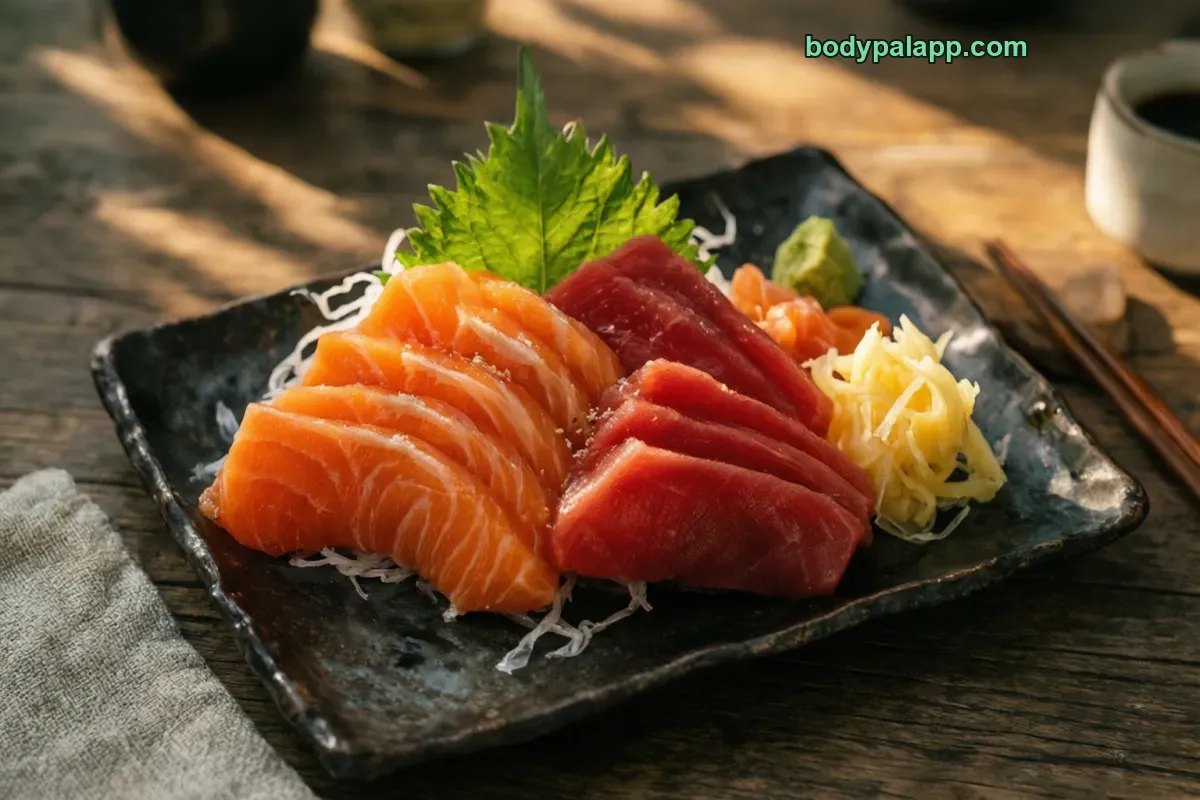
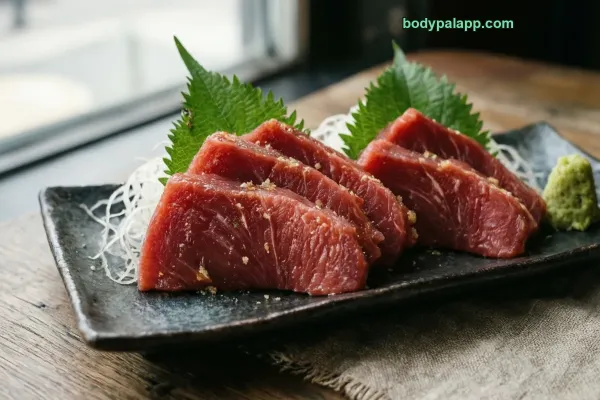
Sushi sashimi calories come to 150 for one 147 g serving and 102 per 100 g. The striking part is the protein: that serving delivers 29 g, or 58% of the daily value, and 80% of its calories come from protein while fat supplies just 3%. Sodium is the number that climbs as plates multiply.
150kcal
1 serving · 147 g, packaged, per label
80%protein
29 gProtein
6 gCarbs
0.5 gFat
How to burn off 150 kcal
—Walking, brisk
—Jogging
—Cycling, moderate
—Swimming
Skip the math. BodyPal counts these calories from your steps and workouts automatically.
Nutrition facts
Packaged, per label · per 147 g
Calories
150 kcal
Protein
29 g
Carbohydrate
6 g
Fat
0.5 g
Saturated fat
0 g
Sodium
370 mg
Source: USDA FoodData Central
🛡️
Verified nutrition data
Numbers on this page come from USDA FoodData Central, the U.S. Department of Agriculture’s food composition database, and from manufacturer labels where a branded product is named. Last verified September 2026. How we verify our data →
Sashimi: calories, protein and sodium by serving
Percent of daily value uses the FDA reference of 2,000 kcal a day.
Serving
kcal
Protein
Carbs
Fat
Sodium
% DV kcal
1 serving (147 g)
150
29 g
6 g
0.5 g
370 mg
7%
3 oz portion (85 g)
87
16.8 g
3.5 g
0.3 g
214 mg
4%
100 g
102
19.7 g
4.1 g
0.3 g
252 mg
5%
3 × 1 serving (147 g)
450
87 g
1,111 mg
5 × 1 serving (147 g)
750
145 g
1,852 mg
One packaged serving is a 150-calorie plate
The serving on the label weighs 147 g and lands at 150 calories, which is 7% of the daily calorie value. That buys 29 g of protein, 6 g of carbs and only 0.5 g of fat. For a meal built around fish, it is a light start.
A 3 oz portion (85 g), closer to what a restaurant puts on a small plate, comes to 87 calories with 16.8 g of protein. Totals rise in a straight line because nothing in the fish is calorie dense. Two servings (294 g) reach 300 calories, three servings (441 g) reach 450, and five servings (735 g) reach 750.
Even that last plate, a big one by any measure, carries 145 g of protein. With sashimi the calorie count of the fish rarely becomes the problem. What you add around it usually does.
Protein supplies 80% of the calories
Per 100 g, sashimi holds 19.7 g of protein, 4.1 g of carbs and 0.3 g of fat. Run those through the calorie math and protein accounts for 80% of the energy, carbs 17% and fat a mere 3%. Saturated fat reads 0 on the label.
Few prepared foods look like this. The 4.1 g of carbs is a reminder that this is a packaged plate, not a bare slice of fish; plain tuna sashimi and salmon sashimi both list 0 g carbs. The difference is small, but it shows up on the label.
The practical point is simple. Sashimi works as the protein anchor of a meal for very few calories. One serving covers 58% of the protein daily value, and 100 g alone covers 39%. If you want more protein without many more calories, it is hard to beat.
Sodium is the row to watch
Sodium is the one number on this label that grows faster than you might expect. A 147 g serving carries 370 mg, or 16% of the daily value. Per 100 g it is 252 mg, far above plain fish: tuna sashimi lists 45 mg and salmon sashimi 63 mg per 100 g.
Scale the plate and it adds up quickly. Two servings bring 741 mg, three bring 1,111 mg, and five bring 1,852 mg. None of that counts the soy sauce sitting in the dish beside the fish.
If you watch sodium, dip lightly or choose a reduced-sodium soy sauce. When you order fresh sashimi, plain fish will look more like the tuna and salmon figures than this packaged value, since the label reflects whatever seasoning the maker added.
Build the rest of the plate around the fish
Because a serving is mostly protein, sashimi leaves most of a meal's calorie room open. That makes it easy to pair. Miso soup, a seaweed salad, edamame or a pile of crisp vegetables round it out without crowding the total.
Very lean meals can feel light an hour later. If that happens, add a small bowl of rice or a piece of a roll for carbs, or some avocado for fat. You keep the protein high and the plate more satisfying, and you decide how much the extras cost.
Packaged options such as Yummi Sushi Sashimi or Sushi Sara Raw Sashimi make a quick lunch, and Pada Sushi Sashimi Salad adds greens to the same idea. Whatever you pick, BodyPal can log the plate from a photo, which helps when a sushi spread has several items on it.
How does sashimi compare?
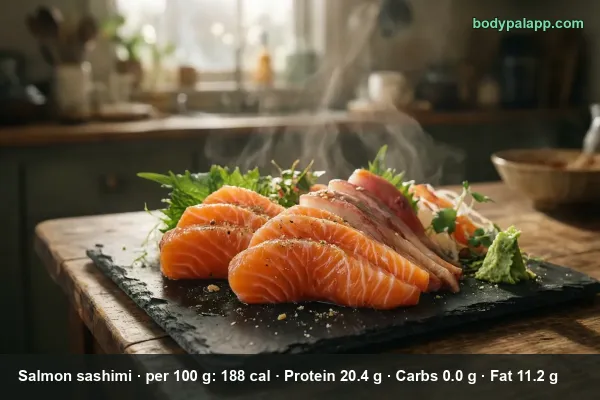
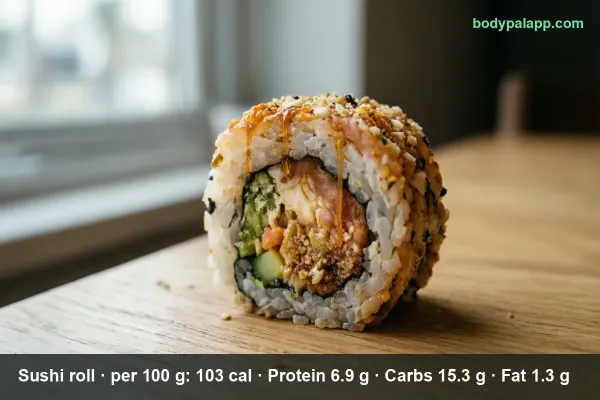
Here is how sashimi stacks up against tuna sashimi, salmon sashimi and a sushi roll, per 100 g and per usual serving.
Verdict: For the leanest plate pick sashimi or tuna sashimi, at 102 and 109 calories per 100 g with almost no fat, and tuna wins on sodium at 45 mg. Salmon sashimi costs 188 per 100 g because of its 11.2 g of fat, while a sushi roll matches sashimi at 103 calories but delivers only 6.9 g of protein, so it is the weaker pick for staying full.
A 147 g sashimi serving is 150 calories. Per 100 g sashimi has 102 calories.
Is sashimi good for weight loss?
Sashimi has 102 calories per 100 g with 19.7 g protein and 0.3 g fat, so a 147 g serving stays at 150 calories.
Is sashimi lower in calories than tuna sashimi?
They are close: this sashimi is 102 calories per 100 g and tuna sashimi is 109 calories per 100 g.
How much protein is in sashimi?
100 g has 19.7 g protein, so a 147 g serving has about 29 g protein along with 6 g carbs.
How many calories are in 3 oz of sashimi?
A 3 oz portion (85 g) of sashimi has 87 calories. It also gives 16.8 g of protein, 3.5 g of carbs and 0.3 g of fat, plus 214 mg of sodium, about 9% of the daily value.
How much sodium is in sashimi?
One 147 g serving of packaged sashimi has 370 mg of sodium, 16% of the daily value. That is 252 mg per 100 g, well above tuna sashimi at 45 mg, and soy sauce adds more on top.
How many calories are in two servings of sashimi?
Two servings (294 g) of sashimi come to 300 calories. That plate also brings 58 g of protein and 741 mg of sodium, so the sodium grows faster than the calories do.
Does sashimi have carbs?
This packaged sashimi has 4.1 g of carbs per 100 g and 6 g per 147 g serving, which is 17% of its calories. Plain tuna and salmon sashimi list 0 g carbs.
How much fat is in sashimi?
Sashimi has just 0.3 g of fat per 100 g and 0.5 g in a 147 g serving, with 0 g saturated fat. Fat supplies only 3% of its calories, far less than salmon sashimi at 11.2 g per 100 g.
Is sashimi lower in calories than a sushi roll?
Barely: sashimi has 102 calories per 100 g and a sushi roll has 103. The real gap is protein, 19.7 g for sashimi against 6.9 g for the roll, which carries 15.3 g of carbs.