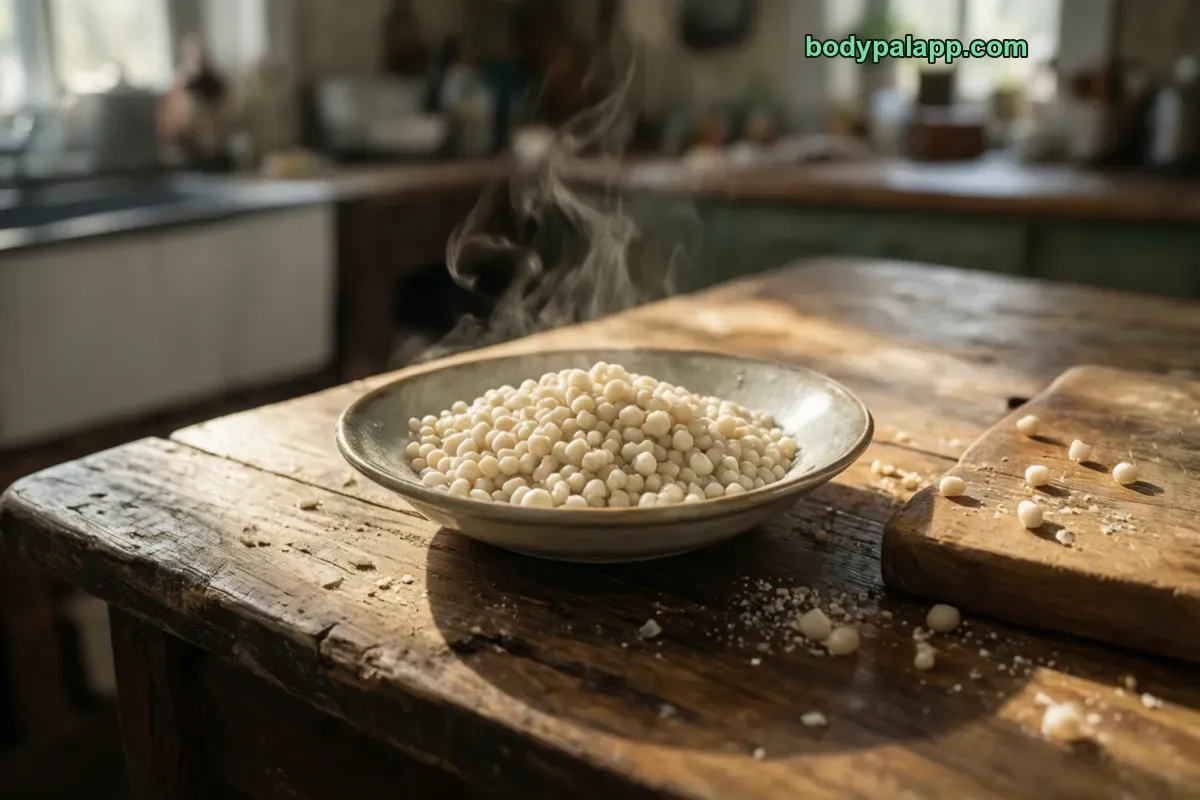
Tapioca pearls calories come to 544 for 1 cup (152 g) of dry pearls and 358 per 100 g. The detail worth noticing is where those calories come from: carbs supply 100 percent of them, with 88.7 g of carbs, 0.2 g of protein and 0 g of fat in every 100 g. This is close to pure starch.
544kcal
1 cup · 152 g, pearl, dry
0%protein
0.3 gProtein
135 gCarbs
0 gFat
How to burn off 544 kcal
—Walking, brisk
—Jogging
—Cycling, moderate
—Swimming
Skip the math. BodyPal counts these calories from your steps and workouts automatically.
Nutrition facts
Pearl, dry · per 152 g
Calories
544 kcal
Protein
0.3 g
Carbohydrate
135 g
Fat
0 g
Saturated fat
0 g
Cholesterol
0 mg
Sodium
2 mg
Potassium
17 mg
Iron
2.4 mg
Source: USDA FoodData Central
🛡️
Verified nutrition data
Numbers on this page come from USDA FoodData Central, the U.S. Department of Agriculture’s food composition database, and from manufacturer labels where a branded product is named. Last verified October 2026. How we verify our data →
Tapioca pearls: calories, protein and sodium by serving
Percent of daily value uses the FDA reference of 2,000 kcal a day.
Serving
kcal
Protein
Carbs
Fat
Sodium
% DV kcal
1 cup (152 g)
544
0.3 g
134.8 g
0 g
2 mg
27%
1 oz portion (28 g)
100
0.1 g
24.8 g
0 g
0 mg
5%
100 g
358
0.2 g
88.7 g
0 g
1 mg
18%
3 × 1 cup (152 g)
1,632
0.9 g
5 mg
5 × 1 cup (152 g)
2,721
1.4 g
8 mg
A cup of dry pearls is a 544-calorie portion
The numbers on this page are for dry pearls, the way they come out of the bag. A cup weighs 152 g and carries 544 calories, which is 27% of the daily value used on food labels. That is a lot of energy for something most people think of as a drink topping. A 1 oz portion (28 g) is far more modest at 100 calories, or 5% of the daily value.
Totals climb fast once you scale up for a batch. Two cups (304 g) reach 1,088 calories, three cups (456 g) reach 1,632, and five cups (760 g) hit 2,721. If you cook a big pot for a party or a week of homemade bubble tea, those are the figures to divide by the number of drinks you actually pour.
Cooking changes the weight, not the calories. Pearls soak up water as they boil, so a cooked scoop weighs more than the dry pearls that went into it. The cleanest way to log them is to weigh the pearls dry, note the total, and split it across servings. Measuring a cooked scoop against dry values will overstate what you ate.
Carbs supply 100 percent of the calories
The calorie split here is as lopsided as food gets: 100 percent carbs, 0 percent protein, 0 percent fat. Per 100 g you get 88.7 g of carbohydrate, 0.2 g of protein and 0 g of fat, with saturated fat and cholesterol both at 0. Tapioca is starch extracted from cassava, and the label reads like it.
Scale that to a cup and the carb number stands out. One cup holds 134.8 g of carbs, roughly half of the 275 g daily value. Protein in the same cup is 0.3 g, just 1% of the daily value, so pearls do almost nothing for the protein side of your day.
Sugar is a small part of the carb total. There are 3.4 g of sugars per 100 g and 5.1 g per cup, which means the rest is starch. The sweetness people associate with bubble tea pearls usually comes from the syrup they soak in, which is not part of these dry values. If you add syrup or brown sugar, log it as its own item.
Fiber is the thin row, not sodium
Sodium is not a concern with plain pearls. There is 1 mg per 100 g and 2 mg per cup, which rounds to 0% of the 2300 mg daily value. Even five cups only reach 8 mg. If you watch salt, the pearls themselves will not move your total; any salty snack served alongside will.
Fiber is the weak spot. A cup gives 1.4 g against a daily value of 28 g, and 100 g gives 0.9 g. With almost no fiber, no fat and next to no protein, pearls offer little to slow digestion or keep you full relative to their calories.
Potassium is also minimal at 11 mg per 100 g, far below the 4700 mg daily value. In plain terms, tapioca pearls bring energy and texture to a dish and not much else. That is fine for a treat, but it is worth knowing what you are trading the calories for.
Pair pearls with protein and fiber
Because pearls are nearly all carbohydrate, the rest of the bowl or glass decides how filling it feels. Milk-based drinks, yogurt, or a tapioca pudding made with milk and eggs add the protein that the pearls lack. Fresh fruit brings fiber that the pearls cannot supply on their own.
Portion is the main lever. A 1 oz portion at 100 calories fits easily into most days, while a full cup at 544 calories behaves more like a meal than a topping. If you are counting calories, decide on the dry weight before cooking rather than eyeballing a cooked scoop.
Toppings and syrups often add as much as the pearls themselves, so log them separately. BodyPal can log tapioca pearls from a photo, which helps when you are tracking a drink from a shop, but for homemade batches a kitchen scale and the dry numbers above give the most honest count.
How does tapioca pearls compare?
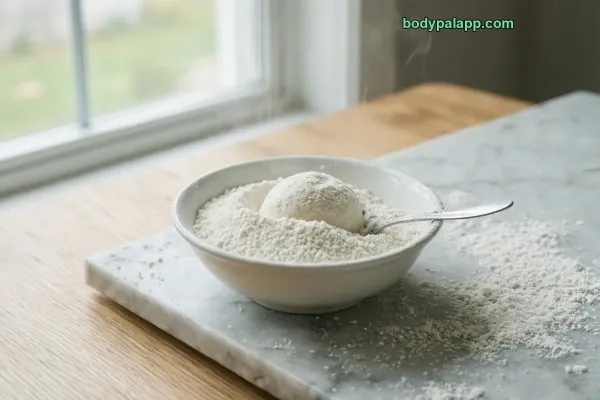
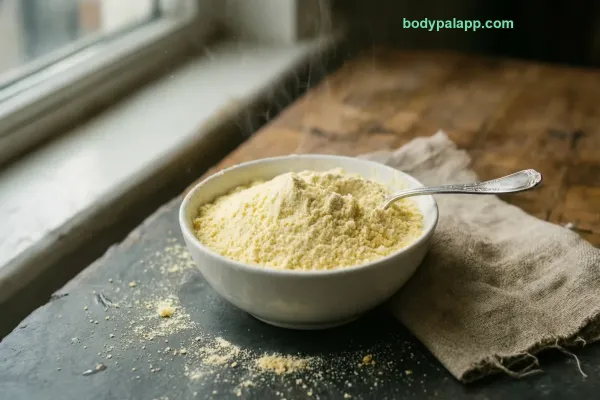
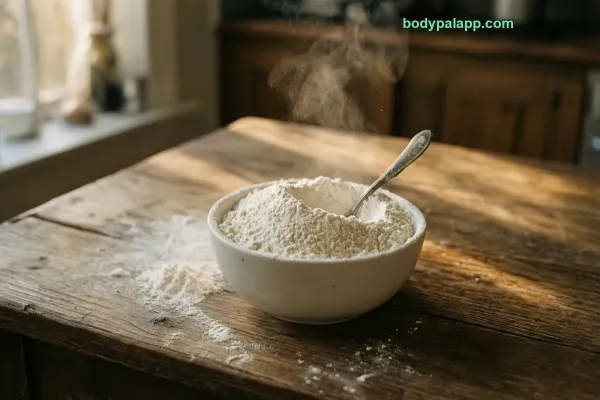
Here is how tapioca pearls stack up against corn starch, corn flour and all-purpose flour, per 100 g and per usual cup serving.
Verdict: Per 100 g the four are close, with tapioca pearls at 358 the lowest and corn starch at 381 the highest, though a cup of pearls at 544 outweighs a cup of corn starch at 488 because pearls pack denser. If you want your starch to bring some protein and keep you fuller, pick all-purpose flour at 10.3 g per 100 g over pearls at 0.2 g.
Tapioca pearls FAQs
How many calories are in a cup of tapioca pearls?
A cup of dry tapioca pearls (152 g) has about 544 calories. Per 100 g the figure is 358 calories.
Are tapioca pearls good for weight loss?
Tapioca pearls are almost pure starch: per 100 g dry they have 358 calories, 88.7 g carbs, 0.2 g protein and 0.9 g fiber. A cup adds 544 calories with very little protein or fiber.
Tapioca pearls vs corn starch: which has fewer calories?
Dry tapioca pearls have 358 calories per 100 g, corn starch has 381. Both are mostly carbohydrate.
How many carbs are in tapioca pearls?
A cup of dry tapioca pearls (152 g) has about 134.8 g carbs, of which 5.1 g sugars. Per 100 g it is 88.7 g carbs.
How many calories does USDA FoodData Central list for tapioca pearls per 100 g?
USDA FoodData Central lists 358 calories per 100 g for the row Tapioca, pearl, dry (FDC 169717). That value is for dry pearls. Cooked pearls hold water, so weigh them dry and log the dry figure.
How many calories are in 1 oz of tapioca pearls?
A 1 oz portion (28 g) of dry tapioca pearls has 100 calories, about 5% of the daily value. It carries 24.8 g of carbs, 0.1 g of protein and 0 g of fat.
How much protein is in tapioca pearls?
Tapioca pearls have just 0.2 g of protein per 100 g and 0.3 g per cup, which is 1% of the daily value. Nearly all of their calories come from carbs.
How much sugar is in tapioca pearls?
Dry tapioca pearls contain 3.4 g of sugars per 100 g and 5.1 g per cup. The rest of their 88.7 g of carbs per 100 g is starch, with 0.9 g of fiber.
Do tapioca pearls have fat or sodium?
Tapioca pearls have 0 g of fat and only 1 mg of sodium per 100 g. A full cup has 2 mg of sodium, which is 0% of the daily value.