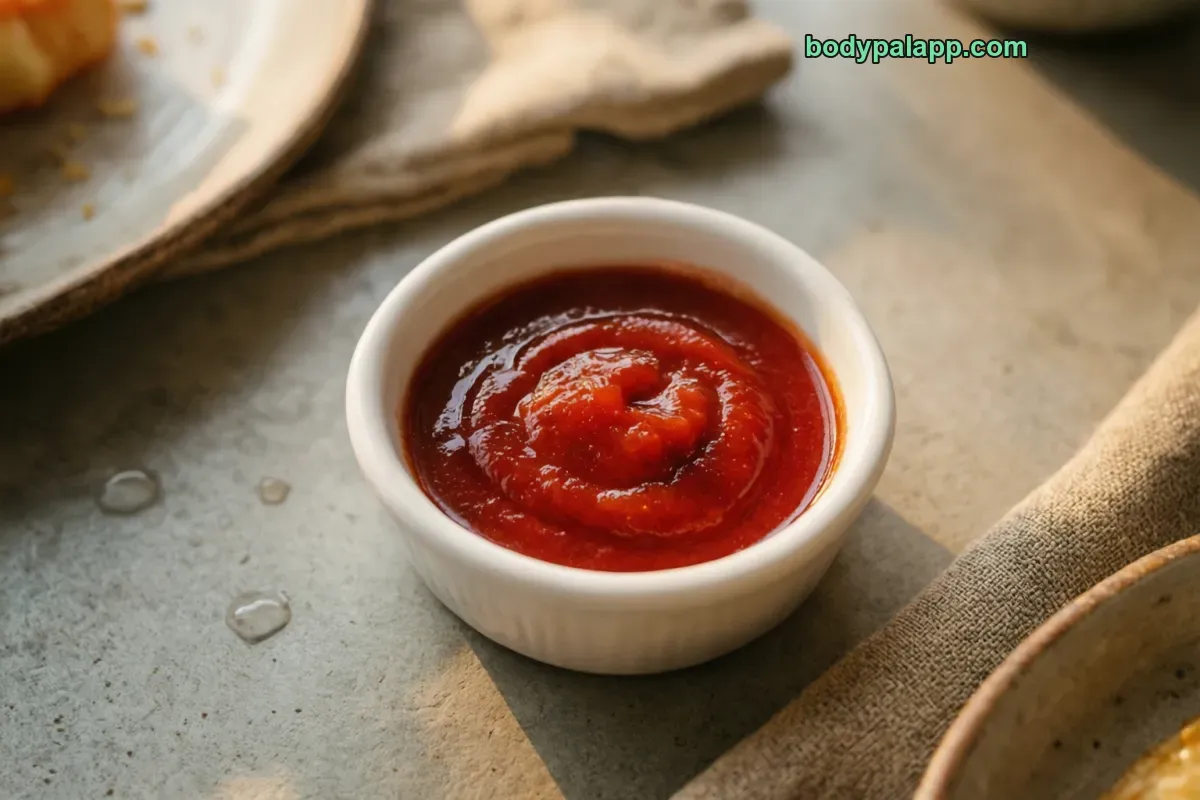
Tomato ketchup calories come to 17 for 1 tbsp (17 g) and 101 per 100 g of bottled ketchup. The calories are small, and the sodium is not: one tablespoon carries 154 mg, or 7% of the daily value. Nearly all of the energy comes from carbs, and most of those carbs are sugar.
17kcal
1 tablespoon · 17 g, bottled ketchup
4%protein
0.2 gProtein
5 gCarbs
0 gFat
How to burn off 17 kcal
—Walking, brisk
—Jogging
—Cycling, moderate
—Swimming
Skip the math. BodyPal counts these calories from your steps and workouts automatically.
Nutrition facts
Bottled ketchup · per 17 g
Calories
17 kcal
Protein
0.2 g
Carbohydrate
4.7 g
Fat
0 g
Saturated fat
0 g
Cholesterol
0 mg
Sodium
154 mg
Potassium
48 mg
Iron
0.1 mg
Source: USDA FoodData Central
🛡️
Verified nutrition data
Numbers on this page come from USDA FoodData Central, the U.S. Department of Agriculture’s food composition database, and from manufacturer labels where a branded product is named. Last verified September 2026. How we verify our data →
Tomato ketchup: calories, protein and sodium by serving
Percent of daily value uses the FDA reference of 2,000 kcal a day.
Serving
kcal
Protein
Carbs
Fat
Sodium
% DV kcal
1 tbsp (17 g)
17
0.2 g
4.7 g
0 g
154 mg
1%
1 packet (9 g)
9
0.1 g
2.5 g
0 g
82 mg
0%
1 cup (240 g)
242
2.5 g
65.8 g
0.2 g
2,177 mg
12%
100 g
101
1 g
27.4 g
0.1 g
907 mg
5%
3 × 1 tbsp (17 g)
52
0.5 g
463 mg
5 × 1 tbsp (17 g)
86
0.9 g
771 mg
One tablespoon is 17 calories, but nobody stops at one
The label serving is 1 tbsp (17 g), worth 17 calories, 4.7 g of carbs and 3.6 g of sugar. A fast-food packet is about half that at 9 g, so it lands at 9 calories and 82 mg of sodium. Both numbers look like rounding errors on a day of eating. The trouble is that real portions rarely match the label.
Count what actually goes on the plate. Two tablespoons on a burger come to 34 calories. Three tablespoons for a plate of fries reach 52. A generous dip of 5 tablespoons, roughly 85 g, adds 86 calories and 771 mg of sodium. A full cup (240 g) is 242 calories, which is about 12% of the daily calorie value on its own.
So ketchup is a condiment where calories stay modest even when you overdo it, while sodium and sugar climb faster than you expect. If you log it, log the real number of spoonfuls or packets rather than a single serving. Squeezing it into a measuring spoon once is enough to calibrate your eye for the rest of the week.
Carbs supply 96% of the calories, and most of that is sugar
The calorie split is lopsided: 96% from carbs, 4% from protein and 1% from fat. Per 100 g, ketchup has 27.4 g of carbs, 1 g of protein and 0.1 g of fat. Saturated fat and cholesterol both read 0. This is a sweetened tomato sauce, and the numbers say so plainly.
Of those 27.4 g of carbs, 21.3 g are sugars. Fiber is only 0.3 g per 100 g, so the tomato base contributes very little bulk once it is cooked down, strained and sweetened. Per tablespoon that means 3.6 g of sugar and 0.1 g of fiber. A cup holds 51 g of sugar.
Protein is close to nothing at normal portions: 0.2 g per tablespoon, 0.9 g even across 5 tablespoons. Ketchup will not help you feel full, and it is not meant to. Treat it as a flavor add-on whose calories come almost entirely from sugar, and judge the portion by that, not by the tomato on the label.
Sodium is the row to watch
Per 100 g, ketchup has 907 mg of sodium, which is 39% of the daily value. That density is high for something people pour freely. One tablespoon is 154 mg, or 7% of the daily value, and a single packet is 82 mg, or 4%.
The totals stack quickly. Two tablespoons bring 308 mg, three bring 463 mg and five bring 771 mg. A cup reaches 2,177 mg, which is 95% of the daily value in one container's worth of condiment. Ketchup also tends to land on foods that already carry salt, such as fries, burgers, hot dogs and eggs with bacon, so its sodium rarely arrives alone.
If you watch sodium, the practical move is portion control rather than avoidance. Use one measured tablespoon instead of a free pour, or ask for a single packet. Tomato paste is one option when cooking: it has 59 mg of sodium per 100 g against ketchup's 907 mg, and you can season it yourself.
Ketchup fits most plans when you measure it
At 17 calories a tablespoon, ketchup is one of the cheaper ways to add flavor to eggs, potatoes, meatloaf or a turkey burger. The calorie cost barely registers next to the food it sits on. The sugar and sodium are what earn it a place in your log, so measure the first few times and you will learn what your usual squeeze looks like.
Pair it with foods that bring what ketchup lacks. Eggs, lean meat or beans add the protein it does not have, and vegetables or whole potatoes add fiber. Ketchup does carry some potassium, 281 mg per 100 g, but at tablespoon portions that is a small contribution rather than a reason to eat more of it.
Brand choice changes little here. Heinz Tomato Ketchup sits on the same per 100 g numbers in our data as generic ketchup. If you want a quick log, BodyPal can record ketchup from a photo of your plate, but a measured spoonful is still the most honest way to count it.
How does tomato ketchup compare?
Here is how tomato ketchup compares with generic ketchup, Heinz ketchup and tomato paste per 100 g and per usual tablespoon serving.
Verdict: Generic, Heinz and tomato ketchup are interchangeable at 17 calories per tablespoon and 907 mg of sodium per 100 g, so pick the one you like best. For cooking with fewer calories and far less sodium, tomato paste wins at 13 calories per tablespoon and 59 mg of sodium per 100 g, with 4.3 g of protein against ketchup's 1 g.
Most popular tomato ketchup brands in the United States
Ranked by popularity in the BodyPal database
# Productkcal / 100 g
1Heinz Tomato Ketchup1 tbsp · 17 g118 kcal
The Heinz label lists 118 calories per 100 g, about 20 per tablespoon, a little above the 101 per 100 g USDA average for bottled ketchup. Source: manufacturer labels / USDA FoodData Central.
Tomato ketchup FAQs
How many calories are in a tablespoon of tomato ketchup?
About 17 calories per tablespoon (17 g). A single-serve packet of 9 g is 9 calories.
Is tomato ketchup good for weight loss?
A tablespoon adds 17 calories, 4.7 g carbs and almost no fat, so it is a light topping. A full cup (240 g) would be 242 calories.
Tomato ketchup vs Heinz ketchup: which has more calories?
Heinz lists 118 calories per 100 g, about 20 per tablespoon, against 101 per 100 g (17 per tablespoon) for the USDA average.
How much sugar and sodium are in tomato ketchup?
Per 100 g there are 21.3 g sugars and 907 mg sodium, which works out to 3.6 g sugars and 154 mg sodium in one tablespoon.
How many calories are in a ketchup packet?
A 9 g packet of ketchup has about 9 calories. It also carries 82 mg of sodium, 4% of the daily value, and 1.9 g of sugar, so several packets add up faster on sodium than on calories.
How many calories are in a cup of ketchup?
One cup (240 g) of ketchup has 242 calories. That cup also holds 51 g of sugar and 2,177 mg of sodium, which is 95% of the daily value, so it is a recipe amount rather than a portion.
How many calories are in 100 grams of ketchup?
100 g of ketchup has 101 calories, with 27.4 g of carbs, 21.3 g of sugars, 1 g of protein and 0.1 g of fat. Sodium per 100 g is 907 mg, or 39% of the daily value.
How many calories are in 5 tablespoons of ketchup?
Five tablespoons (85 g) of ketchup come to 86 calories. The same amount carries 771 mg of sodium and 0.9 g of protein, which shows how a generous dip adds more sodium than calories.
Does ketchup have any protein, fat or fiber?
Barely. One tablespoon has 0.2 g of protein, 0 g of fat and 0.1 g of fiber. Carbs supply 96% of ketchup's calories, and most of those carbs are sugar.