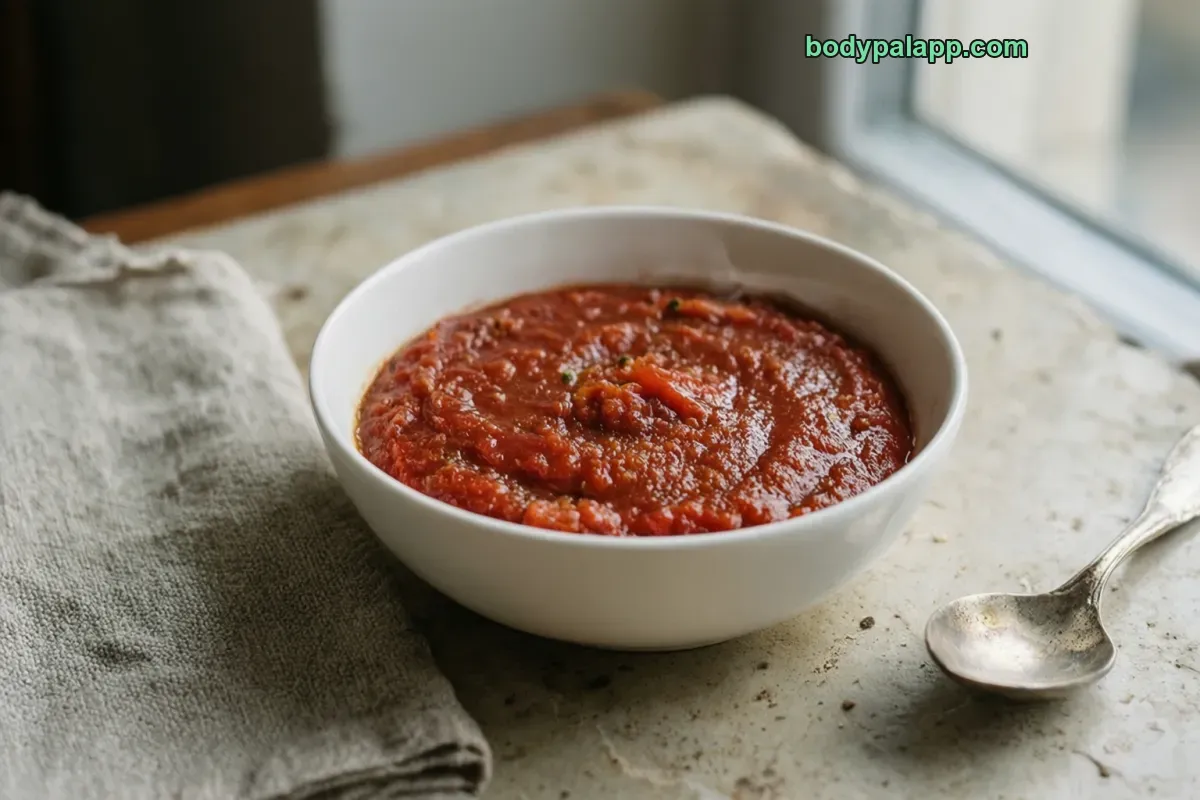
Tomato puree calories come to 95 for 1 cup (250 g) and 38 per 100 g. Carbs supply 81% of those calories, but sodium is the number to watch. A salted cup carries 505 mg, 22% of the daily value, while the no-salt-added version has just 70 mg for the same calories.
95kcal
1 cup · 250 g, canned, with salt added
15%protein
4.1 gProtein
22 gCarbs
0.5 gFat
How to burn off 95 kcal
—Walking, brisk
—Jogging
—Cycling, moderate
—Swimming
Skip the math. BodyPal counts these calories from your steps and workouts automatically.
Nutrition facts
Canned, with salt added · per 250 g
Calories
95 kcal
Protein
4.1 g
Carbohydrate
22 g
Fat
0.5 g
Saturated fat
0.1 g
Cholesterol
0 mg
Sodium
505 mg
Potassium
1098 mg
Iron
4.5 mg
Source: USDA FoodData Central
🛡️
Verified nutrition data
Numbers on this page come from USDA FoodData Central, the U.S. Department of Agriculture’s food composition database, and from manufacturer labels where a branded product is named. Last verified September 2026. How we verify our data →
Tomato puree: calories, protein and sodium by serving
Percent of daily value uses the FDA reference of 2,000 kcal a day.
Serving
kcal
Protein
Carbs
Fat
Sodium
% DV kcal
1 cup (250 g)
95
4.1 g
22.5 g
0.5 g
505 mg
5%
100 g
38
1.7 g
9 g
0.2 g
202 mg
2%
2 oz portion (57 g)
22
0.9 g
5.1 g
0.1 g
115 mg
1%
No salt added (250 g)
95
4.1 g
22.5 g
0.5 g
70 mg
5%
3 × 1 cup (250 g)
285
12.4 g
1,515 mg
5 × 1 cup (250 g)
475
20.6 g
2,525 mg
A full cup is only 95 calories
One cup (250 g) of canned tomato puree has 95 calories, 5% of the daily value. That cup also brings 4.1 g protein, 22.5 g carbs and 4.8 g fiber. A 2 oz portion (57 g), closer to what ends up in a single serving of sauce, drops to 22 calories. Per 100 g the figure is 38, so even a heavy hand with the can barely moves the total.
Scaling up shows how light puree really is. Two cups (500 g) come to 190 calories, three cups (750 g) to 285, and five cups (1,250 g), enough for a big pot of chili or marinara, reach 475. Split that pot across several bowls and the puree adds very little to each one.
The puree rarely decides the calories of the dish. The oil you cook the onions in, the meat, the cheese and the pasta do. If you log a homemade sauce, weigh the puree once and log the other ingredients separately. BodyPal can also log the finished plate from a photo.
Carbs make up 81% of every calorie
Carbs supply 81% of the calories in tomato puree, protein 15% and fat 4%. Per 100 g that works out to 9 g carbs, 1.7 g protein and 0.2 g fat, with 0 g saturated fat and 0 mg cholesterol. There is almost nothing here except tomato.
About half of those carbs are sugar: 4.8 g per 100 g, or 12.1 g in a cup. The USDA entry names salt as the only addition, so in that row the sugar is the tomato's own. Check the label on your can if you want to be sure a brand adds nothing else.
Fiber balances part of the picture. A cup gives 4.8 g, and its 4.1 g of protein covers 8% of the daily value. Puree also carries 439 mg potassium per 100 g. It will not keep you full by itself, but it adds volume, color and flavor for very few calories.
Salt is what separates one can from another
Sodium is the row that matters most here. Salted puree carries 202 mg per 100 g and 505 mg per cup, which is 22% of the daily value. The no-salt-added version has the same 95 calories per cup but only 70 mg sodium, or 3% of the daily value. Same tomatoes, very different label.
The gap grows with the batch. Two cups of salted puree hold 1,010 mg sodium, three cups 1,515 mg, and five cups 2,525 mg. That last figure is more than a full day's value before you salt the pot, pour in broth or grate cheese on top.
If you watch sodium, buy no-salt-added cans and season at the end, when you can taste what the dish actually needs. Shelves carry several brands, including Cento, Furmano's, Sclafani and Nina, and the front of the can usually tells you which version you are holding. Reading it takes two seconds and can save hundreds of milligrams.
Puree is a base, not a meal
Tomato puree works best as the backdrop. A cup gives you 95 calories and 4.1 g protein, so it needs partners that bring protein and some fat: beans, lentils, chicken, ground meat, or eggs baked right in the sauce.
Its low calorie density is the real advantage. A cup stirred into a soup, stew or curry adds bulk and body for 95 calories, which makes it handy if you want bigger bowls without a big jump in the total. Thinning a creamy sauce with puree works the same way.
Watch what travels with it. Pasta, pizza crust and melted cheese carry far more calories than the sauce under them, and ready-made tomato condiments often bring more sodium per spoon. Build the dish around the puree and you control both numbers.
How does tomato puree compare?
Here is how tomato puree stacks up against tomato paste, tomato ketchup and corn salsa, per 100 g and per usual serving.
Verdict: For the fewest calories per gram, puree wins at 38 per 100 g, while paste runs 82 and ketchup 101 with 907 mg sodium. If sodium is your main concern, paste has just 59 mg per 100 g, so a spoon of paste thinned with water beats both ketchup and salted puree.
Most popular tomato puree brands in the United States
Ranked by popularity in the BodyPal database
# Productkcal / 100 g
1Furmano's Tomato Puree1/4 cup · 63 g32 kcal
2Key Food Tomato Puree1/4 cup · 63 g40 kcal
3Nina Extra Heavy Tomato Puree1/4 cup · 63 g48 kcal
4Cento Tomato Puree1/4 cup · 63 g40 kcal
5Cento Extra Heavy Tomato Puree1/4 cup · 63 g48 kcal
6Sclafani Tomato Puree1/4 cup · 62 g48 kcal
Label numbers run from 32 to 48 calories per 100 g because extra heavy purees are thicker than standard ones. Source: manufacturer labels / USDA FoodData Central.
Tomato puree FAQs
How many calories are in tomato puree?
One cup (250 g) has 95 calories, and 100 g has 38 calories. A 2 oz portion (57 g) is 22 calories.
Is tomato puree good for weight loss?
It carries 38 calories, 0.21 g fat and 1.9 g fiber per 100 g, which is less than half the 82 calories per 100 g in tomato paste.
Tomato puree vs tomato paste: which has more calories?
Tomato paste has 82 calories per 100 g, more than double the 38 calories in tomato puree.
How much sugar and sodium are in tomato puree?
100 g holds 4.83 g sugars and 202 mg sodium, so a cup has 12.1 g sugars. The version without salt added has 28 mg sodium per 100 g.
Does tomato puree have sugar?
Yes, 4.8 g per 100 g and 12.1 g in a 1 cup (250 g) serving. In the USDA entry the only listed addition is salt, so that sugar comes from the tomatoes. Labels vary by brand, so check yours.
What is the nutrition of tomato puree per 100 g?
Per 100 g, tomato puree has 38 calories, 1.7 g protein, 9 g carbs, 0.2 g fat, 1.9 g fiber and 202 mg sodium. It also carries 439 mg potassium and 0 mg cholesterol.
How many calories are in 2 tbsp of tomato puree?
Fewer than 22 calories. A 2 oz portion (57 g), which is more than two tablespoons, has 22 calories, and 100 g has 38, so a couple of spoonfuls barely register in a day's total.
Does no-salt-added tomato puree have fewer calories?
No. A 250 g serving has 95 calories either way. The difference is sodium: 70 mg in the no-salt-added version versus 505 mg in the salted one, 3% against 22% of the daily value.
How much potassium is in tomato puree?
Tomato puree has 439 mg potassium per 100 g. That comes with only 38 calories and 0.2 g fat, a good trade for a pantry staple you can stir into soups, stews and sauces.