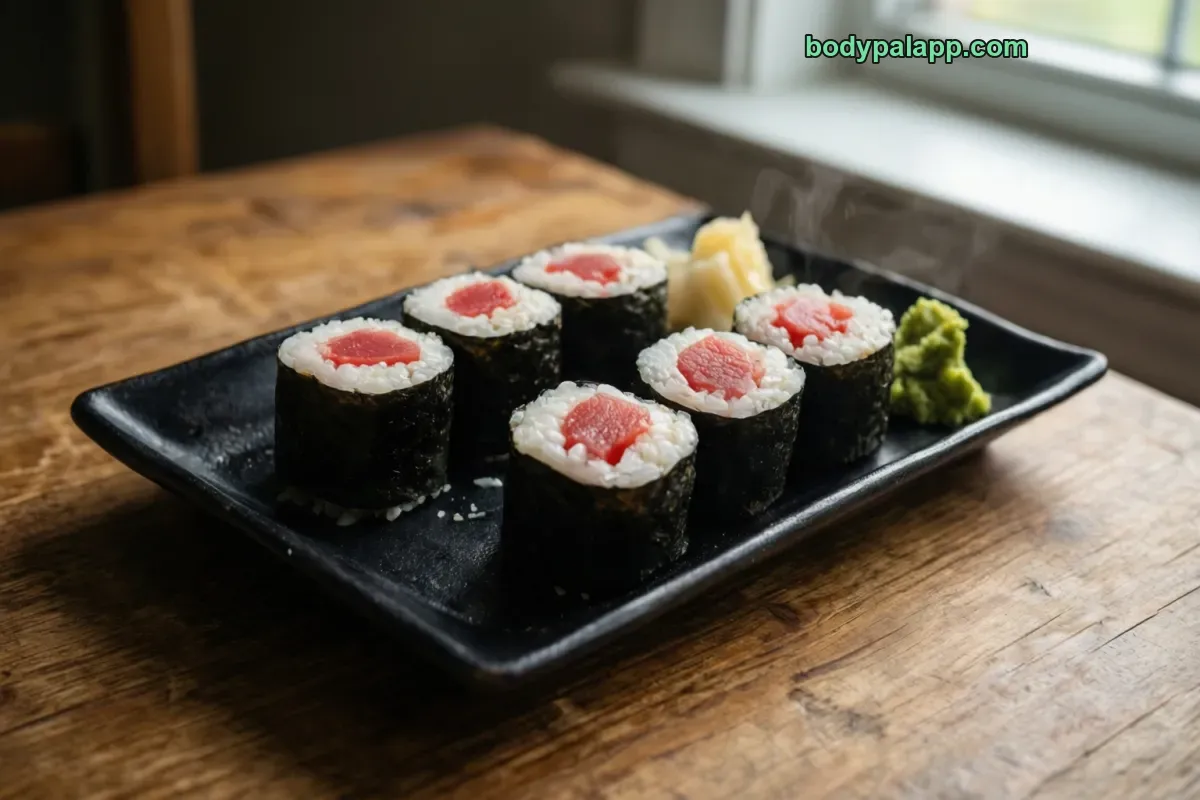
Tuna maki calories come to 175 for one roll (180 g) and 97 per 100 g. Rice supplies 66% of those calories and fat is almost absent, so the roll is lean. The number to watch is sodium: one roll carries 616 mg, 27% of the daily value, before any soy sauce.
175kcal
1 roll · 180 g, sushi roll, ready to eat
32%protein
13.3 gProtein
28 gCarbs
0.5 gFat
How to burn off 175 kcal
—Walking, brisk
—Jogging
—Cycling, moderate
—Swimming
Skip the math. BodyPal counts these calories from your steps and workouts automatically.
Nutrition facts
Sushi roll, ready to eat · per 180 g
Calories
175 kcal
Protein
13.3 g
Carbohydrate
28 g
Fat
0.5 g
Saturated fat
0.1 g
Cholesterol
18 mg
Sodium
616 mg
Potassium
214 mg
Iron
0.6 mg
Source: USDA FoodData Central
🛡️
Verified nutrition data
Numbers on this page come from USDA FoodData Central, the U.S. Department of Agriculture’s food composition database, and from manufacturer labels where a branded product is named. Last verified September 2026. How we verify our data →
Tuna maki: calories, protein and sodium by serving
Percent of daily value uses the FDA reference of 2,000 kcal a day.
Serving
kcal
Protein
Carbs
Fat
Sodium
% DV kcal
1 roll (180 g)
175
13.3 g
27.5 g
0.5 g
616 mg
9%
1 piece (30 g)
29
2.2 g
4.6 g
0.1 g
103 mg
1%
1 cup (150 g)
146
11.1 g
23 g
0.4 g
513 mg
7%
100 g
97
7.4 g
15.3 g
0.3 g
342 mg
5%
3 × 1 roll (180 g)
524
40 g
1,847 mg
5 × 1 roll (180 g)
873
66.6 g
3,078 mg
One roll is 175 calories, two are 349
A standard roll of tuna maki weighs 180 g and comes to 175 calories, about 9% of the daily value. Cut into its usual 6 pieces, each 30 g piece is roughly 29 calories. That makes tuna maki easy to count. You add pieces one at a time instead of guessing at a plate.
The total moves quickly once rolls stack up. Two rolls (360 g) reach 349 calories, three rolls (540 g) land at 524, and a five-roll platter of 900 g hits 873 calories. A dinner of two or three rolls stays moderate on calories, which is why the sides and sauces deserve a closer look than the fish.
If you measure by volume, 1 cup of pieces (150 g) holds 146 calories and 11.1 g of protein. That is a handy check for a bento box or a takeout tray where the roll count is unclear. Shared platters are where estimates drift most, so count your own pieces rather than splitting the total by eye.
Rice supplies two thirds of the calories
The calorie split is 66% carbs, 32% protein and 3% fat. That is the rice talking: per 100 g there are 15.3 g of carbs against 7.4 g of protein and only 0.3 g of fat. Sugars stay low at 0.9 g per 100 g, so most of the carbohydrate is starch.
Tuna is the reason the protein share is respectable. One roll gives 13.3 g of protein, 27% of the daily value, for 175 calories. Two rolls bring 26.6 g and three rolls 40 g, which puts a three-roll order in the range of a solid protein meal.
Fat barely registers. A full roll has 0.5 g of fat, and saturated fat is 0.1 g per 100 g. Lean tuna and plain rice leave little room for it, and that is exactly where tuna maki pulls ahead of rolls made with fattier fish. If you want the leanest item on a sushi menu, this is a strong default.
Sodium is the row to watch
Each roll carries 616 mg of sodium, 27% of the daily value, while its calories cover only 9%. Per 100 g that is 342 mg, or 15% of the daily value. For a food this low in fat and sugar, sodium is the one row that runs ahead of the calories.
Stacking rolls makes this the limiting number. Two rolls reach 1,231 mg, three rolls 1,847 mg, and five rolls 3,078 mg, which is past the full daily value on its own. A single piece adds about 103 mg, so even snacking on a few extra pieces shows up in the total.
That count is before any dipping. Soy sauce is salty, so if you watch sodium, dip lightly or ask for a reduced-sodium version and let the rolls carry the flavor. Keeping the order to one or two rolls is the simplest way to hold the sodium in check.
Low fiber means it needs a side
One roll gives only 1.3 g of fiber, and a piece just 0.2 g. Tuna maki is lean and moderate in calories but thin on vegetables, so it works best as part of a plate rather than the whole meal.
A side salad, cucumber, edamame or steamed vegetables add volume and fiber without much energy. If you already have a salty soup with your sushi, keep the roll count low so the sodium does not pile up. Pairing one roll with a big vegetable side gives a fuller plate than adding a second roll.
Potassium is modest at 119 mg per 100 g, and cholesterol is low at 10 mg. For logging, BodyPal can log the food from a photo, and you can then adjust the piece count so the 29-calorie steps add up to what you actually ate.
How does tuna maki compare?
This table sets tuna maki against salmon maki, generic maki sushi and tuna sushi, per 100 g and per usual serving.
Verdict: For the leanest roll pick tuna maki: 97 calories and 0.3 g of fat per 100 g, against 103 calories and 1.3 g of fat for salmon maki. Generic maki sushi is close at 169 per serving but has only 2.9 g of protein per 100 g against 7.4 g, so tuna maki is the better pick for staying full.
Tuna maki FAQs
How many calories are in one tuna maki roll?
A 6-piece tuna maki roll (180 g) has about 175 calories, or 29 calories per piece (30 g).
Is tuna maki good for weight loss?
A roll has 175 calories with 13.3 g protein and only 0.5 g fat. It also carries 616 mg sodium per roll.
Tuna maki vs maki sushi: which has fewer calories?
They are almost the same: tuna maki has 97 calories per 100 g and generic maki sushi has 94.
How many carbs are in tuna maki?
A 180 g roll has 27.5 g carbs, mostly from the rice, and 0.7 g fiber per 100 g.
How many calories are in one piece of tuna maki?
One piece of tuna maki (30 g) has about 29 calories, with 2.2 g of protein and 4.6 g of carbs. A standard roll cut into 6 pieces totals 175 calories, so counting pieces is the simplest way to log it.
How many calories are in tuna maki per 100 g?
Tuna maki has 97 calories per 100 g, with 7.4 g of protein, 15.3 g of carbs and 0.3 g of fat. That covers 5% of the daily value for calories and 15% for sodium.
Does salmon maki have more calories than tuna maki?
Slightly. Salmon maki has 185 calories per 180 g roll versus 175 for tuna maki, and 1.3 g of fat per 100 g against 0.3 g. Tuna maki is the leaner of the two.
How much sodium is in a tuna maki roll?
A tuna maki roll has 616 mg of sodium, 27% of the daily value, before any soy sauce. One piece carries about 103 mg, and two rolls reach 1,231 mg.
Is tuna maki the same as a tuna sushi roll?
In our data, yes. A 6 piece tuna sushi roll of 180 g has the same 175 calories and 97 per 100 g as tuna maki, with identical protein, carbs and fat.