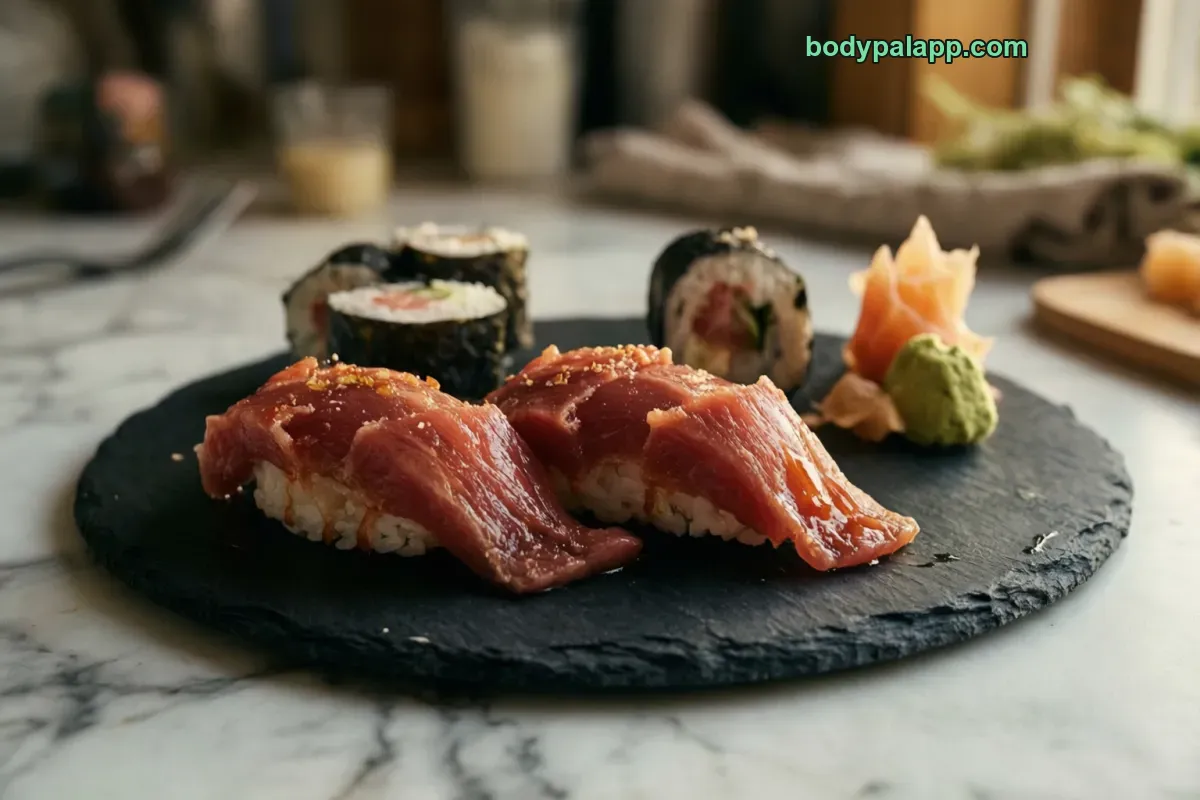
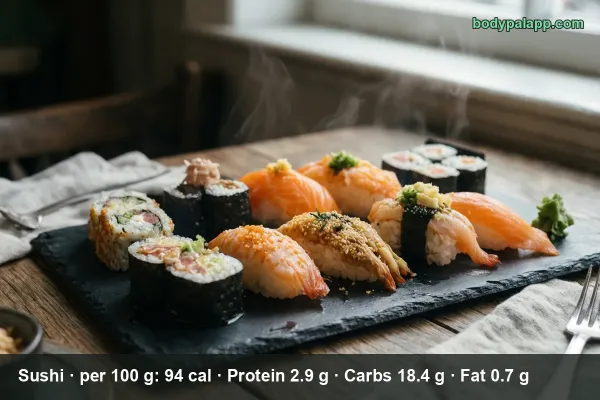
Tuna sushi calories come to 175 for a 6 piece roll (180 g) and 97 per 100 g. What to notice: the rice, not the fish, drives the total. Carbs supply 66% of the calories, protein 32% and fat only 3%, so how many rolls you order matters far more than the tuna inside them.
175kcal
1 6-piece roll · 180 g, tuna roll with rice
32%protein
13.3 gProtein
28 gCarbs
0.5 gFat
How to burn off 175 kcal
—Walking, brisk
—Jogging
—Cycling, moderate
—Swimming
Skip the math. BodyPal counts these calories from your steps and workouts automatically.
Nutrition facts
Tuna roll with rice · per 180 g
Calories
175 kcal
Protein
13.3 g
Carbohydrate
28 g
Fat
0.5 g
Saturated fat
0.1 g
Cholesterol
18 mg
Sodium
616 mg
Potassium
214 mg
Iron
0.6 mg
Source: USDA FoodData Central
🛡️
Verified nutrition data
Numbers on this page come from USDA FoodData Central, the U.S. Department of Agriculture’s food composition database, and from manufacturer labels where a branded product is named. Last verified September 2026. How we verify our data →
Tuna sushi: calories, protein and sodium by serving
Percent of daily value uses the FDA reference of 2,000 kcal a day.
Serving
kcal
Protein
Carbs
Fat
Sodium
% DV kcal
6 piece roll (180 g)
175
13.3 g
27.5 g
0.5 g
616 mg
9%
1 piece (30 g)
29
2.2 g
4.6 g
0.1 g
103 mg
1%
Nigiri piece (35 g)
35
3.4 g
4.7 g
0.1 g
107 mg
2%
1 cup (150 g)
146
11.1 g
23 g
0.4 g
513 mg
7%
3 × 6 piece roll (180 g)
524
40 g
1,847 mg
5 × 6 piece roll (180 g)
873
66.6 g
3,078 mg
One roll is 175 calories, three rolls reach 524
A 6 piece roll (180 g) lands at 175 calories, about 9% of the daily value. That is a light lunch on its own. The trouble is that sushi is easy to keep ordering, and each extra roll adds the same block of calories without much change in how full you feel.
Two rolls (360 g) come to 349 calories with 26.6 g of protein. Three rolls (540 g) climb to 524 calories and 40 g of protein. A five-roll platter (900 g) reaches 873 calories, which is a full dinner and then some.
Smaller units help if you share a plate. A single piece (30 g) is 29 calories, and a nigiri piece (35 g) is 35 calories. A 1 cup (150 g) portion, roughly what a poke-style serving looks like, sits at 146. Counting pieces is the simplest way to keep the total honest.
Rice supplies two thirds of the calories
Per 100 g, tuna sushi has 15.3 g of carbs, 7.4 g of protein and just 0.3 g of fat. In calorie terms that splits into 66% carbs, 32% protein and 3% fat. Tuna itself is very lean, so almost nothing in the roll comes from fat.
That lean profile is the main reason a roll stays at 175 calories. Fat per roll is only 0.5 g, with 0.1 g saturated per 100 g. Sugars are low too, at 1.7 g per roll, though seasoned sushi rice is where most of that comes from.
Protein is respectable rather than high. One roll gives 13.3 g, which is 27% of the daily value. If protein is your priority, nigiri pulls ahead: a 35 g piece carries 3.4 g of protein against 2.2 g in a 30 g roll piece, because the fish sits on top of a smaller pad of rice.
Sodium is the row to watch
Tuna sushi has 342 mg of sodium per 100 g. A single roll brings 616 mg, or 27% of the 2300 mg daily value, before you add any soy sauce. That is a bigger share of your day than the 9% the calories represent.
It scales fast. Two rolls carry 1,231 mg, three rolls 1,847 mg, and a five-roll platter 3,078 mg, which is past the full daily value on the fish and rice alone. Seasoned rice and any sauces inside the roll account for most of it.
If you watch sodium, the roll count is the lever that matters most. Dip lightly, or skip the soy sauce on pieces that are already sauced. Potassium is modest at 119 mg per 100 g, so the roll does little to balance that salt.
Add vegetables to fill the fiber gap
Fiber is the weak spot. A full roll has only 1.3 g, and the 0.7 g per 100 g figure is low for a meal built on rice. That partly explains why a 175-calorie roll can leave you looking for a second one.
Pairing the roll with a side that adds volume and fiber, such as a seaweed or cucumber salad or a bowl of edamame, makes one roll feel like more of a meal. Swapping a few roll pieces for nigiri raises the protein per bite without adding much to the calories.
Cholesterol is low at 10 mg per 100 g, and the overall fat load stays small, so the roll fits most eating patterns with room to spare. Packaged options such as Bento Sushi or Mai sets vary, so check the label on those. BodyPal can also log your plate from a photo.
How does tuna sushi compare?
Here is how tuna sushi stacks up against salmon sushi, generic sushi and tuna nigiri, per 100 g and per usual serving.
Verdict: For the fewest calories with solid protein, tuna sushi at 97 per 100 g and 7.4 g of protein beats generic sushi, which has 94 calories but only 2.9 g of protein and 428 mg of sodium. If you want the most protein and do not mind a little fat, salmon sushi gives 8.9 g per 100 g for 107 calories.
Most popular tuna sushi brands in the United States
Packaged sets and spicy rolls include condiments and mayo based sauces, so they read higher per 100 g than a plain tuna roll. Source: manufacturer labels / USDA FoodData Central.
Tuna sushi FAQs
How many calories are in tuna sushi?
A 6-piece tuna roll (180 g) is 175 calories, and one piece (30 g) is 29 calories.
Is tuna sushi good for weight loss?
Tuna sushi has 97 calories per 100 g, so a 6-piece roll is 175 calories with 13.3 g protein and 0.5 g fat.
Tuna sushi or salmon sushi: which has fewer calories?
Tuna sushi has 97 calories per 100 g and salmon sushi 107, a difference of 10 calories per 100 g.
How much protein is in tuna sushi?
There is 7.4 g of protein per 100 g, which is 2.2 g in one piece and 13.3 g in a 6-piece roll.
How many calories are in one piece of tuna sushi?
One piece of tuna roll (30 g) has 29 calories. It carries 2.2 g of protein, 4.6 g of carbs and 103 mg of sodium, so six pieces add up to a 175-calorie roll.
How many calories are in a piece of tuna nigiri?
A tuna nigiri piece (35 g) has 35 calories and 3.4 g of protein. That is more protein per piece than a roll slice, because the fish sits on a smaller portion of rice.
How much sodium is in a tuna roll?
A 6 piece tuna roll (180 g) has 616 mg of sodium, about 27% of the daily value, before soy sauce. Two rolls reach 1,231 mg, so dipping lightly makes a real difference.
How many calories are in two tuna rolls?
Two tuna rolls (360 g) come to 349 calories with 26.6 g of protein. They also carry 1,231 mg of sodium, which is the number that grows fastest as you add rolls.
How much fat is in tuna sushi?
Tuna sushi has just 0.3 g of fat per 100 g, and a full roll has 0.5 g. Fat supplies only 3% of the calories; rice-based carbs supply 66%.