
How many calories are in sushi?
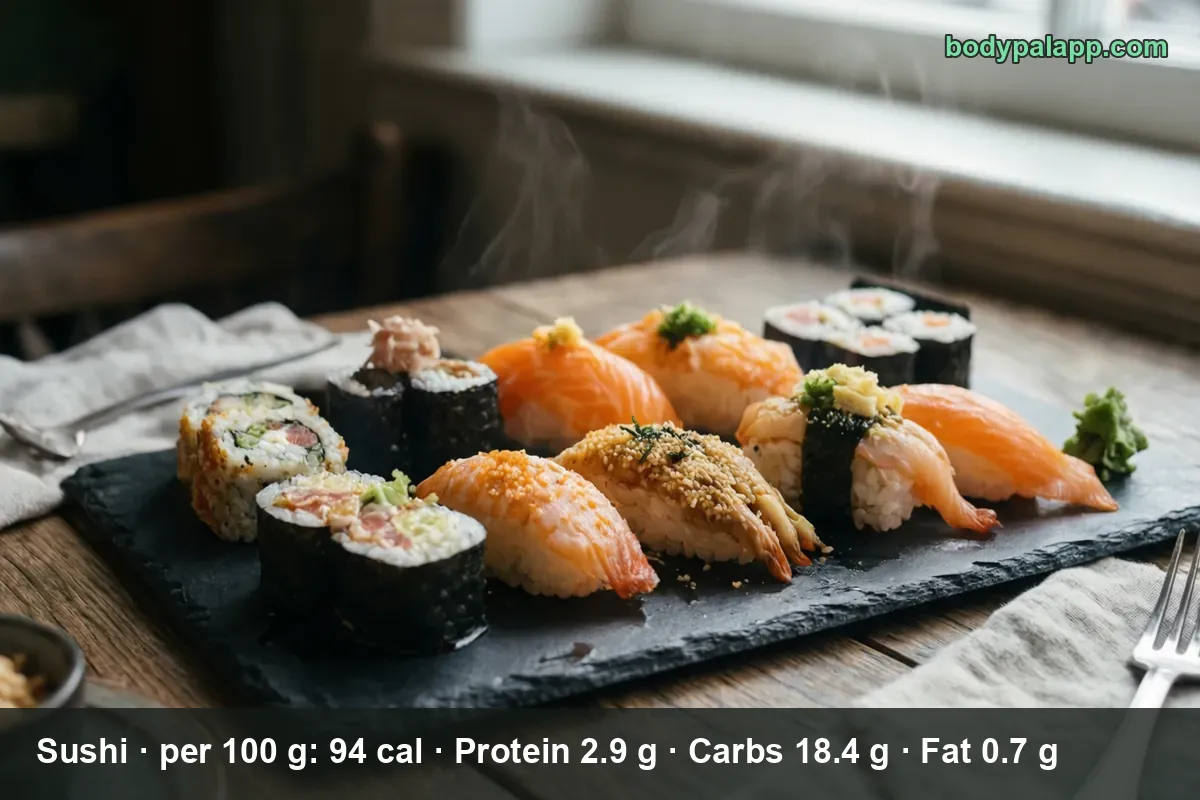
A six-piece plate of sushi weighs about 180 g and carries 169 calories. Per 100 g, mixed sushi runs 94 calories, which makes it one of the lightest plates on any restaurant table by weight. One piece is 28. The surprise sits in the sodium row, not the calorie row: 770 mg on that plate.
On this page
- Sushi quick facts
- US servings, from one piece to a whole roll
- California, tuna, salmon and eel rolls
- Nigiri versus maki, less rice and more fish
- Sodium is the row to watch
- How does sushi compare?
- Most popular sushi brands
- FAQ
Sushi quick facts
The record behind these numbers is FNDDS 2708959, "Sushi, NFS", USDA's catch-all entry for a mixed plate. That is deliberate. Almost nobody eats one named roll and nothing else; the thing in front of you is usually a tray with a few maki, a piece or two of nigiri and a slice of pickled ginger. The named rolls in the same USDA group sit in a tight band of 93 to 116 calories per 100 g around this record, so the mixed number is a fair stand-in for the whole tray.
Six pieces at 180 g is the serving used throughout this page, because that is what a supermarket pack or a lunch order actually holds.
| Nutrient | Per 100 g | Per 6 pieces (180 g) | % Daily Value |
|---|---|---|---|
| Calories | 94 | 169 | — |
| Total fat | 0.67 g | 1.2 g | 2% |
| Saturated fat | 0.13 g | 0.2 g | 1% |
| Carbohydrate | 18.39 g | 33.1 g | 12% |
| Dietary fiber | 1 g | 1.8 g | 6% |
| Total sugars | 2.13 g | 3.8 g | — |
| Protein | 2.92 g | 5.3 g | 11% |
| Sodium | 428 mg | 770 mg | 33% |
% Daily Value is based on a 2,000-calorie diet.
Verified nutrition data
Numbers on this page come from USDA FoodData Central, the U.S. Department of Agriculture’s food composition database, and from manufacturer labels where a branded product is named. Last verified September 2026. How we verify our data →
Two rows you would see on a packaged label are missing here: added sugars and trans fat. USDA does not publish either value for prepared mixed dishes in this edition of the survey database, so they are left out rather than guessed at. Cholesterol is low, 4 mg per 100 g and 7 mg on the plate, 2% of the Daily Value. Potassium comes to 86 mg for six pieces, also 2%.
The shape of that table is the story of sushi. Fat is almost absent at 1.2 g a plate. Carbohydrate carries 33.1 g, and it is nearly all rice. Protein, the reason people order fish in the first place, comes to 5.3 g, less than you would get from a single large egg.
US servings, from one piece to a whole roll
| Serving | Weight | Calories |
|---|---|---|
| 1 piece | 30 g | 28 kcal |
| 1 oz | 28 g | 26 kcal |
| 1 cup | 150 g | 141 kcal |
| 6 pieces, typical plate | 180 g | 169 kcal |
| 1 roll, 8 pieces | 240 g | 226 kcal |
| Per 100 g | 100 g | 94 kcal |
The single piece, the cup and the ounce are USDA household measures for this record. The eight-piece roll is our own arithmetic from the USDA 100 g figure, not a USDA serving, but it matches how most American takeout counters cut a full roll.
Watch the cup. It looks like the obvious way to log a tray, and it is the measure a lot of apps default to, but USDA's cup of sushi weighs 150 g and comes to 141 calories. A real six-piece order is 180 g and 169. Log the cup every lunch and you are 28 calories light each time, which is a quiet 140 calories over a working week. Count pieces instead. They are the one unit sushi actually comes in.
California, tuna, salmon and eel rolls
| Roll | Per 100 g | 6 pieces | Calories |
|---|---|---|---|
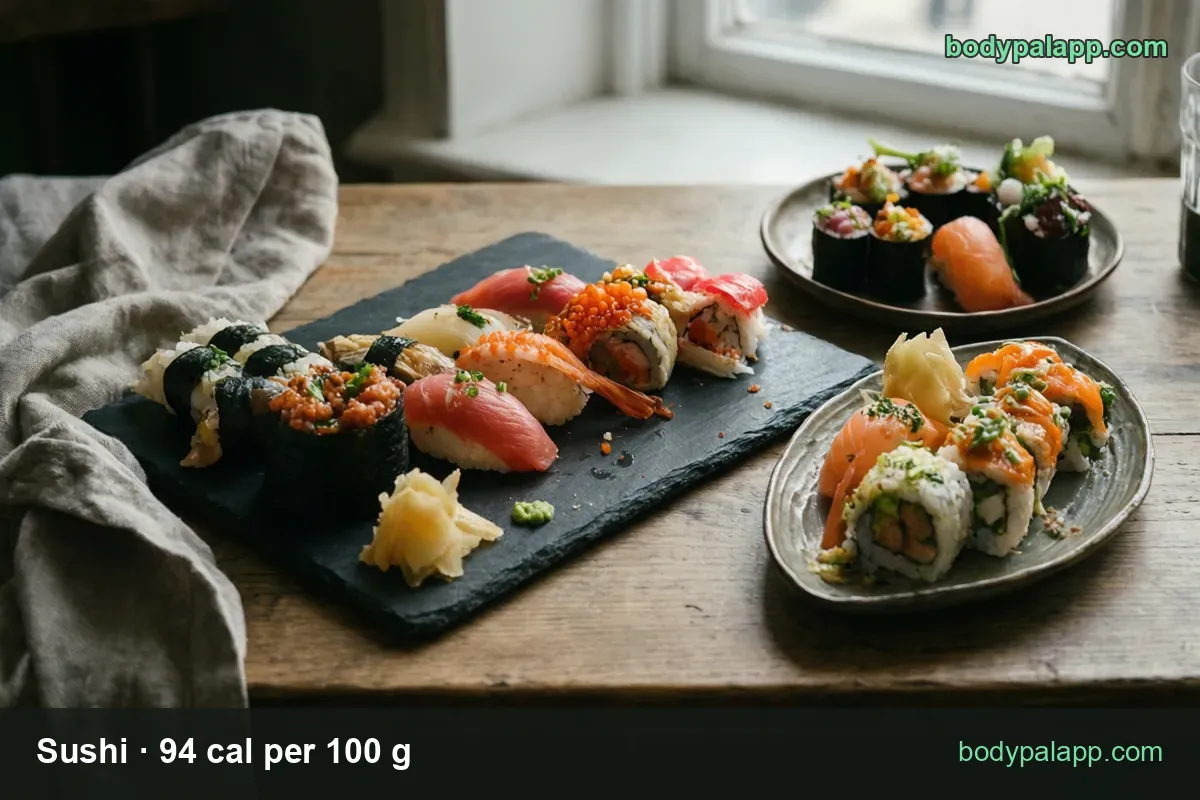
| Avocado (vegetable) roll | 93 kcal | 180 g | 167 kcal |
| California roll | 94 kcal | 180 g | 169 kcal |
| Tuna roll | 97 kcal | 180 g | 175 kcal |
| Shrimp roll | 100 kcal | 180 g | 180 kcal |
| Salmon roll | 103 kcal | 180 g | 185 kcal |
| Eel roll | 116 kcal | 180 g | 209 kcal |
The spread from the lightest roll to the heaviest is 42 calories per six pieces. That is smaller than most people expect, and it is because every one of these rolls is built on the same bed of seasoned rice. The filling changes the fine print, not the headline.
The California roll matches the mixed-sushi record exactly, 94 calories per 100 g, which is one reason USDA's catch-all entry works so well as a default: imitation crab and avocado over rice is the American baseline.
Tuna is the leanest thing you can put in a roll, 0.26 g of fat per 100 g, and it more than doubles protein against the California roll, 7.4 g versus 2.92 g. Salmon adds fat back, 1.28 g per 100 g, and the calories move up by 16 a plate. Eel is the only roll here above 110 calories per 100 g, and the reason is the sweet unagi glaze rather than the fish: fat reaches 2.98 g per 100 g, more than four times a California roll.
The avocado roll is the lightest per 100 g at 93, and it carries the most fiber of the group, 1.4 g per 100 g. It is also the weakest on protein, 1.8 g, so it fills the plate without doing much for how long you stay full.
Nigiri versus maki, less rice and more fish
Nigiri is the one format that genuinely changes the ratio. USDA's sushi topped with tuna runs 100 calories per 100 g, slightly above a California roll, but the composition is different: 9.66 g of protein and 13.39 g of carbohydrate per 100 g, against 2.92 g and 18.39 g in the mixed record. Sodium drops to 306 mg per 100 g, the lowest figure on this page.
Two pieces of tuna nigiri at 30 g each is 60 g, about 60 calories and 5.8 g of protein by our own arithmetic from the 100 g values. That is roughly the protein of a whole six-piece California roll in a third of the food. If you leave a sushi lunch hungry two hours later, this is the trade to make: fewer rolls, more nigiri or sashimi alongside.
MyPlate's protein guidance counts seafood as a protein food to hit several times a week, and sushi is an easy way to do it. Just be clear-eyed that a plate of maki is mostly a rice dish with fish on board.
Sodium is the row to watch
This is where sushi stops looking innocent. Six pieces carry 770 mg of sodium, 33% of the FDA Daily Value of 2,300 mg, or about a third of a teaspoon of table salt. It arrives from the vinegared rice, the imitation crab and the pickles, all before you touch the soy sauce dish.
Put that next to a 169-calorie plate and the ratio is unusual: a third of your day's sodium for 8% of a 2,000-calorie day. Very few foods that light are that salty.
If sodium is something you track, the fix is easy and does not cost you the meal. Nigiri topped with tuna is 306 mg per 100 g against 428 mg for the mixed plate, a 28% drop. Tuna, shrimp and salmon rolls all sit between 342 and 358 mg per 100 g. Skipping the second packet of soy sauce does more than any of these swaps. The Dietary Guidelines for Americans put sodium among the nutrients most adults over-consume, and restaurant food is where most of it comes from.
How does sushi compare?
| Dish | Per 100 g | US serving | Calories |
|---|---|---|---|
| Sushi, mixed plate | 94 kcal | 6 pieces, 180 g | 169 kcal |
| Fresh spring roll with shrimp, not fried | 112 kcal | 100 g | 112 kcal |
| Steamed dumpling or pot sticker | 113 kcal | 100 g | 113 kcal |
| Fried dumpling or pot sticker | 192 kcal | 100 g | 192 kcal |
USDA lists the three comparison dishes only as "1 item, any size" with no weight attached, so the honest comparison is at equal weight rather than per piece.
Our take: sushi wins the weight contest. At 94 calories per 100 g it is the lightest of the four, and frying is the single biggest lever in the group, turning a 113-calorie dumpling into a 192-calorie one. But steamed dumplings deliver 6.9 g of protein per 100 g against sushi's 2.92 g, so if you are ordering for fullness rather than for a low number, a mixed order of nigiri and dumplings beats a tray of maki. For pure calorie economy, sushi with a side of edamame is hard to beat.
Most popular sushi brands in the United States
Ranked by how widely each product appears among foods sold in the United States, from the BodyPal food database of over 3.3 million products. Calories are the figures printed on each Nutrition Facts label, checked against USDA FoodData Central.
| Product | Calories (per 100 g) |
|---|---|
| Pada Sushi Inari Sushi | 167 cal |
| Asian Avenue Salmoncado Roll | 141 cal |
| Snow Fox Sushi Combo | 166 cal |
| SnowFox Nigiri Sushi | 165 cal |
| SnowFox Sushi Combo D | 129 cal |
Brand popularity: BodyPal food database. Nutrition: manufacturer labels / USDA FoodData Central.
Sushi FAQs
How many calories are in one piece of sushi?
One piece of sushi averages 28 calories at a 30 g USDA serving, based on the mixed-sushi record of 94 calories per 100 g. A piece of eel roll runs closer to 35 and an avocado piece 28, both scaled from their USDA 100 g figures. Six pieces come to 169.
How many calories in 6 pieces of sushi?
Six pieces weigh about 180 g and come to 169 calories, with 33.1 g of carbohydrate, 5.3 g of protein and just 1.2 g of fat. That is a light lunch by American standards. The catch is 770 mg of sodium, 33% of the Daily Value, before any soy sauce.
How many calories in a California roll?
A California roll is 94 calories per 100 g in USDA's data, identical to the mixed-sushi record, so six pieces at 180 g land on 169 calories. Imitation crab, avocado and rice keep fat down to 0.67 g per 100 g. Sodium is the highest of the group, 428 mg per 100 g.
Is sushi good for weight loss?
At 94 calories per 100 g, sushi is one of the lighter restaurant plates, and a 169-calorie six-piece order leaves plenty of room in a day. Protein is the weak spot: 5.3 g a plate, 11% of the Daily Value. If fullness is the goal, tuna or salmon rolls do more per calorie.
How much protein is in sushi?
A 180 g plate of mixed sushi gives 5.3 g of protein, 11% of the Daily Value. Tuna rolls carry 7.4 g per 100 g and tuna nigiri 9.66 g, more than triple the 2.92 g in the mixed record. Fish-forward pieces, not extra rice, are what move that number.
How much sodium is in sushi?
Six pieces carry 770 mg of sodium, 33% of the 2,300 mg Daily Value and roughly a third of a teaspoon of table salt. That is before soy sauce. Nigiri topped with tuna is lowest at 306 mg per 100 g, against 428 mg for a mixed plate or California roll.
How many calories in a salmon roll?
A salmon roll is 103 calories per 100 g, so six pieces at 180 g come to 185 calories, 16 more than a California roll. The extra comes from fat, 1.28 g per 100 g against 0.67 g. Protein more than doubles at the same time, 6.88 g against 2.92 g.
Is nigiri lower in calories than a roll?
Not per 100 g. Sushi topped with tuna is 100 calories per 100 g against 94 for a California roll, because nigiri swaps rice for fish rather than removing it. Protein triples to 9.66 g and sodium falls to 306 mg. Per piece, nigiri is usually the bigger bite.
Similar foods
- Chinese Chicken and Broccoli — 206 cal per cup
- Clam Chowder — 237 cal per cup
- Pomegranate — 72 cal for 1/2 cup arils
- Pork And Beans — 273 cal per cup
- Turkey deli meat — 89 cal for 3 slices
- Chicken Tikka Masala — 257 cal per cup
Count it without the math
Point the camera at the tray and BodyPal counts the pieces for you, rice and all.


How long does it take to burn off sushi?
A 6-piece serving (180 g) is 169 kcal. Enter your weight and the amount you ate to see how long it takes you to burn that off:
lb
| Activity | Time to burn 169 kcal |
|---|---|
| Walking, brisk | 34 min |
| Cycling, moderate | 21 min |
| Swimming, moderate | 24 min |
| Jogging | 20 min |
| Weight training, moderate | 38 min |
Times are for a 155 lb adult at a steady pace; change the weight to see yours. The amount is set to the portion in the text (180 g); change it to what you actually ate. BodyPal works this out from your steps automatically.
Want the bigger picture? Calculate your daily calorie needs — your maintenance figure, a target for losing or gaining, and the date you get there.