
How Many Calories Are in a Tuna Sandwich?
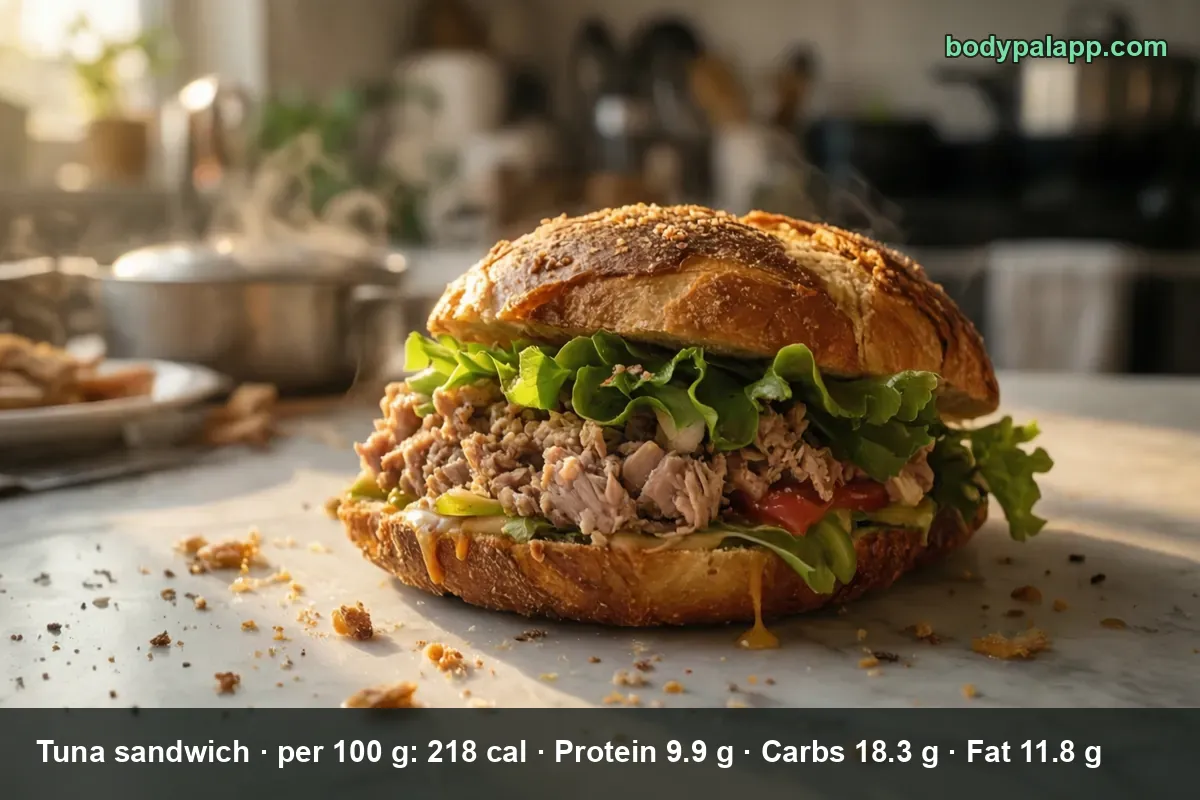
A regular tuna salad sandwich on white bread weighs 180 g and carries 392 calories. Per 100 g the sandwich runs 218 calories, which puts it right in the middle of the deli case. Mayonnaise, not tuna, sets that number: 21.2 g of fat against 17.7 g of protein.
On this page
- Tuna sandwich quick facts
- US servings from a slider to a large deli sandwich
- Wheat bread cheese wraps and the 6-inch sub
- Sodium is the row to watch
- How does a tuna sandwich compare?
- Most popular tuna sandwich brands
- FAQ
Tuna sandwich quick facts
The record used here is FNDDS 2707034, "Tuna salad sandwich on white". That is the sandwich most people actually hold: canned tuna mixed with mayonnaise, spread between two slices of white bread, made at home or pulled out of a deli case. It is not a restaurant sub, and it is not a plain can of tuna. USDA also attaches real household weights to this record, which is why a slider, a regular and a large sandwich can each be priced below instead of guessed.
| Nutrient | Per 100 g | Per 1 regular sandwich (180 g) | % Daily Value |
|---|---|---|---|
| Calories | 218 | 392 | — |
| Total fat | 11.76 g | 21.2 g | 27% |
| Saturated fat | 1.95 g | 3.5 g | 18% |
| Carbohydrate | 18.33 g | 33.0 g | 12% |
| Dietary fiber | 1 g | 1.8 g | 6% |
| Total sugars | 3.16 g | 5.7 g | — |
| Protein | 9.86 g | 17.7 g | 35% |
| Sodium | 429 mg | 772 mg | 34% |
% Daily Value is based on a 2,000-calorie diet.
Verified nutrition data
Numbers on this page come from USDA FoodData Central, the U.S. Department of Agriculture’s food composition database, and from manufacturer labels where a branded product is named. Last verified September 2026. How we verify our data →
Two rows you would see on a packaged label are missing here on purpose. USDA does not publish added sugars or trans fat for composite dishes in this FNDDS release, so listing either one would mean inventing it. The 5.7 g of total sugars in a regular sandwich come mostly from the bread and the sweetened mayonnaise, and total sugars have no Daily Value, which is why that cell stays empty.
Two more numbers are worth knowing before you order: a regular sandwich carries 32 mg of cholesterol, about 11% of the Daily Value, and 256 mg of potassium, roughly 5%. The percentages follow the FDA Daily Values for the Nutrition Facts label.
US servings from a slider to a large deli sandwich
| Serving | Weight | Calories |
|---|---|---|
| 1 oz | 28 g | 62 kcal |
| One miniature sandwich or slider | 90 g | 196 kcal |
| One regular sandwich | 180 g | 392 kcal |
| One large deli sandwich | 270 g | 589 kcal |
| Per 100 g | 100 g | 218 kcal |
The slider, the regular and the large are all USDA household measures attached to the same record, so those three are not estimates. The 1 oz line is our own arithmetic from the USDA 100 g figure, not a USDA serving, and it is there for one reason: it is the cheapest way to price the odd half you left on the plate.
Size, not recipe, is what moves this food. Going from a slider to a large sandwich adds 393 calories without changing a single ingredient. That is a bigger swing than anything the bread or the cheese can do, and it is the swing people miss most often, because a deli sandwich and a homemade one look identical once they are cut in half.
Wheat bread cheese wraps and the 6-inch sub
| Version | Per 100 g | Typical sandwich | Calories |
|---|---|---|---|
| On white bread | 218 kcal | one regular, 180 g | 392 kcal |
| On wheat bread | 217 kcal | one regular, 180 g | 391 kcal |
| On white with cheese | 233 kcal | one regular, 200 g | 466 kcal |
| On wheat with cheese | 232 kcal | one regular, 200 g | 464 kcal |
| Tuna salad wrap | 244 kcal | one wrap, 200 g | 488 kcal |
| 6-inch tuna sub with lettuce and tomato | 218 kcal | one sub, 237 g | 517 kcal |
| Large tuna salad sandwich | 218 kcal | one large, 270 g | 589 kcal |
Wheat bread is the swap people expect to save them calories, and it saves exactly one: 391 against 392 in a regular sandwich. What it actually buys is fiber. The wheat record carries 2.1 g per 100 g against 1 g for white, so a regular sandwich goes from 1.8 g of fiber to 3.8 g. Protein nudges up too, to 18.9 g. If you are choosing bread for a reason, choose it for that reason.
Cheese is the expensive add. One slice takes the sandwich from 392 to 466 calories, partly because the portion itself grows from 180 g to 200 g, and it nearly doubles saturated fat, from 3.5 g to 6.9 g. The wrap is the densest of the family at 244 calories per 100 g; a tortilla is compressed bread, so the same filling in a wrap comes to 488 calories with 8.2 g of saturated fat.
The 6-inch sub is the interesting one. Its density is identical to a homemade white-bread sandwich, 218 calories per 100 g, because the lettuce and tomato dilute exactly as much as the longer roll adds. It reaches 517 calories only because it weighs 237 g. It also delivers the most protein of any version here, 29.2 g, and the least sodium per gram. Everything in this paragraph beyond the USDA 100 g values is our own arithmetic scaled to the listed weights.
Refrigerated grab-and-go sandwiches sit below the USDA record rather than above it. Renaissance Food Group's tuna sandwich on wheat is 157 calories per 100 g and 290 for the 185 g container, Frankly Fresh's white-bread version is 183 and 329 for a 180 g sandwich, and the Good & Delish apple cranberry tuna sandwich sold at Walgreens is 194 and 440 for a 227 g sandwich. Packaged kitchens spread the tuna salad thinner than most home cooks do.
Sodium is the row to watch
Calories are not the number that should worry you here. A regular tuna sandwich carries 772 mg of sodium, 34% of the Daily Value, or roughly a third of a teaspoon of table salt, and that is before a bag of potato chips or a pickle. Canned tuna is brined, mayonnaise is salted, and commercial bread contributes more than people expect.
| Version | Weight | Sodium | % Daily Value |
|---|---|---|---|
| Slider | 90 g | 386 mg | 17% |
| Regular on white | 180 g | 772 mg | 34% |
| Regular on wheat | 180 g | 765 mg | 33% |
| Regular with cheese | 200 g | 978 mg | 43% |
| 6-inch tuna sub | 237 g | 780 mg | 34% |
| Tuna salad wrap | 200 g | 1128 mg | 49% |
| Large deli sandwich | 270 g | 1158 mg | 50% |
These sodium figures for the portions are our own arithmetic from each USDA 100 g value, not USDA servings. Two versions cross 1,000 mg: the wrap at 1,128 mg and the large sandwich at 1,158 mg. Half a day's sodium in one lunch, from a food nobody thinks of as salty. The Dietary Guidelines for Americans put the ceiling at 2,300 mg a day for adults, which is the same number the Daily Value uses.
The protein side is the good news. At 17.7 g, a regular sandwich covers 35% of the Daily Value of 50 g, and the sub covers 58%. That is a legitimate protein lunch by the standards MyPlate sets for the protein foods group, which is more than can be said for most sandwiches in the same calorie range. If you are watching sodium, the 6-inch sub is quietly the better pick per gram of protein; if you are watching calories, the slider wins outright.
How does a tuna sandwich compare?
| Sandwich | Per 100 g | US serving | Calories |
|---|---|---|---|
| Tuna salad on white | 218 kcal | one regular, 180 g | 392 kcal |
| Seafood salad sandwich | 216 kcal | one regular, 180 g | 389 kcal |
| Fish sandwich, fried, on a wheat bun | 229 kcal | one sandwich, 180 g | 412 kcal |
| Sardine sandwich | 234 kcal | one regular, 180 g | 421 kcal |
The 180 g columns for the three neighbors are our own arithmetic from their USDA 100 g values, so that all four are compared at the same weight.
Our take: at the same size, the whole fish-sandwich family lands within 32 calories of itself, so choosing between them on calories alone is wasted effort. Choose on protein instead. The sardine sandwich carries 17.87 g per 100 g and the fried fish sandwich 15.16 g, against 9.86 g for tuna salad, because tuna salad is diluted with mayonnaise while the others are not. Tuna wins on familiarity and on price, and it stays a sensible 392-calorie lunch. But if you want the most protein per calorie from a fish sandwich, tuna is the weakest of the four.
Most popular tuna sandwich brands in the United States
Ranked by how widely each product appears among foods sold in the United States, from the BodyPal food database of over 3.3 million products. Calories are the figures printed on each Nutrition Facts label, checked against USDA FoodData Central.
| Product | Calories (per 100 g) |
|---|---|
| Renaissance Food Group Tuna Sandwich on Wheat | 157 cal |
| Frankly Fresh Tuna Sandwich on White Bread | 183 cal |
| Good & Delish Apple Cranberry Tuna Sandwich | 194 cal |
Brand popularity: BodyPal food database. Nutrition: manufacturer labels / USDA FoodData Central.
Tuna sandwich FAQs
How many calories are in a tuna sandwich?
A regular tuna salad sandwich on white bread weighs 180 g and carries 392 calories, or 218 calories per 100 g. A slider-sized one is 196 calories and a large deli sandwich reaches 589. The mayonnaise does most of the damage: 21.2 g of fat sits in that regular sandwich.
How many calories in a tuna sandwich on wheat bread?
391 calories for a regular 180 g tuna salad sandwich on wheat bread, against 392 on white. The energy is a rounding error, but the fiber is not: wheat brings 3.8 g per sandwich versus 1.8 g on white, and protein edges up to 18.9 g.
How much protein is in a tuna salad sandwich?
A regular tuna salad sandwich holds 17.7 g of protein, which is 35% of the FDA Daily Value of 50 g. Per 100 g the sandwich runs 9.86 g. A 6-inch tuna sub is the protein winner at 29.2 g, because it is simply a bigger sandwich at 237 g.
How many calories in a 6 inch tuna sub?
517 calories for a 6-inch tuna submarine on white bread with lettuce and tomato, weighing 237 g. That is 218 calories per 100 g, the same density as a homemade sandwich on white; the sub is just bigger. It also carries 29.2 g of protein and 780 mg of sodium.
How many calories in a tuna sandwich with cheese?
466 calories once you add a slice of cheese, up from 392. The USDA record for the cheese version runs 233 calories per 100 g and the sandwich grows to 200 g. Saturated fat almost doubles, 6.9 g against 3.5 g, and sodium climbs to 978 mg.
How much sodium is in a tuna salad sandwich?
772 mg of sodium in a regular 180 g tuna salad sandwich, or 34% of the 2,300 mg Daily Value. That is roughly a third of a teaspoon of table salt. A large 270 g sandwich hits 1,158 mg and a tuna wrap 1,128 mg, so the bread choice matters less than the size.
How many calories in a tuna salad wrap?
488 calories for a tuna salad wrap of 200 g, the highest energy density of the family at 244 calories per 100 g. The tortilla is denser and saltier than two slices of bread: sodium reaches 1,128 mg and saturated fat 8.2 g, more than double the plain white-bread version.
Is a tuna sandwich good for weight loss?
At 392 calories and 17.7 g of protein, a regular tuna sandwich fits a 350-450 calorie lunch comfortably. Swap to wheat bread for 3.8 g of fiber, skip the cheese to save 74 calories, and keep it slider-sized at 196 calories if you want room for potato chips.
Similar foods
- Hash Brown — 119 cal per patty
- Skirt Steak — 187 cal for 3 oz cooked
- Chicken Taco — 222 cal per taco
- Chuck Steak — 360 cal per steak
- Dosa — 326 cal per large dosa
- Flat iron steak — 391 cal per steak
Count it without the math
Point the camera at the plate and BodyPal counts the sandwich for you, mayonnaise and all.


How long does it take to burn off tuna sandwich?
One regular sandwich (180 g) is 392 kcal. Enter your weight and the amount you ate to see how long it takes you to burn that off:
lb
| Activity | Time to burn 392 kcal |
|---|---|
| Walking, brisk | 1 hr 18 min |
| Cycling, moderate | 49 min |
| Swimming, moderate | 56 min |
| Jogging | 46 min |
| Weight training, moderate | 1 hr 27 min |
Times are for a 155 lb adult at a steady pace; change the weight to see yours. The amount is set to the portion in the text (180 g); change it to what you actually ate. BodyPal works this out from your steps automatically.
Burning it off is one side of it. The other is knowing your number: work out how many calories you need a day, with macros and a goal date.