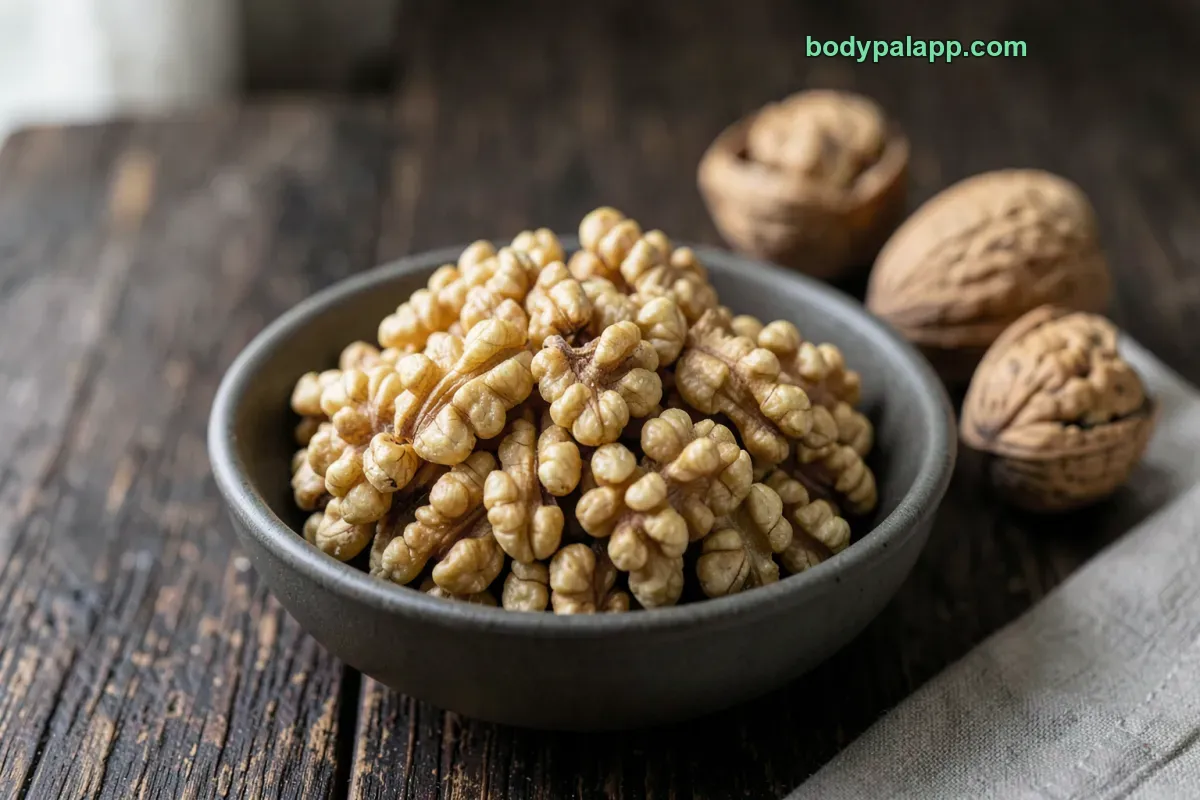
Walnuts calories come to 185 for a 1 oz serving of 14 halves (28 g) and 654 per 100 g. The thing to notice is how quickly that total grows. Fat supplies 84% of the calories, so a cup chopped reaches 765, or 38% of the daily value, before you notice you have eaten much.
185kcal
1 ounce · 28 g, English walnuts, shelled
9%protein
4.3 gProtein
4 gCarbs
18.5 gFat
How to burn off 185 kcal
—Walking, brisk
—Jogging
—Cycling, moderate
—Swimming
Skip the math. BodyPal counts these calories from your steps and workouts automatically.
Nutrition facts
English walnuts, shelled · per 28 g
Calories
185 kcal
Protein
4.3 g
Carbohydrate
3.9 g
Fat
18.5 g
Saturated fat
1.7 g
Cholesterol
0 mg
Sodium
1 mg
Potassium
125 mg
Iron
0.8 mg
Source: USDA FoodData Central
🛡️
Verified nutrition data
Numbers on this page come from USDA FoodData Central, the U.S. Department of Agriculture’s food composition database, and from manufacturer labels where a branded product is named. Last verified September 2026. How we verify our data →
Walnuts: calories, protein and sodium by serving
Percent of daily value uses the FDA reference of 2,000 kcal a day.
Serving
kcal
Protein
Carbs
Fat
Sodium
% DV kcal
1 oz, 14 halves (28 g)
185
4.3 g
3.9 g
18.5 g
1 mg
9%
1 cup chopped (117 g)
765
17.8 g
16 g
76.3 g
2 mg
38%
100 g
654
15.2 g
13.7 g
65.2 g
2 mg
33%
3 × 1 oz, 14 halves (28 g)
556
13 g
2 mg
5 × 1 oz, 14 halves (28 g)
927
21.6 g
3 mg
One ounce is 185 calories, a cup is 765
The standard serving is 1 oz, which works out to about 14 halves or 28.4 g of shelled English walnuts. That portion carries 185 calories, 9% of the daily value. It looks like a small pile in your palm, and that is the point: walnuts are dense, so the honest serving is smaller than most people pour.
Doubling it is easy. Two ounces (57 g) come to 371 calories, three ounces (85 g) reach 556, and five ounces (142 g) hit 927. That last amount is roughly what a loose bag-to-mouth snacking session looks like, and it lands close to a full meal. A cup chopped (117 g) sits between those steps at 765 calories.
If you bake with walnuts or scatter them over salads, the cup measure matters most. Recipes often call for a cup, and that cup alone adds 765 calories to the batch. Weighing once on a kitchen scale tells you what your usual handful really is, and that single number does more for accuracy than any label.
Fat makes up 84% of the calories
The calorie split is lopsided: 84% from fat, 9% from protein and 8% from carbs. Per 100 g that means 65.2 g of fat, 15.2 g of protein and 13.7 g of carbohydrate. Of those carbs, 6.7 g are fiber and only 2.6 g are sugars, so very little of the total comes from anything sweet.
In a 1 oz serving you get 18.5 g of fat, 4.3 g of protein, 3.9 g of carbs, 1.9 g of fiber and 0.7 g of sugars. The protein covers 9% of the daily value, which is useful but not the reason to eat walnuts. Think of them as a fat source that brings some protein along, not as a protein snack.
That profile explains why the calories are so concentrated. Fat carries more energy per gram than protein or carbs, and walnuts hold very little water. The upside is that a measured ounce is filling for its size; the downside is that an unmeasured bowl is not light at all.
Sodium is a non-issue, saturated fat is modest
Plain shelled walnuts have 2 mg of sodium per 100 g and 1 mg per ounce, which rounds to 0% of the 2300 mg daily value. Cholesterol is 0. If you watch sodium, raw or unsalted walnuts are about as clean as a snack gets, and any salt on a roasted or seasoned bag comes from the coating, not the nut.
Saturated fat is the row worth a glance. It sits at 6.1 g per 100 g, against a daily value of 20 g. Most of the fat in walnuts is unsaturated, so saturated fat stays a minor share even at 65.2 g of total fat.
Fiber is the quiet strength. A cup chopped delivers 7.8 g, a solid chunk of the 28 g daily value, and 100 g gives 6.7 g. Potassium reaches 441 mg per 100 g, against a daily value of 4700 mg. None of these rows change the calorie story, but they make the calories you do spend count for more.
Walnuts work best as a measured topping
The easiest way to fit walnuts into a day is to treat them as an ingredient rather than the whole snack. A tablespoon or two chopped over oatmeal, yogurt or a green salad adds crunch and fat that makes a lighter dish more satisfying, without pushing the meal toward the 371 calories of two full ounces.
Pair them with foods that bring what walnuts lack. Fruit adds volume and water, lean protein balances the 84% fat split, and vegetables add bulk for very few calories. A walnut-and-apple snack feels bigger than a handful of nuts alone, mostly because the apple takes up space.
If you snack straight from the bag, portion first. Count out 14 halves, close the bag, and you know you are at 185 calories. If you prefer not to count, BodyPal can log walnuts from a photo of your plate or bowl.
How does walnuts compare?
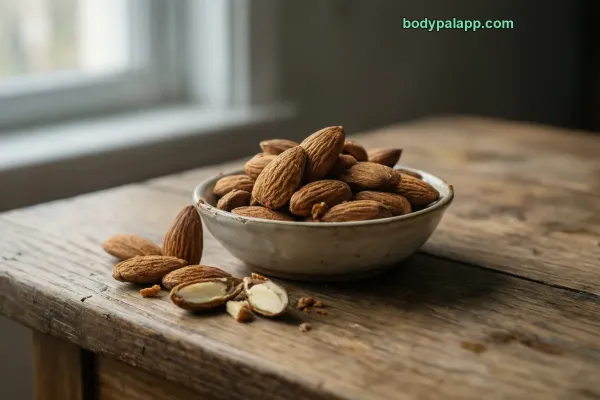
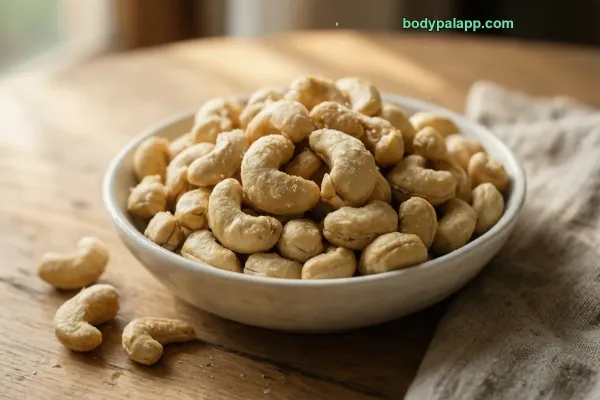
Here is how walnuts stack up against Brazil nuts, almonds and cashews, per 100 g and per usual 1 oz serving.
Verdict: For the fewest calories per ounce, pick cashews at 161 or almonds at 167, while walnuts and Brazil nuts tie at 185. If you want the most protein for the calories, almonds win with 21 g per 100 g against 15.2 g in walnuts.
Most popular walnuts brands in the United States
Ranked by popularity in the BodyPal database
# Productkcal / 100 g
1Meijer Walnuts1/3 cup · 34 g647 kcal
2Kirkland Signature Walnuts1/4 cup · 28 g679 kcal
3Diamond Chopped Walnuts1/4 cup · 30 g667 kcal
4Meijer Chopped Walnuts1/4 cup · 30 g667 kcal
5Diamond of California Chopped Walnuts1/4 cup · 30 g667 kcal
About 185 calories in 1 oz (28 g, roughly 14 halves). A cup of chopped walnuts (117 g) has 765 calories.
Are walnuts good for weight loss?
Walnuts are calorie dense at 654 calories per 100 g, so a 1 oz serving adds 185 calories. That ounce also has 4.3 g protein and 1.9 g fiber.
Walnuts vs Brazil nuts: which has fewer calories?
They are almost equal: walnuts have 654 calories per 100 g and Brazil nuts 659. Walnuts have 15.2 g protein per 100 g, Brazil nuts 14.3 g.
How much fat is in walnuts?
One ounce of walnuts has 18.5 g fat, of which 1.7 g is saturated. Per 100 g that is 65.2 g fat.
How many calories are in a cup of walnuts?
One cup of chopped walnuts (117 g) has 765 calories, which is 38% of the daily value. It also carries 76.3 g of fat, 17.8 g of protein and 7.8 g of fiber, so it is more of an ingredient amount than a snack.
How many calories are in one walnut half?
One ounce of walnuts is about 14 halves and has 185 calories, so a single half is only a small slice of that. The calories add up through counting halves, not from any one piece.
How many calories are in 100 g of walnuts?
100 g of shelled walnuts has 654 calories, 33% of the daily value. That weight brings 65.2 g of fat, 15.2 g of protein, 13.7 g of carbs and 6.7 g of fiber.
How much protein is in a cup of walnuts?
A cup of chopped walnuts has 17.8 g of protein, 36% of the daily value, alongside 765 calories. Protein supplies only 9% of the calories in walnuts, while fat supplies 84%.