
How many calories are in animal crackers?
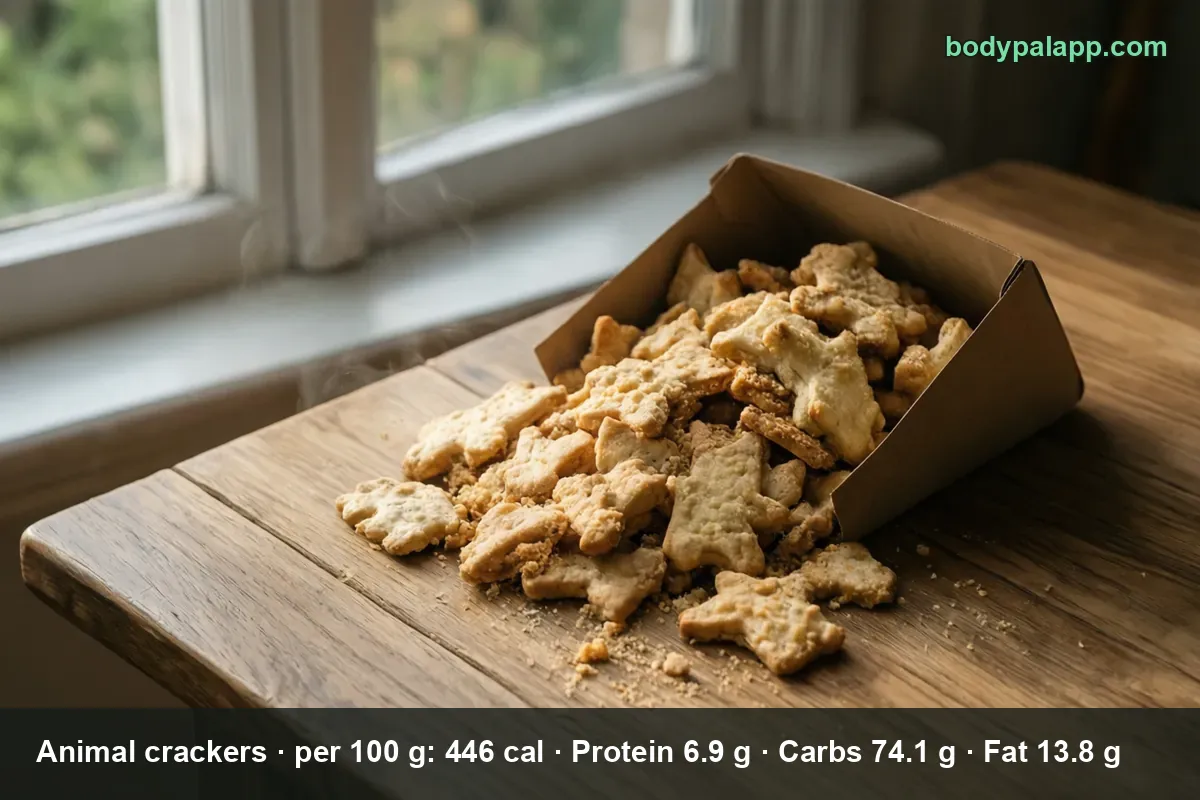
A 1 oz serving of animal crackers, about eleven of the little cookies, carries 126 calories. Per 100 g they run 446 calories, which is heavy for something this small and this crunchy. A single cracker is only 11 calories. That gap between the piece and the pile is the whole story of this snack.
On this page
- Animal cracker quick facts
- US servings, from one cracker to a 2 oz box
- Brand packs and zoo pouches
- Sodium is the surprise row
- How do animal crackers compare?
- Most popular animal crackers brands
- Animal cracker FAQs
Animal cracker quick facts
The number below comes from SR Legacy 168014, "Cookies, animal crackers (includes arrowroot, tea biscuits)". It is the one generic USDA entry for this food, and it describes exactly what a shopper is holding: a plain box or pack of the shaped biscuits, no frosting, no chocolate coating. The branded labels in the USDA files, from 400 to 464 calories per 100 g, all orbit that same figure.
| Nutrient | Per 100 g | Per 1 oz (28.35 g) | % Daily Value |
|---|---|---|---|
| Calories | 446 | 126 | — |
| Total fat | 13.8 g | 3.9 g | 5% |
| Saturated fat | 3.46 g | 1.0 g | 5% |
| Carbohydrate | 74.1 g | 21.0 g | 8% |
| Dietary fiber | 1.1 g | 0.3 g | 1% |
| Total sugars | 23.3 g | 6.6 g | — |
| Protein | 6.9 g | 2.0 g | 4% |
| Sodium | 335 mg | 95 mg | 4% |
% Daily Value is based on a 2,000-calorie diet.
Verified nutrition data
Numbers on this page come from USDA FoodData Central, the U.S. Department of Agriculture’s food composition database, and from manufacturer labels where a branded product is named. Last verified September 2026. How we verify our data →
Two rows you might expect are missing. USDA does not publish added sugars or trans fat for this SR Legacy record, so rather than guess at them we leave them out. Cholesterol is a clean zero, which makes sense for a biscuit built on flour, sugar and vegetable shortening. Potassium is 100 mg per 100 g, or 28 mg in an ounce, roughly 1% of the Daily Value.
The shape of the label is worth a second look. Three quarters of the weight of an animal cracker is carbohydrate, 74.1 g per 100 g, and nearly a third of that carbohydrate is sugar. Fiber barely registers. That is a cookie profile wearing a cracker name.
US servings, from one cracker to a 2 oz box
| Serving | Weight | Calories |
|---|---|---|
| 1 cracker | 2.5 g | 11 kcal |
| 1 arrowroot biscuit | 4.9 g | 22 kcal |
| 1 oz | 28.35 g | 126 kcal |
| 20 crackers | 50 g | 223 kcal |
| 1 individual box, 2 oz | 57 g | 254 kcal |
| Per 100 g | 100 g | 446 kcal |
The first three lines are USDA household measures, straight from the record. The 20-cracker line and the 2 oz box are our own arithmetic from the USDA 100 g figure, not USDA servings, because those are the amounts people actually eat.
Here is the trap. The little individual box that looks like a single serving weighs about 57 g, which is roughly 23 crackers and 254 calories, double the 1 oz reference amount printed in nutrition databases. Handing a child that box is not handing them "a serving". Twenty crackers in a bowl, a modest-looking amount, is already 223 calories, more than a slice of bread and butter.
The arrowroot biscuit at 4.9 g is the same dough in a thicker piece, so it doubles the per-piece number to 22 calories without feeling like two crackers.
Brand packs and zoo pouches
| Version | Per 100 g | Typical pack | Calories |
|---|---|---|---|
| Barnum's animal crackers | 464 kcal | 1 pack (28 g) | 130 kcal |
| Stauffer's original animal crackers | 429 kcal | 1 bag (14 g) | 60 kcal |
| Chocolate animal crackers | 433 kcal | 30 g | 130 kcal |
| Austin zoo animal crackers | 411 kcal | 1 pouch (56 g) | 230 kcal |
Across the six US brand labels in the USDA files the spread is 64 calories per 100 g, from Market Pantry and Happy Snacks at 400 up to Barnum's at 464. That spread flips a comparison that looks obvious on the shelf: a 28 g Barnum's pack is 130 calories while a 30 g Market Pantry serving of 16 crackers is 120. Less weight, more calories.
Stauffer's 14 g bag is the one genuinely small option at 60 calories, which is why it turns up in lunchboxes. At the other end, the 56 g Austin zoo pouch is 230 calories, and note that it lands under the 254 of a plain 57 g box despite weighing almost the same, because that recipe is lighter per gram at 411.
Chocolate versions do not cost as much as people assume. At 433 calories per 100 g the coated crackers sit below Barnum's plain ones. The coating replaces dough rather than piling on top of it.
Sodium is the surprise row
An ounce of animal crackers delivers 95 mg of sodium, 4% of the 2,300 mg Daily Value, while giving back 0.3 g of fiber, which is 1%. A 57 g box reaches 191 mg, about 8%, or under a tenth of a teaspoon of table salt. That is not alarming on its own, but it is four times more sodium than fiber in Daily Value terms, and it is why these taste faintly savory under the sweetness.
The other row worth noticing is protein: 2.0 g per ounce, 4% of the Daily Value. Animal crackers are not a snack that holds anyone until dinner. If you want the grain portion of a snack to do more work, the MyPlate grains guidance points at whole-grain options, which carry the fiber this record almost entirely lacks. The Dietary Guidelines for Americans treat sweet biscuits like these as part of the small allowance left over after nutrient-dense foods, not as the grain itself.
If you are counting for weight loss, the honest move with animal crackers is to portion them before you sit down. If you want a snack that keeps you full, this is the wrong aisle.
How do animal crackers compare?
| Cookie or cracker | Per 100 g | US serving | Calories |
|---|---|---|---|
| Animal crackers | 446 kcal | 1 oz (28.35 g) | 126 kcal |
| Milk crackers | 446 kcal | 1 oz (28.35 g) | 126 kcal |
| Wheat crackers, reduced fat | 444 kcal | 1 oz (28.35 g) | 126 kcal |
| Chocolate chip cookies, soft-type | 444 kcal | 1 oz (28.35 g) | 126 kcal |
Our take: by weight these four are the same snack, all within two calories per 100 g and identical at 126 per ounce, so "I switched to crackers" saves nothing. What changes is what you get for the calories. The reduced-fat wheat crackers bring 9.34 g of protein per 100 g against 6.9 g for animal crackers and just 3.63 g for the soft chocolate chip cookie, which also carries the most fat at 19.77 g. Pick animal crackers because a child will eat them and the pieces are countable, not because they are the light option.
Most popular animal crackers brands in the United States
Ranked by how widely each product appears among foods sold in the United States, from the BodyPal food database of over 3.3 million products. Calories are the figures printed on each Nutrition Facts label, checked against USDA FoodData Central.
| Product | Calories (per 100 g) |
|---|---|
| Stauffer's Original Animal Crackers | 429 cal |
| Market Pantry Animal Crackers | 400 cal |
| Happy Snacks Animal Crackers | 400 cal |
| Austin Zoo Animal Crackers | 411 cal |
| Barnum's Animal Crackers | 464 cal |
| Stauffer's Animal Crackers Chocolate | 433 cal |
Brand popularity: BodyPal food database. Nutrition: manufacturer labels / USDA FoodData Central.
Animal cracker FAQs
How many calories are in one animal cracker?
One animal cracker weighs 2.5 g and carries 11 calories, from the USDA figure of 446 calories per 100 g. The number only matters in handfuls. Twenty crackers, about what fits in a cupped hand, come to 223 calories, and a 57 g individual box holds roughly 23 of them at 254 calories.
How many calories in a serving of animal crackers?
A 1 oz serving is 126 calories, the USDA reference amount and about eleven crackers. Brand packs differ: a 28 g Barnum's pack is 130 calories, a 14 g Stauffer's bag 60, and a 56 g Austin zoo pouch 230. Check the weight on the wrapper, not the piece count.
How many animal crackers are in a 1 oz serving?
About 11. At 2.5 g each, 28.35 g of animal crackers works out to roughly 11 pieces for 126 calories, though shapes vary and some brands count 16 crackers into a 30 g serving. If you want a firm number, weigh the bowl instead of counting elephants and lions.
How many calories in a box of animal crackers?
A 2 oz individual box is 254 calories, our own arithmetic from the USDA 100 g figure rather than a USDA serving. That box also carries 13.3 g of sugar and 191 mg of sodium. Larger family cartons run several times that, so read the net weight printed on the panel.
Are animal crackers healthy?
They are a sweet biscuit at 446 calories per 100 g with 1.1 g of fiber and 23.3 g of sugar, so they belong with cookies rather than with whole grains. As a small portioned snack in a lunchbox they are fine. As an open box on the counter they add up fast.
How much sugar is in animal crackers?
23.3 g per 100 g, which works out to 6.6 g in a 1 oz serving and 13.3 g in a 57 g box. The USDA record for this food does not break out added sugars, so there is no honest way to compare that figure with the 50 g Daily Value for added sugars.
Are animal crackers cookies or crackers?
Nutritionally they are cookies, with 23.3 g of sugar per 100 g. USDA files them under "Cookies, animal crackers", and the numbers agree: 446 calories per 100 g against 1.1 g of fiber. The cracker part is the shape and the snap, not the recipe, which is closer to a sweet tea biscuit.
Do animal crackers have a lot of sodium?
More than the sweet taste suggests: 335 mg per 100 g, or 95 mg in a 1 oz serving, which is 4% of the 2,300 mg Daily Value. A 57 g box reaches 191 mg, about 8%. That is cracker territory rather than cookie territory, and it stacks up if you graze.
Similar foods
- Tea Biscuit — 22 cal per biscuit
- Chocolate Souffle — 400 cal per souffle
- Jordan Almonds — 180 cal per 11 pieces
- Bagel Chips — 126 cal per 1 oz bag
- Cheese Ball — 132 cal per 2 tablespoons
- Cookie Dough — 149 cal per serving
Count it without the math
Point the camera at the bowl and BodyPal counts the crackers for you, box or handful.


How long does it take to burn off animal crackers?
1 oz (28.35 g) is 126 kcal. Enter your weight and the amount you ate to see how long it takes you to burn that off:
lb
| Activity | Time to burn 126 kcal |
|---|---|
| Walking, brisk | 25 min |
| Cycling, moderate | 16 min |
| Swimming, moderate | 18 min |
| Jogging | 15 min |
| Weight training, moderate | 28 min |
Times are for a 155 lb adult at a steady pace; change the weight to see yours. The amount is set to the portion in the text (28.35 g); change it to what you actually ate. BodyPal works this out from your steps automatically.
Burning it off is one side of it. The other is knowing your number: work out how many calories you need a day, with macros and a goal date.