
How many calories are in a bacon egg and cheese?
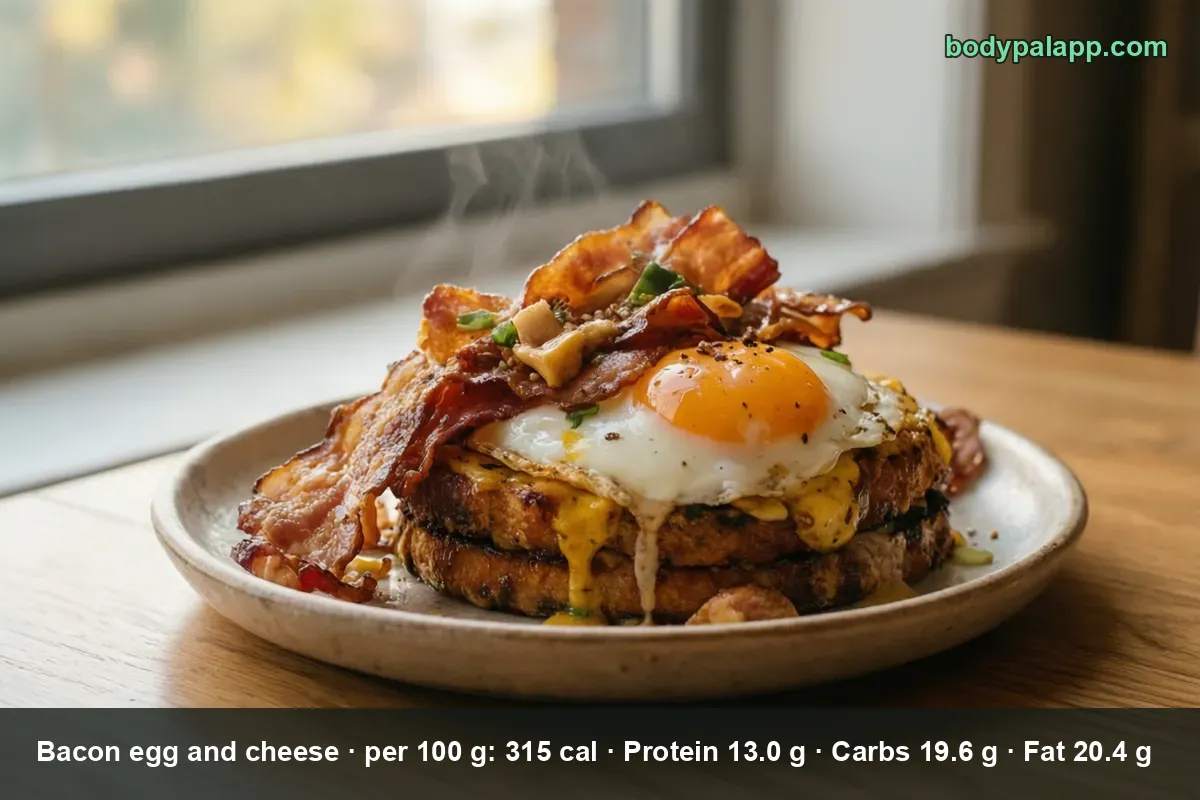
A regular bacon, egg and cheese sandwich weighs 160 g and carries 504 calories. Per 100 g the whole sandwich runs 315 calories, which is why the deli order outruns most breakfasts before you touch the coffee. Fat drives it: 32.7 g in one sandwich, nearly half of that saturated.
On this page
- Bacon egg and cheese quick facts
- US servings from one ounce to a large sandwich
- Biscuit vs croissant vs griddle cake vs English muffin
- Saturated fat and sodium are the rows to watch
- How does a bacon egg and cheese compare?
- Most popular bacon egg and cheese brands
- Bacon egg and cheese FAQs
Bacon egg and cheese quick facts
The number above comes from FNDDS 2707327, "Egg sandwich on biscuit, with bacon and cheese". FNDDS is the USDA's file for mixed dishes as people actually eat them, and this is the one unbranded, non-restaurant record covering the whole sandwich — bread, egg, bacon and cheese together — with real household portions attached to it. The alternatives in FoodData Central are either chain menu items or single ingredients you would have to add up yourself.
The bread in that record is a biscuit. A deli sandwich on a toasted roll or on toast lands close enough that the same figures work as a planning number, as long as the sandwich weighs about the same. Weight is what moves this food, not the shape of the bread.
| Nutrient | Per 100 g | Per 1 sandwich (160 g) | % Daily Value |
|---|---|---|---|
| Calories | 315 | 504 | 25% |
| Total fat | 20.42 g | 32.7 g | 42% |
| Saturated fat | 9.92 g | 15.9 g | 79% |
| Carbohydrate | 19.63 g | 31.4 g | 11% |
| Dietary fiber | 1.1 g | 1.8 g | 6% |
| Total sugars | 2.1 g | 3.4 g | — |
| Protein | 12.98 g | 20.8 g | 42% |
| Sodium | 804 mg | 1286 mg | 56% |
% Daily Value is based on a 2,000-calorie diet.
Verified nutrition data
Numbers on this page come from USDA FoodData Central, the U.S. Department of Agriculture’s food composition database, and from manufacturer labels where a branded product is named. Last verified September 2026. How we verify our data →
Two label rows are missing on purpose. This FNDDS edition publishes no added sugars and no trans fat value for the record, so putting a number in either row would mean inventing one. Cholesterol and potassium are there: 246 mg and 269 mg in one regular sandwich, which is 82% and 6% of their Daily Values.
US servings from one ounce to a large sandwich
| Serving | Weight | Calories |
|---|---|---|
| 1 oz | 28 g | 88 kcal |
| Half a regular sandwich | 80 g | 252 kcal |
| One sandwich, regular | 160 g | 504 kcal |
| One large sandwich | 240 g | 756 kcal |
| Per 100 g | 100 g | 315 kcal |
The two sandwich sizes are USDA household measures for this record: a regular at 160 g and a large at 240 g. The other two lines are our own arithmetic from the USDA 100 g figure, not USDA servings — one ounce because it is the easiest unit to check on a kitchen scale, and the half because a lot of people split one.
That 80 g gap between regular and large is worth reading twice. A large is not a slightly bigger sandwich; it is 252 extra calories, the same as eating half a second one. Bodega and deli sandwiches are not standardized, so if yours feels heavy in the hand it probably sits nearer the large line than the regular one.
Biscuit vs croissant vs griddle cake vs English muffin
| Version | Per 100 g | Typical item | Calories |
|---|---|---|---|
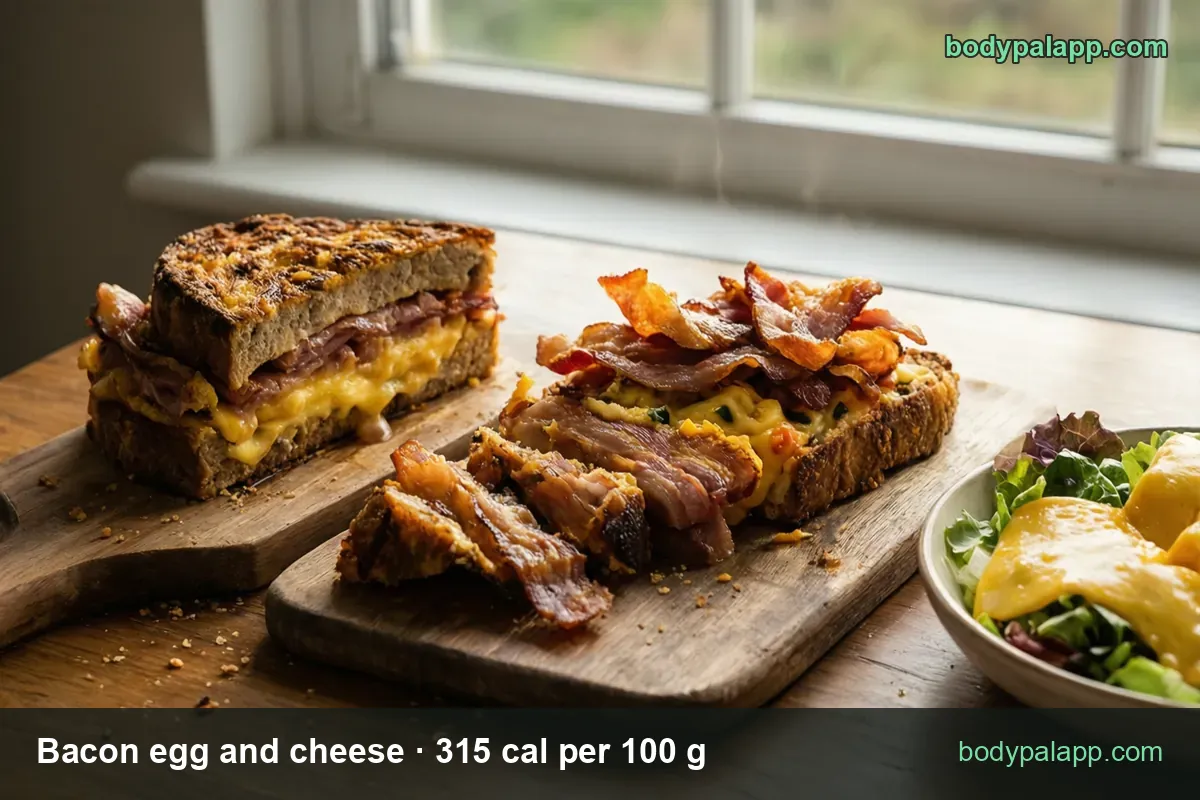
| On a biscuit, deli-style | 315 kcal | 1 sandwich, 160 g | 504 kcal |
| Fast-food biscuit | 301 kcal | 1 item, 145 g | 436 kcal |
| On a croissant | 289 kcal | 1 item, 128 g | 370 kcal |
| On a griddle cake | 272 kcal | 1 item, 174 g | 473 kcal |
| On an English muffin, Canadian bacon | 228 kcal | 1 sandwich, 126 g | 287 kcal |
The griddle cake version is the trap in this table. At 272 calories per 100 g it looks like the light option, second lowest of the five. But the item is the heaviest at 174 g, so it finishes at 473 calories, and the pancake-style bread brings 9.56 g of sugars per 100 g — 16.6 g in one sandwich, against 3.4 g in the regular biscuit build.
The croissant behaves the opposite way. It is denser than the English muffin per 100 g at 289, yet the item is small, so it lands at 370. Whenever two sandwiches are within 30 calories per 100 g of each other, the size of the item decides the outcome, not the recipe.
Packaged versions sit in the same band. USDA's Branded file lists a PRIMA bacon egg cheese slider at 400 calories for two sliders (140 g), a Speedway grilled wrap at 330 for a 128 g wrap, and a Hot Pockets hot honey bacon egg and cheese at 451 for a 181 g sandwich — all lighter than a full-size deli sandwich, mostly because they are less calorie-dense: 249 to 286 per 100 g against 315.
Saturated fat and sodium are the rows to watch
Calories are the least interesting number on this label. One regular sandwich is 25% of a 2,000-calorie day, but 79% of the Daily Value for saturated fat, 82% for cholesterol and 56% for sodium. The FDA sets those Daily Values at 20 g of saturated fat, 300 mg of cholesterol and 2,300 mg of sodium a day.
Put differently: the sandwich takes a quarter of your calories and four-fifths of your saturated fat budget. That is the ratio to know before deciding how often it shows up in the week. The 1,286 mg of sodium is a little over half a teaspoon of table salt, and none of it is visible.
The credit side is real too. At 20.8 g, one sandwich covers 42% of the Daily Value for protein, and eggs plus cheese are exactly the kind of mixed protein foods MyPlate counts toward the daily group. For a breakfast that has to hold until lunch, 20 g of protein does more work than a pastry of the same calories.
If sodium or saturated fat is the number you are watching, the English muffin build with Canadian bacon is the better pick: 617 mg of sodium and 3.59 g of saturated fat per 100 g, against 804 mg and 9.92 g in the biscuit record.
How does a bacon egg and cheese compare?
| Sandwich | Per 100 g | US serving | Calories |
|---|---|---|---|
| Bacon egg and cheese, biscuit | 315 kcal | 1 sandwich, 160 g | 504 kcal |
| Fast-food biscuit version | 301 kcal | 1 item, 145 g | 436 kcal |
| Croissant version | 289 kcal | 1 item, 128 g | 370 kcal |
| English muffin, Canadian bacon | 228 kcal | 1 sandwich, 126 g | 287 kcal |
Our take: the deli-style biscuit sandwich is the heaviest of these four both per 100 g and per sandwich, and it is not close — 504 against 287 for the English muffin, a 217-calorie gap. For weight loss, the English muffin with Canadian bacon is the obvious swap, because it is the only one of the four under 250 calories per 100 g while carrying the most protein per 100 g at 13.64 g. For staying full through a long morning, the regular sandwich earns its 504 with 20.8 g of protein and 32.7 g of fat, which is a genuinely slow breakfast. What we would not do is choose the griddle cake version thinking it is the light one.
Most popular bacon egg and cheese brands in the United States
Ranked by how widely each product appears among foods sold in the United States, from the BodyPal food database of over 3.3 million products. Calories are the figures printed on each Nutrition Facts label, checked against USDA FoodData Central.
| Product | Calories (per 100 g) |
|---|---|
| PRIMA Bacon Egg Cheese Slider | 286 cal |
| Speedway Bacon Egg Cheese Grilled Wrap | 258 cal |
| Hot Pockets Hot Honey Bacon Egg Cheese | 249 cal |
Brand popularity: BodyPal food database. Nutrition: manufacturer labels / USDA FoodData Central.
Bacon egg and cheese FAQs
How many calories are in a bacon egg and cheese sandwich?
A regular 160 g sandwich is 504 calories, based on the USDA's biscuit-built record at 315 calories per 100 g. A large 240 g version reaches 756. If your sandwich is smaller or built on thinner bread, the calories fall roughly in step with the weight.
How much protein is in a bacon egg and cheese?
One regular sandwich carries 20.8 g of protein, 42% of the Daily Value, from 12.98 g per 100 g. That puts it ahead of most sweet breakfasts. The English muffin build is slightly denser in protein at 13.64 g per 100 g, though its smaller size scales to 17.2 g per sandwich.
How much sodium is in a bacon egg and cheese?
One regular sandwich holds 1,286 mg of sodium, 56% of the 2,300 mg Daily Value and a little over half a teaspoon of table salt. The fast-food biscuit record is denser still at 816 mg per 100 g. The croissant build is the mildest of the group at 602 mg.
Bacon egg and cheese on a biscuit vs English muffin - which has fewer calories?
The English muffin with Canadian bacon wins by 217 calories: 287 for a 126 g sandwich against 504 for the 160 g biscuit build. Per 100 g it is 228 against 315. Leaner Canadian bacon and a light muffin do the work, and protein per 100 g actually goes up.
How many calories in a bacon egg and cheese croissant?
A bacon, egg and cheese croissant is 370 calories for a 128 g item, or 289 per 100 g. It is lighter than the biscuit version mostly because the item itself is smaller. Sodium drops too, to 602 mg per 100 g, while sugars rise to 4.8 g.
How many carbs are in a bacon egg and cheese?
A regular sandwich has 31.4 g of carbohydrate, 11% of the Daily Value, with 1.8 g of fiber and 3.4 g of total sugars. The griddle cake version is the outlier: 26.19 g of carbohydrate and 9.56 g of sugars per 100 g, since the pancake bread is sweetened.
Is a bacon egg and cheese healthy for breakfast?
The protein is real at 20.8 g, but one sandwich also carries 79% of the Daily Value for saturated fat and 82% for cholesterol at only 25% of the calories in a 2,000-calorie day. Eaten daily that is a lot; the 287-calorie English muffin build is the better weekday pick.
How many calories in half a bacon egg and cheese?
Half a regular sandwich is 252 calories for 80 g, our own arithmetic from the USDA 100 g figure of 315 rather than a listed USDA serving. Half also halves the rest: 16.3 g fat, 10.4 g protein and 643 mg sodium, which is still 28% of the sodium Daily Value.
Similar foods
- Pancake — 423 cal for 3 medium pancakes
- Toast with butter — 100 cal per slice with butter
- Crepe — 179 cal per crepe
- Omelet — 305 cal for 3-egg omelet
- Egg — 72 cal per large egg
- Bolillo — 372 cal per medium roll
Count it without the math
Point the camera at the sandwich and BodyPal counts it for you, bread and all.


How long does it take to burn off 504 kcal of bacon egg & cheese?
One sandwich (160 g) is 504 kcal. Enter your weight and the amount you ate to see how long it takes you to burn that off:
lb
| Activity | Time to burn 504 kcal |
|---|---|
| Walking, brisk | 1 hr 41 min |
| Cycling, moderate | 1 hr 3 min |
| Swimming, moderate | 1 hr 12 min |
| Jogging | 59 min |
| Weight training, moderate | 1 hr 52 min |
Times are for a 155 lb adult at a steady pace; change the weight to see yours. The amount is set to the portion in the text (160 g); change it to what you actually ate. BodyPal works this out from your steps automatically.
Burning it off is one side of it. The other is knowing your number: work out how many calories you need a day, with macros and a goal date.