
How many calories in a blood orange?
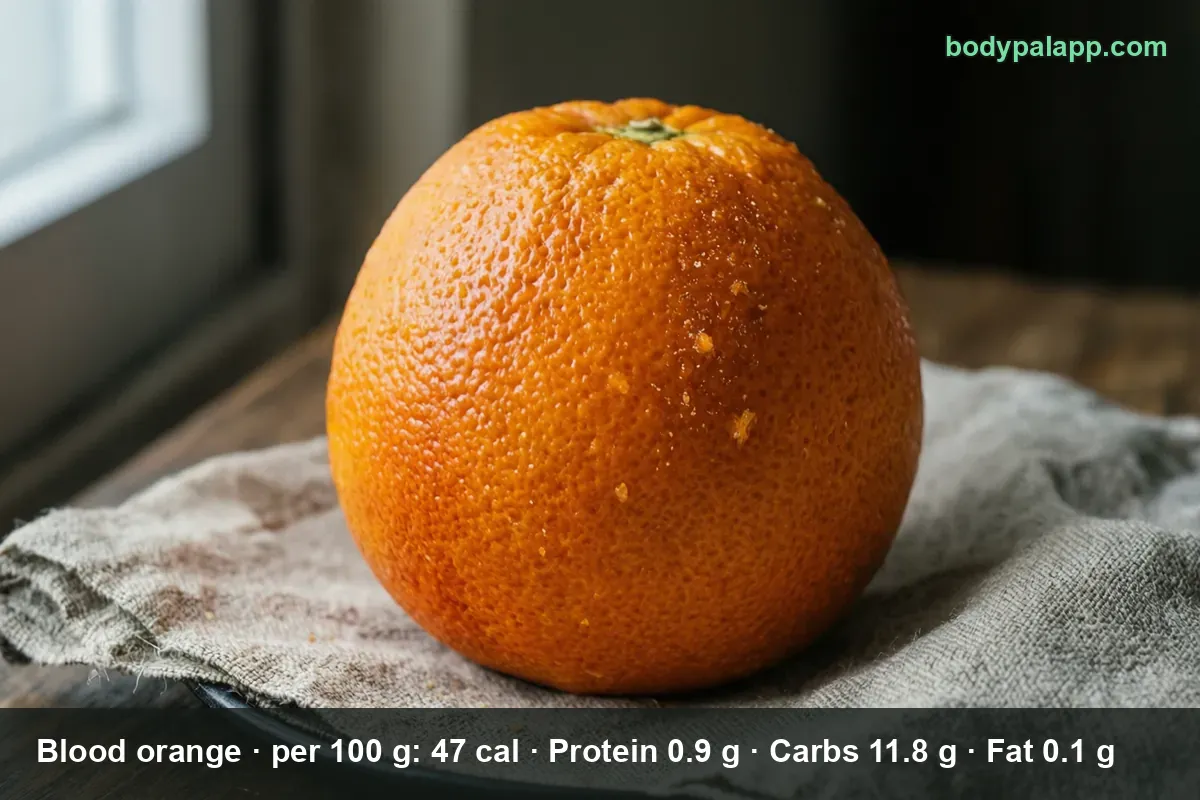
One medium blood orange, 131 g of it, is 62 calories. Per 100 g the fruit runs 47 calories. A cup of sections comes to 85, half a fruit to 31. The calories in blood orange are the calories in any sweet orange, because the ruby pigment that gives the fruit its name costs nothing at all.
On this page
- Blood orange quick facts
- USDA has no blood orange row, and that is fine
- What one blood orange actually weighs
- Halves, sections and the cup problem
- Juice takes the calories up and the fiber out
- The word on the label is rarely the fruit
- How does a blood orange compare?
- FAQ
Blood orange quick facts
The numbers below are for raw fruit, peeled, nothing added, from SR Legacy 169097 — USDA's summary record for commercially grown sweet oranges. The serving column is one medium fruit at 2-5/8 inches across, which USDA weighs at 131 g.
| Nutrient | Per 100 g | Per 1 medium orange (131 g) | % Daily Value |
|---|---|---|---|
| Calories | 47 | 62 | — |
| Total fat | 0.1 g | 0.2 g | 0% |
| Saturated fat | 0 g | 0 g | 0% |
| Carbohydrate | 11.8 g | 15.4 g | 6% |
| Dietary fiber | 2.4 g | 3.1 g | 11% |
| Total sugars | 9.4 g | 12.2 g | — |
| Protein | 0.9 g | 1.2 g | 2% |
| Sodium | 0 mg | 0 mg | 0% |
| Potassium | 181 mg | 237 mg | 5% |
% Daily Value is based on a 2,000-calorie diet.
Verified nutrition data
Numbers on this page come from USDA FoodData Central, the U.S. Department of Agriculture’s food composition database, and from manufacturer labels where a branded product is named. Last verified September 2026. How we verify our data →
There is no added sugars row here, and its absence is the honest answer rather than a gap. A fruit pulled off a tree has nothing added to declare, so all 12.2 g of sugars in a medium blood orange arrived with the fruit. Total sugars carry no Daily Value on a US label either, which is why that percentage cell stays empty on every fruit page you will ever read.
The row worth a second look is fiber. One fruit hands back 3.1 g, which is 11% of the 28 g FDA Daily Value — a bigger share of the day than its carbohydrate takes up, at 6%. Potassium adds 237 mg, another 5%. Fat and sodium are both effectively zero: 0.2 g of fat and no measurable sodium in the whole fruit, against a 2,300 mg sodium Daily Value.
USDA has no blood orange row, and that is fine
Search FoodData Central for "blood orange" and you will not find the fruit. Not in the Foundation set, not in SR Legacy, not in the survey database behind national dietary statistics. This page says so out loud, because the alternative is quietly inventing a number.
Moro, Tarocco and Sanguinello — the three cultivars sold in American stores between December and April — are all Citrus sinensis, the ordinary sweet orange. What makes the flesh run from brick red to deep burgundy is anthocyanin, the same class of pigment that colors a blueberry. Pigment is not fuel. It shifts the color of the juice and none of the macros, which is why the correct record to use is the one covering all commercial varieties.
The proof is in how tightly USDA's orange records cluster:
| USDA record | Per 100 g |
|---|---|
| Oranges, raw, all commercial varieties (this page) | 47 |
| Oranges, raw, Florida | 46 |
| Oranges, raw, navels | 49 |
| Oranges, raw, California valencias | 49 |
| Orange, raw (survey record) | 50 |
Four calories separate every orange USDA lists. A blood orange lives inside that band, and so does a navel, and so does whatever was cheapest at the store. Anyone publishing a distinct "blood orange calorie count" is either rounding differently or making it up.
One technical note on the choice. USDA's newer laboratory records for navel oranges report 47 calories too, but they carry no figure for sugars, saturated fat or cholesterol — three rows a US nutrition panel needs. SR Legacy 169097 carries the full panel, so the whole table comes from one record instead of being stitched from two.
What one blood orange actually weighs
| Serving | Weight | Calories |
|---|---|---|
| 1 oz | 28 g | 13 |
| Half a medium fruit | 66 g | 31 |
| 1 small orange (2-3/8" dia) | 96 g | 45 |
| 1 medium orange (2-5/8" dia) | 131 g | 62 |
| 1 large orange (3-1/16" dia) | 184 g | 86 |
| 1 cup sections | 180 g | 85 |
| 100 g | 100 g | 47 |
The small, medium and large weights are USDA's own household measures for this record, keyed to fruit diameter rather than to guesswork, and so are the ounce and the cup. The half is our own arithmetic on the per-100 g figure.
Size is the only variable that moves the number, and it moves it hard. Small to large is 45 to 86 calories — the large fruit is nearly double the small one. Blood oranges tend toward the smaller end of that range, since Moro and Tarocco are compact fruit next to a Washington navel. If you are eyeballing rather than weighing, the medium at 62 is the safer default, and the 41-calorie spread between the extremes is small enough that no one should lose an evening over it.
Halves, sections and the cup problem
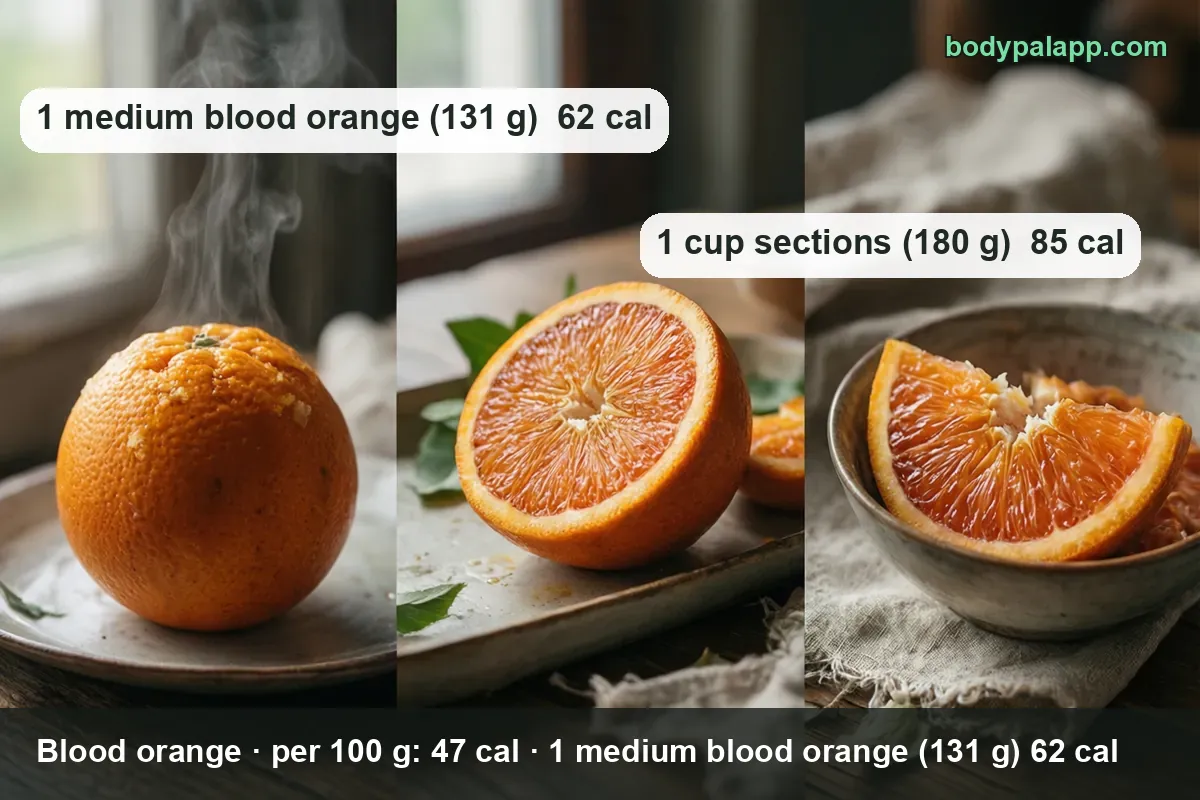
Cutting a blood orange changes nothing about it. Whole in your hand, halved over a bowl, or broken into segments, a 131 g fruit is 62 calories. The unit you pick in a food log is where the count goes wrong.
USDA's cup of orange sections weighs 180 g. A medium fruit weighs 131 g. So a cup is not "an orange" — it is closer to 1.4 of them, and it lands at 85 calories, 37% above the fruit most people picture. Tap "1 cup" after eating one whole orange and you have added 23 calories that never existed. Tap "1 medium" after clearing a bowl of sections and you have hidden the same 23.
The cup does bring the macros up with it: 21.2 g of carbohydrate, 1.7 g of protein and 0.2 g of fat, against 15.4 g, 1.2 g and 0.2 g in the single fruit.
Half a fruit deserves its own line at 66 g and 31 calories, because halves are what actually happen — half sliced into a salad, half squeezed over fish, half eaten standing at the counter. It is the one portion nobody bothers to log, and at 31 calories it is also the one portion where skipping the log costs nothing worth counting.
Juice takes the calories up and the fiber out
This is the trade that matters most, and it runs in the direction people least expect.
A cup of fresh-squeezed orange juice, 248 g, is 112 calories — from SR Legacy 169098, raw juice with nothing added. That is 1.8 medium fruits' worth of calories. The fiber does not come along: raw juice holds 0.2 g per 100 g, so a full cup carries about 0.5 g, while the 1.8 fruits it replaced would have carried 5.6 g.
Squeeze a single orange and you get about 86 g of juice, or 39 calories. Three fruits fill a cup. Eating those three would have been 186 calories and 9.4 g of fiber, which is a third of the day's Daily Value; drinking them is 112 calories and almost none. Juice is not the villain here, but it is a different food, and it is the fastest way to turn a fruit that fills you up into one that does not.
Zest runs the other way. USDA's record for orange with the peel on is 63 calories per 100 g, higher than the flesh alone, but it carries 4.5 g of fiber against 2.4 g. A cup of that, 170 g, is 107 calories. In practice you are never eating a cup of peel — a teaspoon of grated blood orange zest weighs under 2 g, which is a rounding error in calories and a genuine hit of aroma in a marinade or a cake batter.
The word on the label is rarely the fruit
Here is the finding that surprised us while building this page. USDA's branded-food database holds more than 1,300 products with "blood orange" printed on them. Not one of them is a blood orange.
They are sodas, sparkling juices, lemonades, flavored yogurt and chocolate bars. An Italian-style blood orange soda runs about 39 calories per 100 mL, which by our own arithmetic puts a 330 mL can (11.2 fl oz) near 129 calories — roughly two whole fruits, with none of the fiber and none of the potassium. A dark chocolate bar flavored with blood orange sits around 489 calories per 100 g. Both are perfectly fine things to eat. Neither should be logged as fruit.
So when a search for blood orange calories turns up wildly different figures, this is usually why: half the results are describing something that was never on a tree. The fruit itself is 47 calories per 100 g and always has been. If a number is more than about 55, check whether the thing being counted is a beverage.
Fresh blood oranges, meanwhile, carry no nutrition label at all in the produce aisle, which is exactly why federal food composition data exists — and why the whole-fruit advice in MyPlate and the Dietary Guidelines for Americans is written around fruit rather than around fruit flavor.
How does a blood orange compare?
| Item | Per 100 g | Serving | Calories | Carbs | Protein |
|---|---|---|---|---|---|
| Blood orange, raw (this page) | 47 | 1 medium (131 g) | 62 | 15.4 g | 1.2 g |
| Navel orange, raw | 49 | 1 medium (140 g) | 69 | 17.6 g | 1.3 g |
| Tangerine (mandarin), raw | 53 | 1 medium (88 g) | 47 | 11.7 g | 0.7 g |
| Orange, raw, with peel | 63 | 1 fruit (159 g) | 100 | 24.6 g | 2.1 g |
| Fresh-squeezed orange juice | 45 | 1 cup (248 g) | 112 | 25.8 g | 1.7 g |
Read that table by column and it reverses itself. Per 100 g the tangerine is the densest of the peeled fruits at 53, only the orange eaten with its peel is higher at 63, and the juice is the lightest at 45. Per serving the order flips completely: the tangerine becomes the smallest thing you can eat at 47 calories, and the juice becomes the biggest at 112. Density and portion are telling opposite stories, and only one of them ends up in your day.
Our take: if you want the lowest number on the plate, a tangerine wins at 47 calories, purely because USDA's medium mandarin weighs 88 g against the blood orange's 131 g. If you want the most fruit for the calories, the blood orange is the better buy — 62 calories for 3.1 g of fiber beats the navel's 69 for the same 3.1 g, and both beat the juice by a distance no serving size can close. Drink the juice because you like it, not because it is the lighter option.
Blood orange FAQs
How many calories are in a blood orange?
62 calories in one medium blood orange, which USDA weighs at 131 g, eaten raw and peeled. That is 47 calories per 100 g, with 15.4 g of carbohydrate, 3.1 g of fiber, 12.2 g of natural sugars and 237 mg of potassium. A small fruit is 45 and a large one 86.
How many calories are in a cup of blood orange sections?
85 calories for a cup of sections, which USDA weighs at 180 g. That is about 1.4 medium fruits, so a cup runs 37% above the single orange most people picture when they log one. It brings 21.2 g of carbohydrate, 1.7 g of protein and 0.2 g of fat with it.
Blood orange or navel orange - which has fewer calories?
The blood orange, by 7 calories a fruit: 62 for a medium 131 g blood orange against 69 for a medium 140 g navel. Per 100 g they are 47 and 49, a gap smaller than label rounding. The difference is fruit size, not the red pigment, which carries no calories.
How many carbs are in a blood orange?
15.4 g of carbohydrate in a medium 131 g fruit, which is 6% of the 275 g Daily Value. Of that, 3.1 g is fiber and 12.2 g is sugars. Per 100 g the figure is 11.8 g. A cup of sections comes to 21.2 g and half a fruit to about 7.8 g.
How much sugar is in a blood orange?
12.2 g of total sugars in one medium fruit, or 9.4 g per 100 g. None of it is added sugar, since there is nothing to add to a raw orange, and USDA reports no added sugars row for the fruit. Total sugars have no Daily Value on a US label, so that percentage column stays blank.
How much fiber is in a blood orange?
3.1 g in a medium 131 g fruit, which is 11% of the 28 g Daily Value, from 2.4 g per 100 g. That is a larger share of the day than the fruit's carbohydrate takes, at 6%. Juice keeps almost none of it: a cup of fresh-squeezed holds about 0.5 g.
How many calories are in blood orange juice?
112 calories in a cup of fresh-squeezed juice, 248 g, at 45 calories per 100 g. One orange yields about 86 g of juice, or 39 calories, so a cup takes roughly three fruits. Bottled blood orange drinks are a separate question and often land near 39 calories per 100 mL.
Are blood oranges good for you?
A medium blood orange is 62 calories with 3.1 g of fiber, 237 mg of potassium, no fat worth the row and no sodium at all. That is 11% of a day's fiber for about 3% of a 2,000-calorie day. Federal advice at MyPlate is built around whole fruit rather than juice or flavored products.
Similar foods
- Orange — 62 cal per medium orange
- Plum — 30 cal per plum
- Cara Cara Orange — 69 cal per medium orange
- Nectarine — 31 cal for 1/2 medium
- Pineapple — 83 cal per cup chunks
- Papaya — 34 cal for 1/2 small papaya
Count it without the math
Point the camera at the fruit bowl and BodyPal logs the whole orange, the half in the salad and the glass of juice without a scale.


How long does it take to burn off a blood orange?
One medium fruit (131 g) is 62 kcal. Enter your weight and the amount you ate to see how long it takes you to burn that off:
lb
| Activity | Time to burn 62 kcal |
|---|---|
| Walking, brisk | 12 min |
| Cycling, moderate | 8 min |
| Swimming, moderate | 9 min |
| Jogging | 7 min |
| Weight training, moderate | 14 min |
Times are for a 155 lb adult at a steady pace; change the weight to see yours. The amount is set to the portion in the text (131 g); change it to what you actually ate. BodyPal works this out from your steps automatically.
Want the bigger picture? Calculate your daily calorie needs — your maintenance figure, a target for losing or gaining, and the date you get there.