
How many calories are in pineapple?
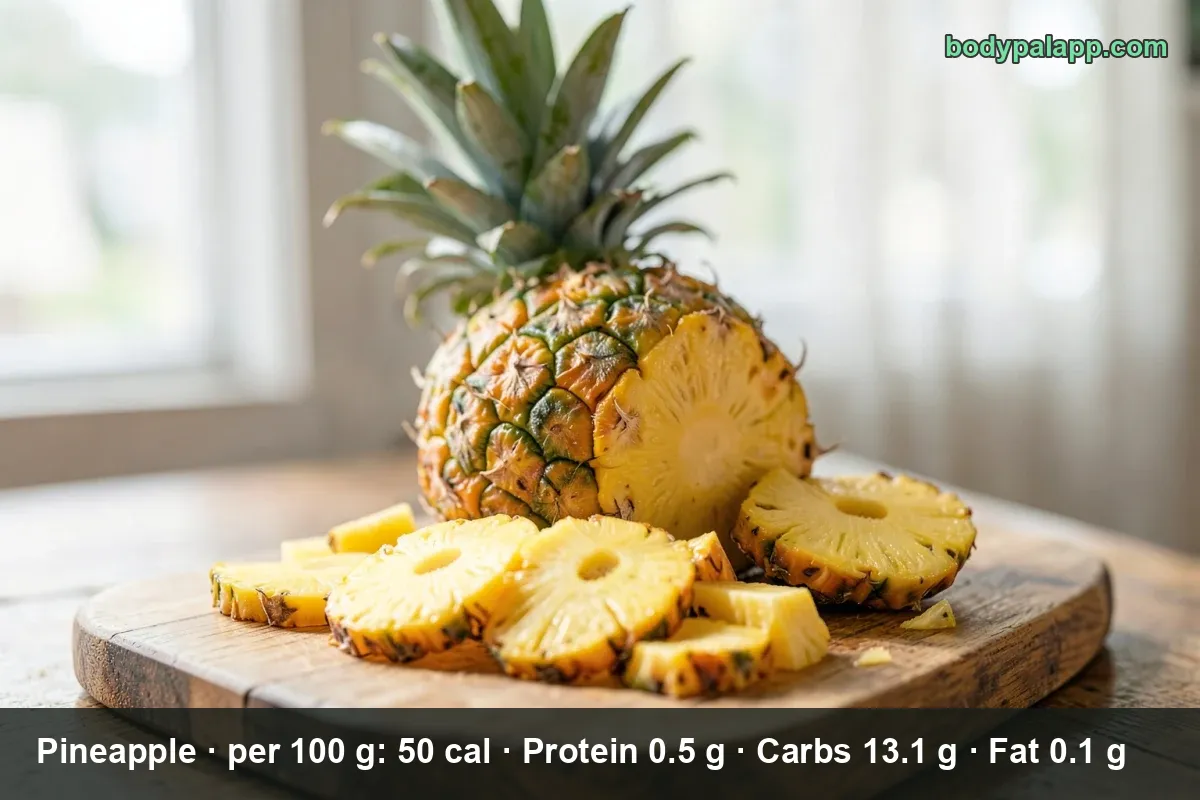
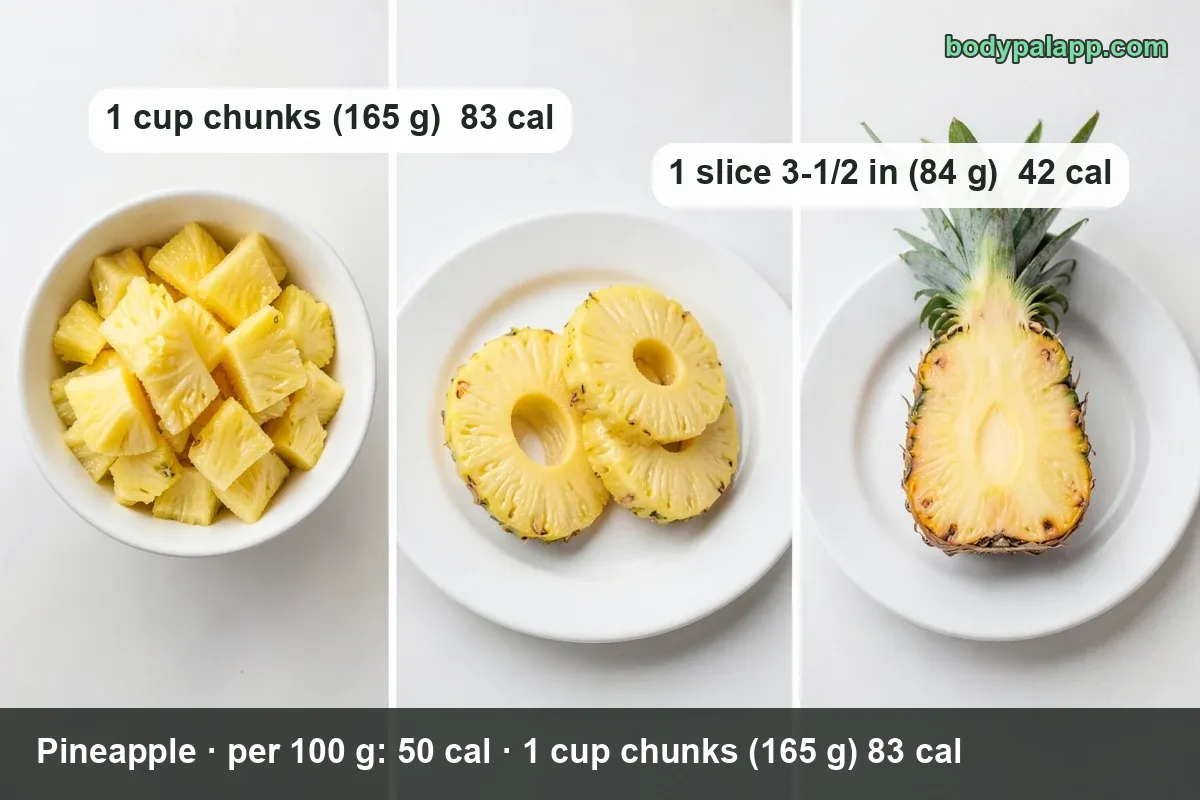
A 1-cup serving of fresh pineapple chunks weighs 165 g and carries 83 calories. Raw pineapple runs 50 calories per 100 g, one of the lighter numbers in the fruit aisle by weight. A single 84 g ring is 42 calories. The whole fruit, 905 g of edible flesh, comes to 453.
On this page
- Pineapple quick facts
- US servings, from one ring to the whole fruit
- Extra sweet, canned, dried and frozen pineapple
- Fiber, potassium and the sugar question
- How does pineapple compare?
- Most popular pineapple brands
- FAQ
Pineapple quick facts
The numbers below come from SR Legacy 169124, "Pineapple, raw, all varieties". That is the record that matches what most people are actually holding: a fresh pineapple cut into chunks, of whatever variety the store happened to stock. It also carries a complete profile, including total sugars and saturated fat, and it comes with real household measures — cups and rings, not just a 100 g abstraction.
There is a second raw entry, Foundation 2346398, that lists 60 calories per 100 g. Its energy figure is Atwater-calculated and it publishes no sugar or saturated fat values, so it cannot fill out a label-style table. Both records describe the same fruit; the 10-calorie gap is a difference in method, not in pineapple. Where a number below is not one of USDA's household measures — the ounce lines, for instance — the arithmetic is ours, scaled from the 100 g row.
| Nutrient | Per 100 g | Per 1 cup chunks (165 g) | % Daily Value |
|---|---|---|---|
| Calories | 50 | 83 | — |
| Total fat | 0.12 g | 0.2 g | 0% |
| Saturated fat | 0.01 g | 0.0 g | 0% |
| Carbohydrate | 13.12 g | 21.6 g | 8% |
| Dietary fiber | 1.4 g | 2.3 g | 8% |
| Total sugars | 9.85 g | 16.3 g | — |
| Protein | 0.54 g | 0.9 g | 2% |
| Sodium | 1 mg | 2 mg | 0% |
% Daily Value is based on a 2,000-calorie diet.
Verified nutrition data
Numbers on this page come from USDA FoodData Central, the U.S. Department of Agriculture’s food composition database, and from manufacturer labels where a branded product is named. Last verified September 2026. How we verify our data →
There is no added-sugars row because this SR Legacy edition does not measure added sugars for raw fruit at all — and for fresh pineapple the answer is zero by definition, since nothing is added. Cholesterol is 0 mg. Potassium is 109 mg per 100 g, so 180 mg in a cup, about 4% of the Daily Value. Sodium is the quietest row on the whole table: 2 mg in a cup is a rounding error next to the 2,300 mg daily limit, roughly a thousandth of a teaspoon of table salt.
US servings, from one ring to the whole fruit
| Serving | Weight | Calories |
|---|---|---|
| 1 oz | 28 g | 14 kcal |
| One ring, 3-1/2 in across, 3/4 in thick | 84 g | 42 kcal |
| 1 cup, chunks | 165 g | 83 kcal |
| One ring, 4-2/3 in across, 3/4 in thick | 166 g | 83 kcal |
| One whole fruit | 905 g | 453 kcal |
| Per 100 g | 100 g | 50 kcal |
Four of those are USDA household measures: the cup of chunks, both rings and the whole fruit. The ounce line is our own arithmetic from the 100 g figure, not a USDA serving, but it is the fastest way to sanity-check a handful of chunks on a food scale.
Two things stand out. A wide ring and a full cup of chunks land on the same 83 calories, because a 4-2/3 inch ring weighs 166 g and a cup of chunks weighs 165 g — near-identical weights hiding behind very different-looking portions. And ring size matters far more than ring thickness: both rings above are cut 3/4 inch thick, yet the wider one carries double the calories of the narrower one purely because the fruit was bigger around.
The whole-fruit line is worth keeping in view even if you never eat one in a sitting. At 453 calories, a whole pineapple is a bigger number than most people expect from a fruit they think of as a light dessert, and it is easy to work through half of one over an afternoon.
Extra sweet, canned, dried and frozen pineapple
| Version | Per 100 g | Typical serving | Calories |
|---|---|---|---|
| Extra sweet variety, fresh | 51 kcal | 1 cup chunks (165 g) | 84 kcal |
| Traditional varieties, fresh | 45 kcal | 1 cup chunks (165 g) | 74 kcal |
| Canned in heavy syrup | 78 kcal | 1 oz (28 g) | 22 kcal |
| Frozen chunks, sweetened | 86 kcal | 1 oz (28 g) | 24 kcal |
| Dried | 347 kcal | 1 oz (28 g) | 98 kcal |
| 100% pineapple juice | 53 kcal | 100 g | 53 kcal |
The ounce servings in that table are our scaling from each record's 100 g row, not USDA household measures.
Variety barely moves the needle. Extra sweet pineapple, the golden supermarket standard, is 51 calories per 100 g against 45 for the older traditional types — 10 calories apart across a full cup. If you are choosing between a Smooth Cayenne and a golden extra-sweet on calorie grounds, you are choosing between 74 and 84, and the sweeter one wins on flavor by a much wider margin than it loses on calories.
Processing is where the numbers actually move. Heavy syrup lifts pineapple to 78 calories per 100 g, and sweetened frozen chunks go higher still at 86, because sugar is added before freezing. Dried pineapple is the outlier: 347 calories per 100 g, roughly seven times the fresh fruit, because the water is gone and the sugar is not. An ounce of dried rings — a small handful — is 98 calories, more than a whole 84 g fresh ring.
Canned pineapple deserves its own note, since it is what most US pantries hold. Store-brand and national-brand chunks packed in 100% pineapple juice sit between 49 and 57 calories per 100 g on their labels, which is why a half-cup label serving typically reads 60 or 70 calories. Those label numbers and the USDA record for juice-packed pineapple agree closely, so a can in juice is a fair substitute for fresh when fresh is out of season.
Fiber, potassium and the sugar question
Sugar is the row people worry about, and it is the row most often misread. A cup of pineapple has 16.3 g of total sugars, and every gram of it is the fruit's own. Total sugars have no Daily Value on the US Nutrition Facts label, so there is no percentage to point at; the 50 g figure people remember applies to added sugars, and fresh pineapple contributes none of those. Comparing 16.3 g of fruit sugar to that limit is comparing two different things. The FDA's Daily Value reference keeps the two rows separate for exactly that reason.
What the cup does deliver is 2.3 g of fiber, 8% of the 28 g Daily Value, alongside 180 mg of potassium and 83 calories. That is a decent fiber-to-calorie trade for something this sweet. It also counts as a full cup toward the fruit group that MyPlate uses for its daily targets, which for most adults sits at 1.5 to 2 cups a day.
One number that surprises people: dried pineapple has 2.4 g of fiber per 100 g, only a little more than fresh, even though almost all the water has been removed. The sugar concentrates almost eightfold; the fiber does not even double. That gap is the whole argument for eating pineapple wet rather than dried if you are counting calories — if you are watching intake, the fresh cup at 83 calories does more for you than the same weight of rings at 347 per 100 g.
How does pineapple compare?
| Pineapple | Per 100 g | US serving | Calories |
|---|---|---|---|
| Fresh, raw, all varieties | 50 kcal | 1 cup chunks, 165 g | 83 kcal |
| Canned in juice, drained | 60 kcal | 1 cup chunks, 181 g | 109 kcal |
| Canned in juice, solids and liquids | 60 kcal | 1 cup, 249 g | 149 kcal |
| Canned in water, solids and liquids | 32 kcal | 1 cup, 246 g | 79 kcal |
Our take: fresh is lighter than every canned pack except the water-packed one, but the gap to drained canned pineapple in juice is smaller than its reputation — 83 against 109, an extra 26 calories a cup, and worth it in February. The line to watch is the third one. A cup of canned pineapple measured with its liquid is 149 calories, nearly double the fresh cup, and the fruit is no sweeter; you are logging 249 g of weight instead of 165 g because the juice came along for the ride. Drain the can and you cut that to 109 without changing what you eat. Water-packed is the only version lighter per gram than fresh, at 32 calories per 100 g, and even a full 246 g cup of it lands at 79 — under the fresh cup, though it tastes like it.
Most popular pineapple brands in the United States
Ranked by how widely each product appears among foods sold in the United States, from the BodyPal food database of over 3.3 million products. Calories are the figures printed on each Nutrition Facts label, checked against USDA FoodData Central.
| Product | Calories (per 100 g) |
|---|---|
| Dole Pineapple Chunks in 100% Pineapple Juice | 57 cal |
| Dole Crushed Pineapple in 100% Pineapple Juice | 57 cal |
| Dole Pineapple Slices in 100% Pineapple Juice | 53 cal |
| Dole Pineapple Tidbits in 100% Pineapple Juice | 49 cal |
| Dole 100% Pineapple Juice | 58 cal |
Brand popularity: BodyPal food database. Nutrition: manufacturer labels / USDA FoodData Central.
Pineapple FAQs
How many calories are in a cup of pineapple?
83 calories in a 1-cup serving of fresh chunks, 165 g on the scale. That cup carries 21.6 g of carbohydrate, 16.3 g of naturally occurring sugar and 2.3 g of fiber, which is 8% of the Daily Value for both carbs and fiber. Canned chunks in juice push the same cup to 109.
How many calories in one slice of pineapple?
42 calories for a 3-1/2 inch ring cut 3/4 inch thick, 84 g on the scale. The wider 4-2/3 inch ring weighs 166 g and lands at 83, the same as a full cup of chunks. Ring calories track the width of the fruit far more than the thickness of the cut.
How many calories in a whole pineapple?
453 calories for one whole 905 g fruit, the largest household measure USDA lists. Scaling the 100 g row gives about 12.7 g of fiber and 89 g of natural sugar for the whole thing — our arithmetic, not a USDA serving. Few people finish one alone in a sitting.
Is canned pineapple higher in calories than fresh?
Yes: 60 calories per 100 g for chunks canned in juice and drained, against 50 for raw. A cup of drained canned chunks weighs 181 g and comes to 109, about a third more than the 83 in a fresh cup. Heavy syrup takes it to 78 per 100 g.
How much sugar is in pineapple?
9.85 g per 100 g, so 16.3 g in a 1-cup serving of chunks. All of it is naturally occurring fruit sugar. Total sugars carry no Daily Value on the US label, so there is no percentage to compare against — the 50 g figure applies to added sugars only.
Does pineapple have added sugar?
Zero in fresh fruit. Nothing is added, so all 16.3 g in a cup is the fruit's own sugar; USDA's SR Legacy record does not publish an added-sugars figure for raw fruit, which is why that row is missing above. Pineapple canned in heavy syrup is another product at 78 calories per 100 g.
How many carbs are in pineapple?
13.12 g per 100 g, or 21.6 g in a 1-cup serving of chunks, which is 8% of the Daily Value. Most of that is sugar at 16.3 g, with 2.3 g of fiber behind it. Protein is 0.9 g a cup and fat 0.2 g, so carbohydrate is essentially the entire calorie count.
How much fiber is in pineapple?
1.4 g per 100 g, which makes 2.3 g in a cup of chunks — 8% of the 28 g Daily Value. That is modest for a fruit, but it arrives with only 83 calories. Dried pineapple concentrates it to just 2.4 g per 100 g, alongside 347 calories.
Similar foods
- Cara Cara Orange — 69 cal per medium orange
- Navel Orange — 69 cal per medium orange
- Apple — 95 cal per medium apple
- Apricot — 17 cal per apricot
- Mixed Berries — 78 cal per cup
- Cosmic Crisp Apple — 95 cal per medium apple
Count it without the math
Point the camera at the bowl and BodyPal counts the chunks for you, fresh or canned.


How long does it take to burn off pineapple?
A 1-cup (165 g) serving of chunks is 83 kcal. Enter your weight and the amount you ate to see how long it takes you to burn that off:
lb
| Activity | Time to burn 83 kcal |
|---|---|
| Walking, brisk | 17 min |
| Cycling, moderate | 10 min |
| Swimming, moderate | 12 min |
| Jogging | 10 min |
| Weight training, moderate | 18 min |
Times are for a 155 lb adult at a steady pace; change the weight to see yours. The amount is set to the portion in the text (165 g); change it to what you actually ate. BodyPal works this out from your steps automatically.
Want the bigger picture? Calculate your daily calorie needs — your maintenance figure, a target for losing or gaining, and the date you get there.