
How many calories are in a navel orange?
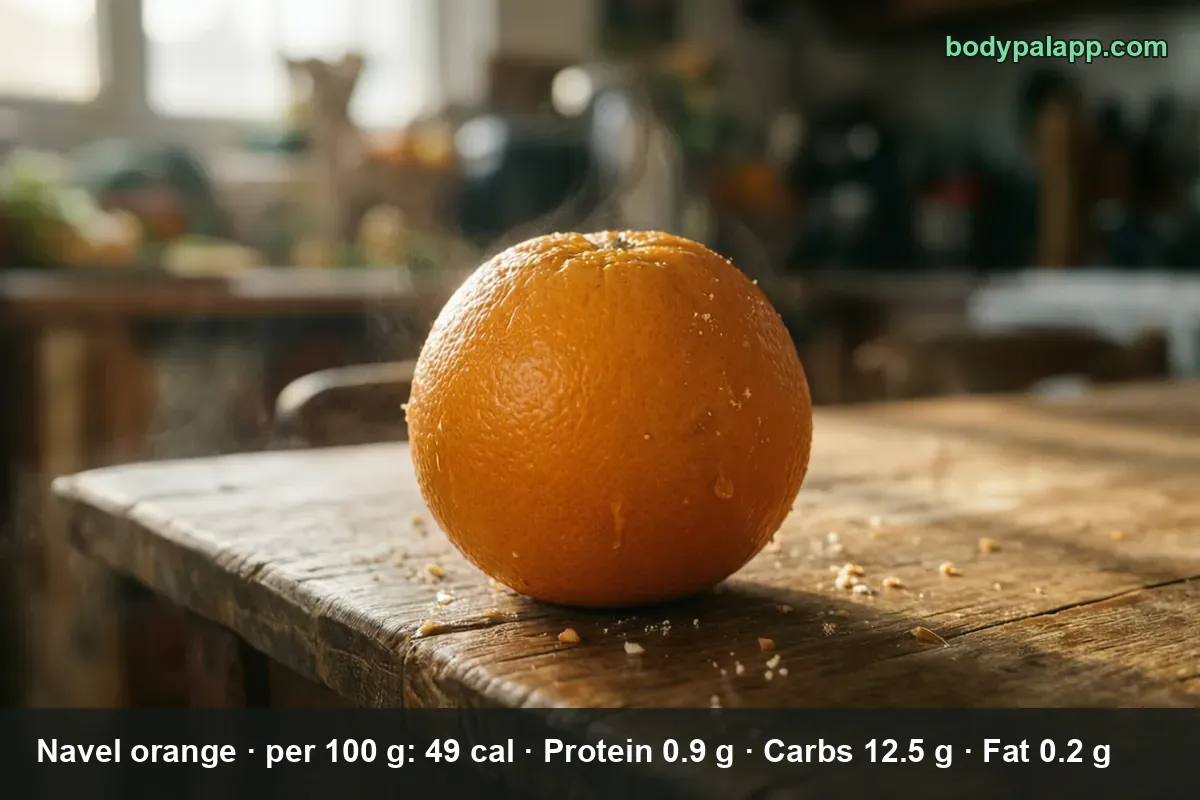
One medium navel orange weighs 140 g and carries 69 calories. Per 100 g the raw fruit runs 49 calories, which is about as low as sweet fruit goes. The peel is not counted; that 140 g is edible flesh, and it brings 17.6 g of carbohydrate and 3.1 g of fiber with it.
On this page
- Navel orange quick facts
- US servings from one ounce to a cup of sections
- Every version of a navel orange USDA lists
- Fiber is the row that earns its keep
- How does a navel orange compare?
- Most popular navel orange brands
- Navel orange FAQs
Navel orange quick facts
The numbers below come from SR Legacy record 169917, "Oranges, raw, navels", the entry that also covers fruit distributed through USDA's Food Distribution Program. There are newer analytical entries for the same fruit, but only this one carries the full label profile - sugars, saturated fat, fiber and sodium together - and only this one comes with the household measures Americans actually use: one medium orange, one cup of sections, one NLEA serving.
The medium orange in the middle column is USDA's own 2-7/8 inch diameter fruit at 140 g. That is the size sitting in most grocery bags, and it is the number the rest of this page is built around.
| Nutrient | Per 100 g | Per one medium orange (140 g) | % Daily Value |
|---|---|---|---|
| Calories | 49 | 69 | — |
| Total fat | 0.15 g | 0.2 g | 0% |
| Saturated fat | 0.02 g | 0.0 g | 0% |
| Carbohydrate | 12.54 g | 17.6 g | 6% |
| Dietary fiber | 2.2 g | 3.1 g | 11% |
| Total sugars | 8.5 g | 11.9 g | — |
| Protein | 0.91 g | 1.3 g | 3% |
| Sodium | 1 mg | 1 mg | 0% |
% Daily Value is based on a 2,000-calorie diet.
Verified nutrition data
Numbers on this page come from USDA FoodData Central, the U.S. Department of Agriculture’s food composition database, and from manufacturer labels where a branded product is named. Last verified September 2026. How we verify our data →
There is no added sugars row here because USDA does not publish added sugars for this record, and a raw orange has none to publish. Cholesterol is 0 mg, as it is for every plant food. Potassium is the one extra worth naming: 166 mg per 100 g, so 232 mg in a medium orange, or 5% of the Daily Value.
Sodium deserves one line of its own. At 1 mg per orange, this is one of the very few foods where the salt question simply does not arise - you would need hundreds of oranges to reach a quarter teaspoon of table salt.
US servings from one ounce to a cup of sections
| Serving | Weight | Calories |
|---|---|---|
| 1 oz | 28 g | 14 kcal |
| Half a medium orange | 70 g | 34 kcal |
| One medium orange, 2-7/8 inch | 140 g | 69 kcal |
| One NLEA serving | 154 g | 75 kcal |
| 1 cup sections, without membranes | 165 g | 81 kcal |
| Per 100 g | 100 g | 49 kcal |
Three of those are USDA household measures: the medium orange, the cup of sections and the NLEA serving, which is the reference amount food labels are supposed to use. The 1 oz row and the half-orange row are our own arithmetic from the USDA 100 g figure, not USDA servings.
Here is the trap. A cup of sections weighs 165 g, and a whole medium orange weighs 140 g. Segment an orange, drop the membranes, pack the pieces into a measuring cup, and you have more fruit than the orange you started with - the cup swallows part of a second one. That is why the cup reads 81 calories against the fruit's 69. Nothing about the food changed; only the weight on the fork did.
The other place people slip is the NLEA serving. At 154 g it is 10% heavier than USDA's medium orange, and it is the size most store labels print against. If a bag of navels says 80 calories per orange and this page says 69, that is the whole story.
Every version of a navel orange USDA lists
| Version | Per 100 g | Typical serving | Calories |
|---|---|---|---|
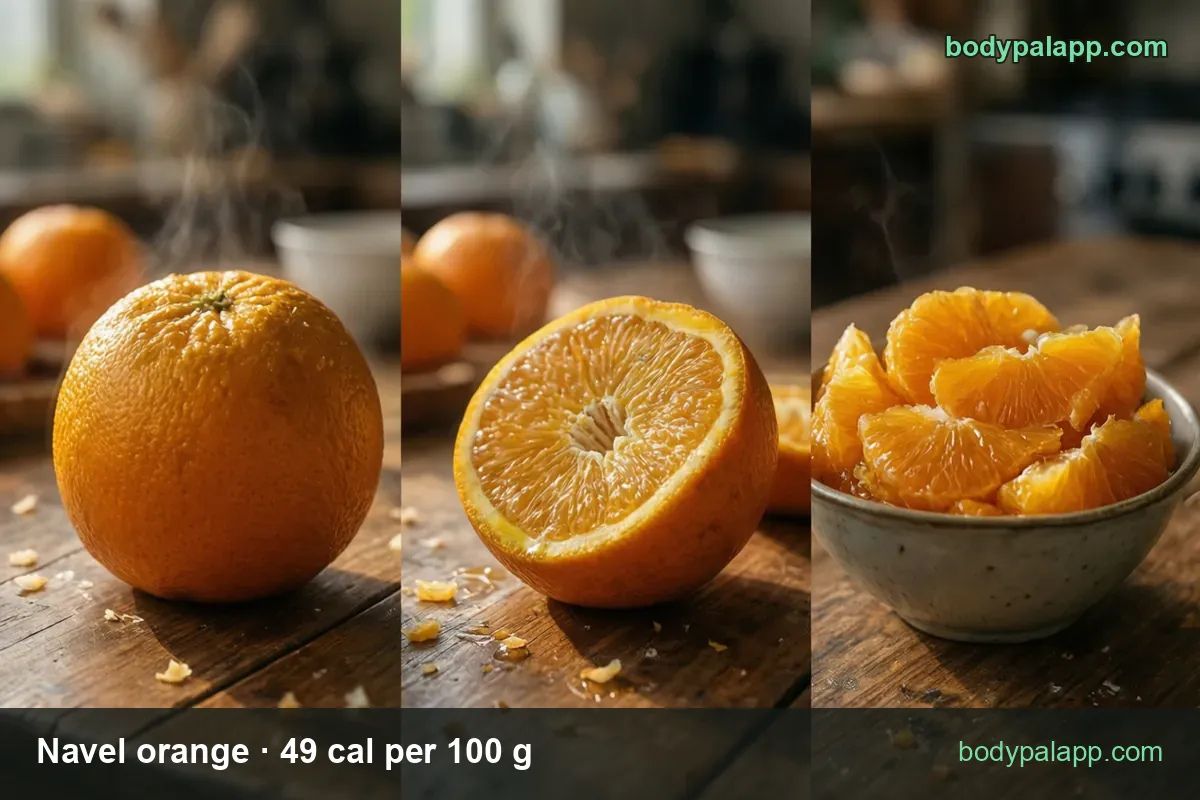
| Navel orange, raw | 49 kcal | one medium, 140 g | 69 kcal |
| Navel orange, cup of sections | 49 kcal | 1 cup, 165 g | 81 kcal |
| Navel orange, Foundation lot | 47 kcal | one fruit 2-7/8 inch, 140 g | 66 kcal |
| Valencia orange, raw | 49 kcal | one medium, 140 g | 69 kcal |
| Sliced navel oranges, packaged | 49 kcal | 5 oz tub, 142 g | 70 kcal |
| Orange juice, chilled | 49 kcal | 1 cup, 248 g | 122 kcal |
The Foundation entry, record 746771, is a newer analytical batch of the same fruit and comes in at 47 calories per 100 g, with 11.8 g of carbohydrate instead of 12.54 g. That is a difference of three calories on a whole orange. It is real, but it is smaller than the difference between two oranges out of the same bag, and the Foundation lot does not report sugars at all, which is why the full profile above uses SR Legacy.
Store labels widen the spread further. Across six national and regional navel orange listings in USDA's Branded database, the per-100-g figures run from 45 to 52, so a "1 medium orange" on the back of a bag comes out anywhere from 69 to 90 calories depending on whether the packer called that orange 154 g or 184 g. None of those labels is wrong. They are describing different oranges.
Juice is the one row that behaves differently, and it is not because of calorie density - chilled orange juice is also 49 calories per 100 g. It is because nobody drinks 140 g of juice. A cup is 248 g, so a glass costs 122 calories, nearly two oranges, and it goes down in twenty seconds.
Fiber is the row that earns its keep
Run down the Daily Value column and one number stands out. Fat 0%, saturated fat 0%, sodium 0%, protein 3%, potassium 5%, carbohydrate 6% - and fiber 11%. Fiber is the only line in the table that clears 10% of the Daily Value, and it does it on 69 calories.
That matters because fiber is one of the nutrients the Dietary Guidelines for Americans flags as under-consumed in the United States. The FDA Daily Value for fiber is 28 g; two oranges cover more than a fifth of it. Meanwhile MyPlate counts a large orange as one cup-equivalent of fruit, so this 140 g medium navel does most of a cup's worth of work in that column too.
The practical read: if you are choosing between the fruit and the glass, the fruit keeps 2.2 g of fiber per 100 g while the juice keeps 0.2 g. Same calories per gram, entirely different amount of chewing.
How does a navel orange compare?
| Food | Per 100 g | US serving | Calories |
|---|---|---|---|
| Navel orange | 49 kcal | one medium, 140 g | 69 kcal |
| Valencia orange | 49 kcal | one medium, 140 g | 69 kcal |
| Apricots, raw | 48 kcal | 1 cup halves, 155 g | 74 kcal |
| Orange juice, chilled | 49 kcal | 1 cup, 248 g | 122 kcal |
The 140 g medium serving on the Valencia row is our own scaling of USDA's 49-calories-per-100-g figure to the navel's size, not a USDA household portion. Our take: on a per-gram basis these four are indistinguishable - 48 or 49 calories per 100 g across the board - so the choice is decided entirely by how much of each you end up holding. For weight control, the whole navel orange is the pick: 69 calories, 3.1 g of fiber, and a peel that forces you to slow down. For appetite between meals, the cup of sections at 81 calories is the better tool, because it is the version you can eat one-handed at a desk. Juice is the one to demote. Nothing is wrong with the numbers per gram; the serving is nearly twice the fruit and a fraction of the fiber.
Most popular navel orange brands in the United States
Ranked by how widely each product appears among foods sold in the United States, from the BodyPal food database of over 3.3 million products. Calories are the figures printed on each Nutrition Facts label, checked against USDA FoodData Central.
| Product | Calories (per 100 g) |
|---|---|
| Food Lion Navel Oranges | 52 cal |
| Wegmans Navel Oranges | 52 cal |
| Nature's Place Navel Oranges | 49 cal |
| Tomorrow's Organics Navel Oranges | 49 cal |
| Wegmans Organic Navel Oranges | 48 cal |
| Price Chopper Navel Oranges | 45 cal |
Brand popularity: BodyPal food database. Nutrition: manufacturer labels / USDA FoodData Central.
Navel orange FAQs
How many calories are in one navel orange?
One medium navel orange, 2-7/8 inches across and 140 g, has 69 calories. That works out to 49 calories per 100 g, one of the lowest figures in the produce aisle. The same orange carries 17.6 g of carbohydrate, 3.1 g of fiber and 1.3 g of protein.
How many calories in a large navel orange?
USDA lists one medium orange at 140 g and 69 calories, and its NLEA serving of 154 g at 75 calories. Store-grade fruit runs heavier still: one national label prints 90 calories for a 184 g orange, which matches our own arithmetic from the 49-per-100-g figure.
How many carbs are in a navel orange?
A 140 g navel orange has 17.6 g of carbohydrate, 6% of the Daily Value. Of that, 11.9 g is naturally occurring sugar and 3.1 g is fiber, so very little is left over. Per 100 g the record reads 12.54 g of carbohydrate.
How much sugar is in a navel orange?
11.9 g of total sugars in a 140 g orange, all of it naturally occurring, and USDA publishes no added sugars figure for raw fruit because there is none. Total sugars have no Daily Value on the Nutrition Facts label, so that row sits in the table without a percentage beside it.
How much fiber does a navel orange have?
3.1 g in one medium orange, which is 11% of the 28 g Daily Value. Fiber is the only line in the table that clears 10%, and it is the main reason the whole fruit sits so differently from juice, which retains almost none of it.
Navel orange vs Valencia orange: which has fewer calories?
Neither wins. Both navel and Valencia oranges are 49 calories per 100 g in USDA's SR Legacy records, so a 140 g fruit of either kind is 69 calories. Valencias carry slightly more protein, 1.04 g against 0.91 g, and twice the fat at 0.3 g.
Is a navel orange healthier than orange juice?
For calories per serving, the whole fruit: 69 in a 140 g orange against 122 in a 1-cup, 248 g glass of chilled juice. The bigger gap is fiber, 2.2 g per 100 g in the fruit versus 0.2 g in the juice. Straining is what changes the numbers.
How many calories in a cup of orange sections?
81 calories for 1 cup of sections without membranes, 165 g. That cup weighs more than the whole 140 g orange it came from, which is why it costs 12 calories more. Per 100 g the value is unchanged at 49; only the weight on the fork moved.
Similar foods
- Cara Cara Orange — 69 cal per medium orange
- Pineapple — 83 cal per cup chunks
- Blood Orange — 62 cal per medium blood orange
- Orange — 62 cal per medium orange
- Apple — 95 cal per medium apple
- Envy apple — 95 cal per medium apple
Count it without the math
Point the camera at the fruit bowl and BodyPal counts the orange for you, whole or in sections.


How long does it take to burn off a navel orange?
One medium orange (140 g) is 69 kcal. Enter your weight and the amount you ate to see how long it takes you to burn that off:
lb
| Activity | Time to burn 69 kcal |
|---|---|
| Walking, brisk | 14 min |
| Cycling, moderate | 9 min |
| Swimming, moderate | 10 min |
| Jogging | 8 min |
| Weight training, moderate | 15 min |
Times are for a 155 lb adult at a steady pace; change the weight to see yours. The amount is set to the portion in the text (140 g); change it to what you actually ate. BodyPal works this out from your steps automatically.
One food is easy to picture; a whole day is harder. See how many calories you need a day and what a deficit actually looks like.