
How many calories in a Cara Cara orange?
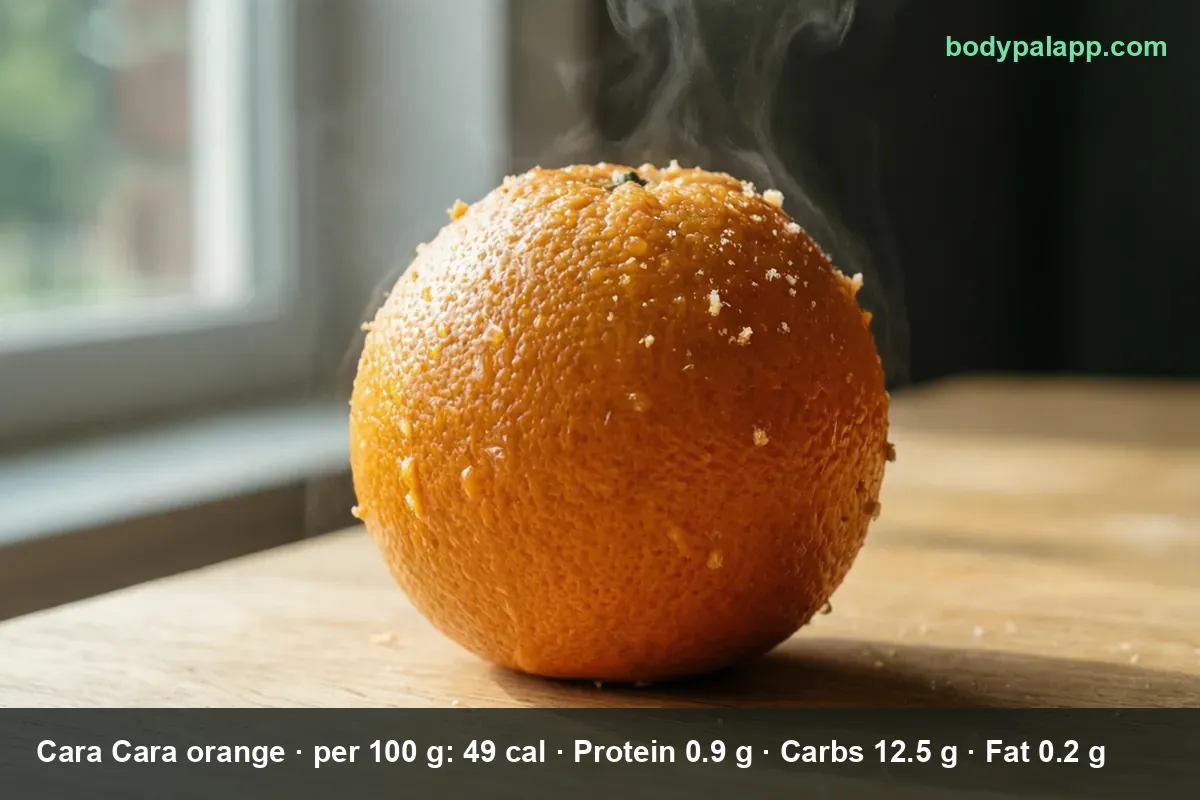
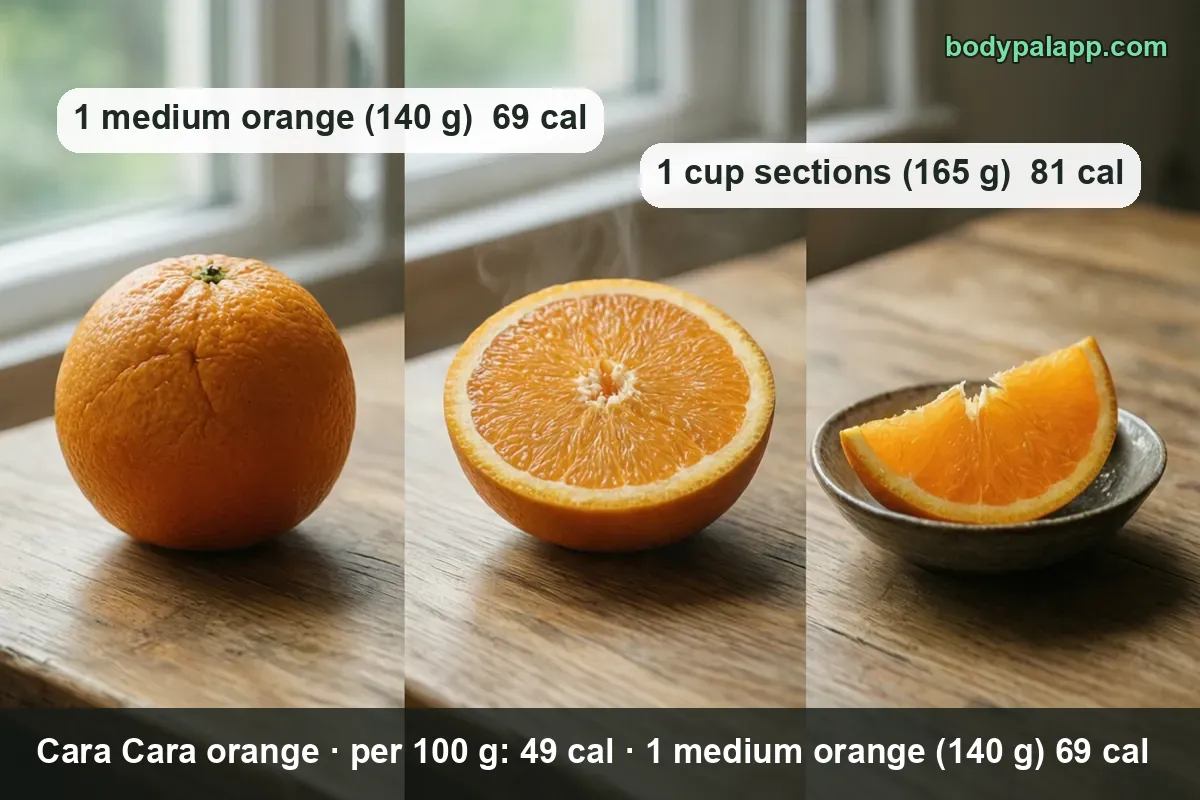
A medium Cara Cara orange weighs 140 g and carries 69 calories. Per 100 g it is 49. A cup of sections with the membranes stripped off comes to 81, which is more than the whole fruit those sections were cut from. The pink-red flesh that makes a Cara Cara cost more at the store changes the color and nothing else on the label.
On this page
- Cara Cara quick facts
- US serving sizes for a Cara Cara orange
- The cup of sections is not the orange
- Why USDA has no Cara Cara record of its own
- Fiber, sugar and the label that has no percentage
- How does a Cara Cara orange compare?
- Most popular cara cara orange brands
- FAQ
Cara Cara quick facts
Nothing in FoodData Central is filed under the name Cara Cara. These numbers come from SR Legacy 169917, "Oranges, raw, navels" — the record for the orange a Cara Cara is a mutation of, and the one that carries the full label panel. The serving column is a medium fruit, 2-7/8 inches across, which USDA weighs at 140 g.
| Nutrient | Per 100 g | Per 1 medium orange (140 g) | % Daily Value |
|---|---|---|---|
| Calories | 49 | 69 | — |
| Total fat | 0.15 g | 0.2 g | 0% |
| Saturated fat | 0.02 g | 0.03 g | 0% |
| Carbohydrate | 12.54 g | 17.6 g | 6% |
| Dietary fiber | 2.2 g | 3.1 g | 11% |
| Total sugars | 8.5 g | 11.9 g | — |
| Protein | 0.91 g | 1.3 g | 3% |
| Sodium | 1 mg | 1.4 mg | 0% |
| Potassium | 166 mg | 232 mg | 5% |
% Daily Value is based on a 2,000-calorie diet.
Verified nutrition data
Numbers on this page come from USDA FoodData Central, the U.S. Department of Agriculture’s food composition database, and from manufacturer labels where a branded product is named. Last verified September 2026. How we verify our data →
There is no added sugars row, and its absence is the honest answer rather than a gap. This USDA edition does not publish added sugars at all, and a fruit picked off a tree has nothing added to declare. All 11.9 g of sugar in a medium Cara Cara arrived with the fruit.
Two rows are worth more than the calorie count. Fiber is 3.1 g, which is 11% of the FDA Daily Value of 28 g, delivered inside 69 calories — about 3.4% of a 2,000-calorie day. That is roughly three times as much of the day's fiber as of the day's energy, a ratio very little else in a lunch bag manages. Potassium adds 232 mg, another 5% of the day.
Carbohydrate looks bigger than it is: 17.6 g reads as a lot until you set it against a 275 g Daily Value, where it lands at 6%. Sodium is 1.4 mg in a whole orange, against a limit of 2,300 mg. You could eat oranges all week and never see the sodium row move.
US serving sizes for a Cara Cara orange
| Serving | Weight | Calories |
|---|---|---|
| 1 oz | 28 g | 14 |
| ½ medium orange | 70 g | 34 |
| 1 medium orange (2-7/8" across) | 140 g | 69 |
| 1 NLEA serving | 154 g | 76 |
| 1 cup sections, membranes removed | 165 g | 81 |
| 100 g | 100 g | 49 |
Four of those weights are USDA's own household measures for record 169917: the medium fruit at 140 g, the cup of sections at 165 g, the ounce at 28 g and the 154 g NLEA serving, which is the reference amount that appears on packaged fresh citrus. The half is our arithmetic on USDA's medium, cut through the core.
Raw is the only form here, and that is unusual for a food page. USDA keeps no cooked, canned or frozen navel line, because nobody cooks a navel orange — the whole point of the fruit is that you peel it and eat it. So the raw/cooked gap that trips people up on rice and ground beef simply does not exist for this one.
The practical range is narrow. From half a fruit to a generous cup you cover 34 to 81 calories, and every serving on that list sits under 100. This is one of the few foods where getting the portion wrong costs you a rounding error rather than a meal.
The cup of sections is not the orange
| Serving | Weight | Calories | Carbs | Fiber |
|---|---|---|---|---|
| ½ orange | 70 g | 34 | 8.8 g | 1.5 g |
| 1 medium orange | 140 g | 69 | 17.6 g | 3.1 g |
| 1 cup sections | 165 g | 81 | 20.7 g | 3.6 g |
Here is where a Cara Cara behaves differently from most fruit in a food log. With apples and peaches, a cup of slices weighs less than the whole fruit, so logging by the cup undercounts. With oranges it goes the other way. USDA's cup of sections weighs 165 g of pure segment flesh; a medium orange gives you 140 g. The cup is a whole orange plus a fifth of another one.
That is 12 calories, which nobody needs to lose sleep over. The point is the direction. If you segment two oranges into a bowl and log "1 orange," you are 12 calories short per fruit, and the same reflex applied to a food where the gap is larger is what quietly wrecks a week of logging. Log what is in the bowl, not what was in your hand.
The 154 g NLEA serving is the third unit you will meet, and it is the one printed on bagged citrus. At USDA's numbers it is 76 calories. The only label filed under the Cara Cara name — Robinson Fresh Cara Cara Oranges, at 52 calories per 100 g — puts that same 154 g serving at 80. Four calories apart, on a fruit, from two different measuring traditions.
Why USDA has no Cara Cara record of its own
Cara Cara is a mutation of the Washington navel, not a separate species, and USDA files it with the parent. That is not a shortcut on USDA's part. The flesh is pinkish-red because it carries lycopene, the same pigment that colors a tomato, and pigment is not a macronutrient. A Cara Cara and an ordinary navel come off the same nutritional page.
There are two USDA readings of that page, and it is worth saying which one this article uses and why. The Foundation record is the newer laboratory analysis and gives 47 calories per 100 g, but it publishes no total sugars and no saturated fat. Leading with it would delete the sugar row, which is the row most people came here to read. SR Legacy 169917 carries the complete panel, so 49 is the number on this page.
Forty-nine against forty-seven is two analyses of the same raw navel orange, not two different fruits, and the two are not averaged into some third number that describes nothing. On a medium fruit the whole disagreement is under three calories.
The branded label runs slightly the other way at 52 per 100 g. Fresh produce labels round generously and are built from a supplier's own sampling, so a three-calorie spread across a hundred grams of orange is exactly what you would expect. Three sources, five calories of daylight between them: this is a food where precision has already stopped mattering.
Fiber, sugar and the label that has no percentage
The sugar row on a US nutrition label is the one that confuses people most, and an orange shows why. A medium Cara Cara has 11.9 g of total sugars and no percentage next to them, because FDA assigns a Daily Value to added sugars only. There are none in a raw orange, so the column stays blank. Blank does not mean unmeasured; it means there is nothing to measure against.
What the fruit does spend its label space on is fiber: 3.1 g per medium orange, 11% of the day. Sugar and fiber arrive in the same bite, which is the entire difference between eating the fruit and drinking it.
Canned segments make the contrast concrete. Mandarin segments packed in light syrup run 61 calories and 15.49 g of sugars per 100 g, against 49 calories and 8.5 g for the raw navel — nearly double the sugar for the same weight in the bowl. Canned in juice and drained, they land at 38 calories and 8.25 g, below the fresh fruit on both counts, because draining takes some of the packing medium with it.
Juice sits in a third place. Not-from-concentrate orange juice is 46.5 calories per 100 g, marginally below the fruit, and from concentrate it is 47.2. Per gram, juice is not the villain it is made out to be. Per glass it is, because a glass takes two or three oranges and leaves all the fiber behind in the press. Federal advice makes the same point in plainer language at MyPlate and in the Dietary Guidelines for Americans: most of your fruit should be whole fruit.
How does a Cara Cara orange compare?
| Fruit | Per 100 g | Carbs per 100 g | Protein per 100 g | US serving | Calories |
|---|---|---|---|---|---|
| Cara Cara orange, raw (this page) | 49 | 12.54 g | 0.91 g | 1 medium (140 g) | 69 |
| Tangerine, raw | 53 | 13.34 g | 0.81 g | 1 medium (88 g) | 47 |
| Mandarin segments, canned in juice, drained | 38 | 9.41 g | 0.75 g | 1 cup (189 g) | 72 |
| Mandarin segments, canned in light syrup | 61 | 16.19 g | 0.45 g | 1 cup (252 g) | 154 |
Per 100 g the fresh Cara Cara is the second-lightest thing on this list, beaten only by drained canned segments. Per serving it is second-lightest again, and for a completely different reason: a tangerine is only 88 g, so it wins on being a smaller object rather than a lighter food. Read the two columns together or the table will fool you twice.
Our take: if you want the smallest number, a tangerine at 47 calories is the fruit to grab, and it is the better pick for a lunchbox purely because it comes in a smaller package. If you want the most fruit for the fewest calories, the Cara Cara wins at 140 g for 69 with 3.1 g of fiber, and it will keep you occupied longer than a tangerine will. And if there is one row to avoid on a calorie budget, it is the light syrup: 154 calories a cup is more than two whole oranges, and the extra came from the can, not the tree.
Most popular cara cara orange brands in the United States
Ranked by how widely each product appears among foods sold in the United States, from the BodyPal food database of over 3.3 million products. Calories are the figures printed on each Nutrition Facts label, checked against USDA FoodData Central.
| Product | Calories (per 100 g) |
|---|---|
| Robinson Fresh Cara Cara Oranges | 52 cal |
Brand popularity: BodyPal food database. Nutrition: manufacturer labels / USDA FoodData Central.
Cara Cara orange FAQs
How many calories are in a Cara Cara orange?
69 calories in one medium Cara Cara, which USDA weighs at 140 g, or 49 calories per 100 g. Half an orange is 34 and a cup of sections is 81. A medium fruit also carries 17.6 g of carbohydrate, 3.1 g of fiber, 11.9 g of natural sugars and 232 mg of potassium.
How many calories are in a cup of Cara Cara orange sections?
81 calories for USDA's cup of sections with the membranes removed, which weighs 165 g. That is 12 more than a whole medium orange, because the cup holds about a fifth more flesh than a 140 g fruit does. The same cup carries 20.7 g of carbohydrate and 3.6 g of fiber.
How much sugar is in a Cara Cara orange?
11.9 g of total sugars in a medium 140 g orange, or 8.5 g per 100 g. None of it is added sugar, so the % Daily Value column stays blank — FDA gives a Daily Value to added sugars only. Canned mandarin segments in light syrup carry 15.49 g per 100 g by comparison.
How many carbs are in a Cara Cara orange?
17.6 g of carbohydrate in a medium orange, which is 6% of the 275 g Daily Value, from 12.54 g per 100 g. Of that total, 3.1 g is fiber and 11.9 g is sugars. Half an orange comes to 8.8 g and a cup of sections to 20.7 g.
How much fiber is in a Cara Cara orange?
3.1 g in a medium 140 g orange, which is 11% of the 28 g Daily Value, from 2.2 g per 100 g. Those 3.1 g come inside 69 calories, roughly 3.4% of a 2,000-calorie day, so the fruit returns about three times more of the day's fiber than of its energy.
Do Cara Cara and navel oranges have the same calories?
Yes. Cara Cara is a mutation of the Washington navel and USDA has no separate record for it, so both are 49 calories per 100 g. The pinkish-red flesh comes from lycopene, a pigment with no calories. A newer USDA analysis of the same navel gives 47, and the one Cara Cara label on file gives 52.
Cara Cara orange or a mandarin — which has fewer calories?
Per fruit the mandarin, at 47 calories for a medium 88 g tangerine against 69 for a 140 g Cara Cara. Per 100 g the Cara Cara is lighter, 49 against 53. The gap is size, not sweetness: a tangerine is a smaller object, so you get less fruit along with the smaller number.
Are Cara Cara oranges good for weight loss?
A medium Cara Cara is 69 calories with 3.1 g of fiber, 11% of a day's fiber for under 4% of a 2,000-calorie day. Federal advice points to whole fruit at MyPlate and in the Dietary Guidelines for Americans. The form to watch is canned in light syrup, at 154 calories a cup.
Similar foods
- Pineapple — 83 cal per cup chunks
- Blood Orange — 62 cal per medium blood orange
- Orange — 62 cal per medium orange
- Apple — 95 cal per medium apple
- Envy apple — 95 cal per medium apple
- Plum — 30 cal per plum
Count it without the math
Point the camera at the fruit bowl and BodyPal logs the whole orange, the half in the yogurt and the cup of sections without a scale.


How long does it take to burn off a Cara Cara orange?
A medium orange (140 g) is 69 kcal. Enter your weight and the amount you ate to see how long it takes you to burn that off:
lb
| Activity | Time to burn 69 kcal |
|---|---|
| Walking, brisk | 14 min |
| Cycling, moderate | 9 min |
| Swimming, moderate | 10 min |
| Jogging | 8 min |
| Weight training, moderate | 15 min |
Times are for a 155 lb adult at a steady pace; change the weight to see yours. The amount is set to the portion in the text (140 g); change it to what you actually ate. BodyPal works this out from your steps automatically.
One food is easy to picture; a whole day is harder. See how many calories you need a day and what a deficit actually looks like.