
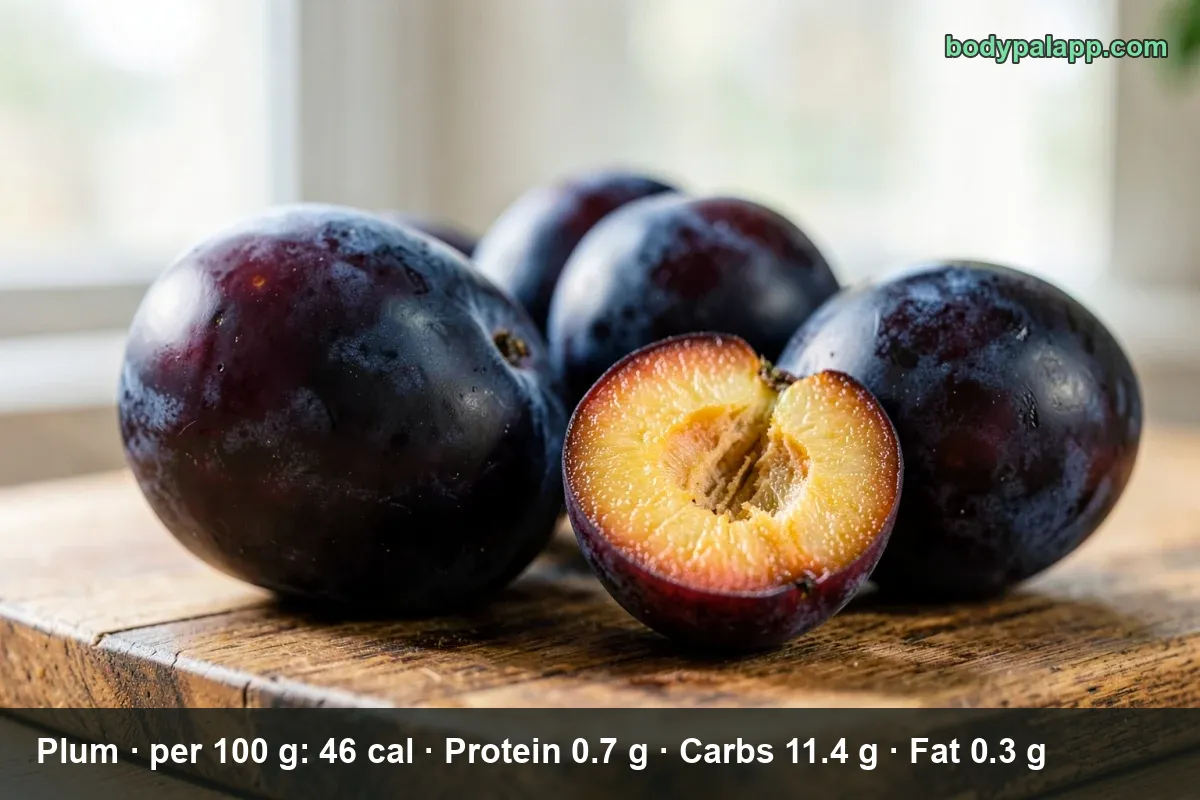
How many calories are in a plum?
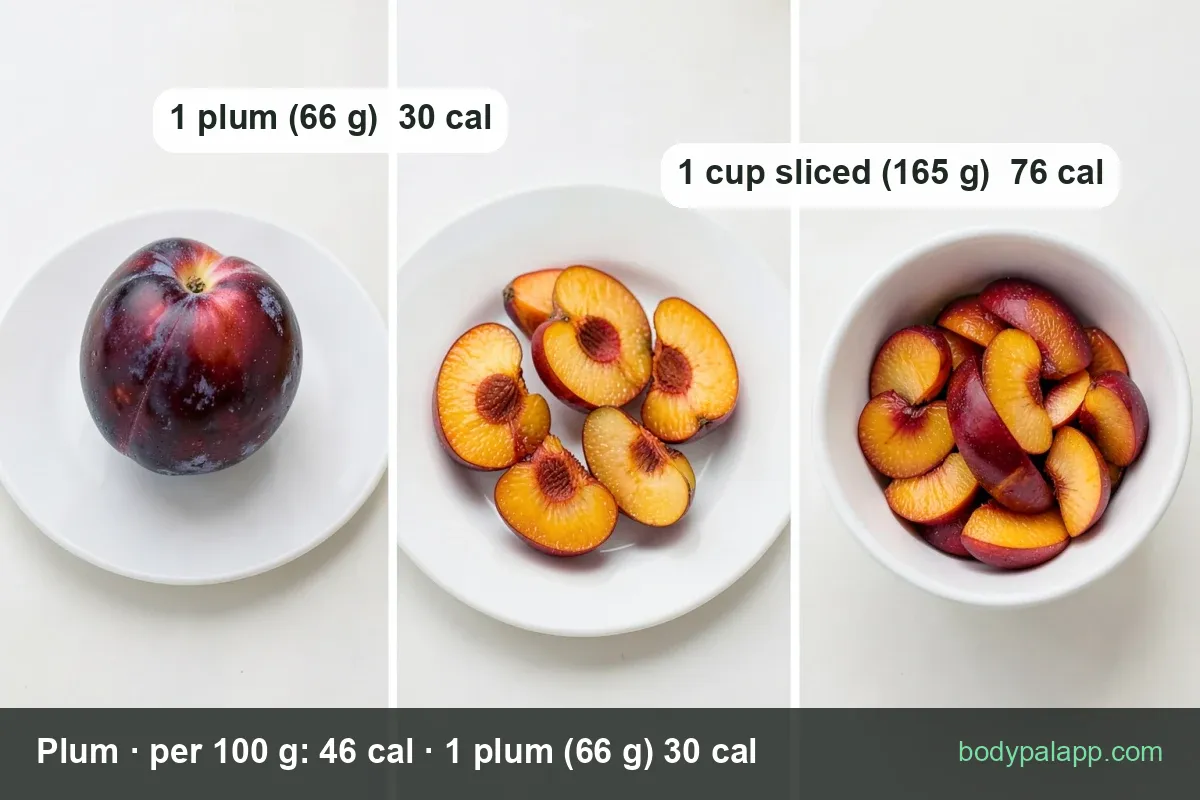
One medium plum weighs 66 g and carries 30 calories. Raw plums run 46 calories per 100 g, which puts them at the light end of the fruit bowl. A cup of sliced plums is 165 g and 76 calories, because a cup holds about two and a half plums, not one.
On this page
- Plum quick facts
- US serving sizes for fresh plums
- Dried plums and prunes are the same fruit
- Canned plums and the pack liquid
- Fiber and potassium in a plum
- How does a plum compare?
- Most popular plum brands
- Plum FAQs
Plum quick facts
The row behind this page is SR Legacy 169949, "Plums, raw", the fresh fruit with the skin on and the pit removed. It is the record that matches what a shopper actually picks up, and it is the only complete plum entry with household measures attached, so a plum, a cup of slices and the NLEA serving all come from one place instead of three.
USDA also keeps a Foundation record for black plums with skin (2710837) that lists 58.7 calories per 100 g, calculated with Atwater factors. It has no sugar or saturated fat figures and no household serving, so it stays out of the table below. The gap between 46 and 58.7 is a difference in laboratory method, not a difference in the fruit.
| Nutrient | Per 100 g | Per 1 plum (66 g) | % Daily Value |
|---|---|---|---|
| Calories | 46 | 30 | — |
| Total fat | 0.28 g | 0.2 g | 0% |
| Saturated fat | 0.02 g | 0.0 g | 0% |
| Carbohydrate | 11.42 g | 7.5 g | 3% |
| Dietary fiber | 1.4 g | 0.9 g | 3% |
| Total sugars | 9.92 g | 6.5 g | — |
| Protein | 0.7 g | 0.5 g | 1% |
| Sodium | 0 mg | 0 mg | 0% |
% Daily Value is based on a 2,000-calorie diet.
Verified nutrition data
Numbers on this page come from USDA FoodData Central, the U.S. Department of Agriculture’s food composition database, and from manufacturer labels where a branded product is named. Last verified September 2026. How we verify our data →
There is no added sugars row here because the SR Legacy edition does not publish one for raw fruit, and a plum has none anyway: all 6.5 g in a single plum is the fruit's own sugar. Cholesterol is zero. Potassium is 157 mg per 100 g, so one plum brings 104 mg, or 2% of the FDA Daily Value of 4,700 mg.
US serving sizes for fresh plums
| Serving | Weight | Calories |
|---|---|---|
| 1 oz | 28 g | 13 kcal |
| One plum, 2-1/8 inch across | 66 g | 30 kcal |
| Two plums | 132 g | 61 kcal |
| 1 NLEA serving | 151 g | 69 kcal |
| 1 cup, sliced | 165 g | 76 kcal |
| Per 100 g | 100 g | 46 kcal |
The 66 g plum, the 165 g cup of slices and the 151 g NLEA serving are USDA household measures for record 169949. The ounce and the two-plum line are our own arithmetic from the USDA 100 g figure, not USDA servings.
The cup is where most logs go wrong. People slice a plum, fill a measuring cup, and log it as one plum. A cup of slices weighs 165 g, so it is two and a half plums and 76 calories rather than 30. That is a small error on any single day and a real one if plums are your afternoon habit all August. If you eat plums whole, count pieces. If you slice them into yogurt, weigh the bowl.
Grocery-store plums are not uniform either. A big black plum can push past 100 g and a small Italian prune plum sits well under 66 g, so the 46 calories per 100 g figure travels better than the per-piece number. One plum is roughly the calorie cost of three saltine-sized bites of anything else in the kitchen, which is why it is one of the easiest snacks to log honestly.
Dried plums and prunes are the same fruit
Prunes are dried plums, sold under both names since the industry rebranded them. USDA lists them as Plums, dried (prunes), uncooked, 168162 at 240 calories per 100 g, more than five times the raw fruit. Take the water out and everything left behind concentrates.
| Version | Per 100 g | Typical piece | Calories |
|---|---|---|---|
| Raw plum | 46 kcal | one plum, 66 g | 30 kcal |
| Dried plums (prunes) | 240 kcal | one pitted prune, 9.5 g | 23 kcal |
| Prunes, stewed, no added sugar | 107 kcal | 1 oz, 28 g | 30 kcal |
Here is the number that surprises people: one pitted prune is 23 calories and a whole fresh plum is 30. Per gram the prune is more than five times heavier in calories, but it is also about a seventh of the size. Eat five prunes out of the bag and you have spent 115 calories, close to four fresh plums, in about forty seconds of chewing.
Fiber moves the other way, and in your favor. Raw plums carry 1.4 g per 100 g; prunes carry 7.1 g, which is 25% of the 28 g Daily Value in a single 100 g handful. Per prune that works out to about 0.7 g, our own scaling from the USDA 100 g figure.
Branded dried plums land in the same range: USDA's Branded records put Sunsweet Dried Plums and Sunsweet D'Noir Prunes at 250 calories per 100 g, with a 1.5 oz (40 g) label serving at 100 calories, while Gold Emblem Pitted Prunes read 225 per 100 g and 90 calories for a 1/4 cup (40 g) serving. Plum jams are a different product entirely: Smucker's Red Plum Jam, Bama Red Plum Jam and Bonne Maman Plum Preserves all sit at 250 calories per 100 g, or 50 calories per 1 tablespoon (20 g).
Canned plums and the pack liquid
Canned plums are where the label matters more than the fruit. The plums are the same plums. What changes is what they are swimming in.
| Version | Per 100 g | Serving | Calories |
|---|---|---|---|
| Canned in water | 41 kcal | 1 cup pitted, 249 g | 102 kcal |
| Canned in juice | 58 kcal | 1 cup pitted, 252 g | 146 kcal |
| Canned in light syrup | 63 kcal | 1 cup pitted, 252 g | 159 kcal |
| Canned in heavy syrup | 89 kcal | 1 cup pitted, 258 g | 230 kcal |
A cup of water-packed plums is 102 calories. The same cup in heavy syrup is 230, more than double, and the total sugars go from 10.1 g per 100 g to 22.31 g. Neither can was sweetened by the plum. The juice pack sits in between at 146 calories a cup because the added juice brings its own fruit sugar with it.
Draining helps less than the label implies. USDA's drained heavy-syrup record (168183) still reads 89 calories per 100 g, identical to the undrained version, because the fruit has already absorbed the syrup by the time you tip out the liquid. If you are buying canned plums to keep calories down, buy the water pack; draining a heavy-syrup can is closing the barn door. A mixed FNDDS survey record for canned plums (2709266) averages 55 calories per 100 g, which tells you most Americans are eating something between water and syrup.
Fiber and potassium in a plum
One plum gives 0.9 g of fiber, 3% of the 28 g Daily Value. A cup of slices gives 2.3 g, or 8%. Those are small numbers on their own, and honest pages should say so: a plum is not a fiber supplement. Two plums with breakfast plus a cup of slices in the afternoon is still under 15% of a day's fiber for 137 calories.
Potassium is the quieter row. One plum has 104 mg and a cup of slices, 165 g of fruit at 157 mg per 100 g, gives about 259 mg, our own arithmetic from the USDA figure. Sodium is zero, so plums cost nothing against the 2,300 mg sodium Daily Value, which is more than you can say for most packaged snacks in the same calorie range.
Where plums earn their place is the fruit group. MyPlate counts fruit in cup-equivalents and puts most adults at 1.5 to 2 cups a day, and the Dietary Guidelines for Americans build the same recommendation around whole fruit rather than juice. At 46 calories per 100 g, plums are one of the cheapest ways to reach that target. If you are watching sugar intake specifically, the 6.5 g in a plum is intrinsic fruit sugar, which the Daily Value for added sugars does not cover.
How does a plum compare?
| Fruit | Per 100 g | US serving | Calories |
|---|---|---|---|
| Plum | 46 kcal | one plum, 66 g | 30 kcal |
| Oranges, raw, Florida | 46 kcal | 1 oz, 28 g | 13 kcal |
| Cranberries, raw | 46 kcal | 1 oz, 28 g | 13 kcal |
| Cherries, canned in water | 46 kcal | 1 oz, 28 g | 13 kcal |
Our take: all four rows in this table are 46 calories per 100 g, which is the most useful thing on the page. Calorie density tells you almost nothing about which fruit to pick, because at this end of the scale every whole fruit is the same. What decides your day is the piece size and how many pieces you eat. Choose plums when you want a portion that ends by itself, at 30 calories with a pit that stops you, and choose the cup of slices only when you actually want 76.
Most popular plum brands in the United States
Ranked by how widely each product appears among foods sold in the United States, from the BodyPal food database of over 3.3 million products. Calories are the figures printed on each Nutrition Facts label, checked against USDA FoodData Central.
| Product | Calories (per 100 g) |
|---|---|
| Gold Emblem Dried Plums Pitted Prunes | 225 cal |
| Smucker's Red Plum Jam | 250 cal |
| Bama Red Plum Jam | 250 cal |
| Bonne Maman Plum Preserves | 250 cal |
| Sunsweet Dried Plums Prunes | 250 cal |
| Sunsweet D'Noir Prunes | 250 cal |
Brand popularity: BodyPal food database. Nutrition: manufacturer labels / USDA FoodData Central.
Plum FAQs
How many calories are in one plum?
One medium plum of 66 g has 30 calories, based on USDA record 169949 for raw plums at 46 calories per 100 g. That plum carries 7.5 g of carbohydrate, 6.5 g of sugars, 0.9 g of fiber and almost no fat. A large black plum over 100 g is closer to 46 calories.
How many calories in a cup of sliced plums?
A cup of sliced plums weighs 165 g and has 76 calories, which is two and a half whole plums rather than one. It brings 2.3 g of fiber, about 8% of the Daily Value, and roughly 16 g of sugars. If you slice fruit into yogurt or oatmeal, log the cup, not the piece.
How much sugar is in a plum?
One 66 g plum has 6.5 g of total sugars, from 9.92 g per 100 g in the USDA raw plum record. All of it is the fruit's own sugar; USDA lists no added sugars for raw fruit, and the added-sugars Daily Value of 50 g does not apply to what is naturally in a plum.
Do plums have fiber?
Yes, 1.4 g per 100 g, so one plum gives 0.9 g and a cup of slices 2.3 g, which is 3% and 8% of the 28 g Daily Value. Dried plums are far denser at 7.1 g per 100 g, a quarter of the Daily Value in a single 100 g handful of prunes.
Are prunes the same as plums?
Yes, prunes are dried plums, and USDA labels the record "Plums, dried (prunes)" at 240 calories per 100 g against 46 for raw. One pitted prune of 9.5 g is 23 calories, almost as much as a whole fresh plum at 30, because drying removes water and concentrates everything else.
How many calories in canned plums?
Between 102 and 230 calories per cup, depending entirely on the pack. Water pack is 41 calories per 100 g and 102 per cup; heavy syrup is 89 per 100 g and 230 per cup. Juice pack lands at 146 and light syrup at 159 for a cup of pitted fruit.
Are plums good for weight loss?
At 30 calories a plum and 46 per 100 g, they are one of the cheapest snacks you can log, and the pit ends the portion for you. If your goal is fewer calories, whole plums beat the sliced cup at 76 and the syrup-packed can at 230. If you want fullness, two plums for 61 calories is better.
Do you eat plum skin?
Yes, and the USDA figures assume you do: record 169949 is raw plum with the skin on and the pit removed, at 46 calories per 100 g. Peeling would remove part of the 1.4 g of fiber per 100 g without changing the calorie count much, so there is no reason to bother.
Similar foods
- Black Plum — 30 cal per plum
- Cranberries — 46 cal per cup whole
- Plumcot — 30 cal per plumcot, medium
- Pluot — 30 cal per pluot
- Blood Orange — 62 cal per medium blood orange
- Clementine — 35 cal per clementine
Count it without the math
Point the camera at the bowl and BodyPal counts the plums for you, whole or sliced.


How long does it take to burn off a plum?
One plum (66 g) is 30 kcal. Enter your weight and the amount you ate to see how long it takes you to burn that off:
lb
| Activity | Time to burn 30 kcal |
|---|---|
| Walking, brisk | 6 min |
| Cycling, moderate | 4 min |
| Swimming, moderate | 4 min |
| Jogging | 4 min |
| Weight training, moderate | 7 min |
Times are for a 155 lb adult at a steady pace; change the weight to see yours. The amount is set to the portion in the text (66 g); change it to what you actually ate. BodyPal works this out from your steps automatically.
One food is easy to picture; a whole day is harder. See how many calories you need a day and what a deficit actually looks like.