
How many calories are in a plumcot?
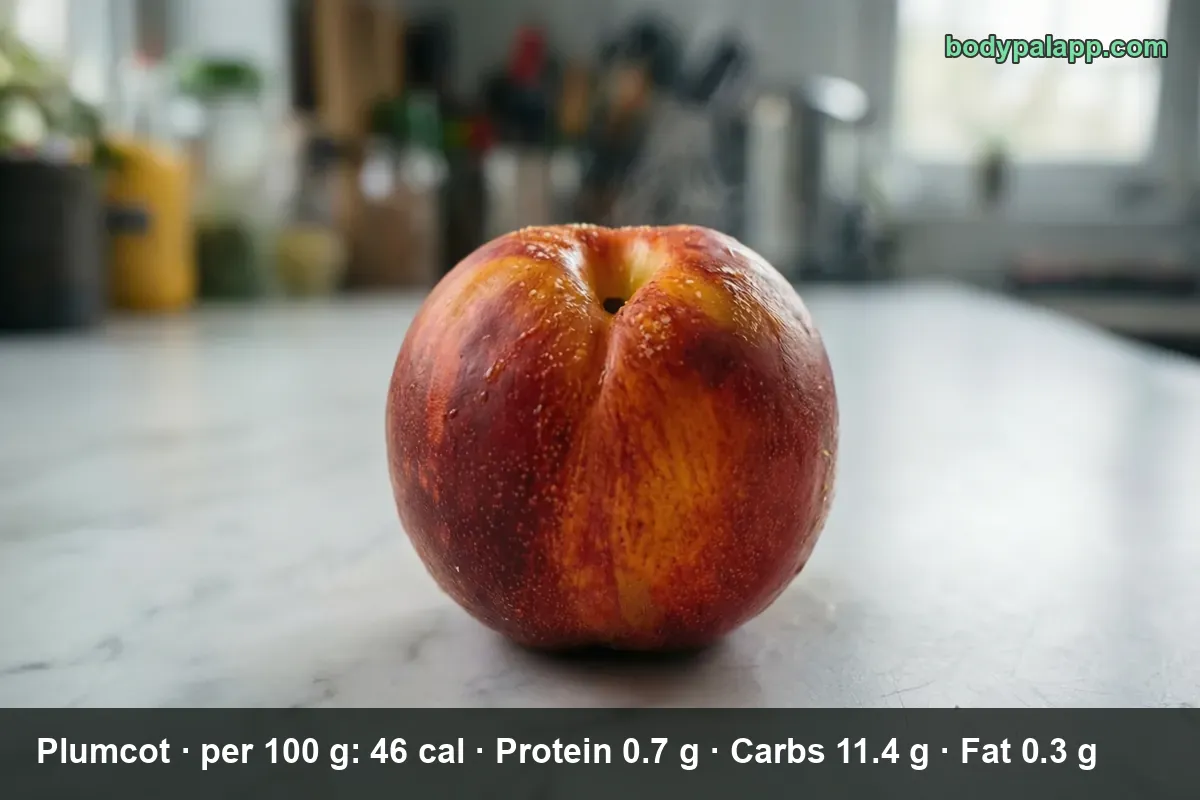
One medium plumcot weighs 66 g and carries 30 calories. Per 100 g the fresh fruit runs 46 calories, which makes it the lightest thing on this page by weight. Almost all of that comes from 11.42 g of carbohydrate per 100 g, most of it the fruit's own sugar.
On this page
- Plumcot quick facts
- US servings, from one ounce to a cup of slices
- Pluots, apricots and the canned aisle
- Dried plums and apricots are a different food
- Fiber and potassium are the rows worth reading
- How does a plumcot compare?
- FAQ
Plumcot quick facts
USDA has no record called "plumcot." The fruit is a plum-apricot cross, it is sold in the plum bins, and the trade counts it with plums. So the numbers here come from SR Legacy 169949, "Plums, raw" — the only record that carries household measures for a whole fresh fruit of this kind. The apricot side of the family, record 171697, sits in the comparison table further down, and the two parents are close enough that the choice barely moves the total: 46 calories against 48 per 100 g.
The medium fruit in this table is the USDA household size, 2-1/8 inches across, 66 g. Supermarket plumcots are often bigger than that; a 100 g fruit is simply the per-100-g column, 46 calories.
| Nutrient | Per 100 g | Per 1 plumcot, medium (66 g) | % Daily Value |
|---|---|---|---|
| Calories | 46 | 30 | — |
| Total fat | 0.28 g | 0.2 g | 0% |
| Saturated fat | 0.02 g | 0.0 g | 0% |
| Carbohydrate | 11.42 g | 7.5 g | 3% |
| Dietary fiber | 1.4 g | 0.9 g | 3% |
| Total sugars | 9.92 g | 6.5 g | — |
| Protein | 0.7 g | 0.5 g | 1% |
| Sodium | 0 mg | 0 mg | 0% |
% Daily Value is based on a 2,000-calorie diet.
Verified nutrition data
Numbers on this page come from USDA FoodData Central, the U.S. Department of Agriculture’s food composition database, and from manufacturer labels where a branded product is named. Last verified September 2026. How we verify our data →
There is no added sugars row here on purpose: the SR Legacy edition does not publish the field, and raw fruit has none to publish. Total sugars have no Daily Value on the US label either, which is why that cell is a dash rather than a percentage. Cholesterol is 0 mg. Potassium is 157 mg per 100 g, or 104 mg in the medium fruit, about 2% of the FDA Daily Value of 4,700 mg.
US servings, from one ounce to a cup of slices
| Serving | Weight | Calories |
|---|---|---|
| 1 oz | 28 g | 13 kcal |
| One plumcot, medium | 66 g | 30 kcal |
| Two plumcots, medium | 132 g | 61 kcal |
| One NLEA serving | 151 g | 69 kcal |
| 1 cup sliced | 165 g | 76 kcal |
| Per 100 g | 100 g | 46 kcal |
The medium fruit, the NLEA serving and the cup of slices are USDA household measures. The ounce and the two-fruit line are our own arithmetic from the USDA 100 g figure, not USDA servings.
The line that trips people up is the cup. A cup of sliced plumcot is 165 g, which is roughly two and a half medium fruits — so logging "1 cup" when you actually ate one piece more than doubles the entry, and logging "1 plumcot" after slicing a whole bowl undercounts by the same margin. If you are eating from a bowl, weigh it once and learn what your usual portion looks like; if you are eating one out of hand, the 66 g line is the right one unless the fruit is visibly large.
The NLEA serving, 151 g, is the reference amount the label system uses for this kind of fruit. It lands at 69 calories, close enough to the cup that either works for a rough estimate.
Pluots, apricots and the canned aisle
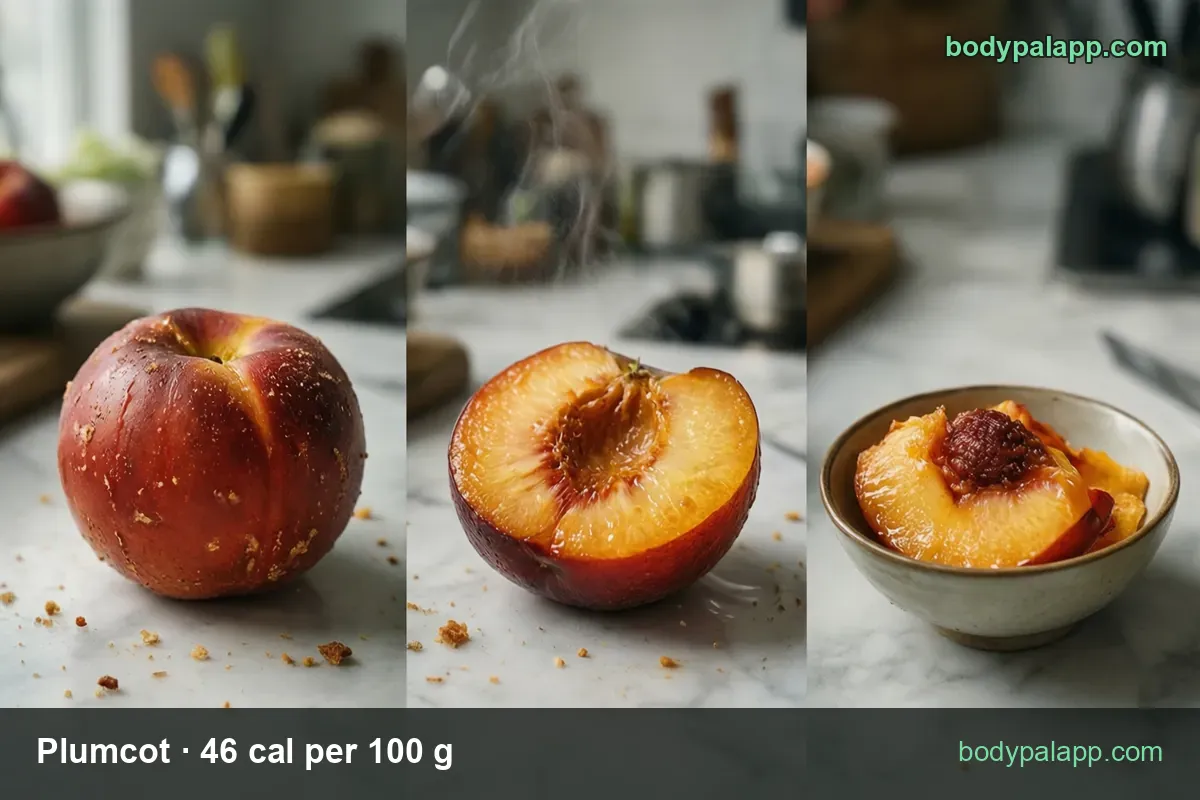
Plumcot, pluot and aprium are marketing names for different splits of the same cross. A plumcot is roughly an even plum-apricot hybrid; a pluot leans plum; an aprium leans apricot. None of them has a USDA record, and the practical difference in calories is small enough to ignore.
| Version | Per 100 g | Typical serving | Calories |
|---|---|---|---|
| Plumcot, raw (counted as plum) | 46 kcal | 1 medium fruit, 66 g | 30 kcal |
| Black plum with skin, raw | 59 kcal | 100 g | 59 kcal |
| Apricot, raw | 48 kcal | 1 apricot, 35 g | 17 kcal |
| Plums, canned in juice | 58 kcal | 100 g | 58 kcal |
| Plums, canned in heavy syrup | 89 kcal | 100 g | 89 kcal |
The Foundation record for black plum with skin reads 59 calories per 100 g, noticeably above the 46 of the general plum line. That is a sweeter, denser cultivar measured with newer methods, not a different way of counting; if your plumcot is the dark, sugary kind that stains your fingers, the higher figure is the safer bet.
Canned is where the fruit stops being light. Packed in juice it goes to 58 calories per 100 g, in heavy syrup to 89 — nearly double the fresh fruit — while fiber drops from 1.4 g to 0.9 g per 100 g because the fruit is peeled before it goes in the can. The syrup adds sugar and the peeling takes away the part worth eating. Heavy syrup also brings 19 mg of sodium per 100 g against 0 mg fresh, which is trivial on its own but a clue about how much processing sits between the two.
Dried plums and apricots are a different food
Dried is not a smaller version of fresh; it is a concentrate. Dried plums, uncooked come in at 240 calories per 100 g against 46 for the fresh fruit — 5.2 times as dense. Dried apricots run 241.
| Dried version | Per 100 g | Typical piece | Calories |
|---|---|---|---|
| Dried plums (prunes) | 240 kcal | 1 pitted prune, 9.5 g | 23 kcal |
| Dried apricots | 241 kcal | 1 half, 3.5 g | 8 kcal |
Piece for piece the dried fruit still looks small — a prune is 23 calories, an apricot half 8. The problem is that nobody eats one. Ten prunes is 95 g of dried fruit and 228 calories, about what seven and a half fresh plumcots would cost you, and you would have to work to eat seven fresh plumcots. Fiber is the honest argument for dried: 7.1 g per 100 g in prunes against 1.4 g fresh. Sugar concentrates too, from 9.92 g to 38.13 g per 100 g.
Fiber and potassium are the rows worth reading
One plumcot gives 0.9 g of fiber, 3% of the 28 g Daily Value, and 104 mg of potassium, 2% of 4,700 mg. Neither number is impressive alone. A cup of slices does better: 2.3 g of fiber, about 8%, and roughly 259 mg of potassium, near 6% — figures we scaled from the USDA 100 g values rather than a USDA serving line.
That is the honest position on this fruit. It is not a nutrient headline; it is a cheap way to fill the fruit slot. MyPlate puts the target for adults on a 2,000-calorie pattern at about 2 cups of fruit a day, and two cups of sliced plumcot would cost 152 calories — less than most single-serve fruit yogurts. If you are choosing between a snack that satisfies and one that barely registers on the day's total, this one is unusual in doing both.
Fat is effectively absent: 0.28 g per 100 g, 0.02 g of it saturated. Protein at 0.7 g per 100 g is not a reason to eat it. Sodium is 0 mg, which is worth noting only because so few ready-to-eat snacks are.
How does a plumcot compare?
| Fruit | Per 100 g | US serving | Calories |
|---|---|---|---|
| Plumcot (plum line) | 46 kcal | 1 medium fruit, 66 g | 30 kcal |
| Apricot, raw | 48 kcal | 1 apricot, 35 g | 17 kcal |
| Black plum with skin, raw | 59 kcal | 100 g | 59 kcal |
| Dried plums, uncooked | 240 kcal | 1 pitted prune, 9.5 g | 23 kcal |
Our take: the plumcot is the lightest fruit here per gram, and the gap between it and the apricot — 46 against 48 per 100 g — is small enough that swapping one for the other changes nothing you would notice. The apricot wins per piece only because it is a smaller fruit, at 35 g against 66 g; it also carries more fiber, 2 g per 100 g against 1.4 g, and twice the protein. If you want volume for the fewest calories, take the plumcot. If you want fiber for the fewest calories, take two apricots. What we would not do is treat the dried line as an equivalent: three prunes cost 69 calories against 30 for one plumcot, and the fresh fruit takes far longer to eat.
Plumcot FAQs
How many calories are in one plumcot?
One medium plumcot weighing 66 grams has 30 calories, based on the USDA row for raw plums. Per 100 grams the fruit runs 46 calories. Larger supermarket plumcots often hit 100 grams, which puts a single fruit at 46 calories — still one of the lighter pieces of fruit you can pack.
Is a plumcot the same as a pluot?
Close, but not identical, and both land at 46 calories per 100 grams. A plumcot is a roughly even plum-apricot cross; a pluot leans more plum. Neither has its own USDA record, so both get counted on the plum line. The Foundation record for black plum with skin is higher, 59 calories per 100 grams.
How many carbs does a plumcot have?
A medium 66-gram plumcot has 7.5 grams of carbohydrate, 3% of the Daily Value, with 0.9 gram of that as fiber. Per 100 grams it is 11.42 grams. A cup of slices, 165 grams, comes to 18.8 grams of carbohydrate, most of it the fruit's own sugar.
How much sugar is in a plumcot?
6.5 grams of total sugars in one medium 66-gram fruit, and 9.92 grams per 100 grams. All of it occurs naturally in the fruit. Total sugars carry no Daily Value on the US label, and the SR Legacy record does not publish added sugars at all, since raw fruit has none.
How much fiber is in a plumcot?
0.9 gram in a medium 66-gram plumcot, which is 3% of the 28-gram Daily Value. Per 100 grams the fruit gives 1.4 grams, and a cup of slices brings about 2.3 grams. Eat the skin: canned plums, peeled before packing, drop to 0.9 gram per 100 grams.
Are plumcots good for weight loss?
At 30 calories a fruit and 46 per 100 grams, the plumcot is the lightest item on this page per gram, and it is mostly water. If you are watching calories, fresh beats every processed version here: canned in heavy syrup is 89 per 100 grams and dried plums are 240.
Do plumcots have potassium?
A medium 66-gram plumcot carries about 104 milligrams of potassium, 2% of the 4,700-milligram Daily Value. Per 100 grams the figure is 157 milligrams, and a cup of slices gets you about 259 milligrams, roughly 6%. Useful, but a plumcot is a light snack rather than a potassium source.
How many calories in a cup of sliced plumcot?
A cup of sliced plumcot weighs 165 grams and holds 76 calories. That is about two and a half medium fruits, not one, which is where cup-based logging goes wrong. The same cup carries 18.8 grams of carbohydrate, 2.3 grams of fiber and 16.4 grams of natural sugars.
Similar foods
- Black Plum — 30 cal per plum
- Cranberries — 46 cal per cup whole
- Plum — 30 cal per plum
- Pluot — 30 cal per pluot
- Blood Orange — 62 cal per medium blood orange
- Clementine — 35 cal per clementine
Count it without the math
Point the camera at the bowl and BodyPal counts the slices for you, cup or single fruit.


How long does it take to burn off a plumcot?
One medium plumcot (66 g) is 30 kcal. Enter your weight and the amount you ate to see how long it takes you to burn that off:
lb
| Activity | Time to burn 30 kcal |
|---|---|
| Walking, brisk | 6 min |
| Cycling, moderate | 4 min |
| Swimming, moderate | 4 min |
| Jogging | 4 min |
| Weight training, moderate | 7 min |
Times are for a 155 lb adult at a steady pace; change the weight to see yours. The amount is set to the portion in the text (66 g); change it to what you actually ate. BodyPal works this out from your steps automatically.
This table assumes you know your daily total. If you do not, the daily calorie calculator works it out from five numbers.