
How many calories are in a clementine?
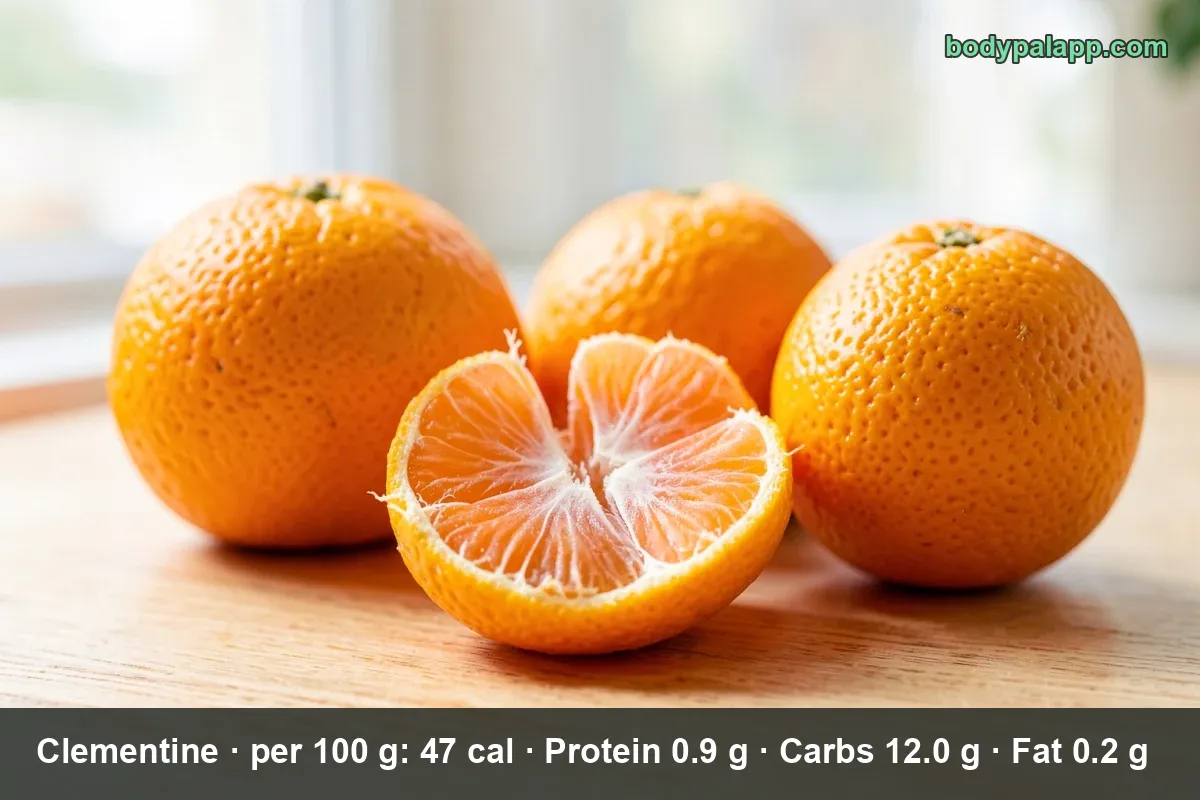
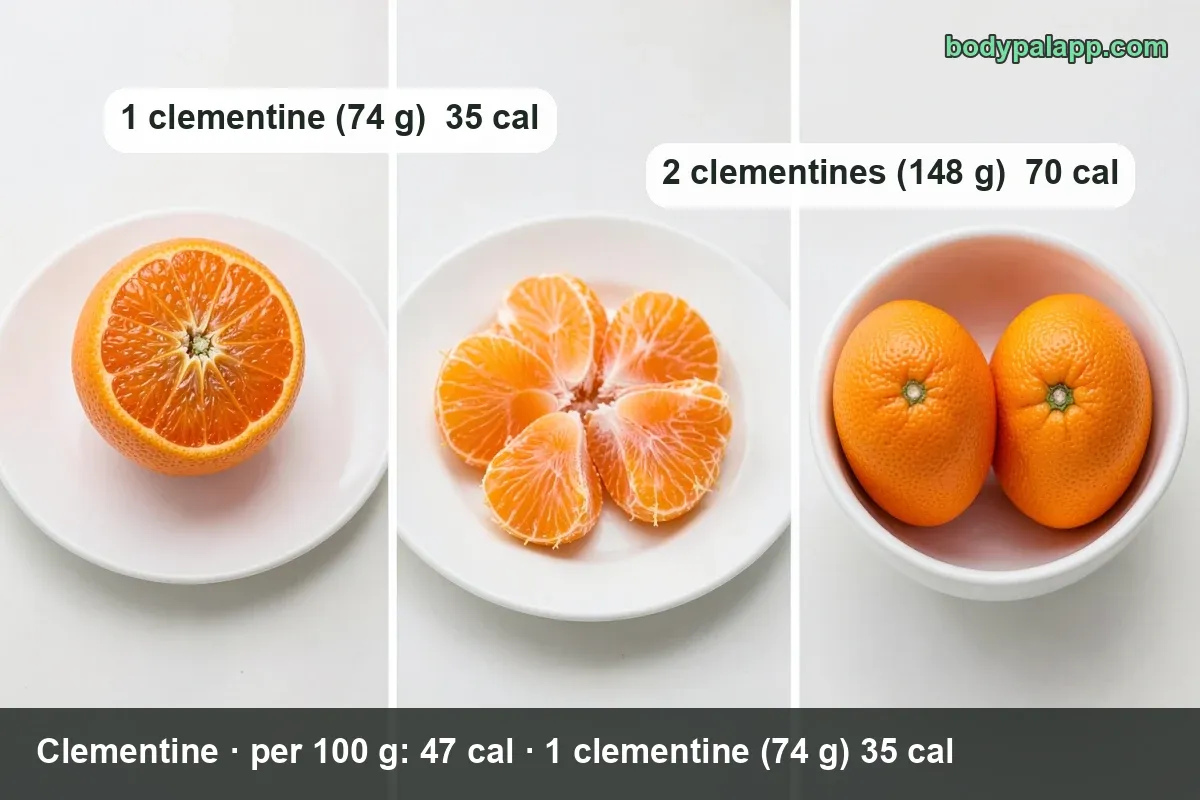
One clementine weighs 74 g and costs you 35 calories. Per 100 g the peeled fruit runs 47 calories, which puts it near the bottom of the whole produce aisle. Two of them, the serving printed on most US clamshell labels, come to 70 calories and bring 2.5 g of fiber with them.
On this page
- Clementine quick facts
- US servings, from one ounce to three fruit
- Sections, segments and the second USDA clementine
- Fiber, potassium and the rows that never show up
- How does a clementine compare?
- Most popular clementine brands
- Clementine FAQs
Clementine quick facts
The numbers below come from USDA SR Legacy 168195, "Clementines, raw". That is the record for the fruit you are actually holding: peeled, fresh, nothing added. It is also the record the retail labels agree with. The clamshells sold by Darling and Wegmans print 148 g as one serving and 70 calories against it, which is exactly two clementines at USDA's 47 calories per 100 g.
USDA has a second clementine record in a newer edition, and it reads 53 calories per 100 g. Same fruit, different sampling, higher sugar estimate. It gets its own section further down rather than being blended into the table here, because averaging two USDA editions produces a number that belongs to neither.
| Nutrient | Per 100 g | Per 1 clementine (74 g) | % Daily Value |
|---|---|---|---|
| Calories | 47 | 35 | — |
| Total fat | 0.15 g | 0.1 g | 0% |
| Carbohydrate | 12.02 g | 8.9 g | 3% |
| Dietary fiber | 1.7 g | 1.3 g | 4% |
| Total sugars | 9.18 g | 6.8 g | — |
| Protein | 0.85 g | 0.6 g | 1% |
| Sodium | 1 mg | 1 mg | 0% |
| Potassium | 177 mg | 131 mg | 3% |
% Daily Value is based on a 2,000-calorie diet.
Verified nutrition data
Numbers on this page come from USDA FoodData Central, the U.S. Department of Agriculture’s food composition database, and from manufacturer labels where a branded product is named. Last verified September 2026. How we verify our data →
Three rows you would expect on a US label are missing on purpose. USDA does not publish saturated fat, added sugars or cholesterol for this raw clementine record, so they are left out instead of guessed at. In practice a whole fresh fruit has no added sugars and no cholesterol at all, and with 0.15 g of total fat per 100 g there is not much fat left to split into saturated and unsaturated anyway.
US servings, from one ounce to three fruit
| Serving | Weight | Calories |
|---|---|---|
| 1 oz | 28.4 g | 13 kcal |
| One clementine | 74 g | 35 kcal |
| Two clementines, the label serving | 148 g | 70 kcal |
| Three clementines | 222 g | 104 kcal |
| Per 100 g | 100 g | 47 kcal |
Three of these come from published measures and two do not. The 74 g fruit is USDA's own household measure for "1 clementine," and the 148 g pair is the serving size US grocery brands print on the bag. The 100 g row is USDA's own basis. The ounce and the three-fruit line are our own arithmetic from that 100 g figure, not USDA servings.
The gap worth noticing is between one and three. Nobody eats one clementine. They come in a five-pound net bag, they peel in four seconds, and the second and third one happen without a decision. That habit is 104 calories, three times what most people log when they type "clementine" into a tracker and move on.
Weight varies more than the calorie figure does. A small fruit from the bottom of the bag might be 60 g and land near 28 calories; a fat one at 90 g is about 42. Anywhere in that range you are inside a 15-calorie window, so precision here buys you very little.
Sections, segments and the second USDA clementine
| Version | Per 100 g | Typical piece | Calories |
|---|---|---|---|
| Clementine, raw (SR Legacy 168195) | 47 kcal | 1 fruit, 74 g | 35 kcal |
| Clementine, raw (FNDDS 2709164) | 53 kcal | 1 fruit, 85 g | 45 kcal |
| Clementine sections, one cup | 53 kcal | 1 cup, 200 g | 106 kcal |
| One segment | 53 kcal | 1 section, 8 g | 4 kcal |
| Two clementines, label pack | 47 kcal | 148 g | 70 kcal |
Here is the trap that no tracker warns you about. USDA's two editions of the same raw fruit disagree twice over: 47 calories per 100 g against 53, and 74 g per fruit against 85. Stack the two disagreements and "one clementine" is either 35 calories or 45. Ten calories on a piece of fruit is nothing on its own and about 70 calories a week if you eat one a day and picked the wrong entry.
The cup measure is the one that catches people out. A cup of loose sections is 200 g, roughly two and a half fruit once the peel is gone, and it lands at 106 calories. That is a different order of magnitude from the 35-calorie snack most people picture, and it is the number to use when clementine sections go into a salad, a bowl of yogurt or a bag of trail mix.
A single segment is 4 calories. That is genuinely rounding error, and it is the honest answer to the person picking at a bowl on a desk. Eight segments in an afternoon is one fruit.
Fiber, potassium and the rows that never show up
One clementine covers 4% of the 28 g fiber Daily Value the FDA sets for a 2,000-calorie diet, and 3% of the 4,700 mg potassium DV at 131 mg. Two fruit doubles both: about 9% of a day's fiber and 6% of potassium, for 70 calories. There are very few foods that pay that rate.
Sodium is the row that reads like a typo. A clementine has 1 mg. Against a 2,300 mg Daily Value that rounds to 0%, and you would need well over a thousand clementines to reach the sodium in one teaspoon of table salt. If you are watching sodium, fresh fruit is effectively free.
Protein is the opposite story. At 0.85 g per 100 g, a clementine gives you 0.6 g, which is 1% of the 50 g DV. It is a carbohydrate food with fiber attached, not a snack that will hold you until dinner. Pairing it with something that has protein is the standard fix, and MyPlate treats whole fruit as the default form of the fruit group precisely because the fiber comes along with the sugar.
About that sugar: 6.8 g per fruit, 9.18 g per 100 g, all of it naturally occurring. Total sugars carry no Daily Value on a US label, so there is no percentage to compare it against, and the 50 g added-sugars limit does not apply to fruit sugar. Comparing the two is the single most common mistake made about this fruit.
How does a clementine compare?
| Food | Per 100 g | Fiber per 100 g | US serving | Calories |
|---|---|---|---|---|
| Clementine | 47 kcal | 1.7 g | one fruit, 74 g | 35 kcal |
| Oranges, raw, all varieties | 47 kcal | 2.4 g | 1 oz, 28.4 g | 13 kcal |
| Loquats, raw | 47 kcal | 1.7 g | 1 oz, 28.4 g | 13 kcal |
| Orange juice, canned, unsweetened | 47 kcal | 0.2 g | 1 oz, 28.4 g | 13 kcal |
All four land on exactly 47 calories per 100 g. That is not a coincidence so much as a reminder that calorie density is a blunt instrument: by that measure a glass of juice and a whole fruit are identical. The one-ounce servings are our own arithmetic from each USDA 100 g figure, used because it is the only measure all four share.
Our take: fiber is what separates them, and it separates them badly. Oranges carry 2.4 g per 100 g, clementines and loquats 1.7 g, and orange juice keeps 0.2 g, which is to say it keeps almost none. Drink 200 g of juice and you have spent 94 calories on 0.4 g of fiber; eat 200 g of clementine sections instead and you get 3.4 g. For weight control, pick the clementine over the juice every time and the orange over the clementine if you want the fiber. Loquats are the odd one out on protein, at 0.43 g per 100 g against the clementine's 0.85 g, though at that scale neither counts.
Most popular clementine brands in the United States
Ranked by how widely each product appears among foods sold in the United States, from the BodyPal food database of over 3.3 million products. Calories are the figures printed on each Nutrition Facts label, checked against USDA FoodData Central.
| Product | Calories (per 100 g) |
|---|---|
| Darling Clementines | 47 cal |
| Wegmans Clementines | 47 cal |
Brand popularity: BodyPal food database. Nutrition: manufacturer labels / USDA FoodData Central.
Clementine FAQs
How many calories are in one clementine?
One clementine of 74 g carries 35 calories, from USDA's figure of 47 calories per 100 g for raw clementines. That is the peeled fruit, flesh only. USDA's newer edition uses a larger 85 g fruit at 53 calories per 100 g, which works out to 45 calories instead.
How many calories are in 2 clementines?
Two clementines are 70 calories at a combined 148 g, which is exactly the serving printed on US clamshell labels from brands like Darling and Wegmans. That pair carries 17.8 g of carbohydrate, 13.6 g of sugars, 2.5 g of fiber and about 1 mg of sodium in total.
How much sugar is in a clementine?
A clementine holds 6.8 g of total sugars in 74 g of fruit, or 9.18 g per 100 g. All of it occurs naturally. USDA does not publish added sugars for raw clementines, and total sugars carry no Daily Value, so the 50 g added-sugars limit is not the yardstick here.
How many carbs are in a clementine?
8.9 g of carbohydrate per clementine, which is 3% of the 275 g Daily Value. Of that, 6.8 g is sugars and 1.3 g is fiber. Two clementines reach 17.8 g, about 6% of a day's carbohydrate on a 2,000-calorie diet. A cup of sections is 106 calories.
Clementine vs orange: which has fewer calories?
Neither: USDA gives raw clementines and raw oranges the same 47 calories per 100 g. Fiber is the real difference: oranges hold 2.4 g per 100 g against 1.7 g in clementines. Size decides your total, and since a clementine is the smaller fruit, one of them costs less than one orange.
Are clementines good for weight loss?
At 35 calories each they are one of the cheapest sweet things you can eat, and 47 calories per 100 g undercuts almost every packaged snack. Three of them are 104 calories with 3.8 g of fiber. If you are watching calories, that is an easy way to make something sweet fit.
Do clementines have fiber?
Yes: 1.3 g per fruit and 1.7 g per 100 g, which is 4% of the 28 g Daily Value. Two clementines get you to 2.5 g, roughly 9%. Oranges do better at 2.4 g per 100 g, and unsweetened orange juice keeps only 0.2 g for the same calories.
How many clementines can I eat a day?
There is no USDA limit to quote, so the arithmetic decides: three clementines are 104 calories, five are about 174, and ten would be 348 calories with 68 g of sugars, all of that our own scaling from the USDA 100 g figure. Most people stop well before ten.
Similar foods
- Tom yum soup — 191 cal per bowl
- Ceviche — 158 cal per cup
- Pomegranate — 72 cal for 1/2 cup arils
- Clam Chowder — 237 cal per cup
- Chinese Chicken and Broccoli — 206 cal per cup
- Pork And Beans — 273 cal per cup
Count it without the math
Point the camera at the bowl and BodyPal counts the clementines for you, segments and all.


How long does it take to burn off a clementine?
One clementine (74 g) is 35 kcal. Enter your weight and the amount you ate to see how long it takes you to burn that off:
lb
| Activity | Time to burn 35 kcal |
|---|---|
| Walking, brisk | 7 min |
| Cycling, moderate | 4 min |
| Swimming, moderate | 5 min |
| Jogging | 4 min |
| Weight training, moderate | 8 min |
Times are for a 155 lb adult at a steady pace; change the weight to see yours. The amount is set to the portion in the text (74 g); change it to what you actually ate. BodyPal works this out from your steps automatically.
Want the bigger picture? Calculate your daily calorie needs — your maintenance figure, a target for losing or gaining, and the date you get there.