
How many calories are in tom yum soup?
A cup of tom yum soup is 96 calories, or 39 calories per 100 grams. The bowl a Thai kitchen actually puts in front of you holds two cups, so that bowl is 191 calories. An instant tom yum packet, which is a different food wearing the same name, is 320 calories before the water goes in.
On this page
- Tom yum quick facts
- The bowl is two cups and it doubles everything
- US servings from an ounce to a restaurant bowl
- Sodium is the number that runs out first
- Six kinds of tom yum six different numbers
- Why USDA has no line called tom yum
- How does tom yum soup compare?
- Most popular tom yum soup brands
- FAQ
Tom yum quick facts
Every figure on this page comes from one record: FNDDS 2707136, "Soup, hot and sour", filed under "Ramen and Asian broth-based soups". That is a thin, sour, chili-hot broth carrying mushrooms and pieces of meat or seafood, which is what a bowl of tom yum nam sai is. It is a stand-in rather than a record named tom yum, and the section further down sets out exactly where the stand-in stops being fair.
| Nutrient | Per 100 g | Per 1 cup (245 g) | % Daily Value |
|---|---|---|---|
| Calories | 39 cal | 96 cal | — |
| Total fat | 1.21 g | 3.0 g | 4% |
| Saturated fat | 0.23 g | 0.6 g | 3% |
| Carbohydrate | 4.35 g | 10.7 g | 4% |
| Dietary fiber | 0.5 g | 1.2 g | 4% |
| Total sugars | 0.42 g | 1.0 g | — |
| Protein | 2.58 g | 6.3 g | 13% |
| Sodium | 376 mg | 921 mg | 40% |
% Daily Value is based on a 2,000-calorie diet.
Verified nutrition data
Numbers on this page come from USDA FoodData Central, the U.S. Department of Agriculture’s food composition database, and from manufacturer labels where a branded product is named. Last verified September 2026. How we verify our data →
Two rows in that table point in opposite directions. Fat, carbohydrate and fiber all land on 4% of the day, and the calories are so low they get no %DV at all. Sodium takes 40% of the day out of a single cup. Tom yum is a very light soup with a very heavy salt bill, and most calorie charts publish the first half of that sentence and drop the second.
Added sugars and trans fat are missing from the table on purpose. The USDA record does not carry those fields at all, and printing a zero where the source has nothing would be an invention rather than a measurement.
The bowl is two cups and it doubles everything
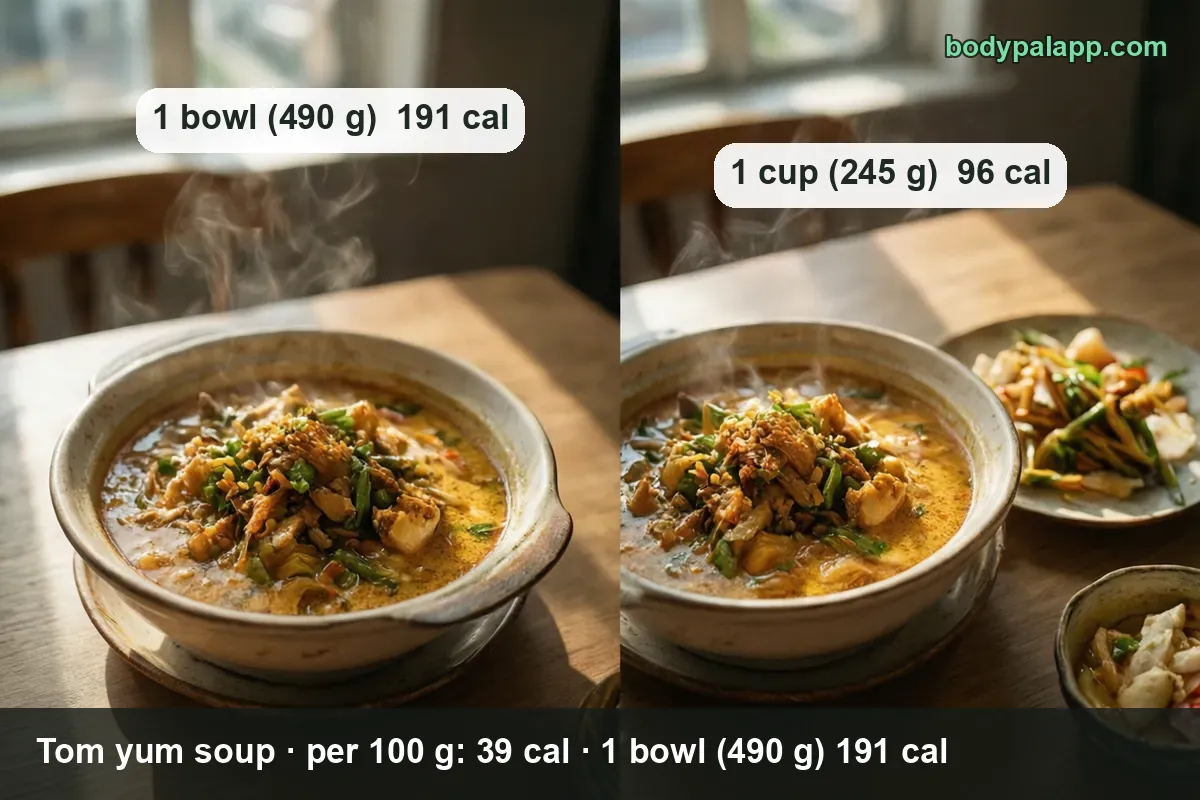
USDA gives this soup exactly one household measure: 1 cup, 245 g. Nobody in a Thai restaurant has ever been handed a cup. The soup bowl on the table is closer to 490 g, which is two USDA cups to the gram, and doubling is the single most useful piece of arithmetic on this page.
At 490 g the bowl is 191 calories. Still small: a light sandwich beats it. What doubles alongside the calories is everything else in the record, and one of those numbers matters much more than the rest.
- Calories: 96 a cup, 191 a bowl
- Protein: 6.3 g a cup, 12.6 g a bowl
- Sodium: 921 mg a cup, 1,842 mg a bowl
The protein figure is the pleasant surprise. A restaurant bowl of tom yum delivers 12.6 g of protein for 191 calories, more protein than a cup of any lighter soup on this page, because the broth itself is nearly weightless and the mushrooms, shrimp or chicken are doing all the work.
The sodium figure is the unpleasant one. Two cups of a 39-calorie soup carry 1,842 mg of sodium, which is 80% of an adult's daily limit. Order tom yum as a starter and the salt budget for the entire day is effectively spent before the main course lands.
US servings from an ounce to a restaurant bowl
| Serving | Weight | Calories |
|---|---|---|
| One ounce, a couple of spoonfuls | 28 g | 11 cal |
| One cup, the USDA measure | 245 g | 96 cal |
| One restaurant bowl, two cups | 490 g | 191 cal |
| 100 grams | 100 g | 39 cal |
Only the cup row is a USDA measure; the ounce, the bowl and the 100 g rows are our own scaling of it. The ounce row is a trap in the direction nobody expects. Tom yum is more than 90% water, so an ounce of it is 11 calories, and anybody logging soup by the ounce will produce a number nine to seventeen times too small for what they actually ate. Soup is not sold, served or eaten in ounces. Log the vessel, not the spoonful.
Raw and cooked columns do not appear anywhere on this page, and that is deliberate. Soup exists only in its finished state; USDA has no dry weight for it, because there is no such thing as uncooked tom yum. The paste is a separate product with its own record, and it gets its own row further down.
Sodium is the number that runs out first
Calories are why people search for tom yum. Sodium is why they should.
One cup takes 40% of the daily sodium allowance. The same cup takes 4% of the fat allowance, 4% of the carbohydrate, 4% of the fiber. That is a tenfold gap between one nutrient and every other nutrient in the record, and it is the sharpest thing this soup has to tell you.
The Dietary Guidelines for Americans put the adult ceiling at 2,300 mg of sodium a day, the same figure the FDA uses for the %DV column on every label in the country. A cup of tom yum uses 921 mg of it. A restaurant bowl uses 1,842 mg.
Here is the part that ruins the obvious workaround. Ready-made tom yum broth in a carton is 10 calories per 100 g against the soup's 39, so it looks like the light option, and it is: a cup is 25 calories. Its sodium is 318 mg per 100 g, which works out at 779 mg a cup. That is a quarter of the calories for 85% of the salt. Taking the mushrooms and the meat out of tom yum removes almost everything except the thing worth removing.
The same logic runs through MyPlate's advice on broth-based dishes: the broth is where the sodium lives, not the solids floating in it.
Six kinds of tom yum six different numbers
| Version | Per 100 g | Typical serving | Calories |
|---|---|---|---|
| Clear tom yum (nam sai) | 39 cal | 1 cup (245 g) | 96 cal |
| Ready-made tom yum broth | 10 cal | 1 cup (245 g) | 25 cal |
| Tom yum chicken bone broth | 61 cal | 1 cup (245 g) | 149 cal |
| Tom yum noodle soup bowl | 167 cal | 1 bowl (168 g) | 281 cal |
| Instant tom yum packet, dry | 457 cal | 1 packet (70 g) | 320 cal |
| Tom yum paste | 281 cal | 1 Tbsp (16 g) | 45 cal |
The spread from 10 to 457 calories per 100 g is the widest thing on this page, and the word tom yum is doing very little work across it.
The instant packet is twelve times the soup. At 457 calories per 100 g against 39, an instant noodle packet is not a heavier version of tom yum; it is fried wheat noodles with tom yum seasoning. One 70 g packet is 320 calories and carries 2,014 mg of sodium per 100 g, which is roughly 1,410 mg in the packet, 61% of the day. The bowl of soup at the restaurant is the lighter order by a distance.
The bone broth sits in the middle. A keto-style tom yum chicken bone broth runs 61 calories per 100 g, with 4.08 g of fat and 2.45 g of protein in that 100 g, so a cup is 149 calories. The extra fat is the whole difference between it and the 39-calorie record.
The ready-made noodle bowl is a meal, not a soup. At 167 calories per 100 g in a 168 g bowl, it is 281 calories, and its 762 mg of sodium per 100 g works out at about 1,280 mg for the bowl. That is 56% of the day from a supermarket lunch.
The paste is a condiment with a soup's name. Tom yum paste is 281 calories per 100 g, but nobody eats 100 g of it. A tablespoon is 16 g and 45 calories, and that is the number worth logging when you make the soup at home: the paste adds roughly half a cup of finished soup's worth of calories to a whole pot.
One version has no number here, and it should be the one you most want. Tom yum nam khon — the creamy orange kind, thickened with evaporated or coconut milk — has no USDA record and no label that matches it exactly. It is certainly higher than 39 calories per 100 g, because the milk adds fat to a broth that had almost none, but there is no honest figure to print, so this page prints none. The clear version, nam sai, is what the 96 describes.
Why USDA has no line called tom yum
Search FoodData Central for tom yum and you get instant noodle packets, seasoning pastes and one seaweed snack. There is no generic record for the soup, which is exactly why every calorie site quotes a different figure for it.
The closest genuine match is hot and sour soup, and the match is closer than it first sounds: same survey category, same construction, sour acidic broth with chili heat, mushrooms and pieces of protein. Tom yum is the Thai member of that family, using lemongrass, galangal and lime where a Chinese kitchen uses vinegar and white pepper. The calorie arithmetic of a watery sour broth does not change much between the two.
There is a second record worth knowing about, because it explains a discrepancy you will meet elsewhere. SR Legacy 174808, "Soup, hot and sour, Chinese restaurant", carries identical values per 100 g — 39 calories, 2.58 g of protein, 376 mg of sodium. The only difference is the cup: SR Legacy sizes it at 233 g, so its cup is 91 calories, while the newer FNDDS release sizes it at 245 g and gets 96. Five calories, and the source of it is a measuring cup rather than a disagreement about soup. This page uses the newer 245 g cup throughout.
Two more caveats belong here rather than buried. The 490 g restaurant bowl is derived, not published: it is two USDA cups, chosen because that is the vessel a Thai restaurant serves. And the most photographed tom yum of all, tom yum goong with shrimp, is covered by the same record, which counts meat or seafood pieces without naming the species.
How does tom yum soup compare?
| Soup | Per 100 g | Per 1 cup | Protein / Carbs / Fat per cup |
|---|---|---|---|
| Miso or tofu soup | 24 cal | 59 cal | 5.4 / 5.6 / 2.1 g |
| Egg drop soup | 27 cal | 66 cal | 2.8 / 10.5 / 1.5 g |
| Wonton soup | 33 cal | 81 cal | 5.9 / 7.2 / 3.2 g |
| Tom yum, hot and sour | 39 cal | 96 cal | 6.3 / 10.7 / 3.0 g |
| Pho with meat | 77 cal | 189 cal | 14.2 / 13.7 / 8.2 g |
All five are USDA survey records from the same category, so this is a fair fight. One honest note about the cup column: USDA publishes a cup measure for each of these soups but our index does not return the gram weight of the other four, so the 245 g cup from the main record has been applied across the table to keep it comparable. The 100 g column is exact; the cup column is exact for tom yum and within a few percent for the rest.
Tom yum lands fourth of five on calories and second of five on protein per cup. That combination is the reason to order it. Miso is the lightest thing on the list at 59 calories a cup, but it gives back only 5.4 g of protein and no real substance; egg drop is lighter still on protein at 2.8 g, which makes it the least filling calorie on the table.
Our take: if you want a starter that costs almost nothing and still counts as food, tom yum is the pick — 96 calories with 6.3 g of protein, more protein per cup than any of the three lighter soups above it. If you want the soup to be lunch, pho is the only one here that can do it, at 189 calories and 14.2 g of protein a cup. And if sodium is the number you watch, none of these is an escape route; broth-based Asian soups are salt in liquid form, and tom yum is at the salty end of a salty category.
Most popular tom yum soup brands in the United States
Ranked by how widely each product appears among foods sold in the United States, from the BodyPal food database of over 3.3 million products. Calories are the figures printed on each Nutrition Facts label, checked against USDA FoodData Central.
| Product | Calories (per 100 g) |
|---|---|
| MAMA Instant Noodles Shrimp Tom Yum | 457 cal |
| KOKA Instant Rice Noodles Tom Yum | 314 cal |
| Annie Chun's Thai Style Tom Yum Soup Bowl | 167 cal |
| Kettle & Fire Tom Yum Chicken Bone Broth | 61 cal |
| Sea Best Tom Yum Wonton Soup | 134 cal |
| Maesri Tom Yum Soup | 23 cal |
Brand popularity: BodyPal food database. Nutrition: manufacturer labels / USDA FoodData Central.
Tom yum soup FAQs
How many calories are in a bowl of tom yum soup?
A restaurant bowl of tom yum is 191 calories. That bowl holds about 490 g, which is two USDA cups, and the soup runs 39 calories per 100 g. The same bowl carries 12.6 g of protein and 1,842 mg of sodium.
How many calories are in 1 cup of tom yum soup?
96 calories in a 1-cup (245 g) serving. That is 6.3 g of protein, 10.7 g of carbohydrate and 3.0 g of fat, so a cup takes under 5% of a 2,000-calorie day. An older USDA record uses a 233 g cup and gets 91 calories instead.
How much sodium is in tom yum soup?
921 mg in a cup, which is 40% of the 2,300 mg daily limit. A 490 g restaurant bowl doubles that to 1,842 mg, or 80% of the day. Sodium is the only nutrient in this soup that takes a large share of anything.
Is tom yum soup good for weight loss?
As a low-calorie starter it is hard to beat: 96 calories a cup, 191 a bowl, with 6.3 g of protein per cup to make it feel like food. The catch is not calories but salt, at 40% of the daily sodium allowance per cup.
Tom yum or tom kha, which has fewer calories?
Clear tom yum, at 39 calories per 100 g and 96 per cup. Tom kha and the creamy tom yum nam khon are thickened with coconut or evaporated milk, and USDA has no record for either, so no figure for them is published here. Milk adds fat to a broth that has 1.21 g per 100 g.
How many calories are in instant tom yum noodles?
320 calories in a 70 g packet, at 457 calories per 100 g dry. That is twelve times the density of the soup in a bowl, because the packet is fried wheat noodles rather than broth. Sodium runs 2,014 mg per 100 g, about 1,410 mg per packet.
Does tom yum soup have protein?
6.3 g in a cup, which is 13% of the Daily Value, and 12.6 g in a 490 g bowl. That is more protein per cup than egg drop soup at 2.8 g or miso at 5.4 g, because tom yum carries shrimp, chicken or fish rather than broth alone.
How many calories are in a tablespoon of tom yum paste?
45 calories in a 16 g tablespoon, at 281 calories per 100 g. The paste is a cooking base rather than a serving, so its number matters only when you build the soup at home, where one spoonful seasons a whole pot.
Similar foods
- Clementine — 35 cal per clementine
- Ceviche — 158 cal per cup
- Pomegranate — 72 cal for 1/2 cup arils
- Clam Chowder — 237 cal per cup
- Chinese Chicken and Broccoli — 206 cal per cup
- Pork And Beans — 273 cal per cup
Count it without the math
Point the camera at the bowl and BodyPal logs the calories and the sodium together, which is the pair that matters in soup.


How long does it take to burn off tom Yum soup?
A 1-cup (245 g) serving is 96 kcal. Enter your weight and the amount you ate to see how long it takes you to burn that off:
lb
| Activity | Time to burn 96 kcal |
|---|---|
| Walking, brisk | 19 min |
| Cycling, moderate | 12 min |
| Swimming, moderate | 14 min |
| Jogging | 11 min |
| Weight training, moderate | 21 min |
Times are for a 155 lb adult at a steady pace; change the weight to see yours. The amount is set to the portion in the text (245 g); change it to what you actually ate. BodyPal works this out from your steps automatically.
One food is easy to picture; a whole day is harder. See how many calories you need a day and what a deficit actually looks like.