
How many calories are in a pluot?
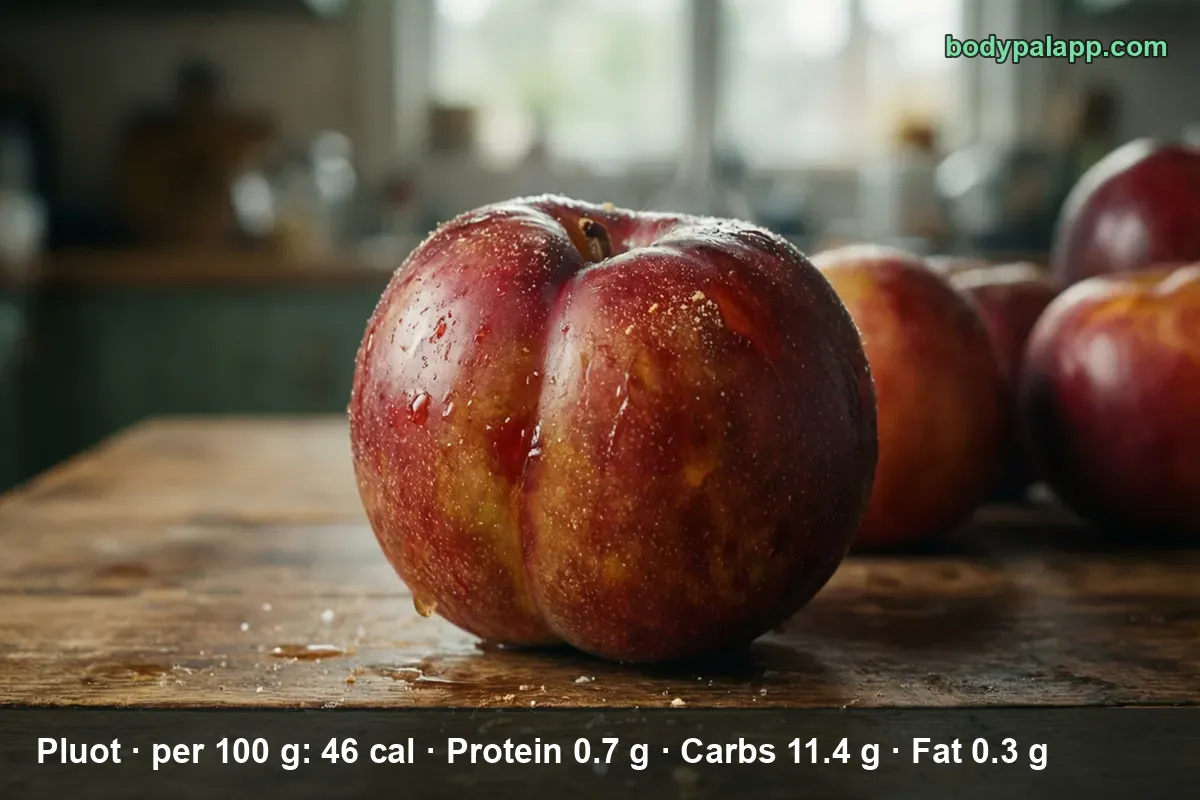
One medium pluot weighs about 66 g and carries 30 calories. Per 100 g the fruit runs 46 calories, the same figure USDA lists for raw plums, because there is no separate pluot record in the database. A cup of slices is 76. Almost all of that energy is sugar.
On this page
- Pluot quick facts
- US servings from one ounce to a cup of slices
- Canned and dried versions of the same fruit
- Sugar has no Daily Value but fiber does
- How does a pluot compare?
- Most popular pluot brands
- Pluot FAQs
Pluot quick facts
A pluot is a plum-apricot hybrid, and USDA has never given it its own entry. The closest complete profile is the SR Legacy row 169949, "Plums, raw", which carries a full nutrient panel measured on fresh fruit. The one branded pluot label in the database, from C & D International, reads 45 calories per 100 g. That is a single calorie away from the plum row, which is as good a confirmation as this fruit is going to get.
There is a Foundation entry for black plum with skin at 58.7 calories per 100 g, and it is tempting because it is newer. It does not lead here: its energy is calculated by Atwater factors rather than measured, and its panel is missing sugars and saturated fat. Mixing the two records would mean averaging across sources, so the page stays on 169949 throughout and quotes the others separately where they matter.
| Nutrient | Per 100 g | Per one pluot (66 g) | % Daily Value |
|---|---|---|---|
| Calories | 46 | 30 | — |
| Total fat | 0.28 g | 0.2 g | 0% |
| Saturated fat | 0.02 g | 0.0 g | 0% |
| Carbohydrate | 11.42 g | 7.5 g | 3% |
| Dietary fiber | 1.4 g | 0.9 g | 3% |
| Total sugars | 9.92 g | 6.5 g | — |
| Protein | 0.7 g | 0.5 g | 1% |
| Sodium | 0 mg | 0 mg | 0% |
| Potassium | 157 mg | 104 mg | 2% |
% Daily Value is based on a 2,000-calorie diet.
Verified nutrition data
Numbers on this page come from USDA FoodData Central, the U.S. Department of Agriculture’s food composition database, and from manufacturer labels where a branded product is named. Last verified September 2026. How we verify our data →
There is no added sugars row above, and the reason is the record itself: the SR Legacy edition does not publish added sugars at all, and a raw fruit has none to publish. Cholesterol is 0 mg, as it is in every plant food. Potassium is the only mineral here that shows up in a meaningful quantity, at 104 mg a fruit.
US servings from one ounce to a cup of slices
| Serving | Weight | Calories |
|---|---|---|
| 1 oz | 28 g | 13 kcal |
| One pluot, 2-1/8 inch diameter | 66 g | 30 kcal |
| Two pluots, the label serving | 154 g | 71 kcal |
| 1 cup, sliced | 165 g | 76 kcal |
| Per 100 g | 100 g | 46 kcal |
The 66 g fruit and the 165 g cup are USDA household measures attached to record 169949. The two-fruit line is the serving printed on the branded pluot label, and its calorie figure is our own arithmetic from the USDA 100 g number rather than a USDA serving. The ounce is the same kind of scaling. USDA also carries an NLEA serving of 151 g, which comes to 69 calories and exists mainly so packaged-fruit labels have a standard to point at.
The gap worth noticing is between the fruit and the cup. People log "a pluot" and then eat a bowl of slices, and 165 g is two and a half pluots, not one. That is 76 calories instead of 30. Nothing about the fruit changed; the portion did. When pluots are small, three of them clear the cup weight easily.
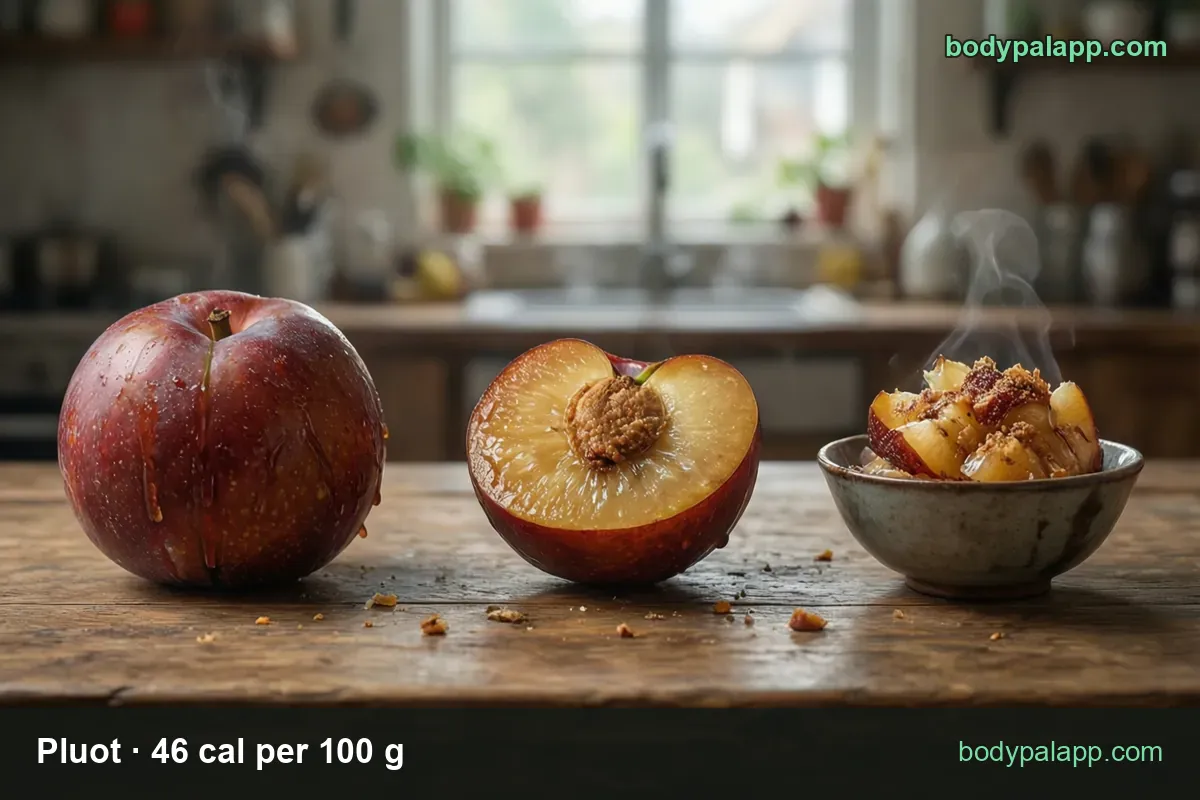
Roasted pluot halves are a common summer preparation and they show up in the picture on this page, but USDA publishes no record for cooked pluot, so there is no honest number to quote for them. Roasting drives off water and concentrates what is left, which pushes the per-gram figure up rather than down.
Canned and dried versions of the same fruit
The fresh fruit is the easy case. Everything else in this family is a story about what the packing liquid or the dehydrator did to the water.
| Version | Per 100 g | Typical serving | Calories |
|---|---|---|---|
| Fresh pluot, raw | 46 kcal | 1 pluot (66 g) | 30 kcal |
| Black plum with skin, raw | 58.7 kcal | 1 oz (28 g) | 17 kcal |
| Plums canned in water | 41 kcal | 1 cup, pitted (249 g) | 102 kcal |
| Plums canned in juice | 58 kcal | 1 cup, pitted (252 g) | 146 kcal |
| Plums canned in heavy syrup | 89 kcal | 1 oz (28 g) | 25 kcal |
| Prunes, dried plums | 240 kcal | 1 cup, pitted (174 g) | 418 kcal |
Water-packed fruit is the lightest thing in the table at 41 calories per 100 g, below even the fresh fruit, because the canning water dilutes what is there. Juice pack adds 17 calories per 100 g on top of that. Heavy syrup more than doubles the water-pack figure, from 41 to 89, and it is the only row here that also brings sodium worth mentioning, at 19 mg per 100 g against 1 mg for the other cans.
Prunes are the extreme. At 240 calories per 100 g they are more than five times the fresh fruit by weight, and a cup of pitted prunes is 418 calories. Drying removes water, not sugar, so the sugar that was spread through 100 g of fresh fruit ends up packed into roughly a fifth of the weight. An ounce of heavy-syrup canned plums is 25 calories, while an ounce of prunes is closer to 68 by the same arithmetic. Both are the same fruit that started at 46.
The branded pluot label from C & D International is worth one line of its own: 45 calories per 100 g, with a stated serving of 154 g described as two raw plumcots, coming to 69 calories on the package. Its panel skips fiber and sugars entirely, which is why it does not run this page.
Sugar has no Daily Value but fiber does
Total sugars are the biggest single nutrient in a pluot after water, at 9.92 g per 100 g, and the label shows no percentage next to them. That is not an oversight. The FDA sets a Daily Value of 50 g for added sugars only; total sugars have none, so the cell stays empty on any honest table, including the one above. The 50 g limit has nothing to say about whole raw fruit.
Fiber does have a Daily Value, 28 g, and this is where a pluot is more ordinary than its reputation suggests. One fruit contributes 0.9 g, or 3%. Reaching the full 28 g on pluots alone would take about 31 of them, which is our arithmetic from the 1.4 g per 100 g figure and obviously not a plan. MyPlate puts most adults at 1.5 to 2 cups of fruit a day, and a pluot is a good way to spend part of that budget cheaply in calories, not a fiber source to lean on.
Potassium is the quieter win: 104 mg a fruit, 2% of the 4,700 mg Daily Value. Sodium is 0 mg, so this is one of the few foods where the salt conversation simply does not start. Fat is 0.2 g a fruit and saturated fat rounds to zero.
How does a pluot compare?
| Fruit | Per 100 g | US serving | Calories |
|---|---|---|---|
| Pluot (raw plum row) | 46 kcal | one pluot, 66 g | 30 kcal |
| Cranberries, raw | 46 kcal | 1 oz, 28 g | 13 kcal |
| Oranges, raw, Florida | 46 kcal | 1 oz, 28 g | 13 kcal |
| Cherries, sweet, canned in water | 46 kcal | 1 oz, 28 g | 13 kcal |
All four rows sit at exactly 46 calories per 100 g, which is a small piece of evidence about fruit generally: once you strip out the dried and syrup-packed versions, most fresh fruit clusters in a narrow band, and the differences people argue about are differences in how much they eat. An ounce of any of these four is 13 calories.
Our take: for calorie counting, treat a pluot as free-ish at the piece level and pay attention only at the bowl. One fruit at 30 calories will not move a day. A cup of slices at 76 still will not, but a cup of prunes at 418 is a meal component and should be logged like one. If you want the fruit to hold you until the next meal, put it next to something with protein, because 0.5 g a fruit is not going to do that job by itself. And if you are choosing between cans, water pack at 41 calories per 100 g beats heavy syrup at 89 without costing you anything but a rinse.
Most popular pluot brands in the United States
Ranked by how widely each product appears among foods sold in the United States, from the BodyPal food database of over 3.3 million products. Calories are the figures printed on each Nutrition Facts label, checked against USDA FoodData Central.
| Product | Calories (per 100 g) |
|---|---|
| C & D International Pluot | 45 cal |
Brand popularity: BodyPal food database. Nutrition: manufacturer labels / USDA FoodData Central.
Pluot FAQs
How many calories are in one pluot?
One pluot of 66 g is 30 calories, based on the USDA raw plum row at 46 calories per 100 g. Bigger fruit scales straight up: a 90 g pluot lands near 41 calories. Two of them, the serving printed on the branded pluot label, come to 71.
How much sugar is in a pluot?
A 66 g pluot carries 6.5 g of total sugars, from 9.92 g per 100 g. Total sugars have no Daily Value on the US label, so no percentage appears for that row. None of it is added sugar, and the 50 g added-sugar limit does not apply to whole raw fruit.
How many carbs are in a pluot?
One pluot has 7.5 g of carbohydrate, 3% of the 275 g Daily Value, and 0.9 g of that is fiber. Per 100 g the fruit is 11.42 g of carbohydrate. A cup of slices, 165 g, brings that to roughly 18.8 g, two and a half times the single piece.
Do pluots have fiber?
A pluot has 0.9 g of fiber, 3% of the 28 g Daily Value, from 1.4 g per 100 g. That is modest for a fruit. Dried plums are the outlier in this family at 7.1 g per 100 g, five times the fresh figure by weight.
Is a pluot healthier than a plum?
Both sit at 46 calories per 100 g in USDA data, because a pluot is logged against the raw plum record. The branded pluot label reads 45, within one calorie. Taste differs more than nutrition does: a pluot is sweeter on the tongue but not measurably denser in energy.
What is a pluot vs a plumcot vs an aprium?
USDA publishes no separate record for any of the three, so all are logged at the plum row's 46 calories per 100 g. A pluot leans plum, an aprium leans apricot, and plumcot is the older name for a straight cross. The one branded pluot label lists 45 calories per 100 g.
How many calories in a cup of sliced pluots?
One cup of sliced pluots weighs 165 g and comes to 76 calories, with 18.8 g of carbohydrate and 16.4 g of sugars. That is two and a half pluots by weight. Slicing makes the fruit disappear faster, which is why the cup is the serving people underestimate most.
Are pluots good for weight loss?
At 30 calories a piece, a pluot is a cheap way to end a meal, and 46 calories per 100 g is light for its bulk. Fiber is only 0.9 g per fruit, so it is not especially filling on its own. The trap is dried: prunes are 240 per 100 g, and a cup is 418.
Similar foods
- Black Plum — 30 cal per plum
- Cranberries — 46 cal per cup whole
- Plum — 30 cal per plum
- Plumcot — 30 cal per plumcot, medium
- Blood Orange — 62 cal per medium blood orange
- Clementine — 35 cal per clementine
Count it without the math
Point the camera at the bowl and BodyPal counts the pluots for you, slices and all.


How long does it take to burn off a pluot?
One pluot (66 g) is 30 kcal. Enter your weight and the amount you ate to see how long it takes you to burn that off:
lb
| Activity | Time to burn 30 kcal |
|---|---|
| Walking, brisk | 6 min |
| Cycling, moderate | 4 min |
| Swimming, moderate | 4 min |
| Jogging | 4 min |
| Weight training, moderate | 7 min |
Times are for a 155 lb adult at a steady pace; change the weight to see yours. The amount is set to the portion in the text (66 g); change it to what you actually ate. BodyPal works this out from your steps automatically.
Want the bigger picture? Calculate your daily calorie needs — your maintenance figure, a target for losing or gaining, and the date you get there.