
How many calories are in an orange?
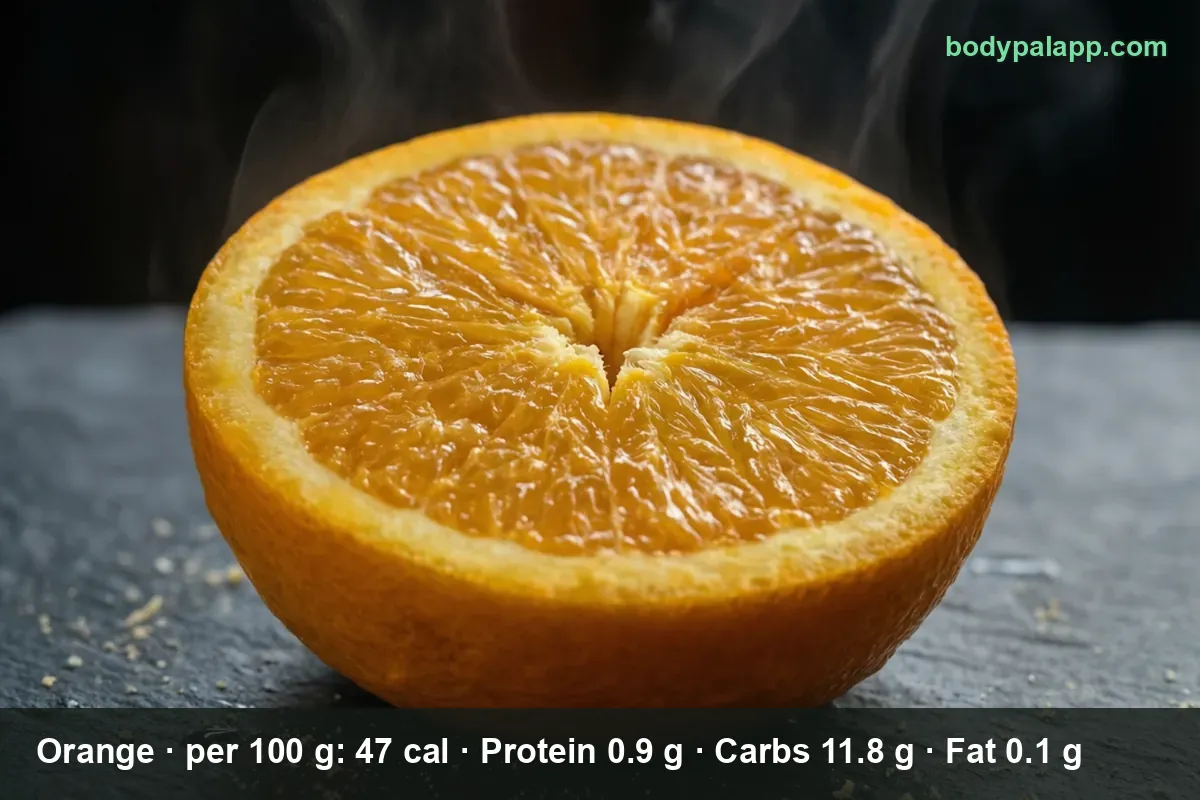
One medium orange, about 131 g of peeled fruit, is 62 calories. Per 100 g the flesh runs 47 calories, which makes an orange one of the lightest things you can hold in one hand and still call a snack. A large one goes to 86. A small one stops at 45.
On this page
- Orange quick facts
- US servings from one ounce to a cup of sections
- Which orange variety are you holding
- Clementines tangerines and orange juice
- Orange chicken is not the fruit
- Fiber is the row that matters
- How does an orange compare
- Orange FAQs
Orange quick facts
The record behind every number on this page is SR Legacy 169097, "Oranges, raw, all commercial varieties". It is the right row for a person holding a piece of fruit: peeled flesh, nothing added, and a sample pooled across navel, Valencia and Florida stock, which is exactly what a grocery store bin contains. Separate rows exist for each of those varieties, and they sit within three calories per 100 g of each other, so choosing one over the composite would change the answer by less than a bite.
The serving column below is the USDA's own household measure for a medium fruit, 2-5/8 inches across and 131 g of edible flesh. Peel weight is not in it.
| Nutrient | Per 100 g | Per 1 medium orange (131 g) | % Daily Value |
|---|---|---|---|
| Calories | 47 | 62 | — |
| Total fat | 0.12 g | 0.2 g | 0% |
| Saturated fat | 0.01 g | 0.0 g | 0% |
| Carbohydrate | 11.75 g | 15.4 g | 6% |
| Dietary fiber | 2.4 g | 3.1 g | 11% |
| Total sugars | 9.35 g | 12.2 g | — |
| Protein | 0.94 g | 1.2 g | 2% |
| Sodium | 0 mg | 0 mg | 0% |
% Daily Value is based on a 2,000-calorie diet.
Verified nutrition data
Numbers on this page come from USDA FoodData Central, the U.S. Department of Agriculture’s food composition database, and from manufacturer labels where a branded product is named. Last verified September 2026. How we verify our data →
There is no added sugars row here. Raw fruit has none, and the SR Legacy edition does not carry the field at all, so quoting one would be invention. Cholesterol is 0 mg and potassium is 237 mg per medium orange, 5% of the FDA Daily Value of 4,700 mg. We are also not quoting a vitamin C figure: it is not one of the Nutrition Facts rows we pull from this record, and a number we cannot show the source for is a number we leave out.
US servings from one ounce to a cup of sections
| Serving | Weight | Calories |
|---|---|---|
| 1 oz | 28 g | 13 kcal |
| 1 small orange, 2-3/8 in | 96 g | 45 kcal |
| 1 medium orange, 2-5/8 in | 131 g | 62 kcal |
| 1 large orange, 3-1/16 in | 184 g | 86 kcal |
| 1 cup sections | 180 g | 85 kcal |
| Per 100 g | 100 g | 47 kcal |
Four of those rows are USDA household measures, listed with the record itself: small, medium, large and the cup of sections. The 1 oz line is our own arithmetic from the USDA 100 g figure, not a USDA serving, and it is there because meal-prep recipes and food scales still speak in ounces.
The cup is where people miscount. A cup of orange sections weighs 180 g, so it is about 1.4 medium oranges, not one. Segment a single medium fruit into a bowl and you have roughly three quarters of a cup. Log a "cup of orange" when you actually ate one orange and you have added 23 calories that never happened, which is small on its own and less small across a week of breakfasts.
The spread between the three whole-fruit sizes is the real story. Small to large is 45 to 86 calories, close to double, while the flesh itself never changes density. Nobody thinks of themselves as eating "a large orange"; they think they ate an orange.
Which orange variety are you holding
| Version | Per 100 g | Typical piece | Calories |
|---|---|---|---|
| All commercial varieties | 47 kcal | 1 medium, 131 g | 62 kcal |
| Navel | 49 kcal | 1 fruit, 140 g | 69 kcal |
| Florida | 46 kcal | 1 fruit, 141 g | 65 kcal |
| California Valencia | 49 kcal | 100 g | 49 kcal |
| Survey composite, FNDDS | 50 kcal | 100 g | 50 kcal |
| With peel | 63 kcal | 100 g | 63 kcal |
Every raw, peeled orange record in FoodData Central sits between 46 and 50 calories per 100 g. That four-calorie band is narrower than the difference between two fruits out of the same bag. So the honest answer to "navel or Valencia?" is that it does not matter for your day's total, and the tape measure matters far more than the sticker.
Two rows deserve a note. The navel and Florida entries come with their own household weights, 140 g and 141 g, which is why a navel lands at 69 calories and a Florida at 65 even though the Florida flesh is the lighter of the two per 100 g. Florida fruit is juicier and more watery, California Valencia flesh is denser, and the fruit size cancels most of that out.
The with-peel row is the odd one at 63 calories per 100 g, because the peel adds carbohydrate and a lot of fiber. It only applies if you are zesting or candying the rind. If you are eating an orange the way people eat oranges, ignore it.
Clementines tangerines and orange juice
| Version | Per 100 g | Typical piece | Calories |
|---|---|---|---|
| Clementine, sold as Cuties or Halos | 47 kcal | 100 g | 47 kcal |
| Tangerine, mandarin | 53 kcal | 100 g | 53 kcal |
| Orange juice, freshly squeezed | 45 kcal | 1 cup, 248 g | 112 kcal |
Cuties and Halos are brand names for clementines, and clementines match oranges exactly at 47 calories per 100 g. Neither the clementine nor the tangerine record carries a household gram weight in this sample, so we are not printing a per-fruit calorie number for them; a guessed fruit weight would make the whole line fiction. Tangerines are the heavier of the two at 53 calories per 100 g, about 13% more than an orange gram for gram.
Juice is the sharp break. A cup of freshly squeezed orange juice is 112 calories, nearly two medium oranges. What does not come along is the fiber: the juice record holds 0.2 g per 100 g, so a full cup is roughly half a gram against 3.1 g in one whole fruit. That is the single biggest information gap between the two foods, and it has nothing to do with sugar labeling.
Orange chicken is not the fruit
People searching for orange calories often want the takeout dish, so here is the number: orange chicken is 262 calories per 100 g, more than five times the fruit. A restaurant portion is several hundred grams, and the sauce carries the sugar and the sodium, not the citrus. It is a different food with a shared word, and it belongs nowhere near your fruit total for the day.
Fiber is the row that matters
One medium orange delivers 3.1 g of fiber, 11% of the FDA Daily Value of 28 g. That is a genuinely good return for 62 calories, and it is the reason an orange fills a gap between meals better than most things at the same calorie cost. Two oranges in a day cover roughly 22% of the fiber Daily Value for 124 calories.
Sodium is a flat 0 mg, which almost nothing else in a lunch bag can claim, and total fat is 0.2 g per fruit. Total sugars are 12.2 g, all of it naturally occurring; the Daily Value that gets quoted in headlines, 50 g, applies to added sugars only, so comparing an orange's 12.2 g against it is comparing two different things. MyPlate counts a large orange, or a cup of orange sections, as one cup-equivalent of fruit, and the Dietary Guidelines for Americans put a two-cup fruit target on a 2,000-calorie day. Two large oranges, 172 calories, close that out.
If you are watching sodium or saturated fat, the orange is a free square: both rows round to zero.
How does an orange compare
| Food | Per 100 g | US serving | Calories |
|---|---|---|---|
| Orange, raw | 47 kcal | one medium fruit, 131 g | 62 kcal |
| Clementine, raw | 47 kcal | 100 g | 47 kcal |
| Tangerine, raw | 53 kcal | 100 g | 53 kcal |
| Orange juice, canned, unsweetened | 47 kcal | 1 cup, 249 g | 117 kcal |
Our take: for weight loss, the whole orange wins and it is not close. Juice matches the fruit gram for gram at 47 calories per 100 g, but you drink 249 g of it in under a minute and pay 117 calories for something that leaves the fiber behind. For a snack that has to hold you until dinner, take the medium orange at 62 calories with its 3.1 g of fiber, and a clementine matches the orange gram for gram at 47 calories per 100 g, so the choice between the two is about size, not density. Save the glass of juice for a day when you actually want a drink.
Orange FAQs
How many calories are in a medium orange?
A medium orange, 2-5/8 inches across and about 131 g of peeled flesh, is 62 calories. That comes from the USDA record for raw oranges across all commercial varieties, which runs 47 calories per 100 g. Most supermarket oranges land within a few grams of that size, so 60 to 65 calories covers almost any one you pick up.
How many calories are in a large orange?
A large orange, 3-1/16 inches across and about 184 g, is 86 calories. That is 24 more than a medium and nearly double a small one at 45. The flesh has the same density in every case, 47 calories per 100 g, so the only thing changing between them is how much fruit you are holding.
How many calories are in a small orange?
A small orange, 2-3/8 inches across and roughly 96 g, is 45 calories. Scaling the USDA 100 g row ourselves puts its fiber near 2.3 g, which is our arithmetic rather than a published serving. Two small oranges come to 90 calories, slightly more than the 86 in a single large one.
How many calories are in a navel orange?
A navel orange is 69 calories for the USDA household size of 140 g, from the navel-only record at 49 calories per 100 g. That is two calories per 100 g above the all-varieties number, a difference smaller than the gap between two fruits from the same bag. Navels are simply sold a little larger.
How many calories are in a clementine or Cutie?
Clementines are 47 calories per 100 g, identical to an orange gram for gram, and Cuties and Halos are brand names for the same fruit. The USDA record does not publish a household gram weight for a single clementine, so we will not print a per-fruit number; guessing the weight would make the calorie count guesswork too.
How many calories are in a cup of orange sections?
A cup of orange sections weighs 180 g and is 85 calories. That is about 1.4 medium oranges, not one, which is the most common logging mistake on this fruit. Segmenting a single medium orange into a bowl gives you roughly three quarters of a cup and 62 calories.
Is an orange or orange juice better for weight loss?
One medium orange is 62 calories with 3.1 g of fiber; a cup of freshly squeezed juice is 112 calories with about half a gram. For the same calories you can eat nearly two whole oranges, and chewing them takes far longer than drinking the glass. If the goal is staying full on fewer calories, take the fruit.
How much fiber is in one orange?
One medium orange has 3.1 g of fiber, 11% of the FDA Daily Value of 28 g, from 2.4 g per 100 g of flesh. Two oranges in a day cover roughly 22% of that target for 124 calories. Juice keeps almost none of it, which is the clearest nutritional difference between the fruit and the glass.
Similar foods
- Blood Orange — 62 cal per medium blood orange
- Plum — 30 cal per plum
- Cara Cara Orange — 69 cal per medium orange
- Nectarine — 31 cal for 1/2 medium
- Pineapple — 83 cal per cup chunks
- Papaya — 34 cal for 1/2 small papaya
Count it without the math
Point the camera at the fruit bowl and BodyPal counts the orange for you, size and all.


How long does it take to burn off an orange?
One medium orange (131 g) is 62 kcal. Enter your weight and the amount you ate to see how long it takes you to burn that off:
lb
| Activity | Time to burn 62 kcal |
|---|---|
| Walking, brisk | 12 min |
| Cycling, moderate | 8 min |
| Swimming, moderate | 9 min |
| Jogging | 7 min |
| Weight training, moderate | 14 min |
Times are for a 155 lb adult at a steady pace; change the weight to see yours. The amount is set to the portion in the text (131 g); change it to what you actually ate. BodyPal works this out from your steps automatically.
One food is easy to picture; a whole day is harder. See how many calories you need a day and what a deficit actually looks like.