
How many calories are in an apricot?
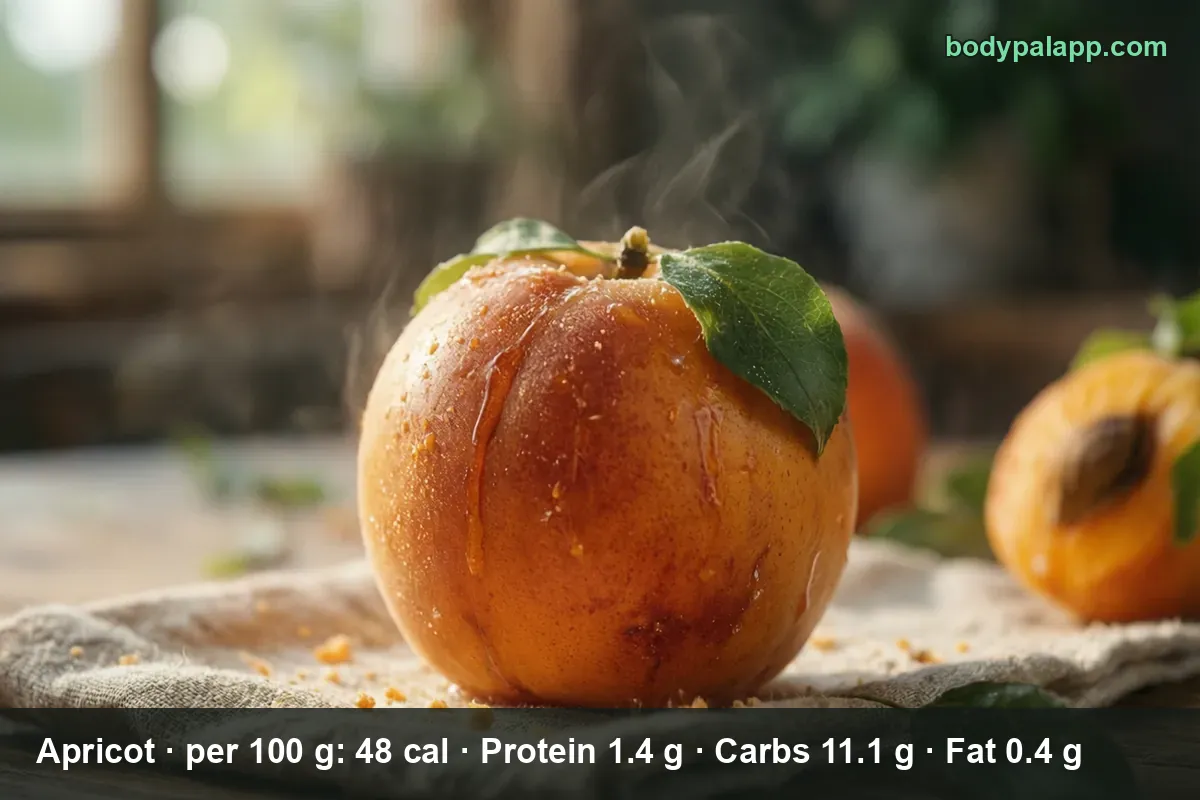
A cup of fresh apricot halves weighs 155 g and carries 74 calories. Per 100 g raw apricot runs 48 calories, so a single medium fruit at 35 g costs you just 17. That is the fresh number. Dried, canned in syrup or poured as nectar, the same apricot lands somewhere else entirely.
On this page
- Apricot quick facts
- US servings from one apricot to a full cup
- Canned apricots in syrup water and juice
- Dried apricots and apricot nectar
- Fiber and potassium for 74 calories
- How do apricots compare
- Most popular apricot brands
- FAQ
Apricot quick facts
The record behind every fresh number on this page is SR Legacy 171697, "Apricots, raw". That is the whole fruit with skin, exactly what you are holding when you look one up, and it is the only fresh apricot entry with a complete profile — energy, fat, saturated fat, fiber, sugars, sodium and potassium in one place.
There is a newer sample in the database, Foundation record 2710815, and it lands at almost the same energy: 48.4 calories per 100 g. It is thinner on detail, though. Its energy is calculated by Atwater factors and it carries no saturated fat or sodium value, so a table built on it would have holes. FNDDS 2709221 exists too, but it mirrors the SR Legacy figures for dietary survey work rather than adding anything new.
| Nutrient | Per 100 g | Per 1 cup, halves (155 g) | % Daily Value |
|---|---|---|---|
| Calories | 48 | 74 | — |
| Total fat | 0.39 g | 0.6 g | 1% |
| Saturated fat | 0.03 g | 0.0 g | 0% |
| Carbohydrate | 11.12 g | 17.2 g | 6% |
| Dietary fiber | 2 g | 3.1 g | 11% |
| Total sugars | 9.24 g | 14.3 g | — |
| Protein | 1.4 g | 2.2 g | 4% |
| Sodium | 1 mg | 2 mg | 0% |
| Potassium | 259 mg | 401 mg | 9% |
% Daily Value is based on a 2,000-calorie diet.
Verified nutrition data
Numbers on this page come from USDA FoodData Central, the U.S. Department of Agriculture’s food composition database, and from manufacturer labels where a branded product is named. Last verified September 2026. How we verify our data →
There is no added sugars row above, and there will not be one: the SR Legacy edition does not publish added sugars at all, and a raw apricot has none by definition. Cholesterol is zero, as it is in every plant food, so it stays out of the table too. The 14.3 g of sugar in that cup is fruit sugar, and total sugars have no Daily Value to measure it against.
US servings from one apricot to a full cup
| Serving | Weight | Calories |
|---|---|---|
| 1 apricot | 35 g | 17 kcal |
| 3 apricots | 105 g | 50 kcal |
| 1 oz | 28.35 g | 14 kcal |
| 1 cup, halves | 155 g | 74 kcal |
| 1 cup, sliced | 165 g | 79 kcal |
| Per 100 g | 100 g | 48 kcal |
The single fruit and both cup measures are USDA household portions. The three-apricot line and the ounce are our own arithmetic scaled from the USDA 100 g figure, not USDA servings, which is why they land on such round numbers.
Watch the two cups. Halves pack at 155 g, slices at 165 g, and that 10 g difference is worth 5 calories — nothing worth arguing about. The gap that matters is which apricot goes in the cup, and that is the next three sections.
Canned apricots in syrup water and juice
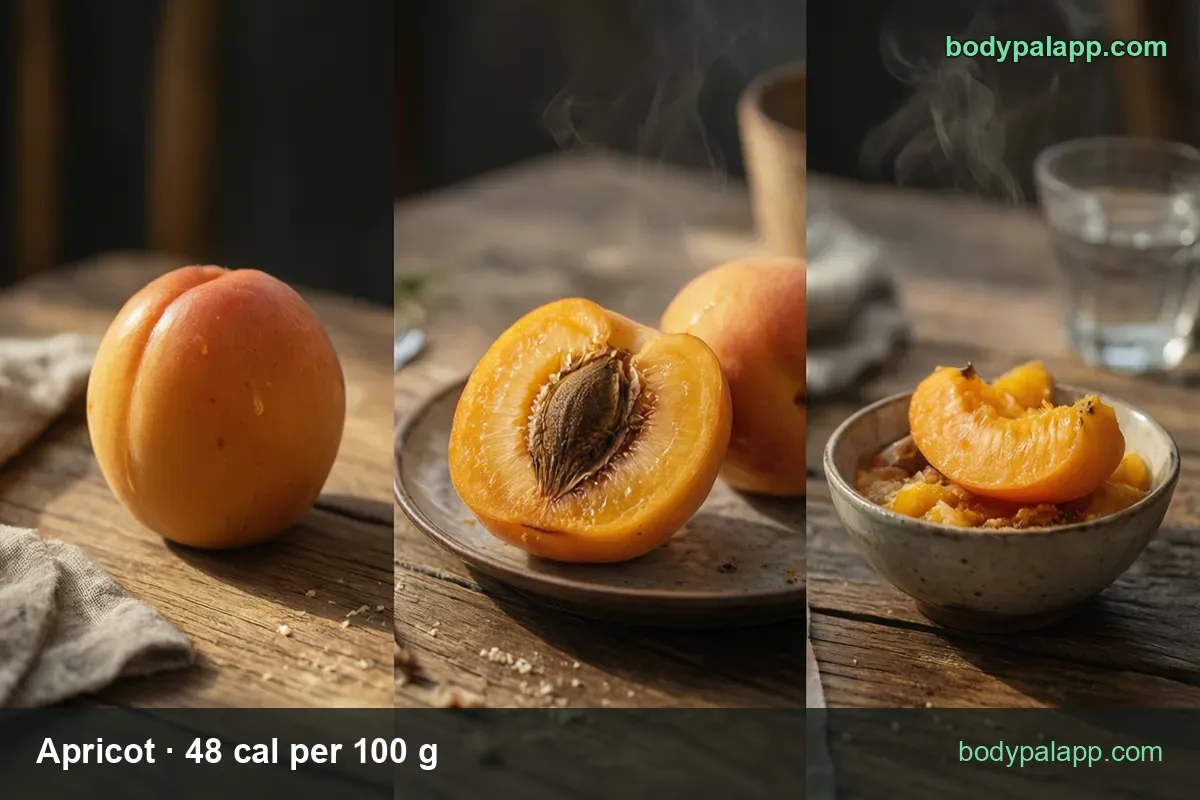
A can of apricots is mostly a question about the liquid. SR Legacy 171699, heavy syrup with the liquid included, sits at 83 calories per 100 g against 48 for the fresh fruit, and the packed cup is heavier as well: 258 g instead of 155 g. Two multipliers stacking is how a cup of fruit reaches 214 calories.
| Version | Per 100 g | Cup measure | Calories |
|---|---|---|---|
| Fresh, raw | 48 kcal | 1 cup, halves (155 g) | 74 kcal |
| Canned in heavy syrup, with liquid | 83 kcal | 1 cup, halves (258 g) | 214 kcal |
| Canned in heavy syrup, drained | 83 kcal | 1 cup, halves (219 g) | 182 kcal |
| Canned in juice | 48 kcal | 100 g | 48 kcal |
| Canned in water, with liquid | 27 kcal | 1 cup, halves (243 g) | 66 kcal |
Draining the syrup is not the fix people assume it is. The drained record still reads 83 calories per 100 g, because the sugar has already moved into the fruit during processing; all you lose is the weight of the liquid you pour off, and the cup drops from 214 to 182 calories. The water pack is the real difference: 27 calories per 100 g, 66 for a 243 g cup. That is 148 calories between two cans that look identical on the shelf.
Only the water pack comes in under fresh apricot per gram. The juice pack ties fresh at 48 calories per 100 g, and USDA does not publish a cup weight for that record, so it is shown per 100 g rather than guessed at.
Dried apricots and apricot nectar
Dried apricot is the one that surprises people, and it is not because anyone added sugar. SR Legacy 173941, sulfured and uncooked, reads 241 calories per 100 g — just over five times fresh — for the simple reason that the water is gone and everything else stayed.
| Version | Per 100 g | US serving | Calories |
|---|---|---|---|
| Fresh, raw | 48 kcal | 1 cup, halves (155 g) | 74 kcal |
| Dried, sulfured, uncooked | 241 kcal | 1 cup, halves (130 g) | 313 kcal |
| Apricot nectar, canned | 56 kcal | 1 cup (266 g) | 149 kcal |
A cup of dried halves is 130 g and 313 calories, more than four times the 74 in a cup of fresh halves, even though the dried cup weighs less. Dried apricots also carry 7.3 g of fiber and 53.44 g of sugars per 100 g, all of it from the fruit. The upside is that a 40 g handful, about five pieces, is roughly 96 calories and close to 2.9 g of fiber — our own scaling of the USDA 100 g record, not a USDA serving — which is a lot of fiber for a small handful. Store-brand dried apricots on US shelves label that same 40 g at 100 to 120 calories, so the packet and the USDA record agree within a rounding error.
Nectar goes the other way and loses the part of the fruit worth keeping. A 266 g cup is 149 calories, almost exactly double the fresh cup, and it brings 0.3 g of fiber against 3.1 g in the fresh cup — roughly a tenth. If the choice is between a cup of nectar and a cup of fruit, the fruit wins on every row.
Fiber and potassium for 74 calories
The interesting numbers on a fresh apricot are not the calories. A 155 g cup of halves delivers 3.1 g of fiber, 11% of the 28 g Daily Value set by the FDA, and 401 mg of potassium, 9% of the 4,700 mg Daily Value. Both of those arrive for 74 calories and 2 mg of sodium, which rounds to 0% of the sodium Daily Value.
Fat is functionally absent. Total fat is 0.39 g per 100 g, saturated fat 0.03 g, so the cup lands at 0.6 g and 0.0 g respectively — 1% and 0% of their Daily Values. Protein is small at 2.2 g per cup, 4% DV, and no one eats apricots for protein.
If you are watching sodium or potassium for any reason, fresh apricot is an unusually efficient way to move the potassium row without touching the sodium one. MyPlate counts a cup of fruit toward the daily fruit target, and a cup of apricot halves is one of the cheaper ways to get there at 74 calories.
How do apricots compare
| Version | Per 100 g | US serving | Calories |
|---|---|---|---|
| Apricots, raw | 48 kcal | 1 cup, halves (155 g) | 74 kcal |
| Apricots, canned in heavy syrup | 83 kcal | 1 cup, halves (258 g) | 214 kcal |
| Apricots, dried, sulfured | 241 kcal | 1 cup, halves (130 g) | 313 kcal |
| Apricot nectar, canned | 56 kcal | 1 cup (266 g) | 149 kcal |
Our take: buy them fresh and eat them fresh. Four versions of one fruit, one cup measure, and the spread runs from 74 to 313 calories — the processing decides the number, not the apricot. If fresh is out of season, the water-packed can at 66 calories a cup is the closest thing to it and the only option that comes in lighter. Keep dried apricots as a deliberate snack measured in pieces, not handfuls, and treat nectar as a drink rather than as fruit.
Most popular apricot brands in the United States
Ranked by how widely each product appears among foods sold in the United States, from the BodyPal food database of over 3.3 million products. Calories are the figures printed on each Nutrition Facts label, checked against USDA FoodData Central.
| Product | Calories (per 100 g) |
|---|---|
| Lidl Dried Apricots | 250 cal |
| Joseph Xavier Turkish Apricots | 300 cal |
| Valued Naturals Dried Apricots | 250 cal |
| Nutty Naturals Dried Apricots | 250 cal |
Brand popularity: BodyPal food database. Nutrition: manufacturer labels / USDA FoodData Central.
Apricot FAQs
How many calories are in one apricot?
One medium apricot weighs about 35 g and holds 17 calories, based on the USDA figure of 48 calories per 100 g. Three of them come to 105 g and 50 calories. That is our own arithmetic scaled from the 100 g record, and it is small enough that most people never bother logging one.
How many calories in a cup of apricots?
A cup of fresh apricot halves is 155 g and 74 calories; sliced, a cup packs 165 g and 79 calories. Canned in heavy syrup with the liquid, that same cup measure weighs 258 g and jumps to 214 calories. The cup is the same, the fruit inside is not.
Do dried apricots have more calories than fresh?
Yes, and by a lot: 241 calories per 100 g dried against 48 fresh, just over five times as much per gram. A cup of dried halves is 130 g and 313 calories, while a cup of fresh halves is 155 g and 74. Drying removes water, not calories.
How much sugar is in an apricot?
Fresh apricot carries 9.24 g of total sugars per 100 g, so one 35 g fruit has about 3.2 g and a 155 g cup of halves has 14.3 g. All of it is naturally occurring. The USDA SR Legacy record does not publish added sugars, and plain fresh fruit has none.
Are apricots good for weight loss?
At 48 calories per 100 g and 3.1 g of fiber in a 155 g cup, fresh apricots are one of the cheaper ways to finish a meal with something sweet. If you are watching calories, the fresh fruit is the pick: the same cup measure of dried runs 313.
How many carbs are in apricots?
Fresh apricot has 11.12 g of carbohydrate per 100 g, which is 17.2 g in a 155 g cup of halves, or 6% of the Daily Value. One 35 g fruit is about 3.9 g. Dried apricot is a different story at 62.64 g per 100 g.
Are canned apricots healthy?
A 258 g cup canned in heavy syrup with the liquid is 214 calories; the same cup packed in water, 243 g, is 66. The packing liquid decides it, and that is a 148-calorie gap on its own. Draining the syrup helps but only down to 182 calories per 219 g cup.
How much potassium do apricots have?
A 155 g cup of fresh apricot halves gives 401 mg of potassium, 9% of the 4,700 mg Daily Value, for 74 calories. Per 100 g the figure is 259 mg. One 35 g apricot is about 91 mg. Sodium is almost nothing: 1 mg per 100 g.
Similar foods
- Blood Orange — 62 cal per medium blood orange
- Cara Cara Orange — 69 cal per medium orange
- Orange — 62 cal per medium orange
- Pineapple — 83 cal per cup chunks
- Plum — 30 cal per plum
- Apple — 95 cal per medium apple
Count it without the math
Point the camera at the bowl and BodyPal counts the apricots for you, syrup and all.


How long does it take to burn off apricots?
A 1-cup (155 g) serving of halves is 74 kcal. Enter your weight and the amount you ate to see how long it takes you to burn that off:
lb
| Activity | Time to burn 74 kcal |
|---|---|
| Walking, brisk | 15 min |
| Cycling, moderate | 9 min |
| Swimming, moderate | 11 min |
| Jogging | 9 min |
| Weight training, moderate | 16 min |
Times are for a 155 lb adult at a steady pace; change the weight to see yours. The amount is set to the portion in the text (155 g); change it to what you actually ate. BodyPal works this out from your steps automatically.
Burning it off is one side of it. The other is knowing your number: work out how many calories you need a day, with macros and a goal date.