
How many calories are in a breakfast sausage link?
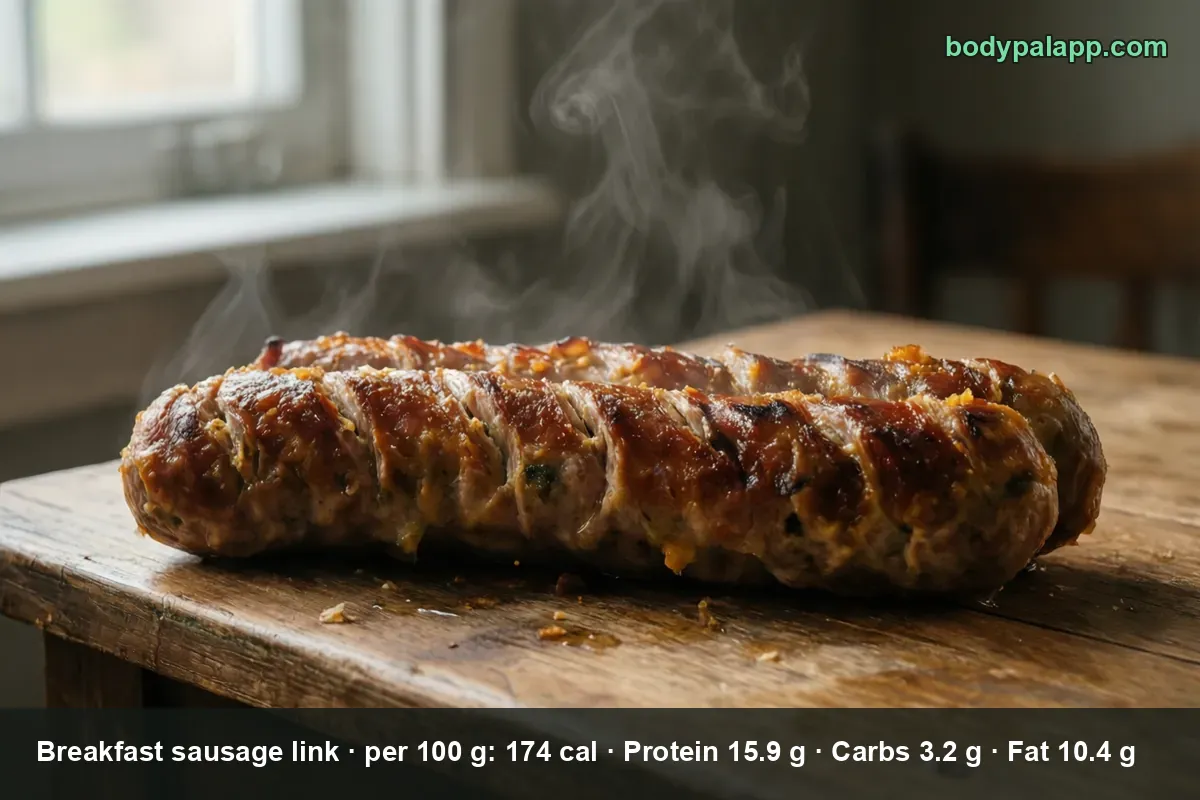
One breakfast sausage link weighs about 28 g and carries 49 calories. Per 100 g the raw turkey link runs 174 calories, so a two-link side comes to 97. That is a small number for a food with a big reputation. The catch is the 200 mg of sodium riding along in every single link.
On this page
- Breakfast sausage link quick facts
- US servings from one link to a full package
- The link you buy changes the number
- Raw or cooked and what to weigh
- Why sodium is the row to watch
- How does a breakfast sausage link compare?
- Most popular breakfast sausage link brands
- Breakfast sausage link FAQs
Breakfast sausage link quick facts
The numbers below come from the SR Legacy record 174600, "Sausage, turkey, breakfast links, mild, raw". It is the record that matches the little skinny links sold in a tray or a tube for the skillet, and it is the only one of the three breakfast-link entries in the database that carries fiber and sugar values, so the label below is complete rather than full of blanks.
The other two entries are newer Foundation samples of the very same product, 325992 and its duplicate 746783. They land at 169 calories per 100 g instead of 174. That is a five-calorie gap between two lab samples of one food, which tells you something useful: the sausage in your pan is never going to match a database row to the decimal, and it does not need to.
| Nutrient | Per 100 g | Per 1 link (28 g) | % Daily Value |
|---|---|---|---|
| Calories | 174 | 49 | — |
| Total fat | 10.39 g | 2.9 g | 4% |
| Saturated fat | 2.82 g | 0.8 g | 4% |
| Carbohydrate | 3.18 g | 0.9 g | 0% |
| Dietary fiber | 0 g | 0.0 g | 0% |
| Total sugars | 0 g | 0.0 g | — |
| Protein | 15.91 g | 4.5 g | 9% |
| Sodium | 714 mg | 200 mg | 9% |
% Daily Value is based on a 2,000-calorie diet.
Verified nutrition data
Numbers on this page come from USDA FoodData Central, the U.S. Department of Agriculture’s food composition database, and from manufacturer labels where a branded product is named. Last verified September 2026. How we verify our data →
There is no added sugars row because USDA does not publish added sugars for this record, which is what you would expect from seasoned ground turkey with no sweetener in it. Cholesterol works out to 21 mg per link, 7% of the Daily Value, and potassium to 72 mg, about 2%. Daily Value percentages follow the FDA reference amounts for a 2,000-calorie day.
US servings from one link to a full package
| Serving | Weight | Calories |
|---|---|---|
| 1 link | 28 g | 49 kcal |
| 1 oz | 28.35 g | 49 kcal |
| 2 links, the usual side | 56 g | 97 kcal |
| 3 links, a full plate | 84 g | 146 kcal |
| 1 package | 450 g | 783 kcal |
| Per 100 g | 100 g | 174 kcal |
USDA lists two of those directly: the single 28 g link and the 450 g package. The two-link and three-link rows, and the ounce, are our own arithmetic from the USDA 100 g figure rather than USDA servings, which is why they scale so cleanly.
A breakfast link is one of the rare foods where an ounce and a piece are the same thing. At 28 g the link is within half a gram of an ounce, so 49 calories covers both, and you can count links instead of weighing them without losing anything. That stops being true the moment you switch brands, because a link is a shape, not a standard weight.
The package row is worth a glance even if you never eat one. Cooking the whole 450 g tray for the family puts 783 calories on the table before the eggs, the toast or the butter in the pan. Split four ways it is a 196-calorie contribution each, which is a reasonable protein anchor for a breakfast; split two ways it is most of a lunch.
The link you buy changes the number
| Version | Per 100 g | Typical serving | Calories |
|---|---|---|---|
| Turkey breakfast link, raw (SR Legacy) | 174 kcal | 1 link (28 g) | 49 kcal |
| Turkey breakfast link, raw (Foundation) | 169 kcal | 1 link (27.9 g) | 47 kcal |
| Turkey links, national brand | 125 kcal | 2 links (56 g) | 70 kcal |
| Chicken links, maple and bacon | 196 kcal | 2 oz (56 g) | 110 kcal |
| Pork breakfast links, cooked store brand | 218 kcal | 3 links (55 g) | 120 kcal |
| Pork links, heat and serve | 343 kcal | 2 oz (56 g) | 192 kcal |
That is a spread of 125 to 343 calories per 100 g for something every one of those packages calls a breakfast sausage link. Jennie-O sits at the bottom of the range at 125; the Jimmy Dean heat-and-serve pork links sit at the top at 343, which is close to double the raw turkey record. Johnsonville sells both a turkey version at 200 and an original recipe at 333, a 133-calorie difference per 100 g inside a single brand's own freezer case.
Here is the trap nobody warns you about. Two links is the label serving for most of these, and two links is not a weight. Johnsonville calls two links 45 g. Jennie-O calls two links 56 g. Follow each label honestly and the same phrase, "two breakfast sausage links," delivers anywhere from 70 to 150 calories. If you log by piece and you switch brands, your breakfast quietly doubles.
The store-brand pork links are the interesting middle case, because they are measured cooked: three cooked links weigh 55 g and come to 120 calories. That is a smaller piece than the raw turkey link, which is why counting links across meat types tells you almost nothing.
Raw or cooked and what to weigh
USDA publishes the generic breakfast link only in its raw state. There is no cooked entry for turkey breakfast links in the standard tables, and there is no generic pork breakfast link at all, which is why every pork number on this page comes from a package label instead.
That leaves two honest ways to count. Weigh the links raw at 174 calories per 100 g and log them before they hit the pan, or use the label figure for the exact product you bought, most of which are stated on the cooked weight. Do not mix the two. A link loses water in the skillet, so it comes out lighter than it went in while keeping nearly all of its calories, and applying a raw per-gram figure to a cooked weight undercounts you.
The cleanest habit is the one that ignores weight entirely: count links, and stay with one brand long enough for the count to mean something. The rest of the arithmetic then takes care of itself.
Why sodium is the row to watch
Most people brace for the fat in sausage. On this record, fat is not the constraint. Two links carry 5.8 g of total fat, 7% of the Daily Value, and 1.6 g of saturated fat, 8%. Neither number is going to reshape your day.
Sodium is a different story. One link brings 200 mg, and the standard two-link side brings 400 mg, or 17% of the 2,300 mg Daily Value, which is roughly a sixth of a teaspoon of table salt. Add a strip of cured bacon or a slice of cheese and breakfast alone can absorb a quarter of the day before you have touched lunch. The newer Foundation sample of the same turkey link came in at 599 mg per 100 g against 714 mg in the older one, so the seasoning varies by batch as well as by brand, and the package label is always the better guide than any average.
The upside is real too. Those two links give 8.9 g of protein for 97 calories, close to a fifth of the day's protein target, and MyPlate counts them squarely in the protein group. If you are watching sodium, two links plus eggs is the better build than four links on their own; if you are chasing protein and calories are tight, the turkey link is one of the most efficient things in the breakfast aisle.
How does a breakfast sausage link compare?
| Food | Per 100 g | US serving | Calories |
|---|---|---|---|
| Breakfast sausage link, turkey, raw | 174 kcal | one link, 28 g | 49 kcal |
| Turkey salami, cooked | 172 kcal | 1 oz, 28.35 g | 49 kcal |
| Chicken bratwurst, cooked | 176 kcal | 1 oz, 28.35 g | 50 kcal |
| Chicken or turkey Italian sausage, lower sodium | 183 kcal | 1 oz, 28.35 g | 52 kcal |
Our take: on calories, poultry sausage is poultry sausage. Only turkey salami is lighter per 100 g, at 172 against 174, and across the whole group an ounce lands between 49 and 52 calories. Choosing among them on calories is a rounding error. Choose on the two rows that actually move: protein, where the Italian style leads at 21.43 g per 100 g against 15.91 g in the breakfast link, and sodium, where the breakfast link's 714 mg per 100 g is high enough that a product named "lower sodium" earns a second look.
Most popular breakfast sausage link brands in the United States
Ranked by how widely each product appears among foods sold in the United States, from the BodyPal food database of over 3.3 million products. Calories are the figures printed on each Nutrition Facts label, checked against USDA FoodData Central.
| Product | Calories (per 100 g) |
|---|---|
| Jennie-O Turkey Breakfast Sausage Links | 125 cal |
| Johnsonville Turkey Fully Cooked Breakfast Sausage Links | 200 cal |
| Wild Harvest Pork Breakfast Sausage Links | 218 cal |
| Aidells Smoked Chicken Breakfast Sausage Links Maple & Bacon | 196 cal |
| Johnsonville Original Recipe Fully Cooked Breakfast Sausage Links | 333 cal |
| Jimmy Dean Heat n Serve Fully Cooked Breakfast Sausage Links | 343 cal |
Brand popularity: BodyPal food database. Nutrition: manufacturer labels / USDA FoodData Central.
Breakfast sausage link FAQs
How many calories are in one breakfast sausage link?
One link is 49 calories at the USDA weight of 28 g, or 174 calories per 100 g for raw mild turkey breakfast links. Two links land at 97 and three at 146. Cooked pork links from a store brand run higher, closer to 120 calories for three.
How many calories in 2 breakfast sausage links?
Two links weigh 56 g and come to 97 calories, our own arithmetic from the USDA 100 g figure of 174. Brand labels disagree: Jennie-O calls two links 56 g and 70 calories, while Johnsonville's original recipe links are 45 g for two and 150 calories.
Are turkey breakfast sausage links lower in calories than pork?
Yes, by a wide margin per 100 g: raw turkey links are 174 calories against 218 for cooked store-brand pork links and 343 for heat-and-serve pork. Three turkey links still come in under two heat-and-serve pork links, 146 against 192. Portion size decides the rest.
How much protein is in a breakfast sausage link?
One link gives 4.5 g of protein, 9% of the Daily Value, from 15.91 g per 100 g. Two links reach 8.9 g, close to a fifth of the day's protein. It is a real contribution for 97 calories, though the sodium climbs at exactly the same pace.
How much sodium is in breakfast sausage links?
One link carries 200 mg of sodium, 9% of the 2,300 mg Daily Value. Two links bring 400 mg, or 17%, about a sixth of a teaspoon of table salt, while the fat in those same two links is only 7% DV. Sodium is the limiting number here.
Do breakfast sausage links have carbs?
Barely: 0.9 g per link, from 3.18 g per 100 g, which is under 1% of the Daily Value. Fiber and total sugars are both 0 g. The newer USDA Foundation sample of the same product lists only 0.93 g of carbohydrate per 100 g, so seasonings and binders explain the gap.
Does cooking change the calories in a sausage link?
USDA publishes this turkey link only raw, at 174 calories per 100 g; cooked store-brand pork links sit at 218. Cooking drives off water, so a browned link weighs less while keeping most of what was in it. Weigh links raw, or log the cooked weight printed on the package.
How many calories in Jimmy Dean breakfast sausage links?
The heat-and-serve pork links are 343 calories per 100 g, so the 2 oz (56 g) label serving is 192 calories. That is close to double the 97 calories in 56 g of raw turkey links, and it is the highest per-100-g figure among the six US brands we checked.
Similar foods
- Omelet — 305 cal for 3-egg omelet
- Egg — 72 cal per large egg
- Crepe — 179 cal per crepe
- Pancake — 423 cal for 3 medium pancakes
- Toast with butter — 100 cal per slice with butter
- Shrimp Tempura Roll — 432 cal per roll, 8 pieces
Count it without the math
Point the camera at the skillet and BodyPal counts the links for you, one by one.


How long does it take to burn off 49 kcal of breakfast sausage link?
One link (28 g) is 49 kcal. Enter your weight and the amount you ate to see how long it takes you to burn that off:
lb
| Activity | Time to burn 49 kcal |
|---|---|
| Walking, brisk | 10 min |
| Cycling, moderate | 6 min |
| Swimming, moderate | 7 min |
| Jogging | 6 min |
| Weight training, moderate | 11 min |
Times are for a 155 lb adult at a steady pace; change the weight to see yours. The amount is set to the portion in the text (28 g); change it to what you actually ate. BodyPal works this out from your steps automatically.
Burning it off is one side of it. The other is knowing your number: work out how many calories you need a day, with macros and a goal date.