
How many calories are in cabbage soup?
A 1-cup serving of homemade cabbage soup is 245 g and 66 calories. Per 100 g the soup runs 27 calories, about as low as a hot dish goes. Fill a real bowl, two cups, and you are at 132 calories. The number that moves on this page is sodium, not calories.
On this page
- Cabbage soup quick facts
- US servings, from one ounce to a two-cup bowl
- With meat, borscht, canned and creamy
- Sodium, not calories, is the row to watch
- How does cabbage soup compare?
- Most popular cabbage soup brands
- FAQ
Cabbage soup quick facts
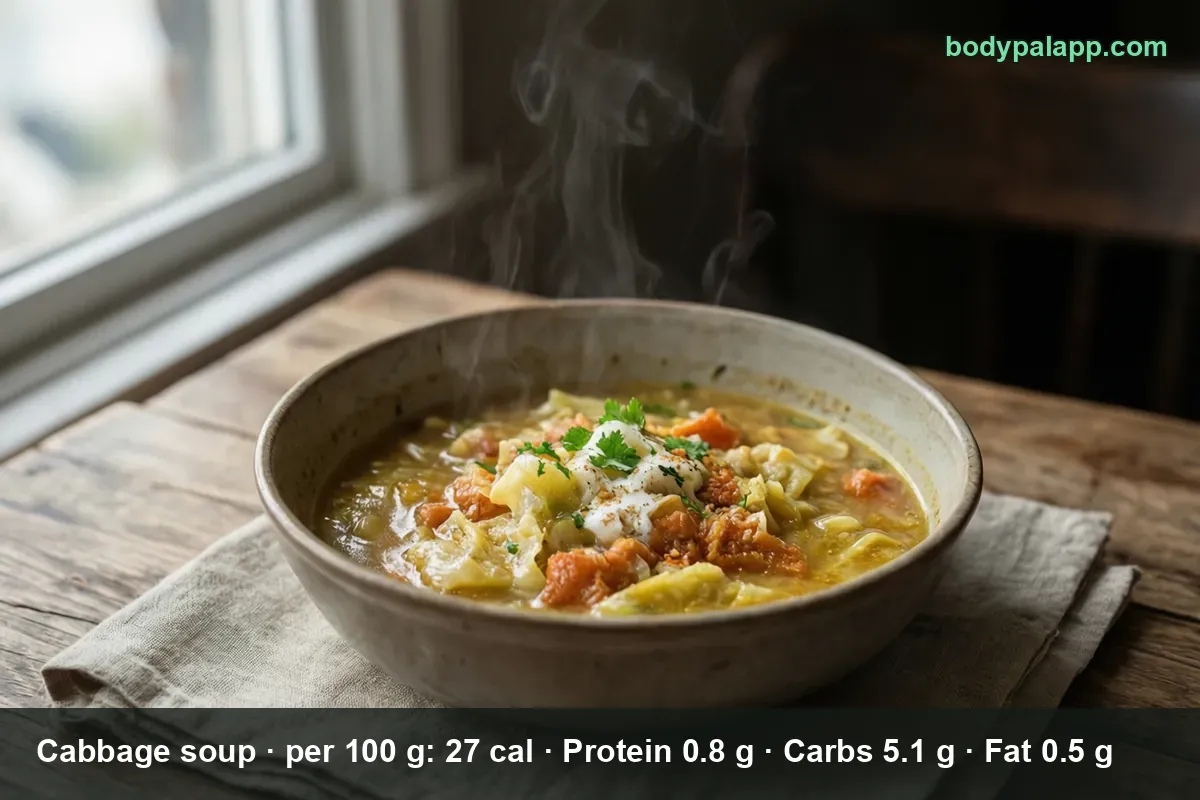
USDA does not publish a record called "cabbage soup." The closest match to what people actually make at home is FNDDS 2710113, "Soup, vegetable", the broth-based vegetable soup built from cabbage, tomatoes and stock with no cream and no meat. That is the pot in the photo above, and it is the pot the search is usually about, so its numbers run this page.
If your version has meat in it, or came out of a can, or has cream stirred through, skip ahead: those are separate USDA records with their own numbers, and the gaps between them are wider than most people expect.
| Nutrient | Per 100 g | Per 1 cup (245 g) | % Daily Value |
|---|---|---|---|
| Calories | 27 | 66 | — |
| Total fat | 0.45 g | 1.1 g | 1% |
| Saturated fat | 0.064 g | 0.2 g | 1% |
| Carbohydrate | 5.08 g | 12.4 g | 5% |
| Dietary fiber | 1.0 g | 2.5 g | 9% |
| Total sugars | 1.33 g | 3.3 g | — |
| Protein | 0.84 g | 2.1 g | 4% |
| Sodium | 243 mg | 595 mg | 26% |
% Daily Value is based on a 2,000-calorie diet.
Verified nutrition data
Numbers on this page come from USDA FoodData Central, the U.S. Department of Agriculture’s food composition database, and from manufacturer labels where a branded product is named. Last verified September 2026. How we verify our data →
Two rows you would see on a can are missing here: added sugars and trans fat. USDA does not publish either value for home-recipe soups, so guessing them would be worse than leaving them out. Cholesterol is 0 mg, since nothing in the pot comes from an animal. Potassium comes to 377 mg a cup, 8% of the FDA Daily Value of 4,700 mg, most of it from the tomatoes.
The fiber line is the quiet winner. A cup delivers 2.5 g of fiber for 66 calories, which is 9% of a day's fiber for 3% of a day's calories. Very few cooked dishes hit that ratio.
US servings, from one ounce to a two-cup bowl
| Serving | Weight | Calories |
|---|---|---|
| 1 oz | 28 g | 8 kcal |
| Per 100 g | 100 g | 27 kcal |
| Half a cup | 123 g | 33 kcal |
| 1 cup | 245 g | 66 kcal |
| One mug, about 1.5 cups | 368 g | 99 kcal |
| One bowl, 2 cups | 490 g | 132 kcal |
Only the 1-cup line is a USDA household measure. The half cup, the mug, the two-cup bowl and the ounce are our own arithmetic scaled from the USDA 100 g figure, not USDA servings.
Watch the ounce. Soup is dense with water, so an ounce of it is 28 g and 8 calories, roughly a mouthful. People who log soup by weight in ounces routinely end up recording an eighth of what they ate. Log soup in cups; the cup is the unit the ladle actually delivers, and 245 g is close enough to a level cup of any thin soup that the error stays small.
The other trap runs the opposite way. A restaurant "cup" of soup is usually about 8 fl oz, but a restaurant "bowl" is often 12 to 16 fl oz. At the top of that range you are eating the two-cup line: 132 calories, which is still light, and 1,191 mg of sodium, which is not.
With meat, borscht, canned and creamy
| Version | USDA record | Per 100 g | 1 cup (245 g) |
|---|---|---|---|
| Homemade, broth-based | FNDDS 2710113 | 27 kcal | 66 kcal |
| With meat | FNDDS 2710116 | 44 kcal | 108 kcal |
| Borscht, cabbage and beet | FNDDS 2710105 | 20 kcal | 49 kcal |
| Canned | FNDDS 2710111 | 38 kcal | 93 kcal |
| Canned, reduced sodium | FNDDS 2710112 | 38 kcal | 93 kcal |
| Chunky, ready to serve | SR Legacy 171559 | 39 kcal | 96 kcal |
| Creamy | FNDDS 2710109 | 78 kcal | 191 kcal |
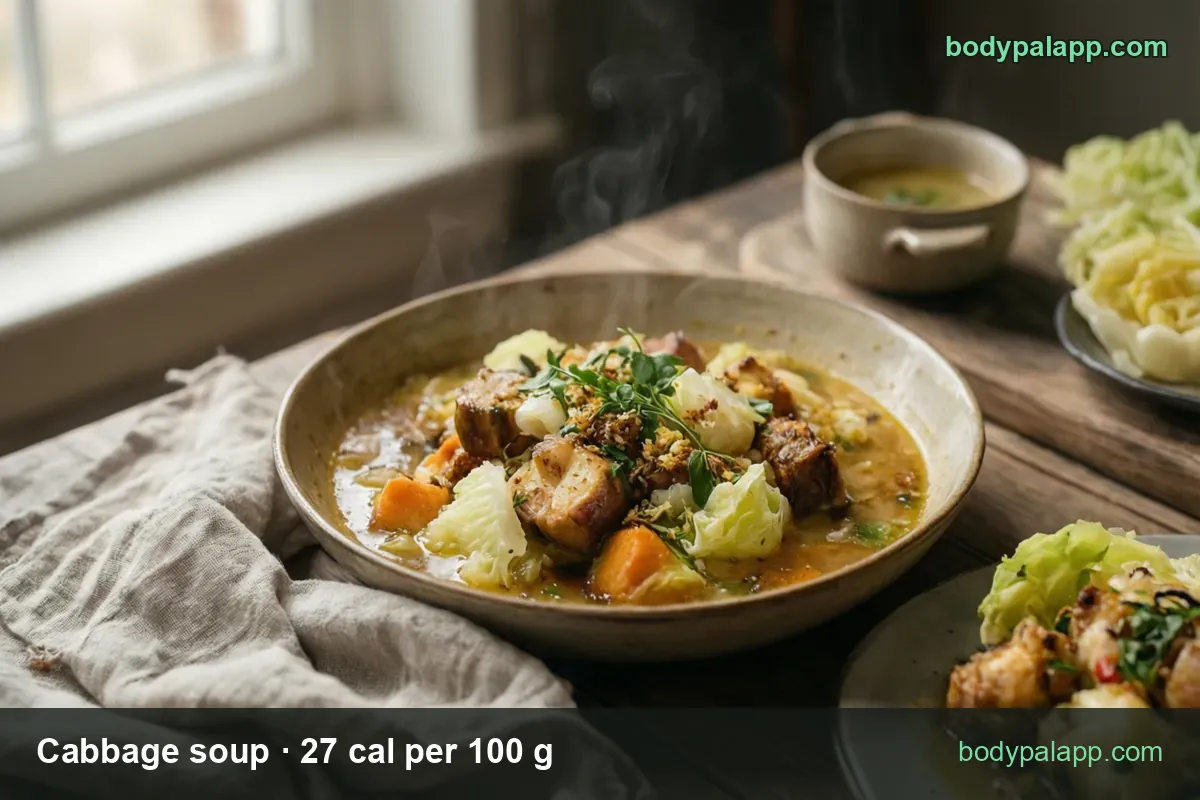
With meat is the version in the second photo, and it is the honest weeknight dinner: 108 calories a cup. The calories go up by 42 a cup, but the protein goes from 2.1 g to 8.2 g, and sodium barely shifts, 610 mg against 595 mg. That is a good trade if the soup is meant to be the meal rather than the starter.
Borscht is the lightest thing on this page at 20 calories per 100 g and 49 a cup, thinner than the plain version because beets and cabbage in stock carry almost no fat. Sodium is essentially the same, 600 mg a cup.
Canned lands at 93 calories a cup, heavier per gram than the homemade pot because canned soups are thicker with starch and vegetables rather than broth. Sodium is where cans separate: about 637 mg a cup for the standard version and about 448 mg for the reduced-sodium can. That is a 189 mg swing for the same recipe, and it is the single easiest change on this page.
Creamy cabbage soup is a different food. At 78 calories per 100 g and 191 a cup, it is nearly three times the plain version, and saturated fat jumps from 0.2 g to 6.1 g a cup, 31% of a day. If you have been logging creamy soup as cabbage soup, that is a 125-calorie miss per cup.
Branded cans and pouches sit inside this range. Tabatchnick Cabbage Soup runs 42 calories per 100 g, 89 for a 213 g pouch; Gold's Classic Hungarian Cabbage Borscht is 48 per 100 g, 130 for a 270 g cup. A condensed cabbage and potato soup like T'sty's is the outlier at 64 per 100 g, since potato does the thickening.
Sodium, not calories, is the row to watch
One cup carries 595 mg of sodium, 26% of the 2,300 mg Daily Value. A two-cup bowl carries about 1,191 mg, 52% of a day, or roughly half a teaspoon of table salt. You reach half your day's sodium for 132 calories, which is a ratio almost no other food manages.
That is not a reason to skip the soup. It is a reason to know which lever to pull. The salt is in the broth, not the cabbage, so a low-sodium stock or a homemade one cuts the number hard while leaving the calories untouched. On canned soup, the reduced-sodium version does the same job for you. The Dietary Guidelines for Americans put the limit at 2,300 mg a day for adults, and soup is one of the top contributors in the US diet.
The upside is on the vegetable side. Two cups of cabbage soup is 5 g of fiber and a real serving of vegetables toward the MyPlate target of 2 to 3 cups a day, for 132 calories. If you are watching sodium, make it yourself; if you are watching calories, the canned version is still fine.
How does cabbage soup compare?
| Soup | Per 100 g | US serving | Calories |
|---|---|---|---|
| Cabbage soup, homemade | 27 kcal | 1 cup, 245 g | 66 kcal |
| Cabbage soup with meat | 44 kcal | 1 cup, 245 g | 108 kcal |
| Canned vegetable cabbage soup | 38 kcal | 1 cup, 245 g | 93 kcal |
| Borscht | 20 kcal | 1 cup, 245 g | 49 kcal |
Our take: for weight loss, the plain homemade pot at 66 calories a cup is the pick, and borscht at 49 is lighter still if you like beets. For staying full, take the version with meat. The extra 42 calories a cup buy 6.1 g more protein, and 8.2 g a cup is the difference between a soup you finish and a soup you follow with a sandwich. The canned versions sit in the middle at 93; buy the reduced-sodium can and the only thing you give up is 189 mg of salt.
Most popular cabbage soup brands in the United States
Ranked by how widely each product appears among foods sold in the United States, from the BodyPal food database of over 3.3 million products. Calories are the figures printed on each Nutrition Facts label, checked against USDA FoodData Central.
| Product | Calories (per 100 g) |
|---|---|
| Tabatchnick Cabbage Soup | 42 cal |
| Gold's Classic Hungarian Cabbage Borscht | 48 cal |
| Pleasant Valley Cabbage Kettle Fresh Soup | 31 cal |
| T'sty Condensed Cabbage Potato Soup | 64 cal |
| Metropolitan Market Hearty Borscht | 31 cal |
Brand popularity: BodyPal food database. Nutrition: manufacturer labels / USDA FoodData Central.
Cabbage soup FAQs
How many calories are in a bowl of cabbage soup?
A two-cup bowl runs 132 calories, using the USDA figure of 27 calories per 100 g for homemade broth-based cabbage soup. Restaurant bowls vary, but two cups is the honest home portion. The catch is not the calories: that same bowl carries about 1,191 mg of sodium, 52% of a day's Daily Value.
How many calories in 1 cup of cabbage soup?
One cup weighs 245 g and gives 66 calories. That is 12.4 g of carbohydrate, 2.5 g of fiber, 2.1 g of protein and barely 1.1 g of fat. It is one of the few hot dishes where a full cup stays under 70 calories.
Is cabbage soup good for weight loss?
At 66 calories a cup, cabbage soup is one of the lowest-calorie hot dishes you can log, and the 2.5 g of fiber per cup helps a small volume feel like a meal. It is thin on protein, though, at 2.1 g a cup, so pair it with a protein source.
How many calories in cabbage soup with meat?
108 calories a cup, from the USDA record for vegetable soup with meat, against 66 for the meatless version. The bigger change is protein: 8.2 g a cup instead of 2.1 g. Sodium barely moves, 610 mg versus 595 mg, so the meat buys protein rather than salt.
Does the cabbage soup diet work?
The soup itself is 66 calories a cup, so a day built on it lands very low without much protein, 2.1 g a cup. The Dietary Guidelines describe eating patterns built on variety rather than a single dish, and any plan this restrictive is worth running past a doctor first.
How much sodium is in homemade cabbage soup?
595 mg in one cup, 26% of the 2,300 mg Daily Value, and 1,191 mg in a two-cup bowl. That is the USDA figure for a homemade recipe; canned versions run higher at about 637 mg a cup, and reduced-sodium cans drop to roughly 448 mg.
How many carbs are in cabbage soup?
12.4 g of carbohydrate in a 1-cup serving, 5% of the Daily Value, and 2.5 g of that is fiber. Total sugars come to 3.3 g, all of it from the vegetables rather than anything added. Per 100 g the soup holds just 5.08 g of carbohydrate.
How much protein is in cabbage soup?
2.1 g in a 1-cup serving, 4% of the Daily Value, so cabbage soup is not a protein dish. The version with meat reaches 8.2 g a cup, and a cup of the creamy style still only gets to 3.5 g. Add chicken, beans or a side of yogurt.
Similar foods
- Bamboo Shoots — 41 cal per cup sliced
- Bell Pepper — 31 cal per medium
- Bell Pepper — 24 cal green, 31 red
- Cabbage — 22 cal per cup chopped
- Cauliflower — 27 cal per cup chopped
- Salad — 23 cal per side salad
Count it without the math
Point the camera at the bowl and BodyPal counts the soup for you, broth and all.


How long does it take to burn off cabbage soup?
A 1-cup (245 g) serving is 66 kcal. Enter your weight and the amount you ate to see how long it takes you to burn that off:
lb
| Activity | Time to burn 66 kcal |
|---|---|
| Walking, brisk | 13 min |
| Cycling, moderate | 8 min |
| Swimming, moderate | 9 min |
| Jogging | 8 min |
| Weight training, moderate | 15 min |
Times are for a 155 lb adult at a steady pace; change the weight to see yours. The amount is set to the portion in the text (245 g); change it to what you actually ate. BodyPal works this out from your steps automatically.
One food is easy to picture; a whole day is harder. See how many calories you need a day and what a deficit actually looks like.